Contractual insurance requirements are the clauses in construction contracts, leases, service agreements and government contracts that oblige one party to carry specified insurance: the coverages, the minimum limits, and the endorsements that extend cover to the other party, such as additional insured status, primary and noncontributory wording and a waiver of subrogation. They are the most specific coverage request an agency ever receives, because they name parties, forms and periods, and they are routinely missed because they live in an exhibit the quote never saw. Botminds' Insurance Policy Checking reads them as promises: its promise finder turns each requirement into a numbered item and searches every issued policy for it by form number, title and wording, because only the endorsement in the policy keeps the promise.
The example below is the insurance exhibit of a subcontract in the solution's fictional sample book: a mechanical contractor, Granite Ridge Mechanical, working for a general contractor on a hospital project for its owner. The clause below is our illustration of that exhibit's requirements; the statuses on the right are what the contractor's renewal actually carried when it was issued.
One contract clause, turned into eight numbered promises and checked against the issued policy
Exhibit C · Insurance
4.1 Subcontractor shall maintain commercial general liability insurance on an occurrence basis with limits of not less than $1,000,000 each occurrence, a general aggregate applying separately to this project, and a products-completed operations aggregate of $2,000,000, maintained for three years after completion. Contractor and Owner shall be additional insureds for ongoing and completed operations, on a primary and noncontributory basis.
4.3 Subcontractor waives, and shall cause its insurers to waive, all rights of subrogation against Contractor and Owner.
- P1Liability on an occurrence formCG 00 01 coverage formIssued
- P2$1,000,000 each occurrenceGeneral liability declarationsIssued
- P3General aggregate applying per projectCG 25 03 or equivalentMissing
- P4$2,000,000 products-completed operations aggregateGeneral liability declarationsIssued at $1,000,000
- P5Additional insureds, ongoing operations: contractor and ownerCG 20 10 or equivalentIssued, older edition accepted
- P6Additional insureds, completed operations, for three yearsCG 20 37 or equivalent, on each renewalNever quoted
- P7Primary and noncontributory to the additional insuredsCG 20 01 or equivalent wordingMissing
- P8Waiver of subrogation for contractor and ownerCG 24 04 or equivalent, naming bothMissing
What are insurance requirements in contracts?
They are obligations in a contract to buy and keep insurance of stated kinds and amounts, usually backed by obligations about how the policy must be written and evidenced. The federal government's standard clause for contractors working on a government installation shows the shape. The contractor must "provide and maintain during the entire performance of this contract, at least the kinds and minimum amounts of insurance required in the schedule or elsewhere in the contract", and must tell the contracting officer in writing that the insurance has been obtained before work starts (FAR 52.228-5).
The same clause asks for an endorsement, not only a policy: "The policies evidencing required insurance shall contain an endorsement to the effect that any cancellation or any material change adversely affecting the Government's interest shall not be effective" until the longer of the state's notice period or 30 days after written notice to the contracting officer. The minimum amounts sit in a separate rule, such as general liability bodily injury cover of at least $500,000 per occurrence and automobile liability of at least $200,000 per person and $500,000 per occurrence for bodily injury (FAR 28.307-2). Private contracts follow the same pattern with higher limits and more endorsements, and every endorsement they name is a promise someone has to procure.
How do you review contract insurance requirements?
Read every clause that touches insurance, split it into single promises, map each promise to the form that keeps it, and check each one twice: against the quote before binding and against the policy after it issues. The splitting is the step most reviews skip. "Additional insureds for ongoing and completed operations on a primary and noncontributory basis" is one sentence and at least three promises, each kept by a different endorsement.
From requirement to form: what keeps each common promise
| Requirement in the contract | What keeps it in the policy | Where the checker looks |
|---|---|---|
| Additional insured, ongoing operations | An additional insured endorsement for work performed for the named party, such as CG 20 10 | Endorsements after the coverage form; the named party or a blanket condition |
| Additional insured, completed operations | A separate completed-operations endorsement, such as CG 20 37, on every renewal for the required years | Endorsements; each renewal for the period after completion |
| Primary and noncontributory | An endorsement or wording making the cover primary and not contributing with the other party's insurance, such as CG 20 01 | Endorsements and the other-insurance condition |
| Waiver of subrogation | A waiver endorsement naming the party or applying where a contract requires it, such as CG 24 04, and a separate one on workers' compensation if required | Endorsements on each policy the contract names |
| Per-project aggregate | An endorsement making the general aggregate apply to each project, such as CG 25 03 | Declarations and endorsements |
| Minimum limits | The declarations, or an umbrella that follows form | Declarations of each policy, including umbrella |
| Notice of cancellation to the other party | An endorsement giving the named party notice | Endorsements; the certificate cannot add it |
How do you confirm additional insured status?
By finding the endorsement in the policy and checking that it fits the relationship, the party and the period the contract requires. Fit is the part that fails quietly. The County of Sonoma's contract insurance guide, written for its own staff reviewing vendors' insurance, puts it plainly: "The additional insured endorsement for an agreement must match the relationship between the parties." It gives its own example: a non-profit that used a county parking lot for an event sent an endorsement covering the county only for food donations and client referrals, and "Because we were neither providing client referrals nor food donations, the endorsement did not protect us" (County of Sonoma, Contract Insurance Requirements Reference Guide).
Period is the second trap. The guide notes that an ongoing-operations form such as CG 20 10 "Only protects the additional insured if the work is performed FOR the additional insured" and does not cover injury after the work is done, which needs a completed-operations endorsement such as CG 20 37. It rejects proprietary completed-operations endorsements limited to work in the current policy period: "These are unacceptable because injury or damage from completed operations claims may occur several months after completion of the work." That is why the sample subcontract's three-year completed-operations requirement is a promise on every renewal for three years, not a box ticked once.
Blanket endorsements need the contract itself. "There is no additional insured status unless there is a contract or agreement which requires it," the guide says of automatic additional insured forms, so the checker confirms both the endorsement and that the client's contract, signed before the loss, requires the status. Additional insured status also does not add limits; the guide notes that the named insured and every additional insured share them, which is one reason contracts ask for per-project aggregates. The difference between holding a certificate and being an additional insured is set out from the certificate holder's side in certificate holder against additional insured.
What does primary and noncontributory mean in a contract?
It means the subcontractor's policy pays first, and does not ask the other party's insurer to share the loss. The Sonoma guide defines the two halves separately. Primary: "The vendor's policy pays before the additional insured's policy or self-insurance are involved." Noncontributory: when both parties' policies are primary, "both policies become contributing primary insurance, unless the additional insured endorsement specifies that it is non-contributory, in addition to being primary."
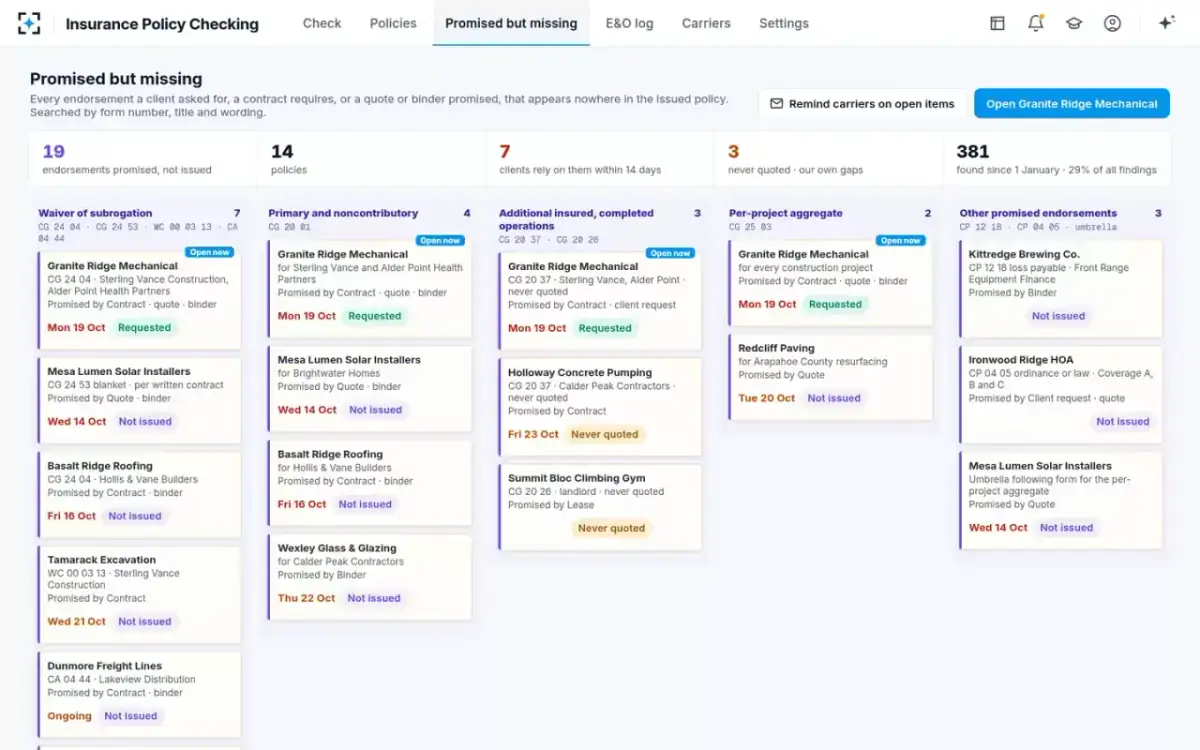
So a policy that names the general contractor as an additional insured but lacks the noncontributory wording may still leave the contractor's own insurer sharing the loss, which is what the contract was written to prevent. On the sample renewal the primary and noncontributory endorsement had been on the expiring policy, was quoted and bound, and was missing from the issued policy: one of four promised endorsements printed nowhere in 142 pages.
What is a waiver of subrogation requirement?
It is a promise that the subcontractor's insurer will not, after paying a claim, sue the other party to recover what it paid. The Sonoma guide describes the workers' compensation version: "A subrogation waiver endorsement prohibits our vendor's WC insurer from seeking reimbursement from us" (County of Sonoma, workers' compensation and employers' liability). It also notes the cost, which explains why waivers are sometimes left off: "many WC insurers make a charge for this endorsement," so the county requires it only for higher-risk agreements.
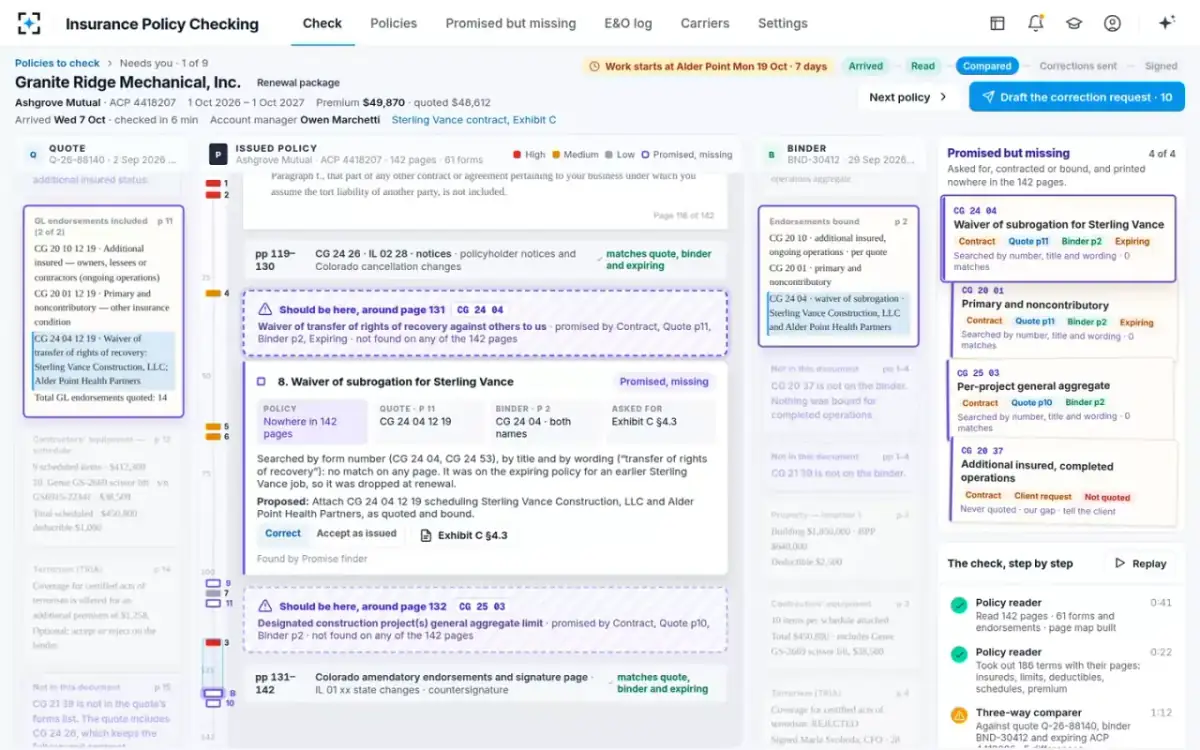
A contract that asks for a waiver usually means every policy it lists: general liability, auto, workers' compensation and umbrella, each of which needs its own endorsement. On the sample renewal the general liability waiver had been quoted with both parties' names and bound, and the issued policy did not contain it. How the same waiver appears, and does not appear, on a certificate is worked through in a certificate of insurance waiver of subrogation example.
Promised but missing, across the book, grouped by kind of promise
Does a certificate of insurance prove contract compliance?
No. A certificate summarises a policy; it cannot add an endorsement the policy does not have. The Sonoma guide says so for its own contracts: "Wording on a certificate stating that we are additional insureds or that coverage is primary & non-contributory is not legally binding; these must be endorsed to, or included in, the policy language" (County of Sonoma, insurance terminology). If the policy has no additional insured endorsement, the party is not an additional insured, whatever the certificate shows.
For the agency the lesson runs the other way. A certificate issued with a waiver or primary wording ticked, on a policy that does not carry the endorsement, does not keep the client's promise; it records that someone believed it was kept. Insurance Policy Checking's promise finder never counts a certificate as proof: a promise closes only when the endorsement is found in the issued policy. The certificate's own legal limits are explained in certificate of insurance confers no rights.
When the law voids the promise
Some contract requirements cannot be kept as written, because the state voids them. Texas voids a construction contract's requirement for additional insured coverage to the extent it would cover the other party's own negligence beyond what the state allows for indemnity: a provision "that requires the purchase of additional insured coverage, or any coverage endorsement, or provision within an insurance policy providing additional insured coverage, is void and unenforceable to the extent that it requires or provides coverage the scope of which is prohibited under this subchapter for an agreement to indemnify, hold harmless, or defend" (Texas Insurance Code § 151.104). The chapter has its own exclusions, among them single-family houses and a municipality's public works projects (§ 151.105).
New York takes the opposite route. Its statute voids construction indemnity for the promisee's own negligence, but provides that it "shall not affect the validity of any insurance contract, workers' compensation agreement or other agreement issued by an admitted insurer" (New York General Obligations Law § 5-322.1). In New York the insurance requirement is left as the lawful channel for what the indemnity cannot do, which raises the stakes of getting the endorsement issued.
Additional insured requirements in construction contracts: Texas and New York
Texas Insurance Code ch. 151: Void and unenforceable, with exceptions such as claims for bodily injury to the indemnitor's own employees.
New York Gen. Oblig. Law § 5-322.1: Void and unenforceable for damage caused by the promisee's negligence, in whole or in part.
Texas Insurance Code ch. 151: Void to the same extent as the prohibited indemnity.
New York Gen. Oblig. Law § 5-322.1: The statute does not affect the validity of an insurance contract issued by an admitted insurer.
Texas Insurance Code ch. 151: Policy provisions listing, adding or deleting named insureds under a consolidated program are excepted.
New York Gen. Oblig. Law § 5-322.1: Not addressed in the section.
Texas Insurance Code ch. 151: Mark requirements that reach beyond the statute for counsel; procure what the law allows.
New York Gen. Oblig. Law § 5-322.1: Procure the endorsement as written; it carries the risk the indemnity cannot.
Who reviews contract insurance requirements, broker or lawyer?
Both, for different questions. The lawyer decides what the client should agree to: the indemnity, the limits, whether a requirement is enforceable in the state, and whether to push back before signing. The broker decides whether the market can provide it and at what cost, and the agency's checker proves afterwards that the policy does what the contract requires. The Texas statute above is the clearest case for both: a lawyer can tell the client a requirement reaches further than the law allows, and the agency can then procure what the law does allow and record why the rest was not.
The agency's part is easiest when the contract reaches it before the quote. A requirement first seen after binding is one the carrier never priced, which is how the sample contractor's completed-operations additional insured requirement became the agency's own gap: it was in the client's request and the contract, but never in the submission, so the carrier never quoted it.
Which contract promises go missing: waivers first
What happens if a policy does not meet contract requirements?
The client is in breach of its contract, may be shut out of the job, and may be uninsured for the very claim the requirement was meant to cover; and if the client specifically asked its broker for the cover, the broker may face a claim of its own. New York's leading broker case began that way: a lease required general liability insurance of $5,000,000, the policy in place did not comply, and an injured employee's claim fell into an exclusion. The rules that then decide whether the broker pays are set out in failure to procure insurance in New York.
Found early, a gap is a correction or a purchase. On the sample renewal the promise finder found four contract promises missing a week before the crew was due on site; the carrier was asked to correct three of them and to quote the fourth as a new request, and the client was told, in a note the account manager approved, which item was the agency's own miss. Found on the job site, the same gap is a refused start; found after a loss, it is a claim.
The waiver the contract required, searched for and not found
Questions people ask
What insurance is usually required in a construction contract?
Commonly general liability with stated limits and a per-project aggregate, automobile liability, workers' compensation and employers' liability, and an umbrella, with the owner and contractor as additional insureds for ongoing and completed operations, primary and noncontributory wording, waivers of subrogation and notice of cancellation. The exact list is the contract's, which is why each one needs reading.
Can an insurance agent change what a contract requires?
No; only the parties can amend the contract. The agent can tell the client early what the market will provide, what it will cost, and which requirements cannot be met, so the client can negotiate before signing rather than after a job site turns its crew away.
What if the carrier will only offer its own form instead of the one named?
Many contracts accept equivalent forms; the Sonoma guide, for one, accepts endorsements with equivalent or similar language. The checker compares the carrier's form with what the contract requires, records why it is or is not equivalent, and asks the other party to accept it in writing where there is doubt.
How long must completed-operations additional insured status last?
As long as the contract says, often a stated number of years after completion. Because completed-operations claims depend on when the injury or damage happens, the status has to be on each renewal for the whole period, and each renewal has to be checked for it.
Do government contracts have insurance requirements?
Yes. Federal contractors working on a government installation must carry the kinds and minimum amounts the contract requires, notify the contracting officer before work begins, and have policies endorsed so that cancellation or adverse material change takes effect only after notice; minimums such as $500,000 per occurrence of general liability bodily injury cover are set in FAR 28.307-2.