"Confers no rights" on a certificate of insurance means the certificate gives the holder nothing the policy does not already give: no coverage, no notice of cancellation, no claim against the insurer. The meaning of the sentence is that a certificate reports a contract between the insured and the insurer to someone outside it, and the holder's rights, if any, come from the policy and its endorsements. It does not mean the certificate is worthless. It is evidence of insurance, a statement the agency answers for, and in Texas and Louisiana a properly issued one confirms by statute that the policy exists or was bound, whatever its disclaimer says. Certificate of Insurance Issuance, Botminds' software for agency certificate desks, is designed around that line: it fills a certificate only with what the policy gives, so the disclaimer is never doing the work of hiding a gap.
What a certificate of insurance can prove, and what it cannot change
What the certificate can do: Evidence that a policy was issued, and in Texas and Louisiana a confirmation that it was issued or bound.
What it cannot do: Create a policy, or keep one alive after it is cancelled.
What the certificate can do: Report an endorsement that gives it, and be evidence of an agreement behind it.
What it cannot do: Make anyone an additional insured the endorsement does not reach.
What the certificate can do: Summarize limits, dates and forms from the policy.
What it cannot do: Raise a limit, widen a definition or remove an exclusion.
What the certificate can do: Repeat notice terms the policy or an endorsement actually gives.
What it cannot do: Give a holder notice rights the policy does not give.
What the certificate can do: Identify the job or contract it relates to.
What it cannot do: Warrant that the policy meets the contract’s insurance requirements.
What the certificate can do: Bind the issuer to tell the truth about the policy, on pain of penalties in several states.
What it cannot do: Shift the insurer’s obligations onto the agency by its wording.
What does "confers no rights" mean on a certificate of insurance?
It means the holder cannot use the certificate to claim anything against the insurer that the policy does not provide. The classic wording appears in the certificate a New York court examined in 2004: "[t]his certificate is issued as a matter of information only and confers no rights upon the certificate holder. This certificate does not amend, extend or alter the coverage afforded by the policies below." The first sentence speaks to rights, the second to coverage, and both say the same thing from different sides: look at the policy.
The statutes now say it for themselves, so the printed sentence is a reminder rather than the source of the rule. Texas provides that a certificate "shall not confer to a certificate holder new or additional rights beyond what the referenced policy or any executed endorsement of insurance provides". Texas also forbids any certificate from giving its holder a contractual right (the definitions are set out in certificate holder vs additional insured). The words "or any executed endorsement" matter: rights the holder does have, as an additional insured or a named recipient of notice, come through endorsements, and the certificate merely reports them.
Where the disclaimer wording comes from: statutes that require it
Several states require a disclaimer on the form itself. Texas will approve a certificate form only if it says "for information purposes only" or similar language or, instead, states that the certificate does not confer rights or obligations other than those of the policy and that the policy's terms control (§1811.101). Minnesota requires every certificate issued to someone other than the policyholder to carry this or a similar statement: "This certificate or memorandum of insurance does not affirmatively or negatively amend, extend, or alter the coverage afforded by the insurance policy." Kentucky's regulation prescribes a near-identical sentence with blanks for the policy number and insurer.
That is why the line is nearly universal on standard forms, and why holders cannot negotiate it away. A contract that tells the agency to strike or soften the disclaimer is asking for a form the state has not approved, which Texas and the NCOIL model forbid anyone to alter.
The Texas twist: a certificate that confirms the policy exists
Texas, and Louisiana after it, gives a properly issued certificate one affirmative effect the disclaimer cannot remove. Texas Insurance Code §1811.151 provides that an approved certificate, properly executed and issued by an insurer or agent, "constitutes a confirmation that the referenced insurance policy has been issued or that coverage has been bound. This section applies regardless of whether the face of the certificate includes the phrase "for information purposes only" or similar language."
"shall constitute a confirmation that the referenced insurance policy has been issued or that coverage has been bound notwithstanding the inclusion of "for information purposes only" or similar language on the face of the certificate"
Louisiana Revised Statutes 22:890(G)
The confirmation is narrow and it is real. It is about existence: that the policy referenced was issued, or the coverage bound, as the certificate says. It is not about scope; in the same chapter Texas repeats that a certificate does not amend, extend or alter coverage and confers no new rights. So in Texas and Louisiana, "for information purposes only" does not let an issuer say afterwards that a certificate it signed was never meant to be relied on for the fact that the policy exists. That puts weight on the dates and policy numbers an agency types, which is one more reason the sample's drafter fills them only from the policies themselves.
Certificate of insurance does not amend, extend or alter coverage: what courts do with that sentence
They apply it, and look past the certificate to the policy. In New York the Appellate Division has repeatedly refused to find additional insured status from a certificate alone, and has pointed to the disclaimer as part of the reason. In 2016 it held the standard language "was insufficient to establish additional insured status under the policy"; in 2025 it repeated that a certificate "is evidence of a contract for insurance, but is not conclusive proof that the contract exists and not, in and of itself, a contract to insure".
Five New York decisions on what a disclaimed certificate is worth
| Decision | The certificate | Weight the court gave it |
|---|---|---|
| Tribeca Broadway v Mount Vernon, 1st Dept 2004 | Listed the owner as additional insured, with the information-only disclaimer | Evidence of intent only; no coverage, and the broker who issued it could not bind the carrier |
| Three Boroughs v Endurance, 1st Dept 2016 | Standard “confers no rights … does not amend, extend or alter” wording | Insufficient to establish additional insured status |
| Harco v First Mercury, 2d Dept 2017 | Issued by the subcontractor’s broker to the owner | Insufficient to raise a triable issue on status |
| Fiedler v New York Marine, 1st Dept 2021 | Named the contractor for all jobs and operations | Confers no coverage, but supported the written agreement the endorsement required |
| Island Trees v A 1 Construction, 2d Dept 2025 | Named the school district as additional insured | Insufficient without more; evidence of a contract, not proof of one |
The pattern has a practical edge for agencies. In each case the holder had a certificate saying it was covered and turned out not to be; in Tribeca, the issuer was the insured's broker, with no authority to bind the carrier. The disclaimer protected the insurer. It did nothing for the holder, and nothing for whoever told the holder it was covered. The case-by-case comparison of endorsement wordings behind these decisions is in certificate holder vs additional insured.
Notice of cancellation to certificate holders: rights only the policy can give
A certificate holder is entitled to notice of cancellation only if the policy or an endorsement gives it notice. The NCOIL model act puts it in one sentence: "A person is entitled to notice of cancellation, nonrenewal, or any material change, and to any similar notice concerning a policy of insurance only if the person has such notice rights under the terms of the policy of insurance or any endorsement to the policy." Texas and Louisiana add that the person must be named in the policy or an endorsement, Washington that the policy governs the notice's terms and timing, and Minnesota that a certificate may not promise more notice than the statute or the policy gives.
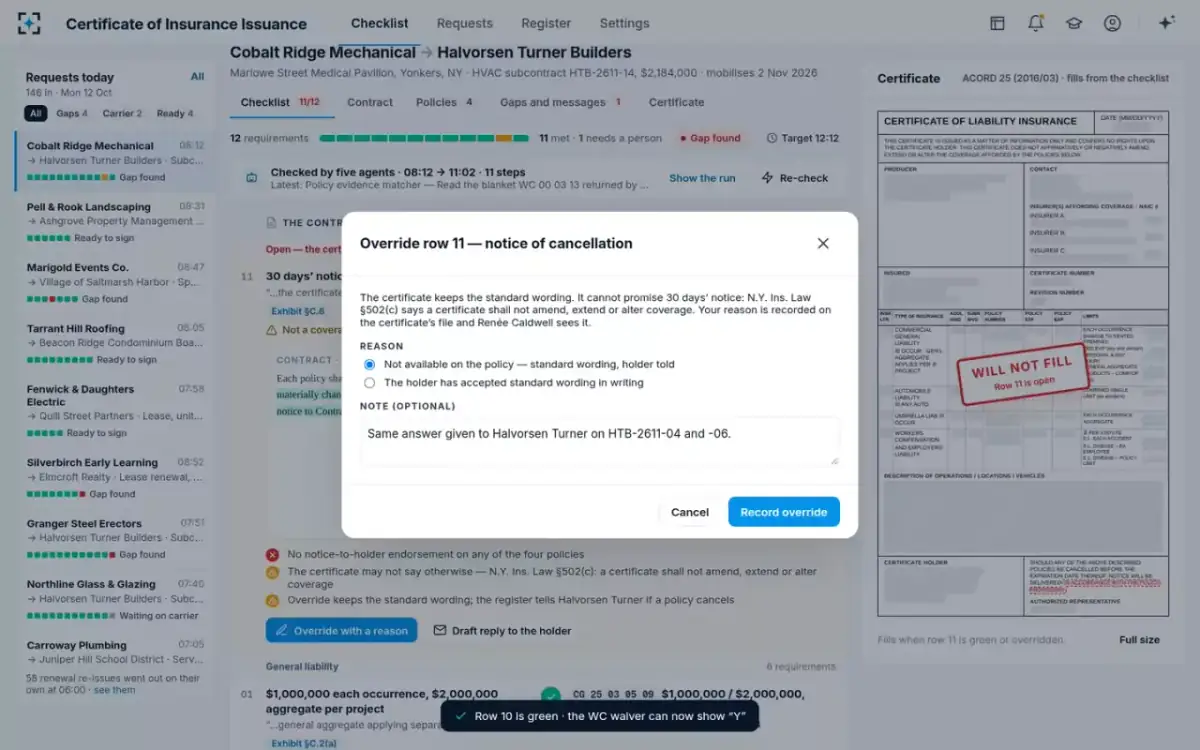
The sample request shows how this plays out. On it, Exhibit C §C.6 asked for 30 days' written notice to the contractor, and none of the insured's four policies gives notice to a certificate holder; the policies' common conditions send it to the first named insured only. The matcher could not mark that row green, and the drafter could not type "30 days' notice" into the description without writing what the law forbids the certificate to promise.
In Certificate of Insurance Issuance the notice row is overridden with a reason, never typed in
30 day notice of cancellation for certificate holders: the endorsement route
If a holder needs notice, the route is an endorsement that names it, not a sentence on the certificate. Texas's Department of Insurance allows a certificate to state that the holder will receive 30 days' notice "as long as the provision mirrors the requirements in the insurance policy", which means the policy must first contain it. Some carriers will endorse a policy to give notice to named third parties; whether they will, and at what cost, is a question for the underwriter, asked the same way as any other endorsement request.
On the sample the agency did not ask for one, because the contractor's real need was to know if the subcontractor's cover lapsed. The specialist overrode the row with the reason "standard wording, holder told", and the drafted reply to the contractor said plainly what the certificate cannot promise and that the agency would call within one business day of any cancellation. That call is the agency's own service promise, outside the certificate, and the certificate register is what lets it keep it.
How the disclaimer protects the issuer, and how it does not
The disclaimer protects the insurer from being held to coverage it never wrote; it does not protect anyone from a false statement. The certificate statutes penalize certificates, and demands for certificates, that alter coverage or misstate the policy, disclaimer or not, and Washington's rule speaks to anyone who "knowingly" issues or circulates such a certificate (WAC 284-30-355). In Texas and Louisiana a certificate breaking the rules is void, which removes the confirmation effect too.
For an agency the lesson is that "confers no rights" is not a shield for a careless box. A "Y" in the additional insured or waiver column with no endorsement behind it is a misstatement, and the holder who relied on it will look for someone to answer for it. That is why the solution's drafter cannot turn a red row into a "Y", why cancellation wording is fixed to the standard text, and why every contract-driven certificate is issued by a named specialist with the evidence for each box on file. The rules each state adds are compared in certificate of insurance laws by state.
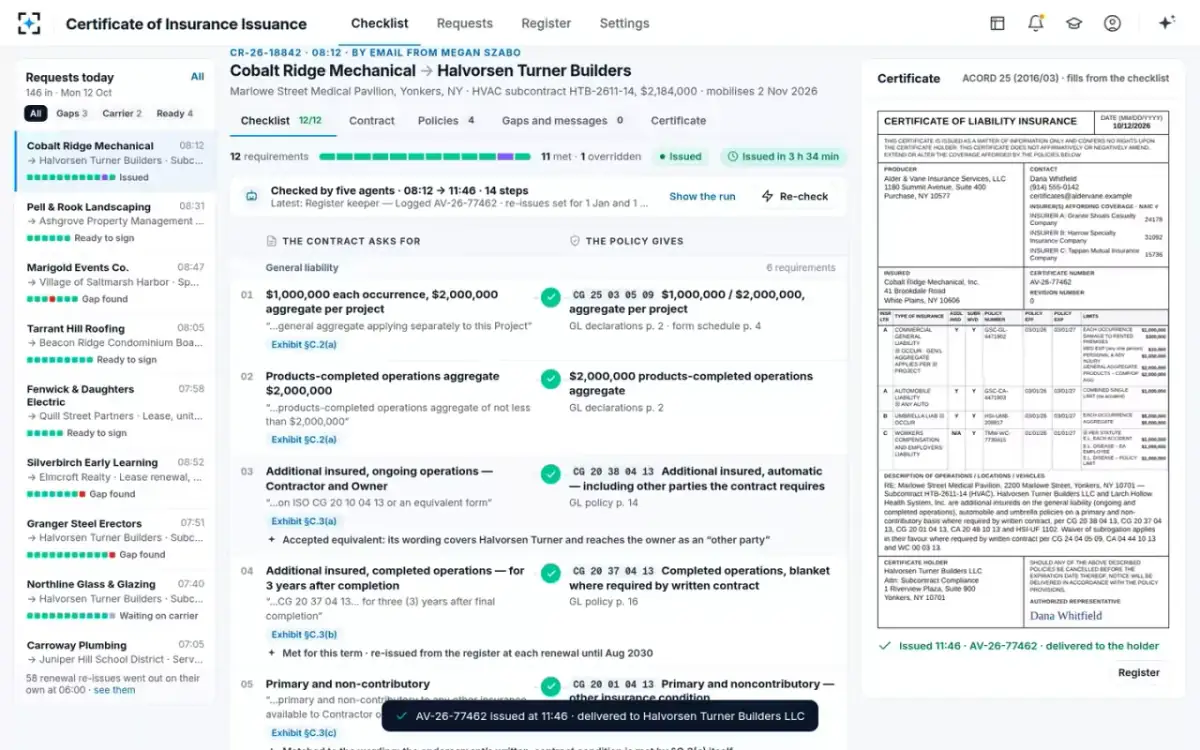
Issued by Certificate of Insurance Issuance: signed, and saying no more than the policy
Reading a certificate's disclaimer: what to check as a holder
Treat the disclaimer as an instruction to read the policy, and check the few things a certificate can reliably tell you. The checks below work in any state; the confirmation rule adds weight in Texas and Louisiana.
Five checks that respect what “confers no rights” means
- Is the policy real and current?
Insurer, policy number and dates; in Texas and Louisiana an issued certificate confirms these. Confirm with the insurer or agent if anything looks altered.
- Which endorsements does the description name?
Ask for copies. Status you need comes from them, not from the column.
- Do the endorsements’ words reach you?
Written-contract conditions, scheduled jobs and named parties decide it.
- Does any endorsement give you notice of cancellation?
If not, the cancellation box gives you nothing beyond the policy’s own terms.
- Is anything typed that the policy cannot support?
“Per contract”, “30 days’ notice” or “all operations covered” are signs the certificate is saying more than the policy.
Questions people ask
What does "for information purposes only" mean on a certificate of insurance?
That the certificate summarizes the policy for a third party and does not change it. Texas requires that phrase, similar language or an equivalent statement on approved forms, yet still treats a properly issued certificate as confirming the policy was issued or bound.
Can a certificate holder sue the insurer?
Not on the certificate alone. A holder has rights against the insurer only if the policy gives them, for example as an additional insured under an endorsement; the certificate cannot convey contractual rights, as Texas §1811.051(b) puts it.
Why won't my agent add 30 days' notice of cancellation to the certificate?
Because the certificate can only repeat notice the policy gives. Under laws modelled on the NCOIL act, notice rights come from the policy or an endorsement; ask the agent whether the carrier will endorse the policy to give you notice.
Does "confers no rights" make a certificate worthless?
No. It is evidence of insurance, its issuer answers for its accuracy, and in Texas and Louisiana it confirms by statute that the policy exists. What it cannot do is add coverage or rights the policy lacks.
Does an additional insured on a certificate have rights?
Only if the policy's endorsement makes it an additional insured; then the rights come from the endorsement. New York courts have held, from 2004 to 2025, that a certificate naming a party, without more, did not establish the status.