To check if a certificate of insurance is valid, ask two separate questions. Is it genuine: was it issued by the agent or insurer named on it, for a policy that exists, with the dates and limits shown? And is it enough: does the policy behind it, through its endorsements, actually give you what your contract requires? The first is answered by confirming with the issuer and the insurer. The second is answered only by the endorsement pages, because a certificate can report a policy but cannot add to it. A holder can verify only what the policy says, so the useful checks are the endorsement forms behind each box, the written-contract condition many of them carry, and the notice the policy, not the certificate, promises. This guide is written from the holder's side by the team behind Certificate of Insurance Issuance, Botminds' software for agency certificate desks, which is built so that every box on an issued certificate has a policy page behind it.
How to check if a certificate of insurance is valid: seven checks and the document that answers each
- 1 · The policy exists, for these dates
Answered by the insurer or the issuing agency, contacted independently. Texas and Louisiana treat a properly issued certificate as confirming it; a fake one confirms nothing.
- 2 · The named insured is the party doing your work
Answered by your contract and the certificate’s insured block. A policy bought by another company does not cover a subcontractor’s crew.
- 3 · Each “Y” has an endorsement behind it
Answered by the endorsement pages for additional insured and waiver of subrogation, which you are entitled to ask for.
- 4 · The endorsement’s words reach you
Answered by the endorsement text: named, or inside a class such as anyone the insured agreed in a written contract “with”.
- 5 · Limits and forms match your contract
Answered by the declarations and the forms list; check editions where your contract names them.
- 6 · Workers’ compensation is proven the state’s way
Answered by the state’s own form or coverage record; in New York, a standard liability certificate is not accepted for it.
- 7 · You will hear if it lapses
Answered by a notice endorsement naming you, or by your own diary of expiry dates; the certificate’s cancellation box promises only what the policy gives.
How to check if a certificate of insurance is valid: two questions, not one
A certificate can be genuine and useless to you, or forged and convincing; checking only one of the two leaves the other risk open. Genuineness is a question of fact about the document: who issued it, from which policy. Sufficiency is a question about the policy's words. The New York cases cited across these guides, in which holders lost coverage they thought they had, were about the second: a real certificate, a real policy and an endorsement whose words did not reach them.
New York's Appellate Division has held as recently as December 2025 that a certificate naming a school district as an additional insured was "insufficient, without more, to show" that the insured had agreed to cover it (Island Trees v A 1 Construction). The district had a certificate. What it needed was proof of the agreement the policy's endorsement required. The difference between those two documents is laid out in certificate holder vs additional insured.
How to spot a fake certificate of insurance
The most reliable test is to confirm the policy with the insurer, because the fake certificates in federal prosecutions looked ordinary to the people who received them. In a 2021 case in Washington State, an insurance agent who pocketed clients' premiums "created false insurance certificates, and led the high-risk companies to believe they were insured"; when insurers cancelled the policies for non-payment, she received the notices and hid them. Some clients, the U.S. Attorney's Office said, learned their policies had been cancelled only when they contacted the insurers directly about renewing. She was sentenced to two years in prison and ordered to repay $273,137 to eight companies or brokers.
A second pattern is a genuine certificate used for the wrong people. In a Florida case sentenced in May 2026, a company sold its insurance to construction subcontractors for 7% to 8% of their payroll: "the defendants caused certificates of insurance in the name of the defendants’ company to be sent to construction contractors from which the subcontractors wished to obtain work, representing that the subcontractors worked for their company and were covered by the company’s workers’ compensation insurance." The policies had been bought on applications describing a handful of employees and a minimal payroll.
One certificate scheme, in the numbers the prosecutors gave
Neither scheme would have survived the checks above. Calling the insurer exposes a cancelled or non-existent policy. Comparing the named insured with the company that signed your subcontract exposes a certificate borrowed from someone else's policy. Typos, mismatched fonts and odd dates are worth noticing, but a well-made fake has none of them; the policy record is the test.
Certificate of insurance verification for workers' compensation: use the state's proof
For workers' compensation, verify through the state's own proof rather than a liability certificate, where the state provides one. New York's law bars state and municipal bodies from issuing permits or entering contracts for hazardous employment unless "proof duly subscribed by an insurance carrier is produced in a form satisfactory to the chair" of the Workers' Compensation Board. The state's Office of General Services spells out what that means for its own construction contracts: "The ACORD 25 form is not acceptable as proof of coverage for Workers’ Compensation or disability." It accepts the C-105.2, the State Insurance Fund's U-26.3, group self-insurance and self-insurance forms, or the CE-200 exemption.
The Florida case shows why. A workers' compensation line on a liability certificate tells you a policy exists in someone's name; it does not tell you whose employees the insurer agreed to cover or on what payroll. Where a state offers a carrier-issued proof form or a coverage lookup, use it, and compare the employer it names with the subcontractor in front of you.
How to read a certificate of insurance, box by box
Read each box as a claim about the policy, and know which document proves it. The frame below walks the standard liability certificate from top to bottom.
How to read a certificate of insurance: what each box says, and what to ask for
Producer
It saysThe agency that issued it, with a contact.
Ask or checkCall that agency on a number you find yourself, not the one printed, if anything looks wrong.
Insurers A–F, NAIC numbers
It saysWhich company writes each line.
Ask or checkConfirm the policy directly with the insurer when the stakes are high.
Insured
It saysThe legal entity the policy covers.
Ask or checkCheck it is the entity that signed your contract and employs the crew.
Policy numbers and dates
It saysWhich policies, from when to when.
Ask or checkDiary the expiry; a certificate says nothing about cancellation after it was issued.
ADDL INSD and SUBR WVD
It saysThat an endorsement gives additional insured status or a waiver.
Ask or checkAsk for the endorsement pages and read whether their words reach you.
Description of operations
It saysThe job, the parties and, ideally, the forms by number.
Ask or checkBe wary of “per contract”: it names no endorsement you can check.
Certificate holder
It saysWho the certificate is addressed to.
Ask or checkBeing here gives you information, not coverage.
Cancellation
It saysThat notice follows the policy provisions.
Ask or checkUnless an endorsement names you for notice, expect none.
How to verify a certificate of liability insurance with the agent
Ask the issuing agency for the endorsement pages and the policy's forms list, and ask specific questions about wording. Texas's Department of Insurance says a holder may ask the agent whether the policy contains specific language or a specific exclusion, or request a copy of the policy, and that nothing in its certificate chapter stops an agent providing policy or endorsement copies (TDI FAQ). What the agent may not do is answer with a different document: the Texas department says agents may not complete affidavits or supplemental questionnaires in place of an approved certificate, and Minnesota bars opinion letters in lieu of certificates.
You can also check the form. In Texas a certificate for a Texas risk must be on an approved form, and every filed certificate form "and any supporting information filed with the department under this subchapter is open to public inspection as of the date of the filing". The department publishes the list of approved forms (TDI listing); a certificate on an unrecognized form for a Texas job is a reason to ask questions. Washington's rule, meanwhile, puts the burden on everyone who handles one: "No person may knowingly issue or circulate a certificate that contains any false or misleading information or that purports to alter, amend, or extend the coverage provided by the insurance policy."
What to do when a certificate fails a check
Stop relying on it, ask the issuer the specific question it failed, and escalate only if the answer does not come. Start by assuming a gap rather than fraud: an endorsement scheduled for a different job, a form edition older than the contract names, a holder outside a blanket class. The agency can fix a gap with an endorsement request; on the sample, a workers' compensation waiver scheduled for another job was replaced with a blanket endorsement in under two hours. Until it is, the contract usually lets you keep the subcontractor off site.
A certificate that no insurer recognizes is a different matter. State insurance regulators take complaints about certificates: Texas's commissioner may investigate a complaint of a prohibited certificate practice and demand information about it (§1811.204), and the federal case against the Washington agent began, the U.S. Attorney's Office said, when the state's Insurance Commissioner's Office received complaints from customers. Keep the certificate, the email it came in and the insurer's answer; they are the evidence a regulator or prosecutor will ask for.
When a valid certificate still does not protect you
A genuine certificate fails you when the endorsement behind its "Y" does not reach you, when the policy lapses after it was issued, or when your contract asked for something the policy never had. Each has a fix that does not involve the certificate. Read the endorsement's class against your relationship to the insured: an owner whose contract is with the general contractor may not be inside a class defined by a written contract "with" the subcontractor. Diary the expiry dates and ask for renewal certificates before them. And where the policy cannot give what you asked for, such as notice of cancellation, write that duty into the subcontract instead, as set out in the requirement wording a certificate can't carry.
Holders who handle many certificates use tracking software to collect them and chase expiries; that holder-side job is covered in certificate of insurance tracking software. Tracking tells you a certificate arrived and when it expires. It does not tell you whether an endorsement's words reach you, which is the check that decides coverage.
Who checks a certificate on the holder's side, and what each should keep
Today
Accepts a certificate whose boxes look right, and finds the gap when a claim is tendered.
With agents
Accepts a certificate that arrives with its endorsements, and reads the class wording before the crew starts.
Still theirs: whether the subcontractor may mobilise
Today
Files the tenant’s certificate and diaries nothing.
With agents
Checks the tenant is the named insured, diaries expiry and asks for renewals before them.
Still theirs: the lease’s remedies if cover lapses
Today
Takes an emailed PDF from a vendor on the day.
With agents
Confirms the policy with the issuing agency for anything high-risk, before the event.
Still theirs: whether the vendor works
Today
Sends the form alone and answers questions when the holder rejects it.
With agents
Sends the form with the endorsement pages and a plain note on what it cannot promise.
Still theirs: the signature and the evidence behind each box
What a well-run agency sends you, so the checks are quick
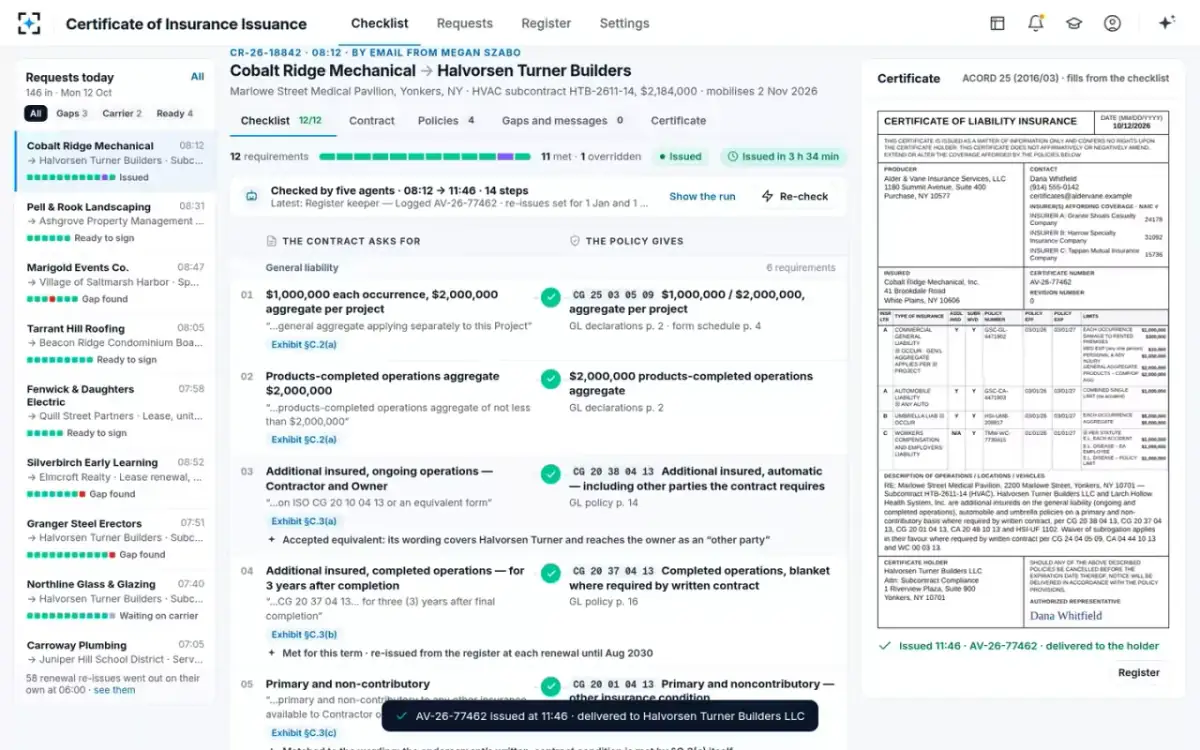
The quickest certificate to verify is one that comes with its evidence. On the fictional sample request in Certificate of Insurance Issuance, the agency issued certificate AV-26-77462 to the contractor's portal and email with the nine endorsements it relied on attached, and a drafted reply explaining that the 30 days' notice the contract asked for could not appear on the certificate because no policy gave it. The contractor could check every "Y" against a page in the same email.
Certificate of Insurance Issuance sends the endorsements with the certificate, so each box can be checked
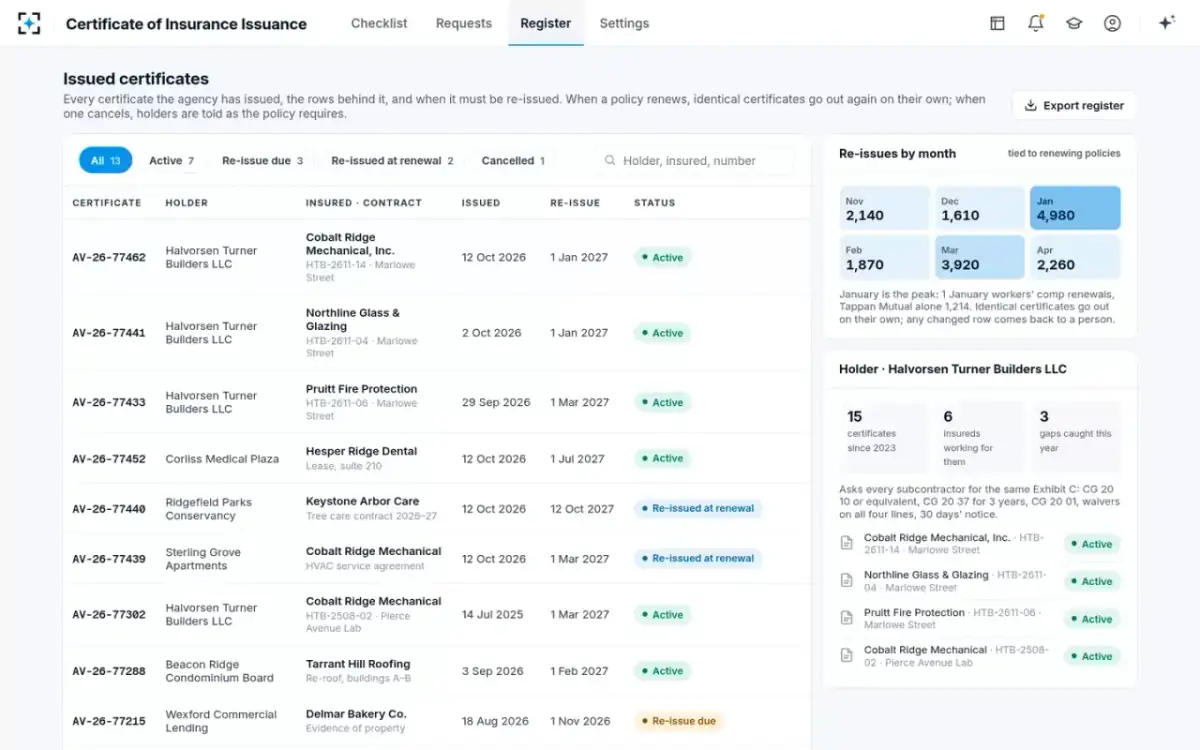
The register behind it matters to holders too. Each certificate is logged with its re-issue date, re-issued on its own at renewal only if every requirement is unchanged, and holders are told when a policy cancels as the policy requires. The sample register's panel for this contractor shows 15 certificates since 2023 for six insureds working for it, and three gaps caught this year before a certificate went out.
The register in Certificate of Insurance Issuance: what was issued to you, and when it is re-issued
Questions people ask
Can I call the insurance company to verify a certificate of insurance?
Yes, and for high-stakes work you should. In the Washington case, clients of an agent who forged certificates learned their policies had been cancelled only when they contacted the insurers directly; use a number you find yourself, not one printed on the certificate.
Is an emailed PDF certificate of insurance valid?
It can be. Texas defines a certificate to include an electronic record, so the format does not matter; what matters is that it was issued by the agent or insurer for a policy that exists, which you confirm the same way as for paper.
What should a COI review checklist include?
The seven checks above: the policy confirmed, the named insured matched to your contract, endorsements behind every "Y", their words read against your relationship to the insured, limits and forms against the contract, workers' compensation through the state's proof, and a plan for hearing about a lapse.
Does an expired certificate mean there is no coverage?
Not necessarily; the policy may have renewed and the certificate not been re-issued. But a certificate is evidence only of the policy period it shows, so ask the agency for the renewal certificate and endorsements before relying on cover after that date.
Who is liable if a certificate of insurance is fake?
Whoever made or knowingly used it, under state certificate laws and, where money changed hands, fraud law; the federal cases on this page ended in prison sentences. The holder's own protection is the contract: require the subcontractor to carry the insurance, not merely to produce a certificate.