COI software for insurance agents and brokers is only as good as four inputs the agency already owns: the rules it issues certificates under, a table of which endorsement forms it accepts as equivalent to the ones contracts name, the insured's policies with every endorsement attached, and a sample of past contracts with the certificates that were issued against them. A vendor can supply the software; nobody else can supply those. Certificate of Insurance Issuance, Botminds' software for agency certificate desks, reads contracts against policy forms and drafts certificates for a named specialist to issue, and these four things are what it asks an agency for before it goes live. This guide is the list to bring, written so an operations or IT lead can start gathering before any contract is signed.
The four inputs COI software needs from an agency, and who owns each
- 1 · Your certificate rules, written down
Which certificate form and edition you issue on, how the description of operations is written, who may override what, the turnaround target, when renewals re-issue on their own. Owner: the service team lead, signed off by the principal.
- 2 · An accepted-equivalents table
For each form contracts commonly name, the forms and editions you accept in its place, with the reason and the person who decided. Owner: the service team lead with your coverage adviser.
- 3 · The policies, with every endorsement and schedule
Declarations, forms lists and the endorsement pages themselves, including schedules that name parties and jobs. Owner: account managers and whoever runs the agency management system.
- 4 · A sample of past contracts and what you issued
Contract-driven requests from the last year, the exhibits, and the certificates that went out, including the ones that came back. Owner: the certificate specialists.
Why COI software for insurance agents starts with the agency's own rules
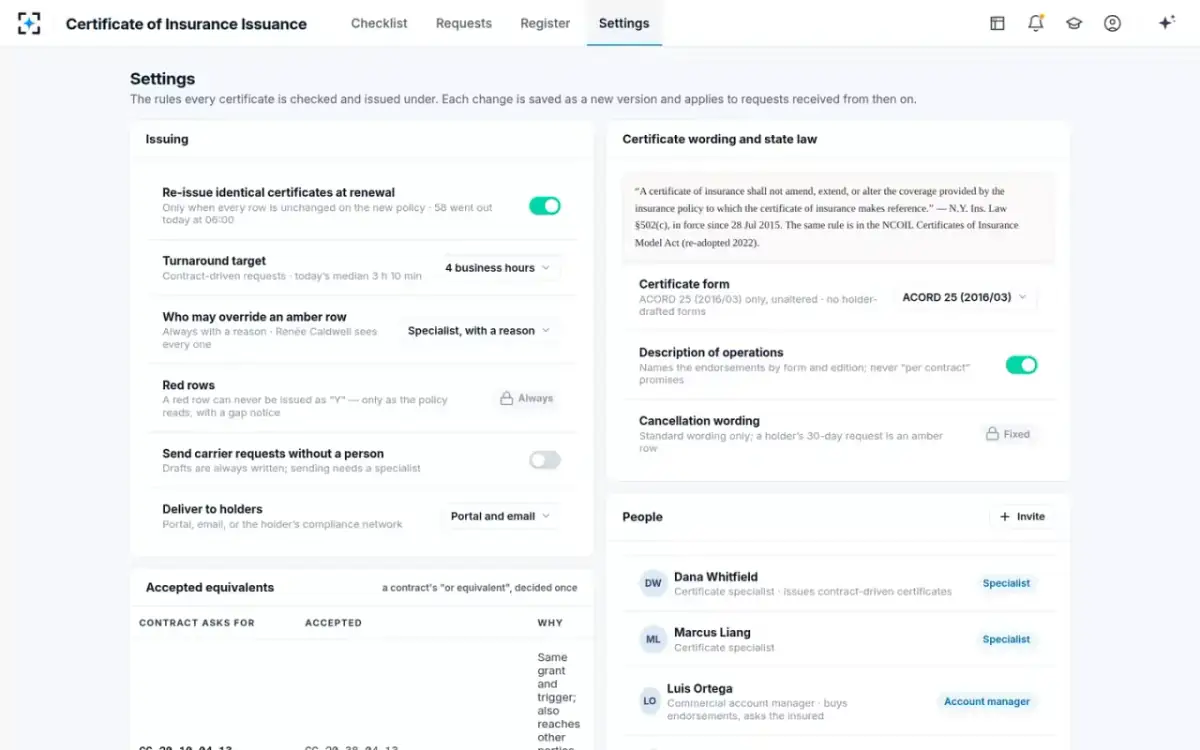
Because a certificate is the agency's statement on the insurer's behalf, and the rules it is made under are policy decisions, not software defaults. Each one in the solution is a setting the agency chooses and can change, and every change is saved as a new version that applies to requests received from then on. That matters when an examiner or a holder asks, months later, why a certificate said what it said: the answer is the rule in force on the day it was issued.
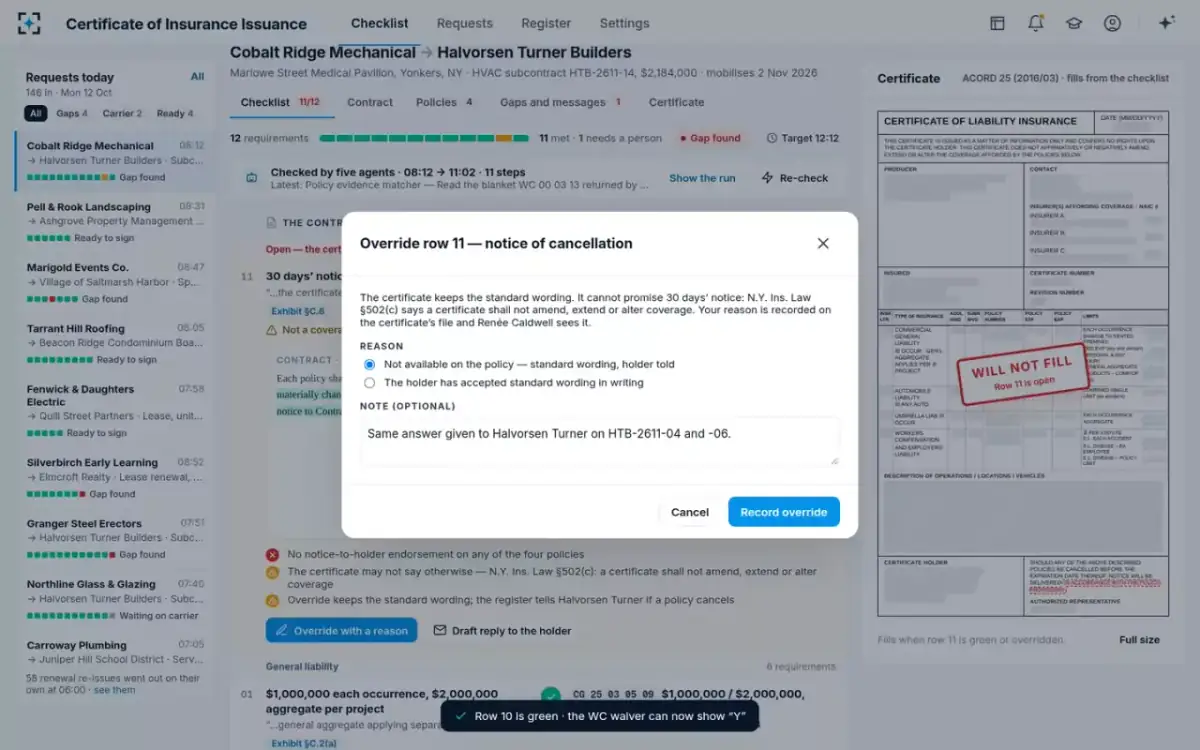
The sample agency's settings show what a complete rule set covers. It issues on one standard form edition, unaltered, and never on holder-drafted forms. Its description of operations names endorsements by form and edition and never writes "per contract". Cancellation wording is fixed at the standard text. A specialist may override an amber row with a reason; the service team lead sees every override and approves above two a day. A red row is locked: it can be issued only as the policy reads, with a gap notice. Carrier requests are never sent without a person. Contract-driven requests carry a four-business-hour turnaround target. Identical certificates re-issue on their own at renewal, but only when every row is unchanged.
The agency's certificate rules, set once and versioned
Which certificate forms may the software issue on? Check what each state has on file
Only on forms the states you issue into accept, which in some states means forms filed with the regulator. Texas lets no one issue a certificate for a Texas risk unless the form has been filed with and approved by the department (§1811.052), with the ACORD, AAIS and ISO standard forms deemed approved once filed. Minnesota requires that "An insurer not using the standard ACORD or ISO form "Certificate of Insurance" shall file with the commissioner, prior to its use, a similar alternative", and adds that filed forms may not be amended at a third party's request. Kentucky's regulation requires each insurer to file its certificate form "Prior to its use".
The lists are long and they move. Our count of the Texas Department of Insurance's published listing on 27 October 2026 shows 1,152 approved certificate forms from 279 filers, and ACORD's certificate of liability insurance appears four times, approved in 2011, twice in 2013 and again on 10 October 2025 (TDI, approved certificates of insurance). The rule a COI tool needs is therefore not "use the ACORD 25" but "use this edition, and these carrier forms, for risks in these states", kept current by someone whose job it is.
The accepted-equivalents table: the decision only the agency can make
Contracts name forms and editions, often followed by "or equivalent", and policies carry whatever the carrier files. Someone has to decide, once, which of the carrier's forms meet each named form, and that decision cannot be delegated to software without delegating the agency's exposure with it. The sample agency's service team lead approved CG 20 38 04 13 as an equivalent for CG 20 10 04 13 on 14 March 2026; from then on, every contract asking for CG 20 10 "or an equivalent form" was matched against that decision, with the date and the name cited on the row.
Building the table is quicker than it sounds. On the sample subcontract, every named form fell into a short list: ongoing and completed operations additional insured forms, primary and non-contributory, waivers on each line, a per-project aggregate and the auto additional insured form. Start from the forms named in the last year's contracts, list the carrier forms you have actually accepted for each, and have the decision made and signed. Editions matter: in the same sample queue, a steel erector's request came back as a gap because the policy carried a 07 04 edition of a completed operations form and the contract asked for 04 13. How the matcher uses the table is shown in what issuance software must check.
The four inputs as the sample agency supplied them to Certificate of Insurance Issuance
| Input | What the sample agency brought | What Certificate of Insurance Issuance does with it |
|---|---|---|
| Certificate rules | One form edition, fixed cancellation wording, override and approval limits, a four-business-hour target, a strict re-issue rule | Applies the version in force when each request arrived; shows the rule on every decision |
| Accepted equivalents | A table of contract forms and the carrier forms accepted for each, with who decided and when | Matches “or equivalent” requirements against the table; anything not on it comes back as a gap |
| Policies and endorsements | Four policies for the sample insured, 31 forms, the workers’ compensation waiver schedule as written | Reads limits from declarations and status from endorsement wording, schedules and conditions |
| Past contracts and certificates | Contract-driven requests with their exhibits and the certificates issued against them | Used to set up and test the matching before go-live, against what the agency actually issued |
Policies with their endorsements: the input most agencies underestimate
The matcher answers from the endorsement pages, so a policy file that holds only the declarations is not enough. The question a certificate answers is whether a form exists, in which edition, naming whom, for which job; declarations answer the first only. On the sample, the decisive page was the workers' compensation waiver schedule, which named the right contractor for a finished job and nobody for the current one. A forms list would have shown WC 00 03 13 as present and the box would have been ticked.
Where policy documents live varies by agency: the management system, the carrier's portal, a document store, an inbox. Setting up the connection to each, or loading documents in bulk where no connection exists, is part of going live and should be scoped explicitly with any vendor. Ask which sources are read automatically, which by file, and what happens when an endorsement is issued mid-term, because that is when last month's certificate stops being true.
Insurance agency automation software: who does what once it is live
Agents take the reading, matching and drafting; people keep every decision that commits the agency, the insured or the carrier. That split is what makes certificate automation safe to switch on, and it should be written into the go-live plan by role.
The roles around COI software, before and after it goes live
Today
Works 140 to 160 requests a day, reading exhibits against policies from memory and last year’s checkboxes.
With agents
Opens each contract-driven request already matched row by row, and issues once every row is met or overridden.
Still theirs: overrides with a reason, and the signature
Today
Hears about a coverage gap when the contractor’s compliance team rejects the client’s certificate.
With agents
Gets the gap, the form wanted and the premium basis the same morning, with the note to the insured drafted.
Still theirs: buying endorsements, with the insured’s consent
Today
Cannot see which certificates went out on an override, or why.
With agents
Sees every override with its reason and decides the accepted equivalents once.
Still theirs: the rules, the equivalents table and approvals above two a day
Today
Keeps the agency management system, the inbox and the document stores running separately.
With agents
Connects them as sources for requests, policies and forms, and owns the register.
Still theirs: access, connections and the forms list
Software for insurance agents and brokers: what to check before you sign
Check that the four inputs stay yours. The rules, the equivalents table and the register of what was issued are the agency's evidence of how it worked; if they live only in a vendor's portal, the agency cannot produce them to an examiner or a holder's lawyer. State examiners test whether insurers adequately monitor the firms that perform work on their behalf (NAIC examination standards), and the same logic applies one step down: an agency should be able to show what its software did on its behalf.
Also check where a person must act. In the solution nothing goes to a carrier, insured or holder unless a person sends it, a red row can never become a "Y", and only a certificate specialist issues a contract-driven certificate. A product that issues contract-driven certificates with no person in the loop has moved the signature, not removed the need for one. Washington's certificate rule makes the stake explicit: it bars anyone from knowingly issuing or circulating a certificate with false or misleading information (WAC 284-30-355).
A go-live plan: replay the past before you trust the present
The safest first step is to run the software on certificates the agency has already issued, and compare. A replay of last year's contract-driven requests shows, before any holder sees anything, whether the matcher reads your contracts the way your best specialist does, where your equivalents table has holes, and which past certificates had a box with nothing behind it.
Going live with Certificate of Insurance Issuance, in six steps
A person decides
Write the certificate rulesForm editions, wording, override and approval limits, turnaround target, re-issue rule. Signed by the principal.
A person decides
Decide the equivalentsFor the forms last year’s contracts named, record the carrier forms accepted and who decided.
Agent
Replay past requestsContract requirement extractor and policy evidence matcher read last year’s contract-driven requests and the policies behind them.
Never: contacts a carrier, insured or holder
A person decides
Compare with what was issuedSpecialists review every row where the replay and the issued certificate disagree, and correct the table or the rules.
Agent
Run alongside the deskLive requests are matched and drafted while specialists issue as before, so turnaround and gaps can be measured.
Never: issues or sends
A person decides
Switch on by ruleThe team lead turns on drafting for issue, then automatic re-issue of unchanged renewals, one rule at a time.
Measure three things during the side-by-side run: the share of contract-driven requests with at least one red or amber row, the time from request to a complete carrier request when there is a gap, and the number of rows where the matcher and the specialist disagree. The first tells you how much of your desk the software changes; the second is the turnaround lever described in pricing the waiting days; the third tells you whether to trust it yet.
Insurance agency management software and COI software: how they fit together
The agency management system remains the place policies, clients and accounting live; COI software reads from it and writes the certificate register beside it. The solution lists what it works with in plain terms: the certificate inbox and client portal, holders' compliance networks, contracts, leases and permits, policies and forms, the holder master and certificate register, and renewals and cancellations. None of that replaces the management system, and an agency evaluating both should keep them separate in the contract, so the certificate evidence is not locked inside either.
For agencies in Texas, one practical rule ties the two together: an agent must hold an appointment with the insurer or managing general agent whose policy a certificate refers to, so the producer data in the management system is part of what decides who may sign. The state-by-state rules behind that are gathered in certificate of insurance laws by state.
An override is a rule in action: a reason, a person, and the team lead sees it
Questions people ask
How long does it take to set up COI software at an agency?
It depends mostly on the policy documents. Rules and an equivalents table take days of a team lead's time; gathering endorsements and schedules for active accounts takes longer where they sit outside the management system. A replay on past requests can begin as soon as one book of policies and its contracts are loaded.
Do we need to file our certificate form with the state?
Not if you issue on a standard form the state accepts; Texas deems the ACORD, AAIS and ISO forms approved once filed, and Minnesota requires filing only for insurers not using the standard ACORD or ISO form. A carrier's or holder's own form is different and may need approval first.
What is an accepted-equivalents table?
A list, kept by the agency, of which endorsement forms and editions it treats as meeting a form a contract names, with the reason and the person who decided. In the sample, CG 20 38 04 13 was accepted for CG 20 10 04 13 on 14 March 2026.
Can COI software work with our agency management system?
It should read from it rather than replace it. Ask any vendor which policy data and documents it reads directly, which must be loaded by file, and how it learns of an endorsement issued mid-term.
Who should own the certificate rules?
A service or operations lead, with the principal signing off, because the rules decide what the agency says on insurers' behalf. In the sample, every change to the rules is saved as a new version and applies to requests received from then on.