The difference between a certificate holder and an additional insured is that the holder learns about a policy, while the additional insured is covered by it. A certificate holder is whoever the certificate is addressed to: New York defines one as "any person, other than a policyholder, that is identified on the certificate as a certificate holder". An additional insured is a person the policy itself covers, because an endorsement adds them to who is an insured, usually for liability arising out of the named insured's work. Being the first does not make you the second; only the endorsement does, and its wording decides whether you qualify. That gap is where Certificate of Insurance Issuance, Botminds' software for agency certificate desks, does its checking: it will not mark a holder as an additional insured until it has found the endorsement and tested its conditions.
Certificate holder against additional insured, right by right
Certificate holder: Your name in the holder box of a certificate.
Additional insured: An endorsement to the policy that adds you, by name or by a description you fit.
Certificate holder: The certificate, which summarizes the policy.
Additional insured: The policy and its endorsement; the certificate only reports it.
Certificate holder: No right to a defence from the insurer.
Additional insured: A right to defence and cover, within the endorsement’s terms and limits.
Certificate holder: None; anyone can be a holder.
Additional insured: Often a written contract with the named insured, a scheduled job, or liability caused by the named insured’s work.
Certificate holder: Only if the policy or an endorsement gives it.
Additional insured: Also only if the policy or an endorsement gives it.
Certificate holder: The certificate holder box, bottom left.
Additional insured: The “ADDL INSD” column and the description of operations, if the endorsement supports them.
Is the certificate holder the same as an additional insured?
No. A holder receives information; an additional insured holds rights under the policy. The statutes define the holder by the certificate alone. Texas calls a certificate holder "a person, other than a policyholder" who is designated on a certificate or to whom one was issued at the policyholder's request, and then provides that a certificate may not "convey a contractual right to a certificate holder" (§1811.051(b)). Nothing about being in the holder box gives a claim against the insurer.
An additional insured's status comes from the policy. A typical blanket endorsement amends the policy's "Who is an insured" section to include certain people or organizations, then limits what it covers them for. The one New York's highest court read in 2018 said: "WHO IS AN INSURED (Section II) is amended to include as an insured any person or organization with whom you have agreed to add as an additional insured by written contract but only with respect to liability arising out of your operations or premises owned by or rented to you." (Gilbane). Every clause of that sentence is a condition.
"While the certificate of insurance confers no coverage, it provides additional evidence showing that the stand-alone agreement required that plaintiff be named as an additional insured"
Appellate Division, First Department, Fiedler Cos. v New York Mar. & Gen. Ins. Co. (2021)
What does it mean to be listed as an additional insured?
It means the policy will defend and pay for claims against you, but only those the endorsement describes, and only up to the named insured's limits. The endorsements in the cases on this page cover the additional insured for liability arising out of the named insured's operations or acts, for ongoing work, completed work or both. On the sample programme completed operations is a separate endorsement, which is why the sample subcontract asks for two forms and a three-year tail.
The scope can be narrower than it looks. In Burlington v New York City Transit Authority (2017), New York's highest court held that an endorsement covering injury "caused, in whole or in part" by the named insured's acts requires the named insured to be a proximate cause of the injury; an additional insured that was solely at fault was not covered. Being listed is a promise about some claims, not all of them. How contract wording tries, and sometimes fails, to push that further is the subject of the requirement wording a certificate can't carry.
Additional insured endorsement vs certificate holder: the wording courts test
Blanket endorsements cover a class of people rather than a name, and the class is defined by a contract. Whether you are in the class depends on the exact words, and New York's courts have read similar-sounding wordings to opposite results. The table puts five side by side.
Five additional insured wordings, and who each one reached
Gilbane v St. Paul (N.Y. 2018)
“any person or organization with whom you have agreed to add as an additional insured by written contract”
A written contract between the named insured and the party claiming. A construction manager named only in the owner’s contract with the prime contractor was not covered.
Not covered
Harco v First Mercury (2d Dept 2017)
“when you and such person or organization have agreed in writing in a contract or agreement that such person or organization be added as an additional insured on your policy”
Writing between the named insured and that party. The building owner, whose contract was with the general contractor, did not qualify.
Not covered
Fiedler v New York Marine (1st Dept 2021)
“the same “you and such person or organization have agreed in writing” wording”
Met, for the duty to defend: a stand-alone agreement between the contractor and the subcontractor, meant for all jobs, was enough, and the certificate was further evidence of it.
Covered
Three Boroughs v Endurance (1st Dept 2016)
“that the insured is required by written contract to name as an additional insured”
A contract that actually contains the requirement. The owner’s contract with the maintenance contractor did not, so the owner was not covered.
Not covered
Island Trees v A 1 Construction (2d Dept 2025)
“[a]ny person or organization for which the Named Insured has agreed to provide insurance prior to loss as provided by this policy”
An agreement before the loss, not necessarily in writing; whether an oral one existed went to trial. The certificate alone did not prove it.
For trial
Read together, the cases give a working rule. Where the endorsement speaks of a contract "with" the named insured, or of the named insured "and such person" agreeing in writing, an owner or construction manager whose contract is with someone else is likely outside the class. Where it speaks of anyone the insured is "required by written contract" to add, the contract has to contain the requirement. And where it needs no writing at all, a certificate can be evidence of an agreement but, as the Second Department held, never conclusive proof of it (Island Trees, 2025; the court's reasoning is read in what "confers no rights" means).
Certificate holder vs additional insured on a COI: the owner two contracts away
The hardest case on a construction certificate is the party who is named in the contract but did not sign with the insured, usually the owner. Take a fictional sample request as it runs through Certificate of Insurance Issuance. An HVAC subcontract between the contractor, Halvorsen Turner Builders, and the subcontractor, Cobalt Ridge Mechanical, requires both the contractor and the hospital owner, Larch Hollow Health System, to be additional insureds for ongoing and completed operations. Larch Hollow's contract is with Halvorsen Turner, not with Cobalt Ridge. Every name is invented.
Read by Certificate of Insurance Issuance: two additional insureds, one signed with the insured
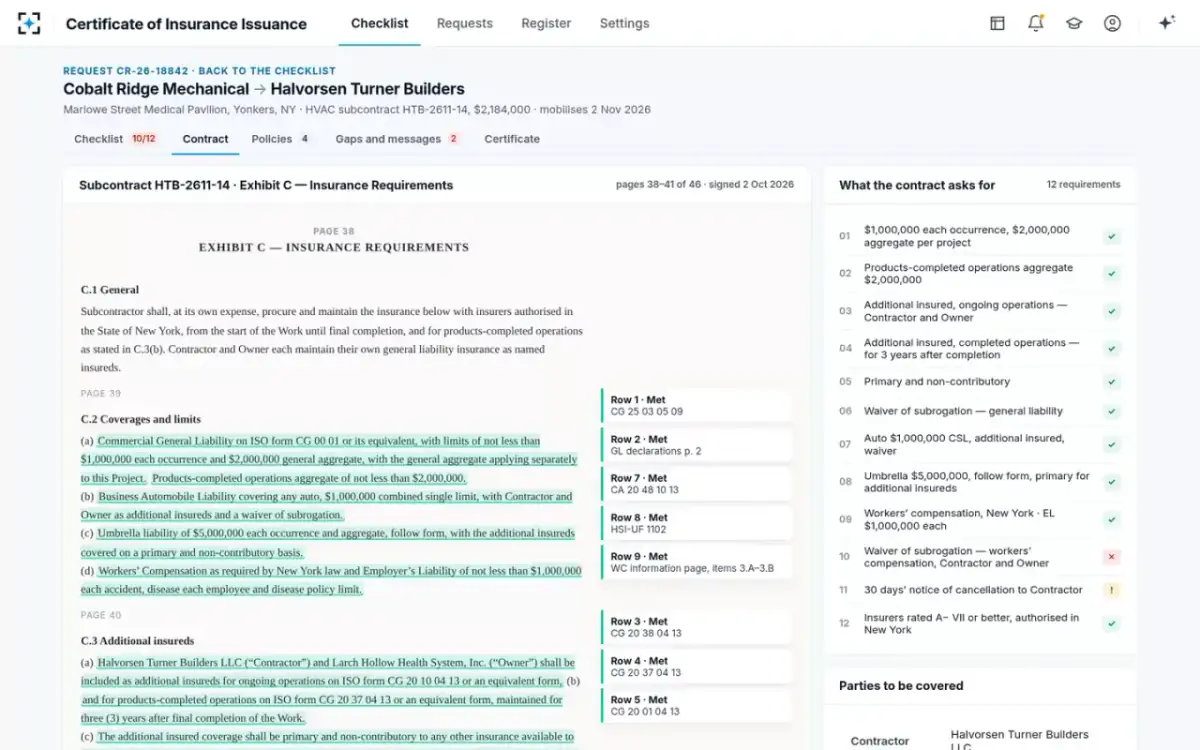
A box-ticking certificate would put "Y" under additional insured and both names in the description. The matcher instead asks of each endorsement whether its words reach each party. On the sample, the contract names CG 20 10 04 13 "or an equivalent form"; the agency's accepted-equivalents table, approved by its service team lead in March 2026, accepts CG 20 38 04 13 in its place, recording as its reason that the form reaches other parties the construction agreement requires. The completed operations form and the primary and non-contributory form were then tested against their own written-contract conditions before the row turned green.
In Certificate of Insurance Issuance, each additional insured row cites its form, condition and clause
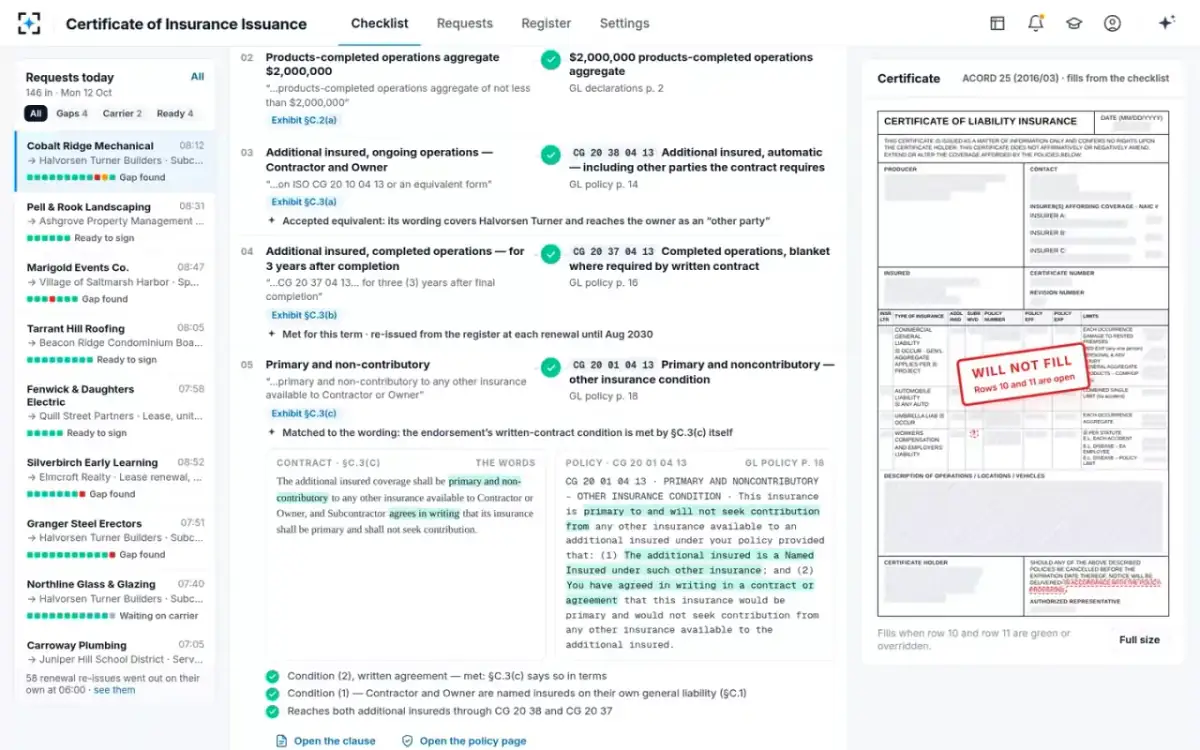
Ongoing and completed operations: two endorsements, two clocks
Additional insured status for the work while it is under way and for the finished work afterwards usually comes from two different endorsements, and the second has to survive renewals. The sample subcontract asks for ongoing operations cover on CG 20 10 04 13 or an equivalent, and completed operations cover on CG 20 37 04 13 for three years after final completion. The policy carrying that second endorsement in 2026 will expire long before the three years end, so the status has to be renewed with the policy each year.
That turns a certificate into an obligation with a calendar. On the sample, the completed operations row is met for the current term and the certificate is set to be re-issued from the register at each renewal until August 2030, and only automatically if the renewed policy carries the same forms. Editions matter at each renewal too: another request in the same sample queue came back as a gap because the policy carried a 07 04 edition of the completed operations form where the contract asked for 04 13.
Where is additional insured on an insurance certificate?
In the narrow "ADDL INSD" column beside each line of coverage, and in the description of operations, where the endorsement is named. A "Y" in the column says the policy on that line has an endorsement giving the holder that status. Texas's regulator reads it strictly: where the policy has only a blanket endorsement, the certificate may not name the holder as an additional insured. Asked exactly that, the Texas Department of Insurance answered: "No, though the certificate can state that the policy contains a Blanket Additional Insured endorsement."
Outside Texas, some agencies mark the column for blanket endorsements and qualify the description with "where required by written contract", as the sample agency does. Either practice stays honest only if the description names the endorsement by form and edition, so a reader can check its words. The certificate itself still adds nothing: in every New York case cited on this page, a certificate naming the party did not create cover the endorsement did not give.
What is the difference between an insured and a certificate holder?
The named insured owns the policy, pays the premium, owes the policy's duties and receives its notices; a certificate holder has none of those. Texas defines the policyholder as the person who has "contracted with a property or casualty insurer for insurance coverage", which the holder by definition has not. On the sample policies, the common conditions give notice of cancellation to the first named insured only, so a holder asking for 30 days' notice is asking for something the policy does not give anyone else.
Named insured, additional insured, certificate holder: who holds what
| Named insured | Additional insured | Certificate holder | |
|---|---|---|---|
| Party to the policy | Yes; it contracted with the insurer | No; added by an endorsement | No; a third person outside the policy |
| Defence and cover if sued | Under the whole policy | Only for claims the endorsement describes | None from the certificate |
| Pays the premium, owes the duties | Yes | No, though its status may cost the named insured a premium | No |
| Notice of cancellation | Yes, to the first named insured on the sample policies | Only if the policy or an endorsement gives it | Only if the policy or an endorsement gives it |
| Where it appears | Declarations | The endorsement, by name or by a class it fits | The holder box of the certificate |
An additional insured sits between the two. It has coverage for the claims its endorsement describes, but not the named insured's other rights: it does not control the policy and, in Texas, has a legal right to notice of cancellation only if it is named in the policy or an endorsement and the policy, endorsement or a Texas law requires the notice (§1811.155). On property policies the comparable roles are loss payee and mortgagee, compared in certificate holder vs mortgagee.
How a certificate holder actually becomes an additional insured
By getting the named insured to obtain an endorsement whose words reach it, and then seeing the endorsement. The contract is where that starts: name the parties, and require an endorsement whose class includes parties with no direct contract with the named insured if the owner or manager needs cover. The agency then checks the insured's policy against those words and, if they do not reach, asks the carrier for a form that does. On the sample, that check and the carrier request are drafted in the first two minutes and sent by a person.
A holder that receives a certificate should ask for the endorsement pages with it; nothing in the Texas certificate law prevents an agent from providing them. If the endorsement turns out not to reach the holder, the remedy runs against the party that promised it: New York's highest court noted in Gilbane that the construction manager "might have a claim against" the contractor that failed to obtain its status. The holder's checklist is in how to check if a certificate of insurance is valid.
Questions people ask
Can you be both a certificate holder and an additional insured?
Yes, and on construction jobs the contractor usually is both: it receives the certificate as holder and is covered as additional insured by the subcontractor's endorsement. The two are separate facts, and only the endorsement gives coverage.
Does an additional insured have to be named on the certificate?
No. Status comes from the endorsement, which may name the party or describe a class it fits. The certificate reports that status; in New York cases, naming a party on a certificate did not create status the endorsement did not give.
Is a blanket additional insured endorsement enough?
It can be, if its words reach you. Under wording that requires a written contract "with" the named insured, an owner whose contract is with the general contractor may be outside it, as in Gilbane and Harco; under wording keyed to what the insured is "required by written contract" to provide, the contract must contain the requirement.
What if my certificate says I am an additional insured but the policy does not?
Then you are not covered by that policy. In Tribeca Broadway, the owner was listed as an additional insured on the certificate but not in the policy, and the court found no duty to defend; the remedy lies against whoever promised the coverage.
Does an additional insured get notice of cancellation?
Only if the policy or an endorsement gives it. Under the NCOIL model and statutes like Texas §1811.155, notice rights come from the policy, not from the certificate or the contract.