Certificate of insurance laws by state share a core taken from one model: a certificate is not the policy and may not amend, extend or alter it; it may not promise that the policy meets a contract's insurance requirements; and nobody gets notice of cancellation from a certificate unless the policy itself gives it. States then differ on forms, penalties and who is liable. Texas requires approved forms, voids certificates that break its rules and fines wilful violations up to $1,000 each; New York aims its law at the people who demand improper certificates; Louisiana and Texas both treat a properly issued certificate as confirming the policy exists. This guide sets the texts side by side. Certificate of Insurance Issuance, Botminds' software for agency certificate desks, applies them as settings: standard wording only, no contract warranties, and no notice the policy does not give.
Certificate laws in four numbers
2012
NCOIL adopts its Certificates of Insurance Model Act; readopted 2017 and 2022
2011
Texas chapter 1811 takes effect, 1 September
Senate Bill 425
$1,000
per wilful violation in Texas and Louisiana; per violation in West Virginia
60days
for a filed certificate form to be deemed approved in Texas
Certificate of insurance laws by state: where the rules actually are
Some states have a certificate statute, some a regulation, and many rely on insurance department bulletins and their general unfair-practices laws; so "which states have a certificate law" depends on what counts. We read the statute or rule text for six states and the model act, and that is what this page covers: Texas Insurance Code chapter 1811, New York Insurance Law article 5, Louisiana R.S. 22:890, Washington WAC 284-30-355, Minnesota §60A.39, West Virginia Code chapter 33 article 53, and Kentucky's 806 KAR 14:100. For any other state, start with the insurance department's own bulletins before relying on a summary, ours included.
The pattern across the texts is clear enough to act on. Every one forbids a certificate that alters coverage. Most deal with forms, either by requiring filing or by naming the standard ones. The newer laws add three things the older rules lacked: a ban on warranting contract compliance, a rule that notice rights come only from the policy, and a penalty that reaches the person who demands a bad certificate, not just the agent who signs it.
NCOIL certificate of insurance model acts: the template
The National Council of Insurance Legislators adopted its Certificates of Insurance Model Act on 18 November 2012 and readopted it in 2017 and 2022. It is a model, not law; it binds no one until a state enacts it. Its rules are short. A certificate form must be filed with the commissioner unless it is a current standard ACORD, AAIS or ISO form. A certificate "shall not confer to any person new or additional rights beyond what the referenced policy of insurance expressly provides". Nobody may alter a filed form, put false or misleading information on a certificate, or make one that purports to change coverage, and the ban covers whoever prepares, issues, requests or requires it.
Two provisions do most of the practical work. Section 4B says a certificate may not warrant that the policy complies with a contract's insurance or indemnification requirements, and that a contract number or description on the certificate may not be read as doing so. Section 5 says a person is entitled to notice of cancellation, nonrenewal or material change only if the policy or an endorsement gives it. A certificate issued in violation is "null and void", and the fine is left blank for each state to fill in.
Certificate of insurance laws by state, rule by rule
| Law | Forms | Changing coverage | Contract references | Notice rights | Consequence |
|---|---|---|---|---|---|
| NCOIL model (2012; readopted 2022) | Filed with the commissioner; standard ACORD, AAIS, ISO forms need no individual filing | Forbidden; no new rights | May not warrant contract compliance | Only under the policy or an endorsement | Null and void; fine left to each state |
| Texas, Ins. Code ch. 1811 (2011) | Filed and approved; standard forms deemed approved on filing; 60-day deemer | Forbidden; no contractual right for the holder | No reference to another contract’s requirements | Only if named in the policy and policy or Texas law requires it | Void; up to $1,000 per wilful violation; issued certificate confirms coverage |
| New York, Ins. Law §§501–504 | Liability certificates required only on the insurer’s form or an approved standard form | Forbidden; no rights beyond the policy | No one may require terms the policy does not include | Through the coverage rule: a certificate cannot add them | $1,000 first, $2,000 each later wilful violation (not governments) |
| Louisiana, R.S. 22:890 | Insurer’s own or ACORD, AAIS, ISO standard forms | Forbidden; no contractual rights | No references; may list only forms and endorsements | Only if named and policy or law requires it | Null and void; up to $1,000 per wilful violation; issued certificate confirms coverage |
| Washington, WAC 284-30-355 | Not addressed | No knowingly issuing or demanding one that alters coverage | Contract obligations to buy cover are unaffected | Only if named and the policy requires it; policy governs timing | From 18 Oct 2026 a violation is an unfair or deceptive practice |
| Minnesota, §60A.39 | Insurers not using ACORD or ISO forms file an alternative | Not without the commissioner’s written approval | Not addressed; inconsistent opinion letters barred | Certificate may not exceed statutory or policy notice | Required disclaimer statement |
| West Virginia, ch. 33 art. 53 | Commissioner prohibits unfair or misleading forms | Forbidden; no new rights | May not warrant contract compliance | Only under the policy or an endorsement | Up to $1,000 per violation after hearing |
| Kentucky, 806 KAR 14:100 | Each insurer files its form before use | Required statement that it does not | Not addressed | Not addressed | Required disclaimer statement |
Texas certificate of insurance laws and regulations: the fullest version
Texas regulates the certificate as a form, makes improper ones void and fines the people who use them. Chapter 1811, added by Senate Bill 425 and effective 1 September 2011, applies to any certificate for a risk located in Texas, wherever the holder, insured, insurer or agent is (§1811.002). No one may issue or require a certificate on a form that has not been filed with and approved by the department; the standard ACORD, AAIS and ISO forms are deemed approved on filing, and the department's form decision can take 60 days, extendable by ten.
The prohibitions reach holders as well as agents. A person may not require a certificate containing false or misleading information about the policy, and may not require a substitute document inconsistent with the chapter (§1811.054 and §1811.055). A certificate breaking the chapter "is void and has no effect". The commissioner may issue cease and desist orders, seek injunctions and ask the attorney general to recover a civil penalty of up to $1,000 for each wilful violation. The department's FAQ applies the chapter to everyday requests: no supplemental questionnaires, no agent affidavits about a contract's insurance requirements, and a job or contract number only for identification (TDI FAQ).
Texas also says what a proper certificate is worth. An approved certificate, properly executed and issued, confirms that the referenced policy has been issued or coverage bound, whatever its disclaimer says (§1811.151); Louisiana has the same rule. That twist, and what the disclaimer still means, is explained in what "confers no rights" means.
New York certificate of insurance laws and regulations: aimed at the people who demand them
New York's article 5 is written mostly against holders. It forbids any person or governmental entity to wilfully require, as a condition of awarding a contract, starting work or paying for it, a liability certificate on anything other than the insurer's own form or a standard form approved by the superintendent (§502(a)). It forbids requiring certificate terms, warranties or guarantees the policy does not expressly include, while allowing minimum insurance requirements in bid solicitations and requests for clarification of the policy (§502(b)). And it states the core rule: a certificate "shall not amend, extend, or alter the coverage provided by the insurance policy to which the certificate of insurance makes reference" (§502(c)).
The penalty is fixed rather than capped. After notice and a hearing, the superintendent may order a wilful violator "to pay to the people of this state a penalty in a sum of one thousand dollars for the first violation and two thousand dollars for each subsequent violation", but the section excludes governmental entities, which the definitions treat separately from persons. A public owner in New York is barred by §502 from wilfully requiring an improper certificate, yet §503's penalty does not reach it.
Texas and New York certificate laws, compared
Texas, Ins. Code ch. 1811: Every certificate form filed and approved; standard forms deemed approved on filing.
New York, Ins. Law art. 5: Liability certificates required only on the insurer’s form or an approved standard form.
Texas, Ins. Code ch. 1811: Insurers, agents, holders and anyone who requires a certificate.
New York, Ins. Law art. 5: Mainly persons and governments who require certificates; the coverage rule binds everyone.
Texas, Ins. Code ch. 1811: Forbidden on the certificate.
New York, Ins. Law art. 5: Terms not in the policy may not be required; bid minimums still allowed.
Texas, Ins. Code ch. 1811: Confirms the policy was issued or coverage bound.
New York, Ins. Law art. 5: No statutory rule; courts treat it as evidence, not a contract.
Texas, Ins. Code ch. 1811: Void and of no effect.
New York, Ins. Law art. 5: Cannot change coverage; no voidness clause.
Texas, Ins. Code ch. 1811: Up to $1,000 per wilful violation, plus orders and injunctions.
New York, Ins. Law art. 5: $1,000 first, $2,000 each later wilful violation; not governments.
Louisiana, Washington, Minnesota, West Virginia and Kentucky: the variations that matter
Louisiana's R.S. 22:890 is the closest to Texas. Certificates must be on the insurer's own form or the ACORD, AAIS or ISO standard forms (lenders excepted), may not reference requirements in other contracts, and "may list only the specific forms or endorsements contained in the underlying contracts of insurance"; an issued certificate confirms the policy, a violating one is null and void, and wilful violations draw up to $1,000 each. Washington's WAC 284-30-355 gives notice rights only to a holder named in the policy or an endorsement that requires notice, bars knowingly demanding or issuing a certificate that is false, misleading or alters coverage, and from 18 October 2026, under Washington State Register order 26-17-089, treats a violation as an unfair or deceptive practice in the business of insurance (Washington State Register 26-17-089).
Minnesota's §60A.39 has a rule the others lack: a certificate "must not provide for notice of cancellation that exceeds the statutory notice of cancellation provided to the policyholder or a period of notice specified in the policy". It also requires a disclaimer statement and bars opinion letters in place of certificates. West Virginia follows the model closely, including the ban on warranting contract compliance, and allows the commissioner to fine up to $1,000 per violation after notice and hearing (§33-53-7). Kentucky's regulation, in force in some form since 1975, requires each insurer to file its certificate form before use and to print a statement that the certificate does not amend, extend or alter the policy.
Fines per violation in the certificate statutes that set one
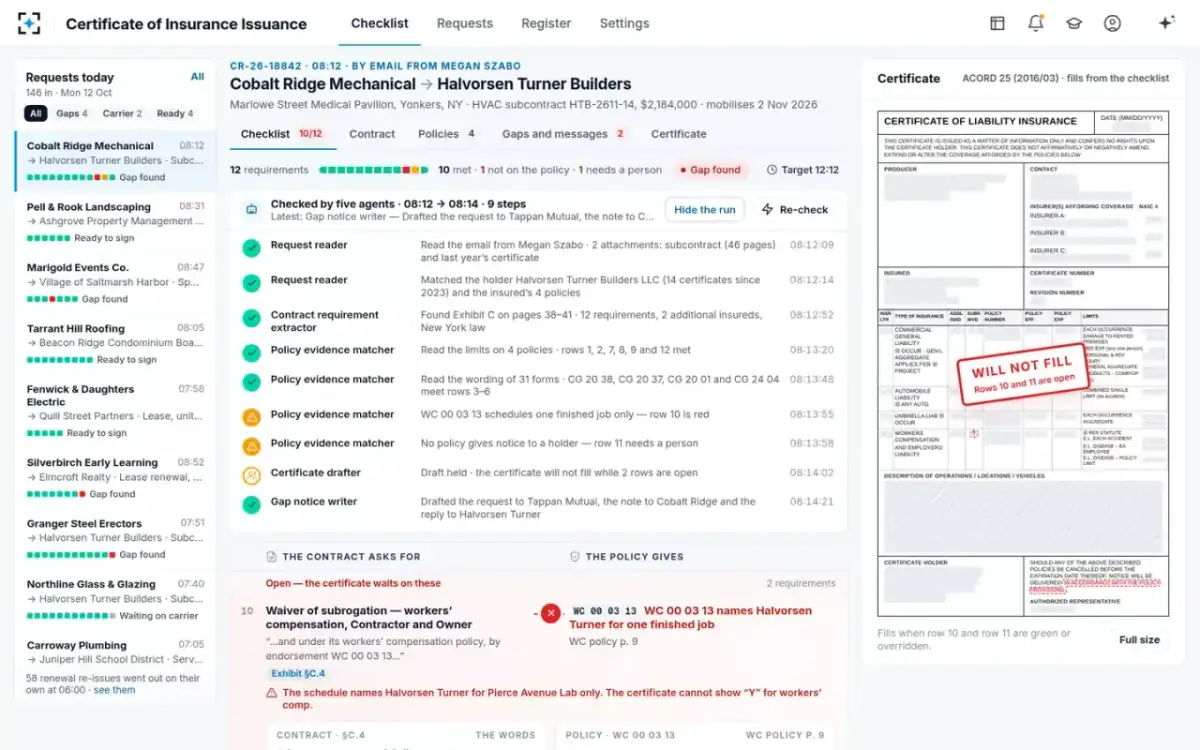
Certificate of Insurance Issuance reads the governing law with the contract, before anything fills
Is a certificate of insurance legally binding?
It binds the people who issue and demand it to tell the truth, but it does not bind the insurer to coverage the policy lacks. Every text above says a certificate cannot change the policy, and New York's appellate courts have repeatedly held that a certificate naming someone as an additional insured does not make them one; the leading cases are compared in certificate holder vs additional insured. Texas and Louisiana add the other side: a properly issued certificate does bind in one respect, as confirmation that the policy exists or coverage was bound.
Liability for a wrong certificate falls elsewhere. An agent who issues one can face the state's penalty and a claim from the holder or the insured, and a holder who demanded it can face the penalty in Texas, New York, Louisiana and West Virginia. The certificate itself stays what every one of these texts says it is: a report on the policy, not a change to it.
Is a certificate of insurance a legal document?
Yes, in the sense that the law regulates its form, content and use, and examiners look for it. Texas approves forms and opens filed forms to public inspection; Minnesota and Kentucky require filing of non-standard forms; Louisiana limits which forms may be used at all. The NAIC's examination standards list certificates among the forms an insurer must file where required. What it is not is a contract of insurance: Texas says a certificate is not a policy of insurance (§1811.152), and the model act says the same.
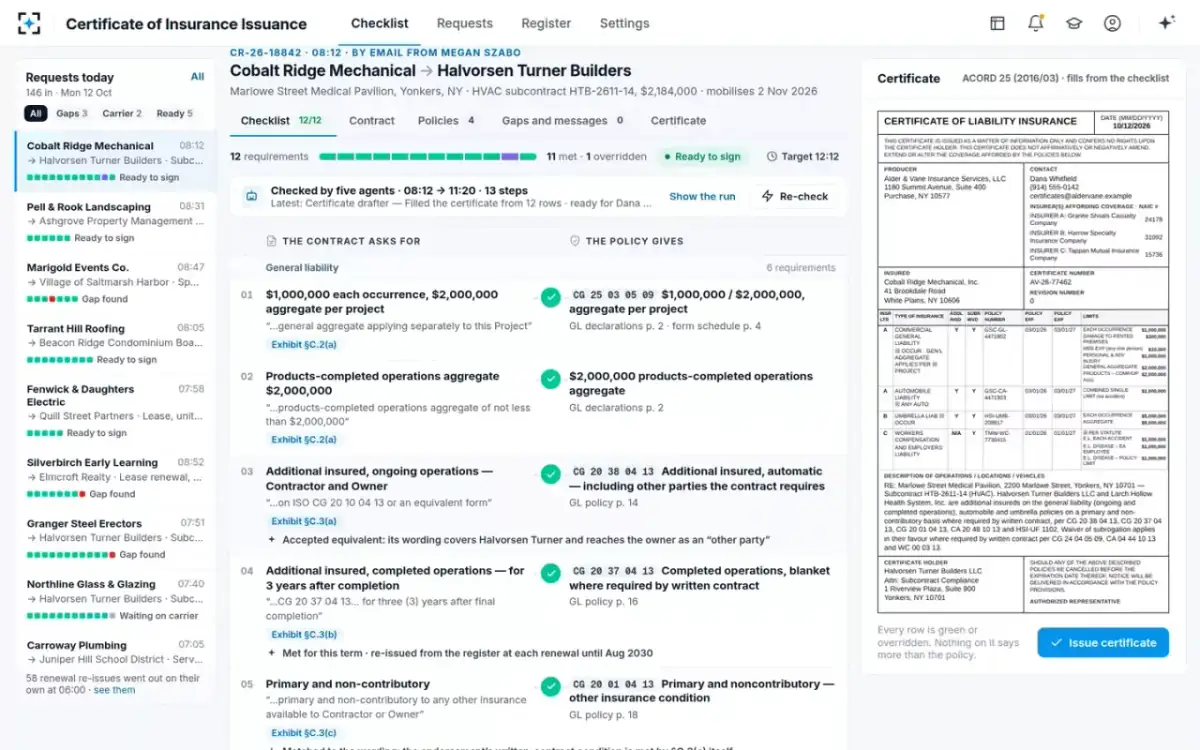
A certificate from Certificate of Insurance Issuance: forms named, contract cited for identification only
Certificate of insurance requirements by state: a checklist for a multistate agency
The safe course for an agency issuing into several states is to meet the strictest common reading on every certificate and to apply state-specific rules where the risk is located. In the solution these are settings rather than habits: one standard form edition, unaltered; descriptions that name endorsements by form and edition and never write "per contract"; standard cancellation wording only, with any holder's request for notice treated as an amber row a person must answer; and a red row, where the policy lacks what the contract asks, that can never become a "Y".
Certificate rules that satisfy every text on this page
- Issue on a standard form or a filed form, unaltered
Texas, Louisiana, Minnesota and Kentucky all speak to forms; Texas and New York penalize demands for anything else.
- Decide by the risk’s location, not the holder’s
Texas and Louisiana apply to risks in the state wherever the holder is.
- Never write that the policy meets a contract
The model, West Virginia and New York forbid warranting contract compliance; Texas and Louisiana forbid contract references.
- Use a contract number only to identify the job
Texas allows it for identification; the model says it may not be read as a warranty.
- Promise no notice the policy does not give
Texas, Louisiana, Washington, West Virginia and the model tie notice to the policy; Minnesota caps it at the policy’s or statute’s period.
- Refuse affidavits, opinion letters and questionnaires
Texas and Minnesota bar substitutes inconsistent with their certificate rules.
- Keep the evidence for each box
A void certificate in Texas or Louisiana leaves the agency with only its file to explain what it meant.
Contract exhibits are where most requests to break these rules come from, usually without the drafter knowing; the clauses to watch, and where each should be satisfied instead, are in the requirement wording a certificate can't carry.
Questions people ask
How many states have certificate of insurance laws?
We have not found an official count, and it depends on whether bulletins and unfair-practices rules are counted. This page covers the statute or rule text of six states and the NCOIL model; check your own department's bulletins as well.
Does a certificate of insurance law apply to an out-of-state holder?
In Texas and Louisiana, yes, if the risk is in the state: the laws apply regardless of where the holder, insured, insurer or agent is located. Texas's department confirms that a certificate for a Texas risk must be on an approved form even when the holder is elsewhere.
Can a city or state agency require its own certificate form?
In New York, no person or governmental entity may wilfully require a liability certificate on anything but the insurer's own or an approved standard form, though §503's penalty excludes governments. In Texas the form must be filed and approved before anyone may require it.
Do certificate laws apply to evidence of property insurance for a mortgage lender?
Not in Texas: chapter 1811 does not apply to evidence of property insurance required by a lender in a lending transaction. Louisiana also carves out lenders from several of its rules.
What is the penalty for issuing a false certificate of insurance?
Under the certificate statutes, up to $1,000 per wilful violation in Texas and Louisiana, $1,000 to $2,000 in New York and up to $1,000 in West Virginia, plus licence action under general insurance law. Fraud statutes can apply on top, as federal prosecutions involving fake certificates show.