Certificate of insurance requirement wording works when it asks for insurance the policy can carry and leaves the certificate to report it. It fails when it asks the certificate itself to promise something: that the policy complies with the contract, that the contract's terms apply, or that the holder will get 30 days' notice of cancellation. Certificate laws forbid a certificate to carry those promises, so the clause cannot be met however willing the agent is. The fix is to move each requirement to where it can be satisfied: an endorsement the insured must buy, or a duty the contract puts on the insured. Certificate of Insurance Issuance, Botminds' software for agency certificate desks, reads insurance exhibits clause by clause and marks the ones a certificate may not promise, so the conversation about them starts the morning the contract arrives.
Six exhibit clauses, and where each one can actually be satisfied
limits of not less than $1,000,000 each occurrence and $2,000,000 general aggregate, the general aggregate applying separately to this Project
Sample Exhibit C §C.2(a)
Certificate + endorsement
The certificate reports the limits; the per-project aggregate needs an endorsement (on the sample, CG 25 03 05 09) that the certificate names.
Contractor and Owner shall be included as additional insureds … on ISO form CG 20 10 04 13 or an equivalent form
Sample Exhibit C §C.3(a)
Endorsement
Only an endorsement whose words reach both parties satisfies it; the certificate can then name that form.
“The People of the State of New York, its Officers, Agents, and Employees are named as additional insured.”
NY Office of General Services, to be typed in the description box
Endorsement
True on a certificate only if an endorsement on the policy says so; typed alone it reports nothing.
“30 Day Notice of Cancellation”
NY Office of General Services, to be typed in the description box
Endorsement or contract
A certificate may only repeat notice the policy gives; otherwise put a notice duty on the insured in the contract.
“the insurer provides coverage in accordance with the terms of contract number _______”
Language the Texas Department of Insurance says a certificate may not contain
Not on a certificate
A warranty of contract compliance, forbidden by Texas, Louisiana, West Virginia and the NCOIL model.
“there are no limitations or exclusions for residential construction exposure”
A holder request the Texas Department of Insurance rejected
Not on a certificate
A certificate cannot say anything the policy does not; ask for the policy wording instead.
Certificate of insurance requirement wording: what a certificate may and may not say
A certificate may report the insurer, the policy, the dates, the limits and the endorsements by name; it may not change, extend or warrant any of them. Texas states the contract rule most bluntly: "A certificate of insurance may not contain a reference to a legal or insurance requirement contained in a contract other than the underlying contract of insurance, including a contract for construction or services." Louisiana goes as far, allowing a certificate to list only the specific forms or endorsements in the policy (R.S. 22:890(H)).
The NCOIL model act, enacted in substance by West Virginia, puts the warranty rule this way: "A certificate of insurance may not warrant that the policy of insurance referenced in the certificate comply with the insurance or indemnification requirements of a contract and the inclusion of a contract number or description within a certificate of insurance may not be interpreted as doing such." A contract number on a certificate is therefore an identifier and nothing more, which is exactly how the Texas department allows it to be used.
Why exhibit wording collides with the law: who the rules bind
The certificate laws bind the people who write exhibits, not only the agents who sign certificates. New York provides that no person or governmental entity "shall wilfully require the inclusion of terms, conditions or language of any kind, including warranties or guarantees, that the insurance policy provides coverage or otherwise sets forth terms and conditions in a certificate of insurance" unless the policy expressly includes them. It keeps two doors open: minimum insurance requirements in bid solicitations, and requests for clarification of the policy's terms. Texas forbids anyone to require a certificate with false or misleading information, or a substitute document inconsistent with its chapter, and fines wilful violators.
So an exhibit that tells the agent to certify compliance is not just unenforceable; in some states the party demanding it is the one in breach. The Texas Department of Insurance's answers give a practical list of what to strike: language that the insurer "provides coverage in accordance with the terms of contract number", broad statements about the absence of exclusions, questions like whether the policy covers "all premises and operations", affidavits and supplemental questionnaires, and coverage terms that do not exist in the line, such as "Basic Automobile" on a business auto certificate (TDI FAQ).
The sample exhibit in Certificate of Insurance Issuance, by what can satisfy each requirement
Exhibit C, 12 requirements
- Limits and policy facts the certificate can report · 50%
- Endorsements the certificate can only name · 41.7%
- A promise no certificate may make · 8.3%
Additional insured wording on certificates: name the endorsement, not the contract
The safe additional insured wording on a certificate names the parties and the endorsement forms, and says nothing about the contract's requirements. On the sample, the description of operations names the project, the subcontract by number for identification, both additional insureds, and the forms that give the status, ending with the list of forms rather than "per contract". Where an endorsement is blanket, the phrase "where required by written contract" describes the endorsement's own condition; it is not a promise that the contract is met.
What the certificate cannot fix is endorsement wording that does not reach a party. An exhibit that names an owner as additional insured should also require an endorsement form whose words reach parties the insured has no direct contract with, because under wording keyed to a contract "with" the named insured the owner may be outside it, as New York's highest court held in Gilbane. And it should say what the cover is for. The form wording quoted in Burlington v New York City Transit Authority granted cover "only with respect to liability for 'bodily injury', 'property damage' or 'personal and advertising injury' caused, in whole or in part, by" the named insured's acts or omissions or those of people acting on its behalf, and the court read that as requiring the named insured to be a proximate cause. An exhibit that expects more than that is asking for a different endorsement, not different certificate wording.
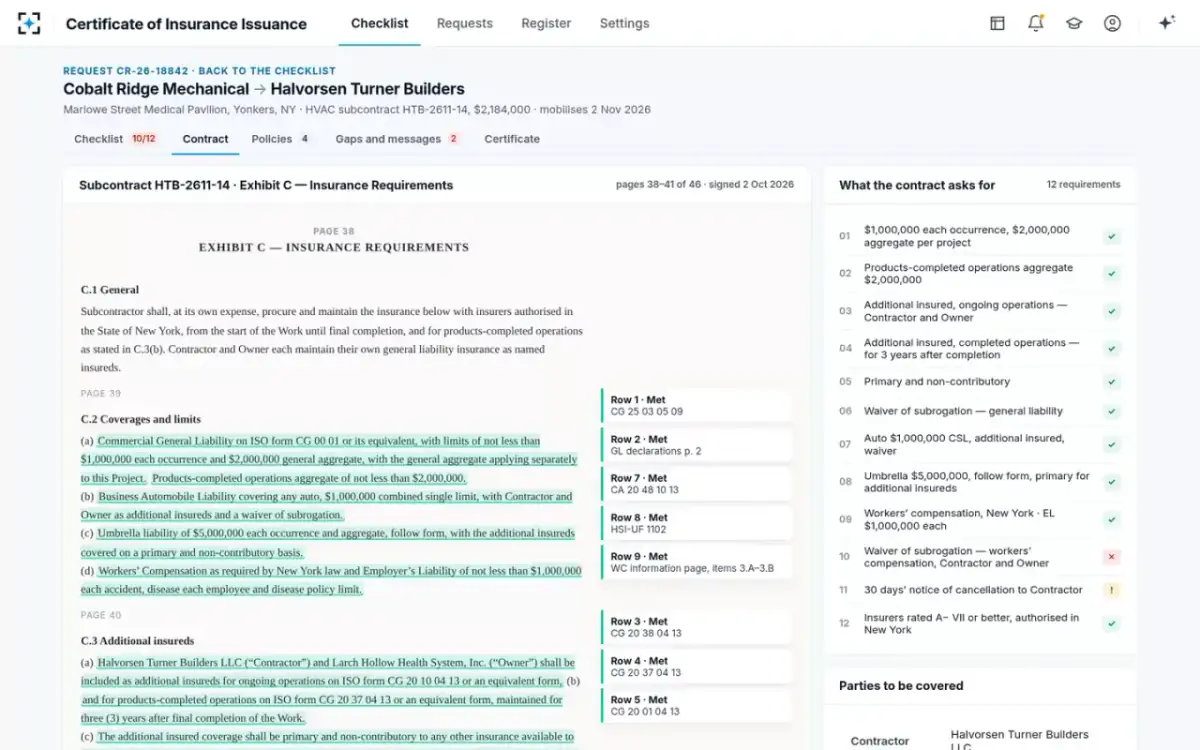
Every requirement highlighted in the contract, with the form that meets it
Primary and non contributory wording on a COI: the condition lives in the contract
Primary and non-contributory status is an endorsement, and on the sample the endorsement applies only where the insured has agreed in writing that its insurance will be primary. That makes the exhibit's own words part of the evidence. The sample's §C.3(c) does the work in one sentence: the additional insured coverage shall be primary and non-contributory to any other insurance available to the contractor or owner, and the subcontractor agrees in writing that its insurance shall be primary and shall not seek contribution. The matcher found that clause, tested the endorsement's conditions against it, and only then marked the row met.
The certificate's part is small: name the endorsement and say the cover is primary and non-contributory where required by written contract. An exhibit that asks the certificate to "state that coverage is primary" without the subcontract containing the written agreement leaves the agency with nothing to certify against; the cleaner draft puts the agreement in the subcontract and asks the certificate only to identify the endorsement.
Notice of cancellation clauses: move them from the certificate to the subcontract
A clause requiring "30 days' notice of cancellation to the holder" cannot be met by a certificate unless the policy already gives that notice, so it belongs either in an endorsement request or as a duty on the insured. New York's Office of General Services, in the 2018 revision of its construction requirements, asks for the words "30 Day Notice of Cancellation" in the description of operations; the same document asks for "The People of the State of New York, its Officers, Agents, and Employees are named as additional insured." Typed into the description, the first promises notice the policy may not give, and the second reports a status that exists only if an endorsement creates it.
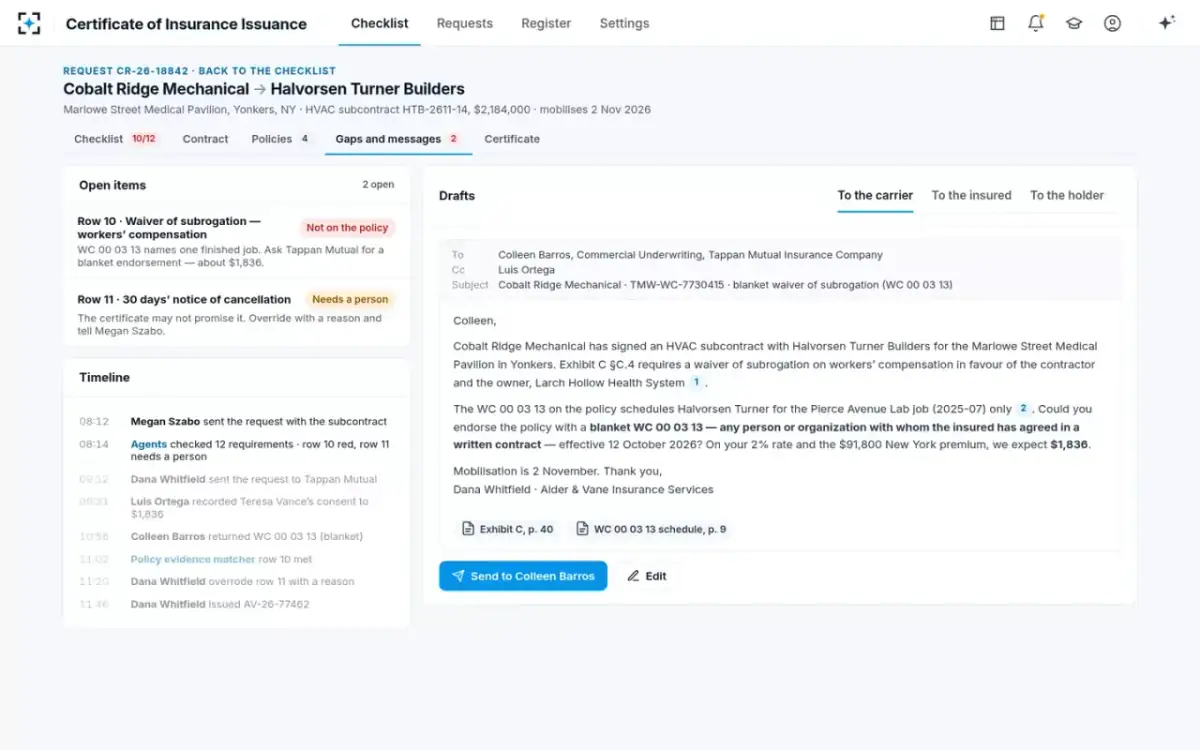
Minnesota makes the limit explicit, forbidding a certificate to provide for notice of cancellation beyond the statute's or the policy's (§60A.39). The workable alternatives are an endorsement naming the holder for notice, where a carrier will issue one, or a subcontract clause requiring the subcontractor to forward any cancellation or nonrenewal notice within a set number of days. On the sample, the notice row was overridden with a reason and the holder was told in plain words; why the certificate cannot do more is in what "confers no rights" means.
Exhibit wording aimed at the certificate, and the same requirement aimed where it can be met
Asks the certificate: The certificate shall name Owner as additional insured.
Asks the policy or the insured: Subcontractor shall maintain an endorsement, on a named form or equivalent, whose terms include Owner, and provide a copy.
Asks the certificate: The certificate shall state coverage is primary.
Asks the policy or the insured: Subcontractor agrees in writing that its insurance is primary and non-contributory, and shall carry an endorsement giving that effect.
Asks the certificate: The certificate shall show a waiver on all lines.
Asks the policy or the insured: Subcontractor shall obtain waiver endorsements on each line in favour of Contractor and Owner for this work.
Asks the certificate: The certificate shall provide 30 days’ notice of cancellation.
Asks the policy or the insured: Subcontractor shall forward any cancellation or nonrenewal notice within a set number of days, or carry an endorsement giving Contractor notice.
Asks the certificate: The certificate shall confirm compliance with this Agreement.
Asks the policy or the insured: Contractor may request copies of the policy and endorsements to verify compliance.
Subcontractor agreement insurance requirements: what to ask of whom
A subcontract's insurance requirements address three parties, and each clause should name which one acts. The subcontractor buys and maintains the insurance, including every endorsement, and gives notice. The subcontractor's agent certifies what the policy says, on a standard form, and supplies endorsement copies. The contractor verifies, and decides whether to let the subcontractor start. Clauses that blur those roles, typically by making the certificate the vehicle for the subcontractor's promises, are the ones that stall.
On the sample, the subcontract got most of this right, which is why ten of twelve rows were met within two minutes and the eleventh after one carrier endorsement. It also listed the forms it wanted by number and edition, accepted equivalents expressly, named both additional insureds, and put the primary and non-contributory agreement in writing. Its one clause aimed at the certificate, the notice requirement, was the one a person had to answer. The time cost of a stalled clause is worked through in pricing the waiting days.
Certificate of insurance requirements sample: an exhibit written to be certified
The checklist below turns the rules on this page into drafting instructions. An exhibit written this way can be certified the day it arrives if the insured's policy carries the forms, and when it does not, the gap is an endorsement request, not an argument about wording.
Writing insurance requirements an agency can certify the same day
- Name every party to be covered, and how each relates to the insured
Direct contract or named in someone else’s; endorsement wording turns on it.
- Name forms and editions, and say whether equivalents are accepted
The sample’s “CG 20 10 04 13 or an equivalent form” let the agency apply a decision it had already made.
- Put conditions the endorsements need into the contract itself
Written agreement to primary and non-contributory, waivers for this work, the completed operations period.
- Ask for endorsement copies, not certificate statements
Agents may provide policy and endorsement copies; a certificate may not warrant compliance.
- Make notice the insured’s duty, or require a notice endorsement
No certificate can promise notice the policy does not give.
- Accept the standard certificate form, unaltered
Demanding your own form can be unlawful in New York and Texas, and in Texas needs approval first.
- Let the contract number identify the job, nothing more
Texas allows it for identification; the NCOIL model says it may not be read as a warranty.
How Certificate of Insurance Issuance handles wording a certificate can't carry
It reads the exhibit, lists every requirement with its clause and page, and marks any requirement a certificate may not promise as amber rather than green, so a person decides what to tell the holder. It never writes "per contract", never adds notice the policy does not give, and names endorsements by form and edition in the description. For each gap the policy could close, the gap notice writer drafts the endorsement request to the carrier, the note to the insured with the cost, and a reply to the holder; a person sends each one.
Two clauses the certificate could not satisfy, and the drafts that answer them
Questions people ask
What should the description of operations say for an additional insured?
The project, the parties and the endorsement forms that give the status, by number and edition; for a blanket form, that the status applies where required by written contract. It should not say coverage is provided "per contract" or in accordance with any contract's terms, which Texas expressly forbids.
Can a contract require a specific certificate wording?
It can require insurance with specific terms; it cannot lawfully require a certificate to say what the policy does not. New York bars anyone from wilfully requiring such terms in a certificate, and Texas bars requiring a certificate with false or misleading information.
Can the certificate reference our contract number?
For identification, yes. Texas's department allows a job or contract number for identification only, and the NCOIL model says including one may not be read as warranting compliance with the contract.
Is "primary and non-contributory" on a certificate enough?
No. It is an endorsement with its own conditions, often a written agreement by the insured; the certificate should name the endorsement, and the contract should contain the agreement it needs.
What if our exhibit asks for something the policy cannot give?
The agency can ask the carrier for an endorsement, at a premium the insured must agree to, or issue the certificate as the policy reads and tell you what is missing. On the sample, one gap was closed by a carrier endorsement within two hours and the other, a notice request, was answered in writing.