Insurance agents issue certificates of insurance by reading the holder's request, checking it against the insured's policy and endorsements, filling a filed certificate form (for liability, usually the ACORD 25) with only what the policy already says, and signing it as the insurer's authorized representative. For a known holder asking for proof of coverage, that is a few minutes' work. For a request that arrives with a construction subcontract, lease or permit, it is not. Those contracts ask for things a certificate can report but never create: additional insured status, waivers of subrogation, primary and non-contributory wording, notice of cancellation. When the policy does not already carry them, the certificate waits for an endorsement, and everyone downstream waits with it. Certificate of Insurance Issuance, Botminds' software for agency certificate desks, was built for that second kind of request.
In the solution, six agents read the request and its contract, match every requirement to the policy's own forms, and draft the certificate and the messages that close any gap, while a named certificate specialist issues it. To see where the time goes, take a fictional sample request as it runs through the solution. On Monday 12 October 2026 at 08:12, Halvorsen Turner Builders emails Alder & Vane Insurance Services a 46-page HVAC subcontract and asks for a certificate for Cobalt Ridge Mechanical, which is due on a Yonkers hospital site on 2 November. Every company and person in it is invented.
One contract-driven certificate, from the holder's email to issued
3 h 34min
from the 08:12 email to the certificate issued at 11:46
12
insurance requirements in the subcontract’s Exhibit C
pages 38–41 of 46
10of 12
met by the policies as written on the first read
106min
of the morning spent waiting on one carrier endorsement
Who issues a certificate of insurance?
The insured's agent or broker usually issues it, and sometimes the insurer does directly; the insured does not. The statutes define the document by who makes it. Texas calls a certificate a document "executed by an insurer or agent and issued to a third person not a party to the subject insurance contract", as a statement or summary of property or casualty coverage. New York's definition covers any document "prepared or issued by an insurer or insurance producer as evidence of property/casualty insurance coverage", whatever it is titled.
Two consequences follow from that wording, and both shape the work. The holder is by definition a third person, outside the policy, which is why the certificate gives the holder information rather than rights. And the agent signs for the insurer: in Texas the form itself must be one the Department of Insurance has approved, or a standard form it deems approved (§1811.052). An agency that signs a certificate is making a statement about another company's contract, which is why the careful ones check the contract before they sign rather than after the holder complains. Texas, Louisiana and New York each regulate the form and what it may say.
How do certificates of insurance work? Four parties and three documents
A certificate sits on top of two contracts and can only report one of them. The holder and the insured have a contract for work, a lease or a permit, which says what insurance the insured must carry. The insured and the carrier have the policy and its endorsements, which say what insurance the insured actually has. The certificate, from the agency to the holder, summarizes the second for the benefit of someone who cares about the first. When the two contracts agree, the certificate is quick. When they do not, it waits.
Four parties carry that request, and each waits on another. The holder waits on the agency for the certificate. The agency waits on the policy, and when the policy falls short, on the carrier's underwriter for an endorsement. The underwriter quotes a premium, so the agency also waits on the insured's consent to pay it. The insured, meanwhile, is waiting to be allowed onto the site.
Who waits on whom for a contract-driven certificate of insurance
Today
Will not let the subcontractor start without a compliant certificate, and finds a gap only when the certificate arrives without it.
With agents
Gets the certificate with the endorsements attached, plus a plain reply on what the certificate cannot promise.
Still theirs: whether the subcontractor may start
Today
Forwards the contract and hears about a missing endorsement, and its price, days later.
With agents
Gets a note the same morning naming the endorsement wanted and what it costs.
Still theirs: consent to buy the endorsement
Today
Reads the exhibit, hunts for endorsements from memory and last year’s certificate, types the form.
With agents
Opens a request already matched requirement by requirement, with the gaps and the drafts beside it.
Still theirs: sending, overriding with a reason, signing and issuing
Today
Receives a free-text request for “a waiver” with no form, schedule or premium basis.
With agents
Receives a request naming the form, the schedule wording, the effective date and the premium basis.
Still theirs: whether to endorse, and at what premium
Where a contract-driven certificate actually waits: the endorsement, not the form
On the sample request, the agents read the contract and four policies in two minutes, and the certificate still took three and a half hours, half of them with the carrier. The request reader matched the holder and Cobalt Ridge's policies. The contract requirement extractor found Exhibit C on pages 38 to 41 and listed twelve requirements, including two additional insureds: the contractor, Halvorsen Turner Builders, and the hospital owner, Larch Hollow Health System. The policy evidence matcher read the limits on four policies and the wording of 31 forms. Ten rows were met as written. Two were not.
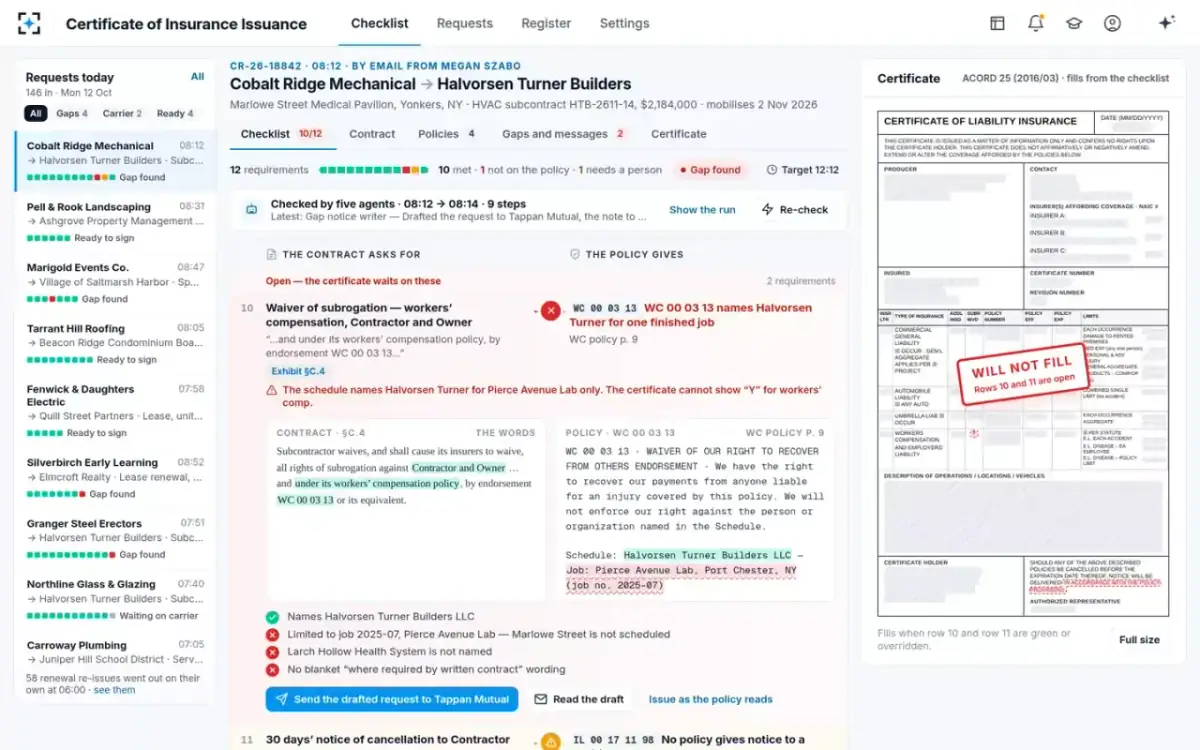
Row 10 was the one that cost the morning. Exhibit C asks Cobalt Ridge to waive subrogation on workers' compensation for the contractor and the owner, and the workers' compensation policy's waiver endorsement scheduled Halvorsen Turner for a different, finished job only. No typing fixes that. The agency had to ask the carrier for a broader endorsement, and the carrier had to agree.
Who held the sample request, minute by minute
- Agents2 min
- Specialist’s queue58 min
- Carrier endorsement106 min
- Re-check, fill22 min
- Review, issue26 min
Examiners judge the carrier's side of that wait as policy work. The NAIC's market conduct standards, the yardstick state examiners use, expect policies and endorsements to be issued accurately, on time and in full (NAIC examination standards; the measures built on that standard are in policy servicing KPIs and metrics). An endorsement requested for a certificate is one of those transactions, so the speed of the certificate depends partly on a process the agency does not control. What the agency controls is how complete its request is when it reaches the underwriter, and how soon; what a complete request contains is set out in endorsement request email.
Row 11 needed a person rather than a carrier. Exhibit C asks for 30 days' written notice of cancellation to the contractor, and no policy gives notice to a certificate holder. That is a request the certificate may not grant, whatever anyone types, so the specialist overrides the row with a reason and tells the holder plainly. Why the law treats notice that way is set out in what "confers no rights" means.
Issuing certificates of insurance for subcontractors: why the contract decides the pace
Subcontract certificates are slow because the exhibit asks for endorsements whose own conditions must be met, and a certificate cannot meet them. A typical exhibit, like the sample's, asks for a per-project aggregate, additional insured status for ongoing and completed operations, primary and non-contributory wording, waivers on every line, an umbrella that follows form and a notice period. Each of those is an endorsement, and most endorsements carry a condition about who is covered and why.
The courts read those conditions literally. In Gilbane v St. Paul (2018), New York's highest court held that an endorsement covering anyone the insured had agreed "with" to add by written contract required a contract between the insured and the party claiming coverage. A construction manager named in the owner's contract with the prime contractor was not covered, and the court added that it "might have a claim against" the contractor for failing to obtain the status. In Harco Construction v First Mercury (2017), a building owner that had no written agreement with a demolition subcontractor was not an additional insured on the subcontractor's policy, and a certificate the broker had issued to the owner was "insufficient to raise an issue of fact". A subcontract certificate is fast only when someone has checked, before signing, that each endorsement reaches each party the exhibit names.
The certificate waits on row 10, and the screen says why
How to request a certificate of insurance so it comes back the same day
Send the agency what it needs to check the requirements, not only the holder's address. Most delays on the requesting side come from requests that name a holder but not the parties, the project or the clauses. The sample request was quick to read because it carried the whole subcontract; a holder who sends only a one-line request to be named as additional insured forces the agency to guess which endorsement, which parties and which job.
A certificate request an agency can act on in one pass
Subject Certificate request · insured, project, contract number
Insured legal name exactly as on the policy, and the agency that placed it
Certificate holder legal name and mailing address for the holder box
Parties to be covered every party the contract says must be an additional insured or receive a waiver, and how each relates to the insured (direct contract, or named in someone else’s)
Project name, address and dates, including any completed-operations period after the work ends
Requirements the insurance exhibit itself, with clause and page, not a summary
Deadline the mobilisation or move-in date the certificate is needed for
The fourth line is the one the cases above turned on. After Gilbane, an owner or construction manager that has no contract with the insured may need different endorsement wording from the party that does, and the agency cannot see that relationship unless the request shows it. On the sample, the exhibit named the owner, which is why the matcher could test whether each endorsement reached it.
How to complete a certificate of insurance: every box reports the policy
Complete it from the declarations and the endorsements, box by box, and stop where the policy stops. The liability certificate has a producer and insured block, the insurers with their NAIC numbers, a row per line of coverage with policy numbers, dates and limits, two narrow columns for additional insured and waiver of subrogation, a description of operations, the holder, a cancellation clause and a signature. Each box is a statement about the policy, so each needs a page of the policy behind it.
The two narrow columns cause most of the trouble. A "Y" under additional insured or waiver says an endorsement exists that gives the holder that status, and a regulator may read it more strictly than the market does; Texas's department, for one, says to mark it only where the endorsement names the holder. The description of operations is the other hazard, because it invites a sentence like "per contract" that the policy never said. On the sample, the drafter names every endorsement by form number and edition instead.
How Certificate of Insurance Issuance moves a request, and where a person decides
Agent
Request readerReads the email and attachments, matches the holder and the insured’s four policies.
Never: creates a holder without a match check, or issues anything
Agent
Contract requirement extractorFinds Exhibit C and lists twelve requirements, each with its clause and page.
Never: adds a requirement the contract does not state
Agent
Policy evidence matcherMatches each row to the declarations or endorsement wording and tests its conditions; ten green, one red, one amber.
Never: marks a row green from a prior certificate’s checkbox
Agent
Gap notice writerDrafts the endorsement request to the underwriter, the note to the insured with the cost, and the reply to the holder.
Never: sends anything
A person decides
Specialist and account managerThe specialist sends the carrier request; the account manager records the insured’s consent to the premium.
A person decides
Carrier underwriterReturns the broader endorsement; the matcher re-checks the row against it.
Agent
Certificate drafterFills the form only from met or overridden rows and writes the description of operations by form and edition.
Never: turns a red row into a “Y”
A person decides
Certificate specialistOverrides the notice row with a reason, reviews and issues the certificate under her own name.
How long does it take to get a certificate of insurance?
A routine certificate for proof of coverage can go out within the hour; a contract-driven one takes as long as its slowest missing endorsement, which can be days. We found no regulator or research body that publishes certificate turnaround times, so any figure you see is a vendor's or an agency's own. The honest way to set expectations is to split the request: what the policy already gives can be certified now, and what it lacks depends on a carrier.
On the sample the whole job took 3 hours 34 minutes because the carrier answered in under two hours and the insured consented within twenty minutes of the carrier request going out. The agency's own turnaround setting for contract-driven requests is four business hours. Botminds estimates that the same request done by hand, reading the exhibit, checking forms and editions, and chasing the carrier and the insured by email, takes about fifteen working hours, close to two days; the arithmetic, and what those days cost the insured, is laid out in pricing the waiting days.
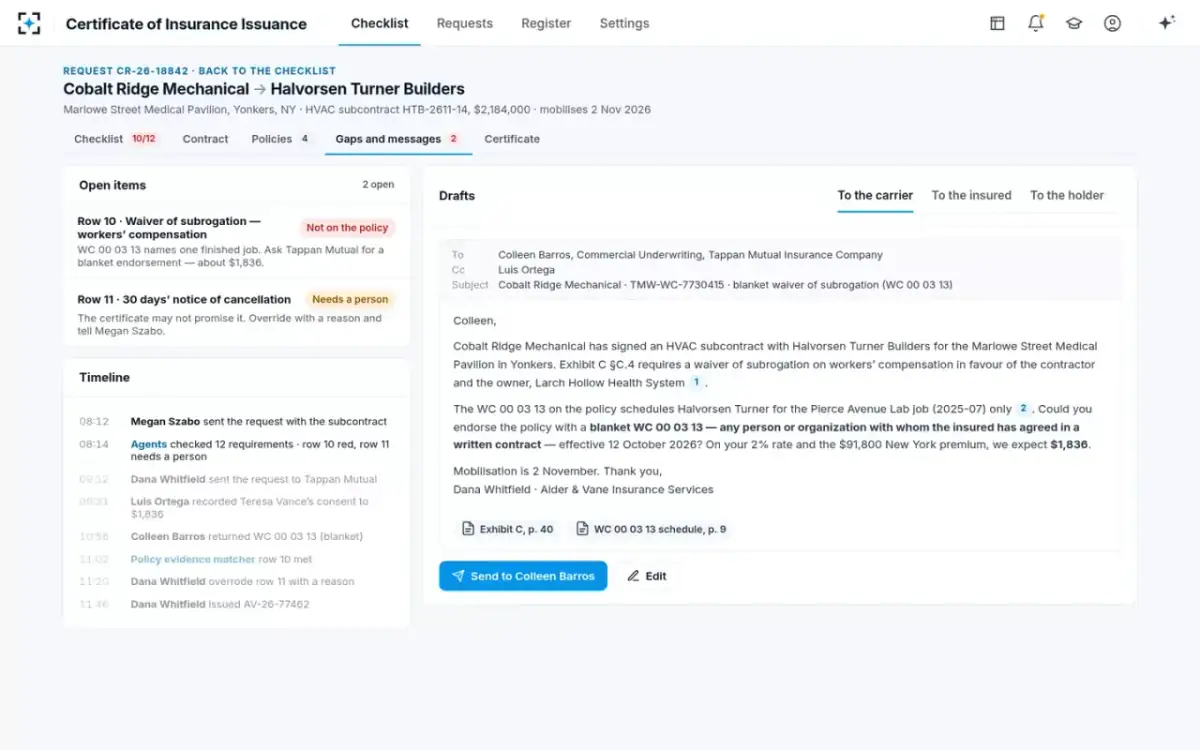
The carrier request, drafted with the form, the schedule and the premium basis
What Certificate of Insurance Issuance changes for each party, and what stays with people
The mechanical reading moves to agents; every decision that binds someone stays with a named person. The holder gets the certificate with the endorsements attached and a plain answer on the one thing it asked for that no certificate can promise. The insured hears about the cost the same morning, not after the site start has slipped. The underwriter gets a request it can act on without a phone call. The specialist issues a certificate whose every box has a page of the policy behind it.
Four rules in the solution keep that division honest. A red row can never become a "Y"; it can be issued only as the policy reads, with a gap notice. An amber row is overridden only with a reason that the service team lead sees. Nothing goes to a carrier, insured or holder unless a person sends it. And every contract-driven certificate is issued by a certificate specialist under her own name. How the matching itself works, row by row, is the subject of what issuance software must check.
Questions people ask
Who signs a certificate of insurance?
An authorized representative of the insurer, usually the agent or broker who placed the policy. In Texas the agent must be appointed by the insurer: the Department of Insurance says an agent "must hold an appointment with the MGA or insurance company that issues the policy to deliver a certificate of insurance to a customer" (TDI FAQ).
Can a business issue its own certificate of insurance?
Not one the law recognizes. The statutes define a certificate as one made by an insurer or its agent, so a document the insured prepares itself does not qualify. A holder that receives one should ask the agent named on the policy to confirm it.
Does the certificate holder have to be named on the policy?
No. The holder box is an address for the certificate, not a place in the policy. To be covered, a holder needs an endorsement that reaches it, which is a different thing explained in certificate holder vs additional insured.
What happens if the policy cannot meet the contract?
The agency can ask the carrier for an endorsement, which usually costs a premium the insured must agree to, or issue the certificate as the policy reads and tell the holder what is missing. On the sample, the drafted request asked for a blanket waiver at an expected $1,836, and the insured consented 19 minutes after the request went out.
Why does my certificate say "for information purposes only"?
Because the certificate summarizes a policy without changing it. Texas requires that phrase, similar language or an equivalent statement on its approved forms (§1811.101), yet still treats a properly issued certificate as confirming the policy exists.