In a certificate of insurance waiver of subrogation example, the "Y" in the SUBR WVD column means only one thing: the policy on that line carries an endorsement under which the insurer gives up its right to recover from this holder, for this work. The certificate cannot create the waiver; it reports one. So the useful example is not a filled form but the file behind it: the contract clause asking for the waiver, the endorsement that grants it, its schedule or blanket wording, and the reason that wording reaches the holder. Certificate of Insurance Issuance, Botminds' software for agency certificate desks, will not put a "Y" in that column until its policy evidence matcher has found that endorsement, and on the sample below it refused once, for good reason.
Take a fictional sample request as it runs through the solution. On Monday 12 October 2026, Halvorsen Turner Builders asks the sample agency, Alder & Vane, for a certificate for its HVAC subcontractor, Cobalt Ridge Mechanical, on a hospital job in Yonkers, New York. Exhibit C of the subcontract asks for waivers of subrogation on every line in favour of the contractor and the hospital owner, Larch Hollow Health System. Every name in the example is invented; the endorsement logic is not.
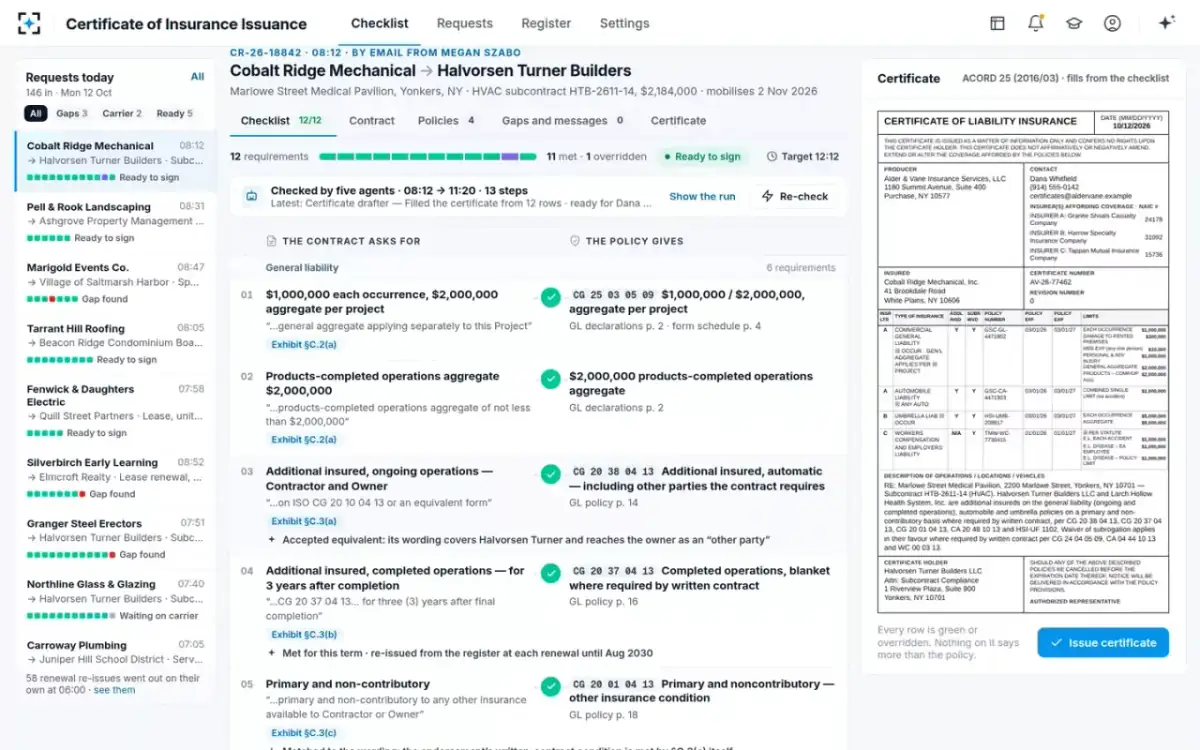
The waiver column of a certificate from Certificate of Insurance Issuance, with the evidence behind each box
Commercial general liability
InsurerA
PolicyGSC-GL-4471902
Addl insdY
Subr wvdY
CG 24 04 05 09 on the general liability policy, answering row 6 of Exhibit C.
Automobile liability
InsurerA
PolicyGSC-CA-4471903
Addl insdY
Subr wvdY
CA 04 44 10 13 on the auto policy, beside CA 20 48 10 13 for additional insured status.
Workers’ compensation and employer’s liability
InsurerC
PolicyTMW-WC-7730415
Addl insdN/A
Subr wvdN → Y
At 08:14: WC 00 03 13 scheduled for job 2025-07 only, so no. At 10:58: blanket WC 00 03 13 returned, effective 12 Oct 2026; row re-checked against its wording.
Description of operations, as issued
Names the project and the subcontract, both parties as additional insureds, and that the waiver of subrogation applies in their favour where required by written contract, per CG 24 04 05 09, CA 04 44 10 13 and WC 00 03 13. It names forms, never "per contract".
What is a waiver of subrogation in insurance?
It is the insurer's agreement not to recover what it pays from a particular party who caused the loss. Without a waiver, an insurer that pays a claim steps into its insured's shoes and can sue whoever was responsible; the construction contract usually wants that right gone, so the parties' own insurance absorbs the loss instead of turning it into a lawsuit between them. The Supreme Court of Texas described the workers' compensation version plainly: carriers may recoup benefits from the injured worker's recovery against a liable third party, and "Carriers may, however, choose to waive this right in exchange for an enhanced premium."
That last phrase is why the certificate cannot simply say "yes". A waiver is a change to the insurer's rights, priced and endorsed onto the policy. On a workers' compensation policy it is a separate endorsement with its own schedule; on general liability, auto and umbrella it is a different form again. Each line in the frame above needed its own evidence, and the workers' compensation line did not have it at first.
The box that stayed "N": a waiver scheduled for a different job
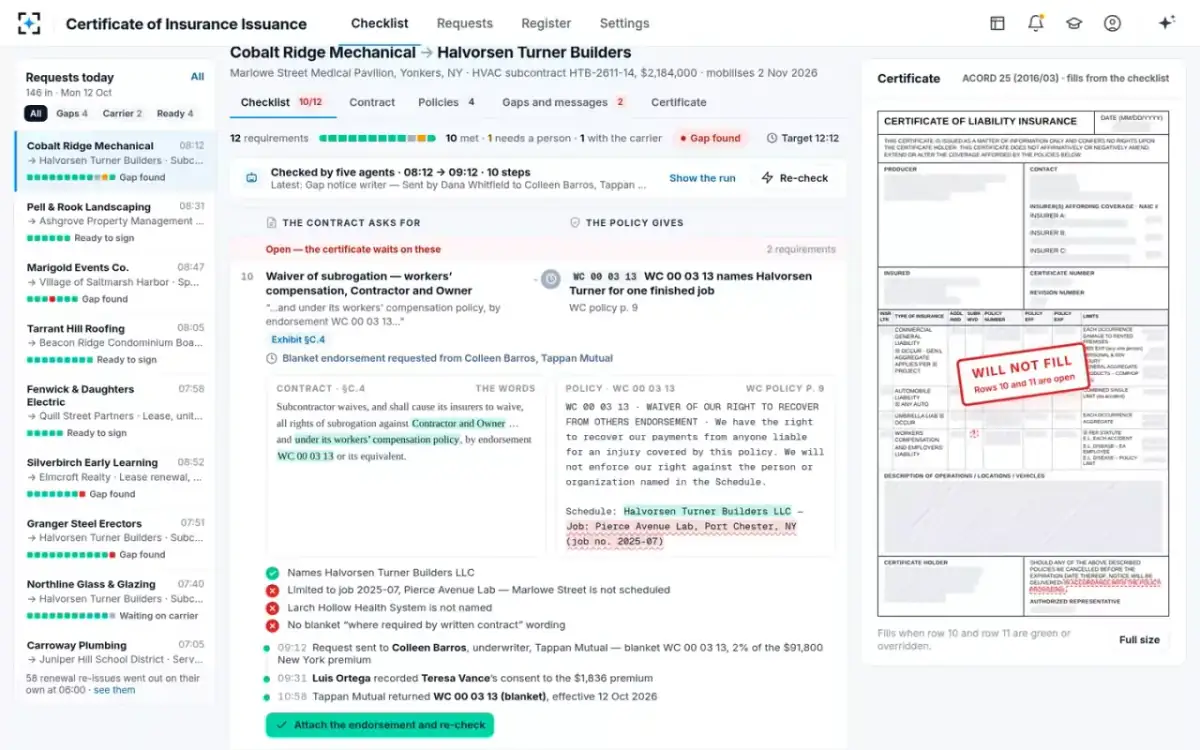
At 08:14 the matcher marked the workers' compensation waiver red. The policy did carry a waiver endorsement, WC 00 03 13, and its schedule did name Halvorsen Turner Builders. But it named it for one finished job, the Pierce Avenue Lab in Port Chester, job 2025-07, and it did not name the owner at all, nor did it carry blanket wording. A desk copying last year's certificate would have found the contractor's name on the endorsement and ticked the box. The schedule said otherwise.
That is a quiet way for a waiver box to go wrong: a specific waiver is written for a person and a job, and the next job inherits the person but not the job. The fix was not a different certificate but a different endorsement. The gap notice writer drafted a request to the carrier's underwriter for a blanket WC 00 03 13 effective 12 October 2026, priced in the sample at 2% of the $91,800 New York premium, $1,836, and a note to the insured with that cost. The specialist sent it at 09:12; the insured consented at 09:31; the carrier returned the blanket endorsement at 10:58.
Requested, consented, returned: the blanket endorsement in Certificate of Insurance Issuance
Blanket or specific: what each waiver covers and what it costs
A specific waiver names a person or organization; a blanket waiver names a class, usually anyone the insured has agreed by written contract to give one to. Texas publishes its standard workers' compensation endorsement and its pricing rule, which makes it a clear reference even for agencies outside Texas. The Texas form waives recovery only for parties named in its schedule, and adds that it "shall not operate directly or indirectly to benefit anyone not named in the Schedule". Its blanket option fills the schedule with a class instead of a name.
Texas's standard waiver of subrogation endorsement, specific against blanket
| Specific waiver | Blanket waiver | |
|---|---|---|
| Who the schedule names | A named person or organization | Any person or organization for whom the named insured has agreed by written contract to furnish the waiver |
| Which work | The operations described in the schedule | The operations described in the schedule; in the case below, all Texas operations |
| Condition | Bodily injury arising out of those operations, where the insured is required by a written contract to obtain the waiver | The same condition, tested against each contract that is said to require it |
| Maximum premium charge | Five percent of the premium developed on the payroll for work performed for the party requiring the waiver | Two percent of the total Texas premium |
| What the certificate may say, per TDI | That the policy contains a waiver naming the holder | That the policy contains a blanket waiver endorsement, not that the waiver is in the holder’s favour |
The court's reading of the blanket form is the part a certificate desk should remember. In Exxon's case the endorsement worked for Exxon because the subcontractor's service contract required the waiver, and the court held that the endorsement "refers to another contract only to identify who may claim the waiver and at what operations". A blanket waiver is therefore only as good as the contract behind it. The certificate desk has to read that contract to know whether a given holder is inside the class.
"With whom" or "for whom": the word that decides who a blanket waiver reaches
Whether a blanket waiver reaches a party with no contract of its own with the insured, such as a project owner, depends on its exact words. The Texas form's class is anyone "for whom" the insured agreed by written contract to furnish the waiver; its words name the beneficiary of the promise and do not ask who the contract was with. New York's highest court read different words, an additional insured grant for anyone "with whom" the insured agreed by written contract, as requiring a contract between the insured and that party; a construction manager named only in someone else's contract fell outside (Gilbane, 2018). That case was about additional insured status, not waivers, but the grammar is the same, and it is why the defensible file keeps the returned endorsement itself rather than a note saying "blanket".
On the sample, the owner, Larch Hollow, has its contract with the general contractor, not with Cobalt Ridge. So when the blanket endorsement came back, the right step was not to tick the box on the strength of the word "blanket" but to read the returned wording against both parties the exhibit names, which is what the re-check does. Where the returned form's words do not reach a party, the honest certificate says what the policy gives and the agency asks again. The same test for additional insureds is worked through in certificate holder vs additional insured.
ACORD 25 waiver of subrogation example: what the box says in Texas and elsewhere
On the ACORD 25, the waiver column sits beside the additional insured column on each line, and in most of the market a "Y" there means a waiver endorsement applies to the holder. Texas reads it more narrowly. Its Department of Insurance answers that where the policy has only a blanket waiver, the certificate may not say the waiver is in the holder's favour: "No, though the certificate can state that the policy contains a Blanket Waiver of Subrogation endorsement." For a Texas risk, the defensible pattern is a "Y" only where the endorsement names the holder, and a sentence in the description where it does not.
The sample is a New York risk, and its certificate marks the column and names the endorsements by form in the description of operations. Either way, the description must stay a description: the NCOIL model act, whose rule West Virginia enacted word for word, forbids a certificate to warrant that the policy complies with a contract's insurance or indemnification requirements (NCOIL model, §4B). Writing "waiver per contract" does exactly that. Naming CG 24 04 05 09, CA 04 44 10 13 and WC 00 03 13 does not.
The certificate fills only after the last row is green or overridden
Primary and noncontributory vs waiver of subrogation: two different promises
Primary and non-contributory decides whose policy pays first; a waiver of subrogation decides whether the paying insurer can then come after anyone. Contracts usually ask for both, and certificates often blur them into one line of description. They come from different endorsements, with different conditions, and they fail differently.
Primary and non-contributory against waiver of subrogation, on the sample subcontract
Primary and non-contributory: Which policy responds first when an additional insured is sued, and whether it may ask the additional insured’s own insurer to share.
Waiver of subrogation: Whether the insurer that pays may then recover from the party that caused the loss.
Primary and non-contributory: An additional insured, so it depends on additional insured status first.
Waiver of subrogation: Whoever the schedule or blanket class names, additional insured or not.
Primary and non-contributory: Liability lines: general liability, auto, umbrella.
Waiver of subrogation: Any line, including workers’ compensation and property.
Primary and non-contributory: CG 20 01 04 13, whose written-agreement condition is met by §C.3(c).
Waiver of subrogation: CG 24 04 05 09, CA 04 44 10 13 and, after 10:58, a blanket WC 00 03 13.
Primary and non-contributory: Nowhere: the condition was in the contract’s own words.
Waiver of subrogation: Workers’ compensation: scheduled for a different job until the carrier endorsed it again.
Public owners ask for waivers routinely. A New York state agency's published requirements for its construction contracts, for example, say "Any CGL or umbrella policy should contain a waiver of subrogation." A request like that is satisfied by an endorsement, never by a word typed into the description box, which is the subject of the requirement wording a certificate can't carry.
Sample certificate of insurance with waiver of subrogation: what to send the holder
Send the certificate and the endorsements it relies on, not the certificate alone. A holder's compliance team cannot see an endorsement through a "Y", and the sample shows why it should not have to: the specialist issued AV-26-77462 to the holder portal and the contractor's email with the nine endorsements attached, so the contractor could read the waiver schedules for itself. Texas says plainly that its certificate law does not stand in the way: "Chapter 1811 does not prohibit an agent or insurer from providing a copy of the policy or endorsements."
Attaching the forms also changes the conversation when something is missing. Instead of a holder rejecting a certificate and the agency rediscovering the gap, the reply to the holder, drafted with the certificate, says which waivers are in place by form, which one was added that morning and from what date, and which request, such as notice of cancellation, no certificate may grant. A holder reading that reply has the same evidence the agency has.
What makes a waiver "Y" defensible: the file behind the box
A "Y" is defensible when the agency can hand anyone who asks, an examiner, the holder or its own errors and omissions carrier, the pages that make it true. On the sample, every row in the frame cites both sides: the contract clause and page, and the policy page, form and edition. When the specialist issued the certificate at 11:46, the twelve rows behind it, including the one override and its reason, went into the certificate register with it.
Seven pages that should sit behind every waiver of subrogation “Y”
- The contract clause that asks for the waiver
With page and the parties it names, so the class can be tested; on the sample, Exhibit C §C.4, page 40.
- The endorsement itself, form and edition
Not a summary; the words decide who is inside a blanket class.
- The schedule, read for name, job and operations
A specific waiver for a finished job is not a waiver for this one.
- The written contract that satisfies a blanket condition
Signed by the insured, and with the right party for “with whom” wording.
- The effective date against the project dates
The sample’s blanket endorsement runs from 12 Oct 2026, ahead of mobilisation on 2 Nov.
- The insured’s consent and the premium charged
A waiver priced but not agreed is not on the policy.
- The state’s rule for the box
In Texas, a “Y” only where the endorsement names the holder; otherwise a sentence saying the policy has a blanket waiver.
That file is what Certificate of Insurance Issuance keeps for every contract-driven certificate. Its drafter cannot turn a red row into a "Y", and its re-issue at renewal happens on its own only if every row, waivers included, is unchanged on the renewed policy. How the matcher decides each row is described in what issuance software must check.
Questions people ask
Does a waiver of subrogation cost extra?
Usually, because the insurer gives up a right of recovery. In Texas the standard workers' compensation manual caps the charge at 5% of the premium on the payroll for the party's work for a specific waiver, and 2% of total Texas premium for a blanket one; the carrier may ask the department for more on unusual risks.
Can a certificate of insurance grant a waiver of subrogation?
No. The waiver is an endorsement to the policy; the certificate only reports it. State laws modelled on the NCOIL act say a certificate does not "amend, extend, or alter the coverage" of the policy it refers to, so a "Y" with no endorsement behind it grants nothing.
Is a waiver of subrogation the same as a hold harmless agreement?
No. A hold harmless or indemnity clause is a promise between the contracting parties; a waiver is the insurer giving up its own recovery. Texas law, for instance, makes an employer liable to a third party for an injured worker's claim only if it signed, before the injury, "a written agreement with the third party to assume the liability" (Tex. Lab. Code §417.004, as quoted in Exxon).
Does a waiver on general liability cover workers' compensation too?
No. Each policy needs its own waiver endorsement. On the sample, general liability, auto and umbrella were met by three separate forms, and the workers' compensation waiver was the one that had to be requested from a different carrier.
What does SUBR WVD mean on a certificate of insurance?
It is the ACORD 25 column for "subrogation waived": a "Y" there says the policy on that line waives the insurer's recovery rights in the holder's favour. It should be marked only where an endorsement on that policy does so.