Certificate of insurance issuance software takes a holder's request, checks what it asks for against the insured's policies, and issues the certificate, usually an ACORD 25, to the holder. Filling the form is the easy part, and most agency systems already do it from policy data. The part that decides whether a product protects the agency is the check before the form fills: does each requirement in the holder's contract match an endorsement on the policy, in the right edition, naming the right parties, with its own conditions met? Certificate of Insurance Issuance, Botminds' software for agency certificate desks, is built around that check. This guide opens it up, one requirement at a time, so a buyer knows what to ask any vendor to show.
"A certificate of insurance is only evidence of a carrier's intent to provide coverage but is not a contract to insure the designated party"
Appellate Division, First Department, Tribeca Broadway Assoc. v Mount Vernon Fire Ins. Co. (2004)
That sentence, from a New York appellate court in 2004, is why the check matters. The owner in that case held a certificate listing it as an additional insured; the policy did not, and the owner had no coverage. A certificate that says more than the policy does not create coverage for the holder. It creates a problem for whoever signed it.
What is certificate of insurance issuance software, and what kinds are there?
It is software on the agency or carrier side that turns policy data into certificates for third parties, and the products differ mainly in what they compare before they fill. A buyer will meet three kinds. Form fillers, usually part of an agency management system, populate the ACORD 25 from the policy's declarations and the last certificate issued to that holder. Holder-side compliance platforms sit with the contractor, landlord or lender and collect certificates from many agencies; that is certificate tracking, a different job covered in certificate of insurance tracking software. The third kind reads the contract and the endorsement wording and decides, row by row, what the certificate may say.
Only the third kind answers the question an agency is liable for. A form filler knows the limits and the policy numbers, which is most of the ACORD 25 by area and almost none of it by risk. The risk sits in two narrow columns, additional insured and waiver of subrogation, and in the description of operations. Those are statements that an endorsement exists for this holder, and a filler that takes them from last year's certificate repeats whatever was true, or untrue, last year.
A form filler and an evidence matcher on the same subcontract
Form filler: Declarations and the holder’s previous certificate.
Evidence matcher (Certificate of Insurance Issuance): The contract’s insurance exhibit and every form on the policies.
Form filler: Copied from the prior certificate or ticked by the specialist.
Evidence matcher (Certificate of Insurance Issuance): Set only when an endorsement’s wording reaches this holder and its conditions are met.
Form filler: Not checked; a form number is a form number.
Evidence matcher (Certificate of Insurance Issuance): Compared with the edition the contract names, against an accepted-equivalents table.
Form filler: Found later, often by the holder’s compliance team.
Evidence matcher (Certificate of Insurance Issuance): Shown red before anything fills, with the endorsement request drafted.
Form filler: Typed into the description if the holder asks.
Evidence matcher (Certificate of Insurance Issuance): Held amber: a certificate may not add notice the policy does not give.
Form filler: None kept beyond the issued form.
Evidence matcher (Certificate of Insurance Issuance): Contract clause and page beside policy page, form and edition.
Why the policy evidence matcher is the agent that matters
Because the boxes are statements about endorsements, and only an agent that reads the endorsements can make them true. Regulators read the boxes literally. The Texas Department of Insurance tells agents: "You should check the “Additional Insured” box if the policy includes an endorsement that names the certificate holder as an additional insured" (TDI FAQ). Its answer for a blanket endorsement is not to tick the box but to say the policy carries a blanket endorsement. Texas law then forbids any certificate that "alters, amends, or extends the coverage or terms and conditions" of the policy (§1811.051), and New York's rule against amending, extending or altering coverage is to the same effect (§502(c)).
The trap is last year's certificate. A holder that has received fourteen certificates from an agency since 2023, as the sample's contractor has, looks like a solved problem: copy the boxes, change the dates. But the subcontract changes the job, the parties and sometimes the edition, and an endorsement scheduled for the last job does not follow the crew to the next one. That is exactly what row 10 on the sample shows. The matcher's first limit in the solution is written against this habit: it never marks a row green from a prior certificate's checkbox.
Inside the matcher: twelve requirements, twelve answers
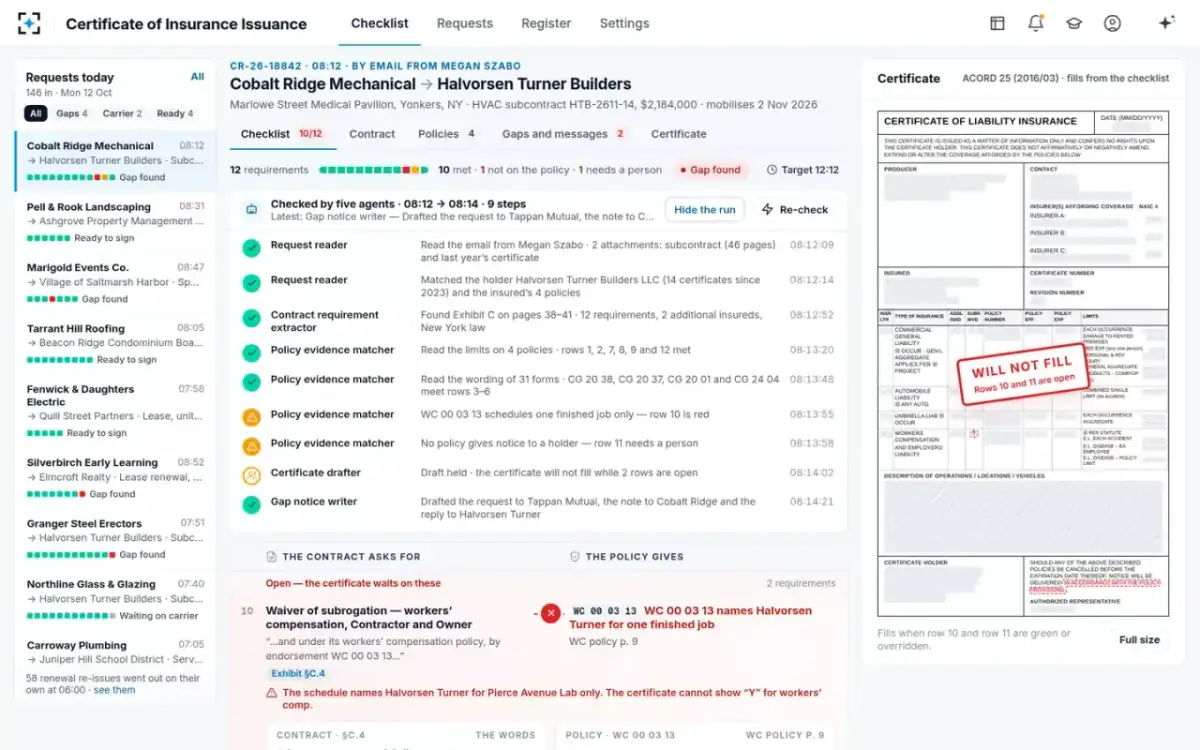
The matcher reads each requirement the extractor lists and answers it from the policy page that settles it: the declarations for limits, an endorsement for status, a schedule for who and where. Take a fictional sample request as it runs through the solution: a 46-page HVAC subcontract between Halvorsen Turner Builders and Cobalt Ridge Mechanical for a hospital site in Yonkers, New York, sent to the sample agency Alder & Vane at 08:12 on Monday 12 October 2026. Its Exhibit C holds twelve requirements. By 08:14, the matcher had read four policies and 31 forms and given each requirement one of three answers.
Certificate of insurance issuance software, row by row: what the matcher answered
01
$1M each occurrence, $2M aggregate applying per project
CG 25 03 05 09, designated construction project aggregateLimits read on the declarations; the per-project aggregate is an endorsement, not a limit.
Met
02
Products-completed operations aggregate $2M
GL declarations, page 2A limit, so the declarations answer it.
Met
03
Additional insured, ongoing operations, contractor and owner, on CG 20 10 04 13 “or an equivalent form”
CG 20 38 04 13On the agency’s accepted-equivalents table since 14 Mar 2026.
Met
04
Additional insured, completed operations, three years after completion
CG 20 37 04 13Met for this term; the certificate must be re-issued at each renewal until Aug 2030.
Met
05
Primary and non-contributory to the contractor’s and owner’s own insurance
CG 20 01 04 13Its written-agreement condition is met by §C.3(c) itself; both parties carry their own liability policies (§C.1).
Met
06
Waiver of subrogation, general liability
CG 24 04 05 09Endorsement on the general liability policy.
Met
07
Auto $1M combined single limit, additional insured and waiver
CA 20 48 10 13 and CA 04 44 10 13Two forms on the auto policy.
Met
08
Umbrella $5M, follow form, primary for the additional insureds
HSI-UF 1102The umbrella insurer’s own follow-form endorsement.
Met
09
Workers’ compensation, New York; employer’s liability $1M
Workers’ compensation information page, items 3.A–3.BState and limits on the information page.
Met
10
Waiver of subrogation, workers’ compensation, contractor and owner
WC 00 03 13, scheduled for one finished jobThe schedule names the contractor for a different job and does not name the owner.
Not on the policy
11
30 days’ written notice of cancellation to the contractor
IL 00 17 11 98, notice to the first named insured onlyNo policy gives a holder notice, and a certificate may not add it.
Needs a person
12
Insurers rated A– VII or better and authorised in New York
The three insurers on the four policiesMet on the first read, alongside the limits.
Met
Three things in that grid separate a matcher from a filler. Row 3 is green on a form the contract did not name, because the contract accepts "an equivalent form" and the agency decided, once, that this form qualifies; the decision has a date and a person. Row 5 is green because an endorsement condition was tested, not assumed: the sample's primary and non-contributory endorsement applies only where the insured has agreed in writing, and the matcher found that agreement in §C.3(c). Row 11 is amber rather than red, because the problem is not that the policy lacks something the carrier could add, but that the contract asks the certificate for something no certificate may promise.
Matched to the wording: the contract clause beside the endorsement, conditions tested
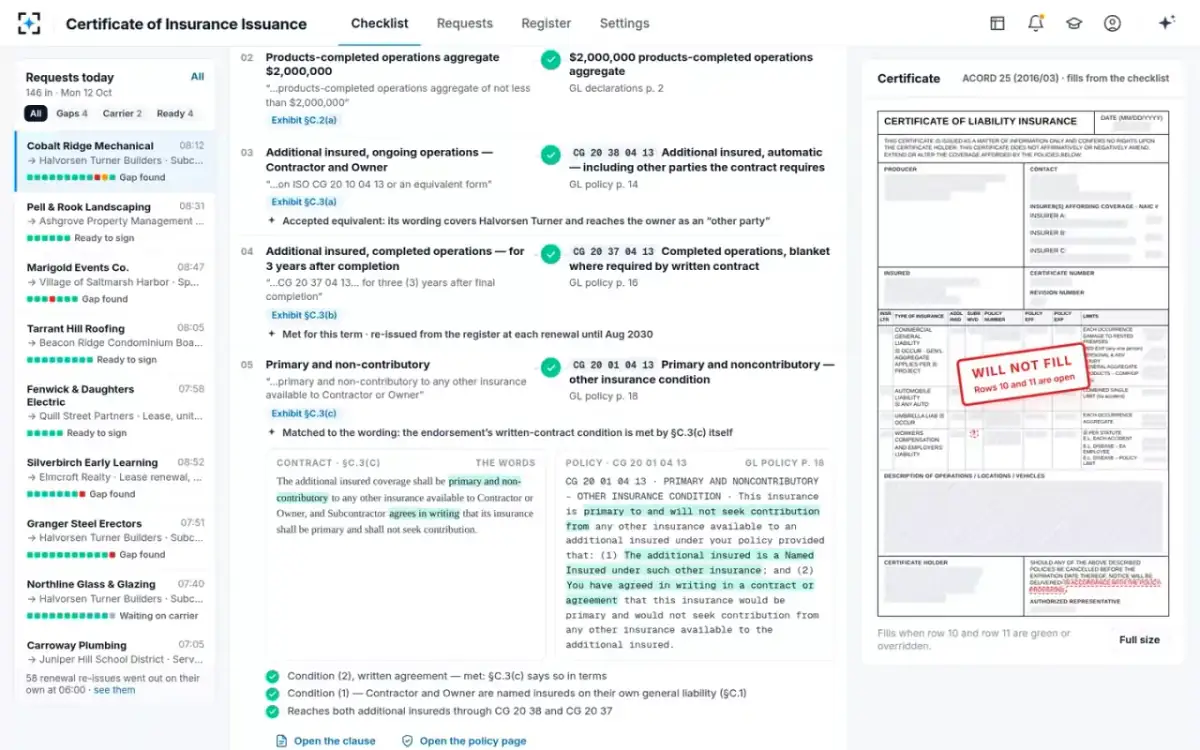
What conditions should certificate software test? Schedules, named parties, written contracts
At minimum, three: whether the endorsement schedules this job or location, whether its wording reaches every party the contract names, and whether any written-contract condition is met by a contract with the right party. Courts read the third literally. New York's highest court read an additional insured endorsement for anyone the insured agreed "with" to add by written contract as requiring a contract between the insured and the claimant, and the construction manager named only in the owner's contract with the contractor was not covered (Gilbane, 2018). The comparison in certificate holder vs additional insured walks through the wordings that pass and fail that test.
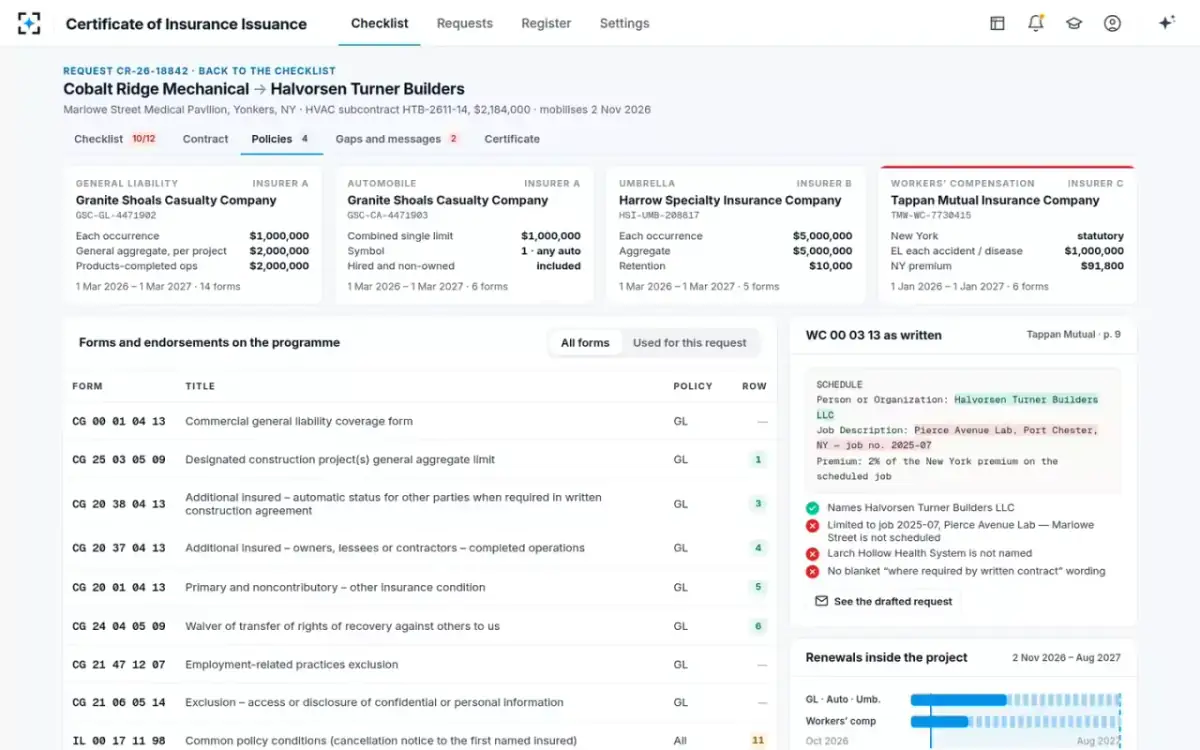
Schedules fail more quietly. A scheduled waiver of subrogation names a person and a job; a blanket one names a class, such as anyone the insured has agreed in writing to give it to. The sample's workers' compensation waiver named the right contractor and the wrong job, which a box-copier would have certified and a matcher marks red. What the certificate may then say, box by box, is worked through in the waiver of subrogation example.
The schedule as written: right contractor, wrong job, owner not named
Accepted equivalents: the decision a matcher should never make alone
Contracts often name a form and edition "or equivalent", and deciding what is equivalent is a judgment the agency should make once, in writing, not one the software makes per request. In the sample, the service team lead approved CG 20 38 04 13 as an equivalent for CG 20 10 04 13 on 14 March 2026, and the matcher applies that decision to every request that asks for CG 20 10, citing it. A request whose contract asks for the 04 13 edition while the policy carries a 07 04 edition, like a steel erector's in the same sample queue, comes back as a gap rather than a quiet substitution.
That table is also where a buyer can test a vendor's honesty. Ask who decides an equivalent, where the decision is kept, what happens when a contract names an edition the table has never seen, and whether a changed table re-checks certificates already issued. Software that leaves the call to its model has put the agency's errors and omissions exposure inside someone else's training data.
What should certificate of insurance software do when the policy falls short?
Stop the form from filling, say why, and draft what would close the gap, without sending anything on its own. In the solution a red row can never become a "Y"; the certificate can be issued only as the policy reads, with an "N" and a sentence, or held while the carrier is asked. The gap notice writer drafts three messages: the endorsement request to the underwriter with the form wanted and the premium basis, a note to the insured with the cost, and a reply to the holder on what the certificate can and cannot say. A person sends each one, and buying an endorsement needs the account manager and the insured's consent.
On the sample, the carrier returned a blanket workers' compensation waiver effective 12 October at 10:58, the matcher re-checked row 10 against the returned wording, the specialist overrode row 11 with a recorded reason, and the certificate filled at 11:20 and was issued at 11:46. Everything the matcher did is visible on the run, with a time on every step.
Nine steps in two minutes, each one with what it found
How to evaluate certificate of insurance issuance software in a demo
Bring your own hardest contract and ask the vendor to show each answer's evidence, not the finished form. A demo on the vendor's sample proves the interface. A demo on a subcontract your agency has already issued against, with a known gap, proves the matcher.
Questions that separate a certificate filler from a certificate checker
- Does it read the contract, or only the request email?
The requirements live in the exhibit, often 30 pages into the contract.
- Does each box cite a policy page, form and edition?
Ask to see the evidence behind a “Y”, not just the “Y”.
- Can a prior certificate ever set a box?
If yes, last year’s endorsement will be certified for this year’s job.
- Does it test endorsement conditions?
Scheduled jobs, named parties and written-contract wording, against the right contract.
- Who decides an “or equivalent”, and where is it kept?
One table, decided by a named person, applied the same way every time.
- What happens to notice-of-cancellation requests?
Software that types “30 days’ notice” into the description is writing what a certificate may not promise.
- Does anything leave the agency without a person?
Carrier requests, notes to the insured and replies to holders should be drafts until someone sends them.
- What happens at renewal?
Automatic re-issue is safe only when every row is unchanged on the renewed policy.
Where Certificate of Insurance Issuance fits, and where it does not
It sits beside the agency's management system and policy files, reading requests, contracts and forms, and putting every decision in front of a named specialist; it does not replace the system that holds the policies or the specialist who signs. It is built for contract-driven requests, the share of a certificate desk's volume where a wrong box is most likely: on the sample agency's Monday, 46 of 146 requests arrived with a contract. Routine renewals of identical certificates are re-issued automatically, but only when every row on the renewed policy is unchanged; any changed row goes back to a person.
It is not certificate tracking for holders, and it is not a coverage opinion. A matcher can show that an endorsement's words reach a party; whether a court would agree on disputed facts is a lawyer's question. The design target is zero certificates that promise more than the policy gives, which is a target, not a measured result. What the agency must supply to reach it, from the forms list to the equivalents table, is set out in what you bring to start.
Questions people ask
Is ACORD certificate of insurance software allowed to change the form?
Not by itself. Texas lets no one alter an approved certificate form unless the department approves the change (§1811.053), and the NCOIL model act states the same ban. Software should fill the standard form's fields, not rewrite its wording.
What is COI automation software?
Any software that issues or re-issues certificates without a person typing them. The useful question is which decisions it automates: filling fields from the declarations is low risk, while setting the additional insured and waiver boxes is a statement about endorsements that needs evidence behind it.
Can certificate software read a contract PDF?
Some can. In the sample, the contract requirement extractor found the insurance exhibit on pages 38 to 41 of a 46-page subcontract and listed twelve requirements with clause and page, without adding any the contract did not state.
Can software issue a certificate without a person?
It can, and for identical renewals it may be reasonable. On the sample agency's Monday, 58 renewal certificates were re-issued automatically at 06:00 because every row was unchanged, while each contract-driven certificate was issued by a named specialist.
Is certificate issuance software the same as certificate tracking software?
No. Issuance software works for the agency that writes certificates; tracking software works for the holder that collects them and chases expiries. An agency needs the first; a general contractor or lender needs the second.