Certificate of insurance management software runs an agency's certificate desk: it takes requests in, checks them, issues certificates, keeps the register of what went out and re-issues at renewal. Most business cases for it count the typing it saves, and typing is the cheapest part of the job. For a certificate that arrives with a construction contract, the expensive part is the wait for whichever endorsement the contract demands, and that wait is paid by the insured whose crew cannot mobilise and the contractor whose schedule slips. Certificate of Insurance Issuance, Botminds' software for agency certificate desks, is built to shorten that wait by finding the missing endorsement in the first two minutes rather than the second day. This guide shows how to price both costs.
One Monday on a sample certificate desk in Certificate of Insurance Issuance
146
certificate requests received by the sample agency
46
arrived with a contract to check against the policies
58
renewal certificates re-issued on their own at 06:00, every row unchanged
3 h 10min
median turnaround that day on contract-driven requests
What does certificate of insurance management software do for an agency?
It turns certificates from one-off documents into a managed book: every request has an owner and a status, every issued certificate is logged with the evidence behind it, and every renewal produces the re-issues it owes. That is a different product from the holder-side platforms that general contractors, landlords and lenders use to collect certificates from many agencies and chase expiries; those are covered in certificate of insurance tracking software. An agency's version answers to the people who sign.
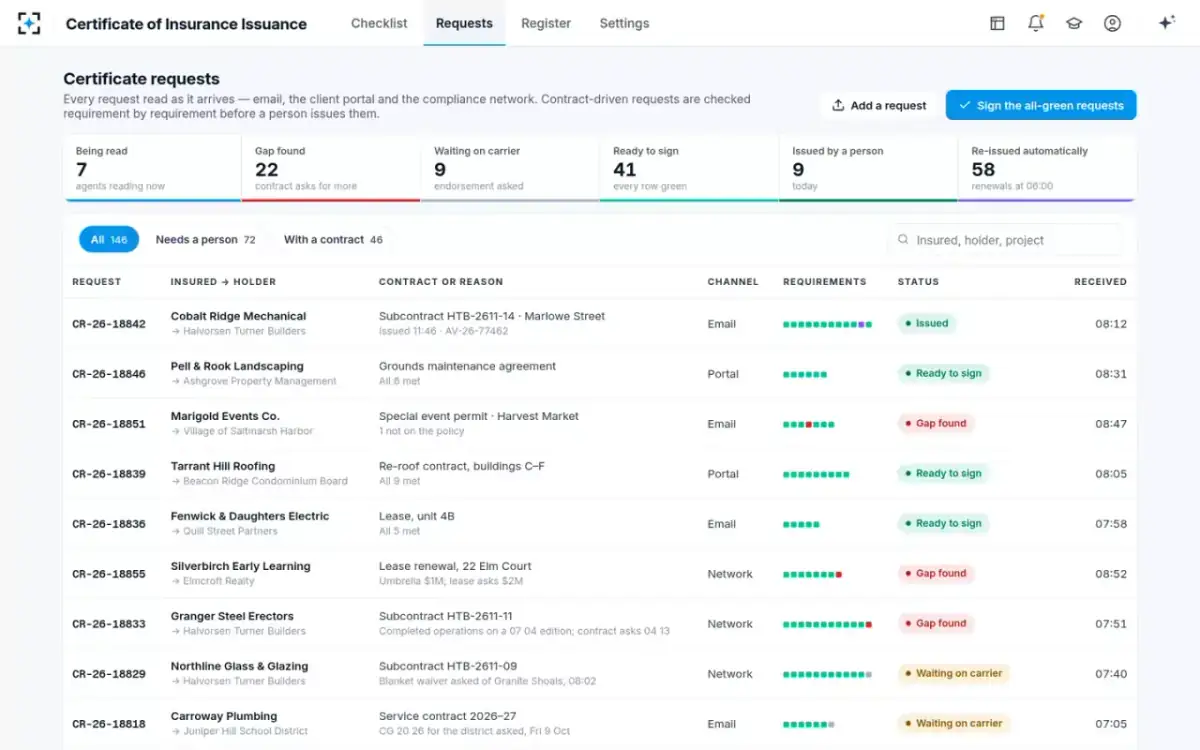
The sample agency's Monday shows the shape of the book. Of 146 requests, 58 were renewals of identical certificates that went out at 06:00 because every requirement was unchanged on the renewed policy. Forty-six came with a contract, and those are where the time and the risk sit.
Where 146 certificate requests stood at the end of the sample Monday
All requests, by status
- Re-issued on their own · 39.7%
- Ready to sign · 28.1%
- Gap found · 15.1%
- Waiting on carrier · 6.2%
- Issued by a person · 6.2%
- Being read · 4.8%
COI turnaround times: where a contract-driven certificate's hours go
By hand, most of a contract-driven certificate's working time goes to finding out what the policy does not give and asking for it; typing the form is about an hour. Botminds estimates fifteen working hours for one request with a contract exhibit, of which six go to asking the carrier and the insured for an endorsement, four to checking forms, editions and schedules, and two to listing the requirements. With the agents reading and matching, the same request takes about three and a half hours, most of it the carrier's turn.
One contract-driven certificate by hand and with Certificate of Insurance Issuance, in working hours
- Read request, find exhibit1 h
- List requirements2 h
- Check forms and schedules4 h
- Ask carrier and insured6 h
- Type form1 h
- Answer holder1 h
- Carrier and insured2.5 h
- Read, check, fill, answer1 h
Two things follow for a business case. First, software cannot make a carrier endorse faster, so the carrier lane does not vanish; it shortens because the request reaches the underwriter complete, with the form, the schedule wording and the premium basis, on the first morning. Second, fifteen working hours is close to two days of elapsed time for one person, and the elapsed time is what the job site feels.
Who pays for a slow certificate? The insured whose crew waits
The insured and the holder pay most of it, and neither appears in the agency's cost model. The sample's contractor will not let a subcontractor on site without a compliant certificate. Every day the certificate is late is a day the subcontractor's crew is idle or reassigned, and a day the contractor's schedule absorbs. The agency's own cost is the specialist's hours, and its exposure is the certificate that goes out saying more than the policy does.
We found no research or regulator figure that prices a waiting crew-day for certificate delays, so the honest way to build the case is with the insured's own numbers. Ask three accounts what an idle day costs them on a typical job: crew wages and burden, equipment on standby, and any schedule penalty the contract carries. Then count how many of last quarter's contract-driven certificates took more than one business day, and how many days over.
A business case for certificate of insurance management software, in four terms
Specialist hours returned
contract-driven certificates a year × (hours by hand − hours with agents) × loaded hourly cost
Botminds’ estimate is 15 h against 3.5 h; replace it with a sample of your own files.
Agency operations
Waiting days avoided for insureds
certificates late by a day or more × days late × the insured’s cost of an idle day
Paid by your clients, so it shows up as retention and referrals, not in your own expenses.
Account managers, with three clients’ figures
Certificates not issued wrong
certificates whose boxes had no endorsement behind them × your cost of fixing one
Count from your own audit of last year’s files; do not borrow a national claims figure.
Errors and omissions manager
Cost of the software
subscription + set-up + the hours to keep forms and equivalents current
The equivalents table and the forms list need an owner, every year.
Agency principal
A worked example with round numbers
Suppose, purely for illustration, a desk issues five contract-driven certificates a week that need an endorsement from a carrier, about 250 a year. At Botminds' estimate of fifteen hours by hand against three and a half with agents, the specialist time returned is 250 × 11.5 = 2,875 hours a year, before any loaded cost is applied. That is the number a typing-time business case shows, and it is the smaller half.
The larger half is elapsed time. If a third of those 250 certificates, about 83, reach the holder a business day later than they would have, and the insured's crew cannot start without them, then 83 idle crew-days sit on your clients' books each year. Multiply by what one of your contractor clients tells you an idle day costs, and compare that with the hours line. Unless an idle crew-day costs your clients less than a few specialist hours, the crew-day line will be the larger, and it is the one your account managers can take to a renewal meeting. Neither number here is data; both are the arithmetic your own files will replace.
What the waiting costs before anyone types: forms the holder invents
Some delay is created by the holder's paperwork, not the policy. In Texas, a certificate form must be filed and approved before use, and a non-standard form is approved only "at the expiration of 60 days after the date the form is filed" unless the commissioner acts sooner; the standard forms of ACORD, AAIS and ISO are deemed approved on filing (§1811.103). A holder that insists on its own certificate form for a Texas risk is asking for a form that someone must first file and that may take 60 days, or 70 with an extension, to be approved (§1811.101(d)).
Public owners add forms of their own. New York's Office of General Services, in its published requirements for construction contracts, states: "As of October 2016, an ACORD 855 must be submitted with each new ACORD 25 to confirm adequate coverage", with the date, agency, named insured, policy number, effective date and carrier matching the ACORD 25 exactly. Every extra form is another place for a mismatch, which is the case for generating both from the same evidence rather than typing each.
COI management software features that change the cost, and those that do not
The features that move the business case are the ones that shorten the carrier lane or prevent a wrong certificate; the rest are convenience. Reading the contract and matching it to the endorsement wording finds the gap on the first morning. Drafting the endorsement request with the form, schedule wording, effective date and premium basis gets a complete request to the underwriter. A rule that a red row can never become a "Y" stops the costliest certificate, the one that promises cover the policy does not give. A re-issue rule that fires only when every row is unchanged lets renewals run without a person while sending changed ones back.
Every request on one page, with the reason each one is waiting
Features that do not change the cost much: holder portals, branded certificates, dashboards. They matter to the experience, but a holder portal that delivers a wrong certificate faster is not a saving. When a vendor demonstrates, ask what happens on a request whose contract the policy does not meet, and time it.
Renewal season: why the register matters more than the queue
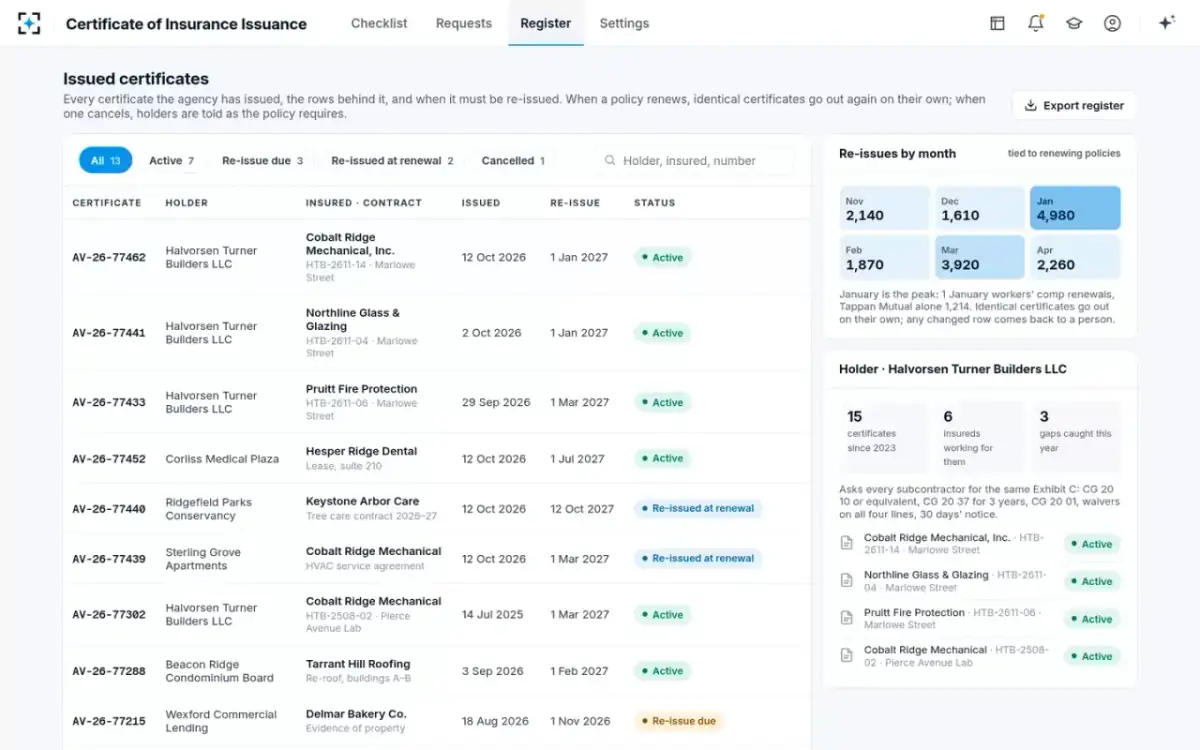
Every certificate tied to a policy term owes a re-issue when that policy renews, and those obligations bunch on the days policies renew. The sample agency's register shows 4,980 re-issues due in January, against 1,610 in December, because so many workers' compensation policies renew on 1 January; one sample carrier accounts for 1,214 of them. A desk that does those by hand spends its January re-typing certificates that have not changed.
Re-issues the sample agency's register owes, month by month
The saving is real only if the re-issue rule is strict. In the solution, a certificate is re-issued on its own only when every requirement behind it is met by the renewed policy in the same way; a changed limit, form edition or schedule sends it back to a person. The same register tells holders when a policy cancels, as the policy requires, which matters because, under the NCOIL model, a holder's notice rights come only from the policy's own terms or an endorsement to it (NCOIL model, §5; read in full in certificate of insurance confers no rights).
The register: every certificate, its re-issue date and the holder's history
Certificate of insurance compliance software: whose compliance?
The phrase means two things, and a buyer should know which it is buying. For a holder, compliance software checks incoming certificates against its own requirements and chases the ones that fail. For an agency, compliance means the certificates it issues obey the certificate laws: no altering coverage, no warranting a contract, no notice the policy does not give. Examiners expect an insurer to keep watch over anyone doing its work under contract (NAIC examination standards; that oversight is the subject of insurance back office outsourcing companies), which is how an agency's certificate practice can become an insurer's examination finding. The state rules are compared in certificate of insurance laws by state.
What a business case for COI software should not count
It should not count claims it cannot evidence. National figures for how many agency errors and omissions claims involve certificates circulate widely, but the ones we traced came from insurers' data repeated by trade associations, not from independent research; build the error term from your own file audit instead. It should not count a design target as a result: the solution's target of zero certificates that promise more than the policy gives is a target, and only your own pilot can measure it. And it should not count the carrier's time as saved; the endorsement still has to be underwritten.
What remains is usually enough. Specialist hours on contract-driven requests, renewal peaks handled without re-typing, and insureds who start on time are each measurable in a month. How to scope that month, and what the agency must bring to it, is set out in what you bring to start; the step-by-step of the issuing itself is in how insurance agents issue certificates.
Questions people ask
What is a reasonable COI turnaround time?
For proof of coverage, the same day. For a contract-driven certificate, the honest answer is the same day for what the policy already gives, and the carrier's endorsement time for what it lacks; the sample agency sets a four-business-hour target for contract-driven requests and met it on the sample request in 3 hours 34 minutes.
Is COI management software worth it for a small agency?
It depends on the share of requests that arrive with a contract, not on the total count. An agency writing for contractors may have a few contract-driven requests a day that each take hours; an agency writing mostly proof-of-coverage certificates will save little beyond what its management system already fills.
Does COI management software replace the agency management system?
No. The agency management system holds the policies; certificate software reads them, along with the contracts and endorsement forms, to decide what a certificate may say. In the sample it works beside the agency's systems and its certificate register.
What is a certificate register?
The list of every certificate an agency has issued, with the holder, the policies and the date it must be re-issued. In the sample it also holds the requirements behind each certificate, so a renewal can be compared row by row before anything is re-issued.
Can the software tell holders when a policy cancels?
It can send what the policy requires. Under laws modelled on the NCOIL act, a holder has notice rights only where the policy or an endorsement gives them; an agency may tell holders more as a courtesy, but the certificate cannot promise it.