Certificate holder vs mortgagee is the difference between being told about a policy and being named in one. A certificate holder is simply the party the insurance agent sent the certificate to: the box records a courtesy, not a right. A mortgagee — or on personal property, a lender's loss payee — is a party written into the policy by endorsement, with its own claim on the proceeds, its own notice of cancellation, and in most forms protection that survives the borrower's own breach of the policy. Checking that a bank is still in the second box, and not quietly demoted to the first, is the work that Botminds' Collateral Insurance & Lien Tracking does on every certificate, declarations page and endorsement it reads.
The examples on this page follow a fictional sample bank as it runs through the solution: Kestrel Valley Bank, 1,846 commercial loans, $2.31 billion. Every bank, borrower, carrier, agency and person named here is invented sample data. The rules and quotations are real, cited where they appear.
Certificate holder vs mortgagee, in one paragraph
A certificate of insurance is evidence that a policy existed on the day the certificate was typed. The certificate holder box is the addressee. It creates no contractual relationship with the insurer, gives no entitlement to claim proceeds, and — under the standard ACORD wording — promises only that notice of cancellation will be delivered in accordance with the policy's own terms. A mortgagee clause is different in kind, not degree: it is an endorsement to the policy itself, naming the lender as a party with a direct interest in the building, a right to be paid to the extent of that interest, a right to its own notice, and, under the standard union (or "standard") mortgage clause, the right to be paid even where the borrower's act or neglect would defeat the borrower's own claim. If the bank appears only as certificate holder, none of that is in force. The loan is secured by a building whose insurance the bank cannot collect on.
That is why the box matters more than the expiry date. A tracking desk that keys the renewal date and files the document has confirmed that the borrower bought insurance. It has not confirmed that the bank is on it.
What a certificate of insurance actually is — and is not
Regulators have said this plainly for years. The New York State Department of Financial Services, answering the question directly in an Office of General Counsel opinion, wrote that "a certificate of insurance is a document that summarizes the terms, conditions, and duration of an insurance contract, but it is not the contract itself" (NYDFS OGC Opinion No. 11-01-08, 31 January 2011).
"A certificate of insurance cannot confer new or additional rights beyond those set forth in the referenced insurance policy."
New York State Department of Financial Services, OGC Opinion No. 11-01-08
Several states have put the same rule into regulation. Washington's certificate-of-insurance rule states that "a certificate of insurance does not confer new or additional rights beyond what the referenced policy of insurance provides" (WAC 284-30-355). The practical consequence is uncomfortable for a tracking desk: a certificate that describes the bank as mortgagee, in a box an agency typed by hand, does not make the bank a mortgagee. It is a statement about what the policy supposedly says. If the endorsement behind it was never issued, the statement is wrong and the bank's remedy, if any, is against whoever made it — not against the insurer that never agreed to anything.
So the certificate has exactly two honest uses. It tells a lender that a policy with a given number, carrier, term and limit is said to exist, and it tells a lender where to look next. Treating it as the proof itself is the single most common failure on a commercial insurance tracking desk, and it is the reason the reading agent in this solution is built never to treat a certificate holder as a mortgagee, however the agency labelled the box.
Does a certificate holder get paid on a claim?
No. A certificate holder has no interest in the policy and no standing to make a claim under it. If the building burns, the insurer pays the named insured — the borrower — and the bank's position depends entirely on the loan agreement and on whatever security interest it holds in the proceeds, not on the insurance contract. That is a materially worse position for three reasons.
First, the money reaches the borrower, not the bank. An owner in financial trouble who receives a seven-figure claim cheque is an owner with options, and a bank chasing the proceeds afterwards is a general creditor arguing about an assignment. Second, the bank has no say in the adjustment or the settlement. Third, and most important, the bank is exposed to the borrower's own conduct. A standard (union) mortgage clause is written so that the lender's protection survives the mortgagor's or owner's own act or neglect — a misrepresentation on the application, a vacancy that breached a condition, an increase in hazard the borrower never disclosed. A certificate holder has none of that separation. If the borrower's claim fails, the bank's collateral is uninsured for exactly the loss it was most worried about.
A loss payee sits in between, and the distinction is worth keeping straight. An ordinary loss payee is paid "as interests may appear" but takes the policy as the named insured leaves it: if the borrower voids coverage, the loss payee is voided with it. A lender's loss payee endorsement on a commercial property or equipment policy gives the lender the same separation from the borrower's conduct that a mortgagee has on real property. Which one a bank needs depends on the collateral, and on what its own loan agreement requires.
Mortgagee, lender's loss payee, additional insured, loss payee: four boxes, four results
Five places on a commercial property programme can carry a bank's name, and they entitle it to four different things. The table below is the one a tracking specialist should be able to recite, because the whole argument on a renewal comes down to which row the bank is in this year.
Where a lender's name can appear, and what each place is worth
| Where the name appears | What it entitles the bank to | What proves it |
|---|---|---|
| Certificate holder | Receipt of the certificate. No claim payment, no contractual notice beyond what the policy itself provides, no protection from the borrower’s conduct. | Nothing — the box is a mailing address on a summary document. |
| Mortgagee (standard or union clause), real property | Payment to the extent of its interest, direct notice of cancellation and non-renewal, and protection where the borrower’s own act or neglect would defeat the borrower’s claim. | The mortgagee endorsement on the policy, and the declarations page listing the bank by exact name. |
| Lender’s loss payee, personal property and equipment | The same separation from the borrower’s conduct, applied to contents, equipment and inventory rather than the building. | The lender’s loss payable endorsement, naming the bank and the scheduled property. |
| Loss payee (ordinary) | A share of the proceeds as interests may appear — but the claim fails if the borrower’s claim fails. | The loss payable endorsement. Read which version was issued. |
| Additional insured | Defence and indemnity under the liability policy for claims arising from the borrower’s work or premises. Nothing at all on the property side. | The additional insured endorsement on the general liability policy. |
The additional insured row deserves its own warning, and loss payee versus additional insured works through it on equipment collateral. The common error runs in one direction. A borrower's agent, asked to "add the bank", reaches for the certificate holder box because it is the quickest field on the form and costs nothing. Adding a mortgagee means issuing an endorsement, which means going back to the carrier. A desk that accepts the quick answer is accepting a document instead of a contract right.
What ISAOA / ATIMA adds, and what it does not
ISAOA stands for "its successors and/or assigns"; ATIMA for "as their interests may appear". Together they do two useful things and one thing they are often wrongly credited with.
The useful part: ISAOA keeps the clause alive when the loan is sold, participated or assigned, so a new holder of the note does not have to re-paper every policy in the book. ATIMA limits the lender's recovery to its actual interest at the time of loss, which is what the lender wants anyway — it avoids arguments about whether a bank with a $2 million balance can claim a $9 million building.
The same suffix turns up on vehicle titles, where ISAOA/ATIMA on a car loan explains what it does for a lienholder. What the suffix does not do is upgrade the box. "Kestrel Valley Bank ISAOA/ATIMA" in the certificate holder field is still a certificate holder. The words qualify a mortgagee clause; they do not create one. A required-wording check is therefore two checks and not one: is the bank named in the mortgagee or lender's loss payee clause at all, and is the name written exactly as the loan agreement requires, including the suffix and the address. On the sample bank's desk the required wording is a setting, compared word for word against what the certificate says, because a mortgagee clause naming a bank that merged four years ago is a clause naming nobody.
Does a certificate holder get notice if the policy is cancelled?
Only to the extent the policy already provides it, which for a certificate holder is usually nothing. The ACORD 25 form has carried a cancellation box for years whose wording now disclaims rather than promises: notice will be delivered in accordance with the policy provisions. Washington's rule makes the same point as a matter of regulation — "the insurance policy governs the terms and conditions of the notice, including the timing of the notice" (WAC 284-30-355). An agency cannot widen the insurer's duty by typing a number of days onto a certificate.
A mortgagee clause is where the notice actually lives. A mortgagee's interest can be cancelled only by notice given to the mortgagee itself — New York's statutory standard fire policy says it "may be cancelled by giving to such mortgagee a ten days' written notice of cancellation" ( N.Y. Insurance Law § 3404), and other forms set their own period — so the duty runs to the mortgagee directly rather than through the borrower. This is the quiet half of the cost of being in the wrong box: a bank that is only a certificate holder does not merely lose the claim, it loses the warning. The first it hears of a cancellation for non-payment is the next renewal cycle, or a loss.
That gap is also why cancellation notices and renewals have to be tracked as two separate events rather than one. A policy that ran its full term and lapsed at expiry shows up on a renewal calendar. A policy cancelled mid-term for non-payment does not, unless the bank is in a box that gets told.
Why a renewal is where banks lose the clause
Almost nobody loses a mortgagee clause at closing. Closing is when a lawyer reads the policy, the endorsement is a condition precedent, and the file is complete. The clause is lost twelve or twenty-four months later, when the borrower's broker remarkets the programme, a new carrier writes it, a new agency issues the certificate, and nobody re-reads the wording because the renewal date arrived and the document arrived with it.
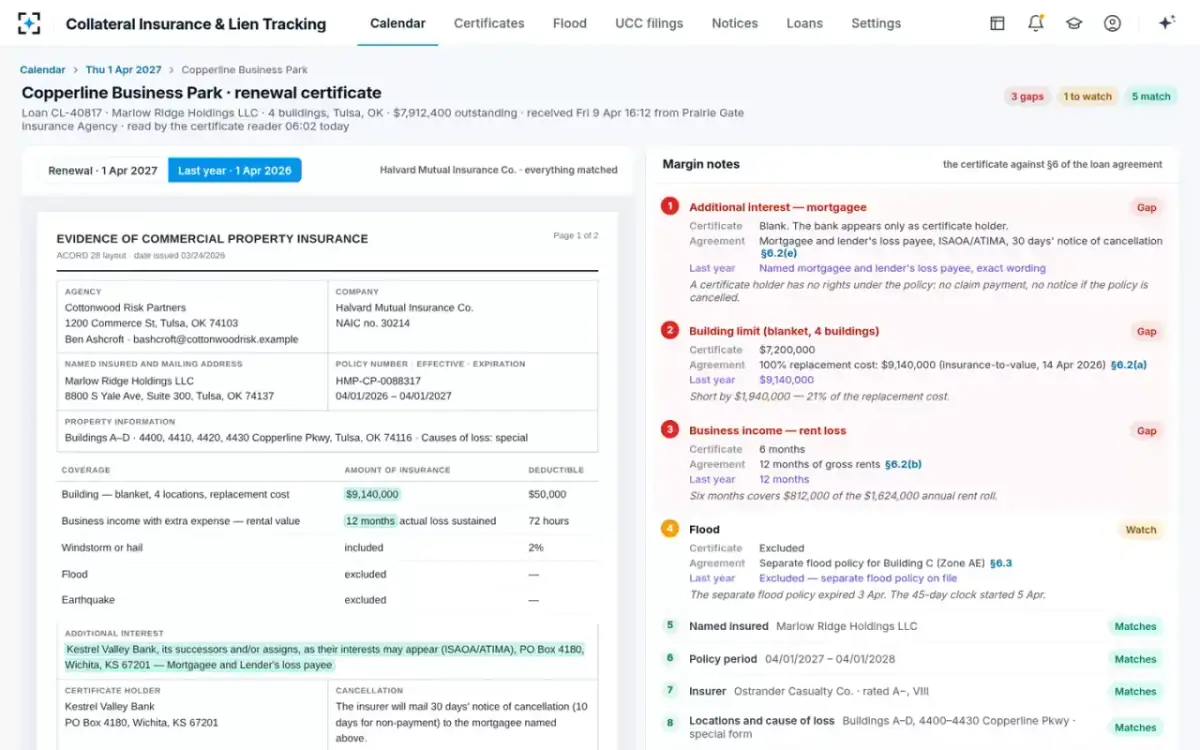
One renewal on the sample desk shows the whole pattern. Copperline Business Park, loan CL-40817, $7,912,400 outstanding, renewed with a new carrier and a new agency. The certificate names the bank only as certificate holder; the additional interest box is blank. Three other things moved with it.
One renewal, read against last year: the clause is not the only thing that changed
Last year’s certificate: Halvard Mutual, placed by the incumbent agency.
This year’s renewal: A new carrier and a new agency — the trigger that should force a full re-read, not a date update.
Last year’s certificate: Kestrel Valley Bank ISAOA/ATIMA, as mortgagee and lender’s loss payee.
This year’s renewal: Certificate holder only. The additional interest box is blank.
Last year’s certificate: $9,140,000 — the replacement cost required by §6.2(a) of the loan agreement.
This year’s renewal: $7,200,000 blanket. A $1,940,000 shortfall against the agreement.
Last year’s certificate: 12 months.
This year’s renewal: 6 months.
Last year’s certificate: In force, expires next April.
This year’s renewal: In force, expires next April. Identical.
Each of those four changes is defensible on its own; the broker probably thought the blanket limit was adequate and the shorter rent-loss period cheaper. None of them was approved by the bank, and three of them breach a section of the loan agreement the bank itself wrote. The reason they travelled together is that they were all decided in one remarketing exercise, by people whose job was the borrower's premium, not the bank's security.
The renewal certificate, read field by field against §6 of the agreement
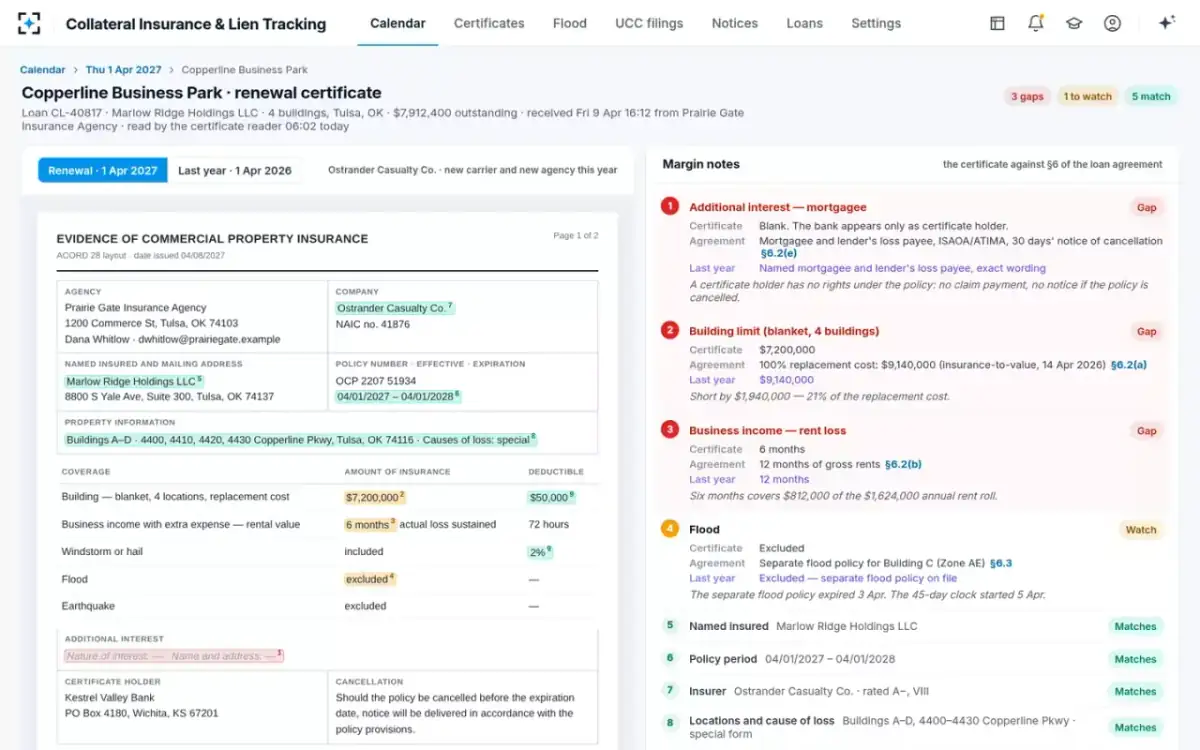
Last year's certificate, beside this year's, in Collateral Insurance & Lien Tracking
What to ask for instead: declarations page, endorsement, evidence form
If a certificate is only a summary, what should a lender insist on? The flood rules give the clearest regulatory answer in the neighbouring context: when a borrower shows that it already has flood cover after the bank has force-placed a policy, a supervised institution must accept a declarations page that shows the existing policy number and identifies the insurance company or agent with its contact details (12 CFR § 339.7(b)(2); the rule is set out in how the 45 days are counted). The declarations page is the document the carrier itself issues, and it is the right default everywhere, not only on flood.
In practice a commercial insurance tracking desk should ask for three documents and accept nothing less at renewal when the carrier or the agency has changed.
Eight things to read before a certificate is filed as satisfactory
- The named insured is the borrower, exactly
An operator, a management company or an affiliate on the named insured line means the policy covers somebody who is not on the note. Prairie Lantern Hotel on the sample desk named the hotel operator rather than the borrower.
- The bank is in the mortgagee or lender’s loss payee clause, not the holder box
Two separate fields. The reader checks them separately because an agency often fills one and leaves the other blank.
- The wording matches the agreement word for word
Entity name, ISAOA/ATIMA where required, and the notice address. A clause naming a predecessor bank protects nobody.
- The limit meets the requirement, per location
A blanket limit across a schedule is not the same as a per-building limit. Copperline’s $7,200,000 blanket sat $1,940,000 under the replacement cost §6.2(a) demands.
- The deductible is inside what the agreement allows
Sable Creek Apartments arrived with a 5% wind and hail deductible where the agreement allows 2% — on a coastal schedule that is most of the first loss.
- Every financed location is on the schedule
Buildings added mid-term, and buildings sold, are the two silent errors. Compare the schedule with the collateral list, not with last year’s schedule.
- It is a policy, not a binder
A binder is temporary evidence with its own expiry. Gantry Point Logistics sent a 30-day binder; the sample bank’s rule accepts one for 30 days and then stops accepting it.
- The carrier meets the rating floor
The sample bank requires A−, VII. A certificate from an unrated or thinly rated carrier is a credit decision, not a filing decision.
Two more asks are worth building into the loan agreement rather than the tracking procedure. Require the endorsement itself, not a description of it, whenever the carrier changes. And require the borrower's broker to deliver evidence to the bank directly, so the document the bank reads is the document the carrier issued.
Reading one certificate against the loan agreement, line by line
The reason this work is hard is not that any single check is subtle. It is that each certificate has to be read against a different agreement, and the agreement's insurance section is prose, not a form. Section 6.2(a) requires replacement cost on each building; 6.2(c) sets the rent-loss period; 6.3 picks up flood; 7.1 covers perfection of the security interest. Those four clauses were negotiated loan by loan, and a desk keying dates from forty certificates a day has no realistic way to hold them all.
What a reading agent changes is the order of the work. Each requirement is extracted from the agreement once, each incoming document is read field by field with the page and position of every value noted, and the comparison is made against both the agreement and last year's evidence. What arrives on a specialist's screen is not a PDF to key but a list of differences with the clause each one breaks. On the sample bank's Monday, 37 documents had arrived since Friday; 30 matched and 7 had gaps.
Where the gaps fell in one Monday's batch of 37 documents
7 documents with at least one gap
- Clause: bank not named as mortgagee or lender’s loss payee · 29%
- Limit below the agreement’s requirement · 29%
- Deductible above what the agreement allows · 14%
- Named insured is not the borrower · 14%
- A binder instead of the policy · 14%
Every document received since Friday, with its verdict
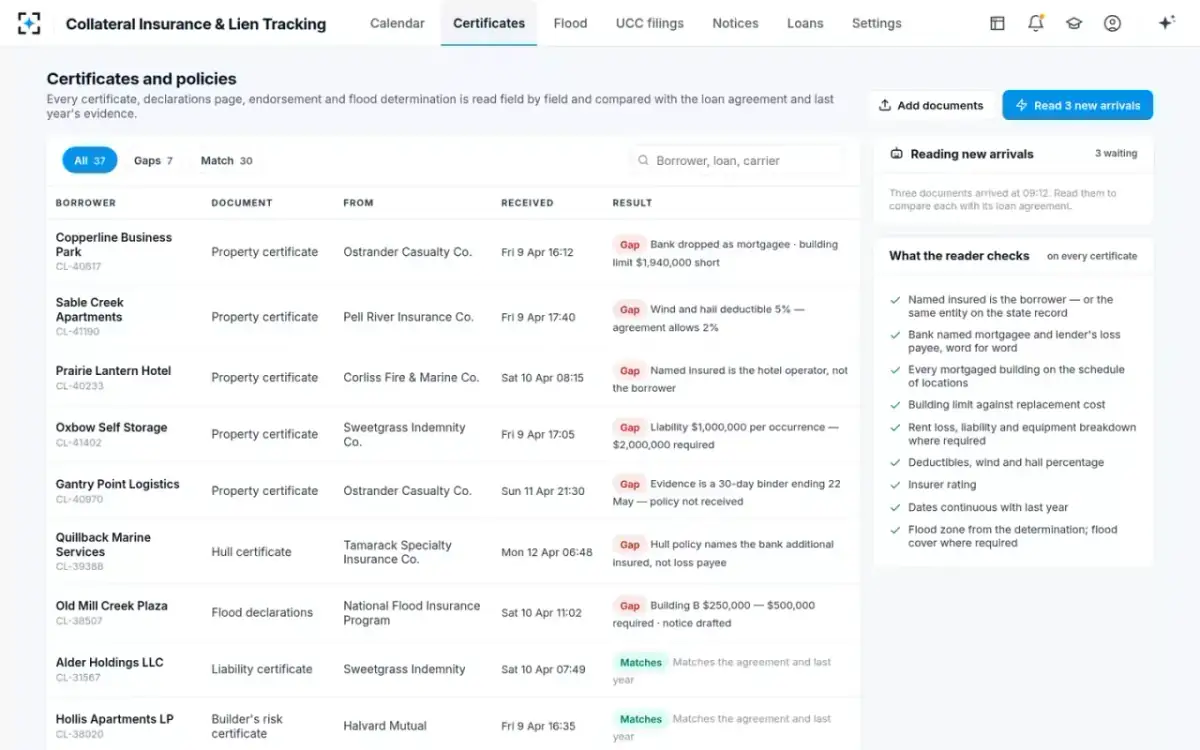
The outcome of a gap is a drafted letter, not an automatic action. On Copperline the draft went to the borrower, copied to the agency, listing the three gaps with the clause each breaks, the exact mortgagee wording to add, the limit to raise to $9,140,000 and the rent-loss period to restore to 12 months, with a date to respond by. A person reads it and sends it. Nothing leaves the bank on its own, which matters most on exactly these letters: a notice that misquotes a borrower's own agreement is worse than no notice at all.
Flood sits apart from all of this and runs on its own regulated clock — the lapse that starts it, and how the 45 days to force-placement are counted, are governed by rules rather than by the loan agreement. The equivalent question on personal property is perfection rather than coverage, and where a UCC lapse date really comes from catches banks out in the same way: a date that was keyed once and never re-read. To see the certificate reader, the comparison and the drafted notice together, start from Collateral Insurance & Lien Tracking.
Questions people ask
What is the difference between a certificate holder and a mortgagee?
A certificate holder is the party the certificate was addressed to; a mortgagee is a party named in the policy itself by endorsement. The holder box creates no rights — a certificate "cannot confer new or additional rights beyond those set forth in the referenced insurance policy", as the New York regulator puts it. A mortgagee clause gives the lender payment to the extent of its interest, its own notice of cancellation, and protection where the borrower's act or neglect would defeat the borrower's own claim.
Does a certificate holder get paid on a claim?
No. The insurer pays the named insured. A certificate holder has no interest in the policy and no standing to claim under it, so a bank in that box depends on its loan agreement and its security interest to reach the proceeds after the borrower has received them. It also loses the separation a mortgagee has from the borrower's conduct: if the borrower's claim fails for misrepresentation or a breached condition, nothing is left for the bank.
Is a lender's loss payee the same as a mortgagee?
They are the same idea applied to different collateral. A mortgagee clause protects a lender's interest in real property; a lender's loss payee endorsement does the same job for personal property such as equipment, contents and inventory. Both give the lender protection that survives the borrower's own act or neglect. An ordinary loss payee endorsement does not — it pays as interests appear, and fails when the named insured's claim fails.
What does ISAOA ATIMA mean on a mortgagee clause?
"Its successors and/or assigns, as their interests may appear." ISAOA keeps the clause effective if the loan is sold or assigned, so a new noteholder inherits the protection without re-papering the policy; ATIMA limits recovery to the lender's actual interest at the time of loss. The suffix qualifies a mortgagee clause. Added to a certificate holder entry it changes nothing.
Does a certificate holder get notice if the policy is cancelled?
Only if the policy itself provides it, which generally means no. Washington's rule states that "the insurance policy governs the terms and conditions of the notice, including the timing of the notice", and current certificate forms say the same: notice will be delivered in accordance with the policy provisions. The direct duty to notify the lender comes from the mortgagee clause: New York's standard fire policy, for example, requires ten days' written notice to a mortgagee before its interest is cancelled.
What should a lender ask for instead of a certificate?
The declarations page and the endorsement. Flood rules point the same way: when a borrower proves existing flood cover after a force-placement, a supervised institution must accept a declarations page showing the policy number and the insurer's identity and contact details as confirmation. Ask for the mortgagee or lender's loss payee endorsement itself whenever the carrier or the agency changes at renewal, and have the broker send evidence to the bank directly rather than through the borrower.