ISAOA/ATIMA is the wording a lender asks to see beside its own name on a car insurance declarations page. ISAOA stands for "its successors and/or assigns" and ATIMA for "as their interests may appear": the first keeps the lender's protection in place when the loan is sold on to somebody else, the second limits what the lender can be paid to the amount it is actually owed. On a financed vehicle the lender is named as lienholder and loss payee, and until the declarations page shows that correctly, the contract does not fund. In the sample data behind Botminds' Dealer Funding Status Assistant, this one line is the largest single reason dealers call the funding desk.
The product figures here are sample data on a fictional lender, Tarrow Auto Finance, and fictional dealers and buyers. The legal and regulatory material is quoted from a state insurance regulation and from the CFPB, linked where it appears.
Why this line matters more than its size suggests
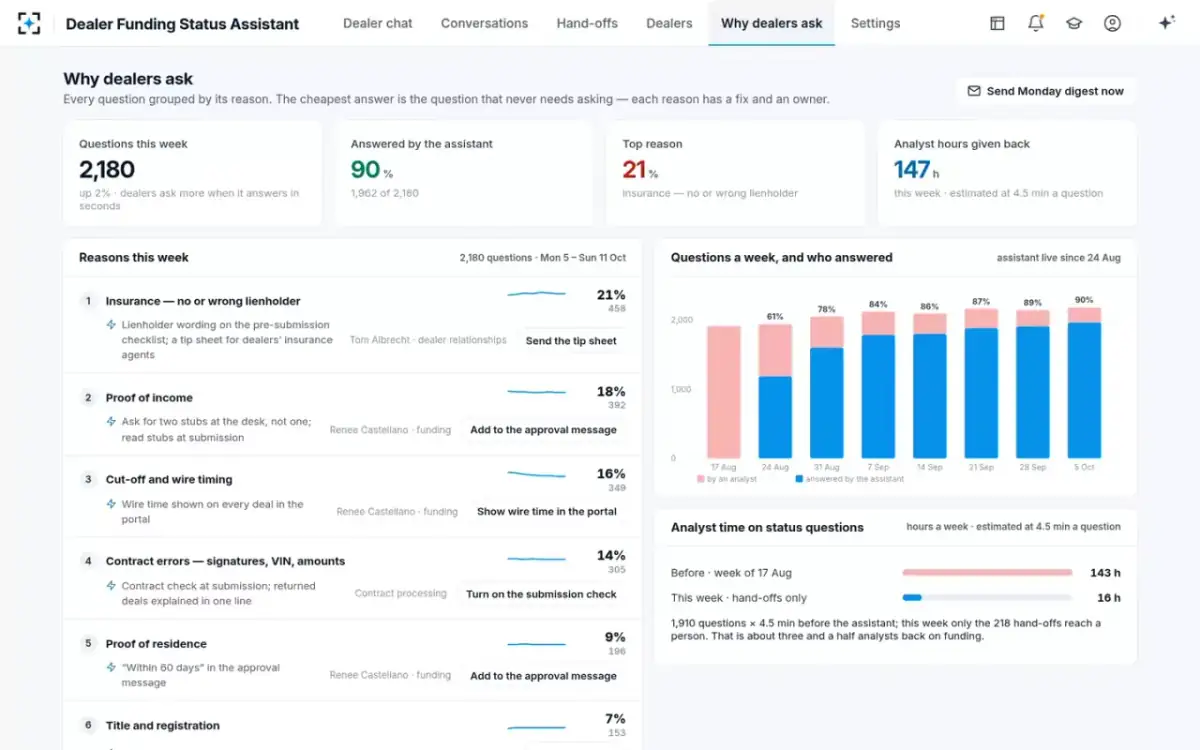
21%
of a week of dealer questions came from the insurance line, the largest single reason
458
questions in that week, out of 2,180
15of 46
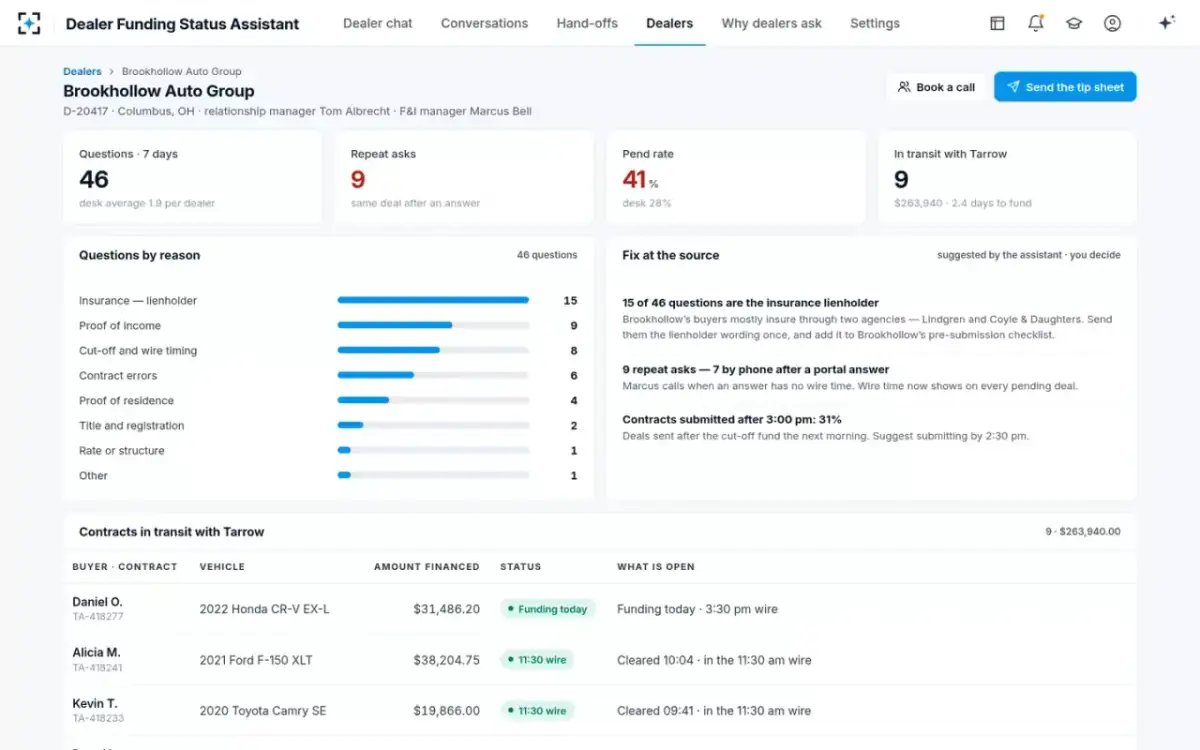
of one dealer group’s questions in seven days, from two insurance agencies
What does ISAOA/ATIMA mean?
They are two separate pieces of wording that usually travel together, and each does a distinct job.
ISAOA — "its successors and/or assigns" — exists because the lender on the contract today may not be the lender tomorrow. In indirect auto lending the contract is assigned the moment it funds: the OCC describes the process as one in which "a bank purchases loan contracts from a dealer or retailer as a holder in due course and collects principal and interest payments from the borrower" (OCC, Retail Lending, version 2.0). That contract can be assigned again — to a servicer, to a securitisation trust, to a bank that buys the portfolio. Without the successors-and-assigns wording, a policy names one entity, and the protection does not travel with the debt.
ATIMA — "as their interests may appear" — is the limit on the other side. It means the named party is paid only to the extent of its interest at the time of the loss. If the vehicle is written off while $18,000 is owed and the car is worth $23,000, the lender takes $18,000 and the rest belongs to the owner. The phrase stops the endorsement from turning the lender into the owner of the whole claim.
Together they describe a relationship rather than a party: whoever holds this loan, to the extent they are owed. That is exactly what a lender needs and nothing more, which is why it has become the standard phrasing rather than a formality somebody invented.
Lienholder, loss payee, additional insured: three different things
They are routinely used as if they were interchangeable, and they are not. One of them a lender must not be.
Three ways a lender can appear on a policy, and what each does
| How it appears | What it means | What it does on a claim |
|---|---|---|
| Lienholder | A party with a recorded security interest in the vehicle, named so the insurer knows who holds the lien and where to send notice. | Typically entitled under the policy to notice of cancellation or non-renewal, so a lapse does not go unnoticed. |
| Loss payee | A party added by a loss payable clause, entitled to be paid out of a physical damage claim to the extent of its interest. | Is named on the settlement for a total loss or major damage, alongside or instead of the owner. |
| Additional insured | A party treated as an insured under the policy, with the policy’s own protection extended to it. | Not appropriate here, and in some states expressly prohibited on a policy the vehicle owner bought. |
That same regulation names the mechanism a lender should use instead, and it is the loss payable clause: "Lienholders', sellers', interests of both, may be protected only by a standard loss payable clause attached to a policy which substantially protects the consumer's interest in the motor vehicle or goods." It adds something an F&I manager can use in an argument with an agency: "No additional premium may be charged for a loss payable clause." Adding the lender is not an upsell.
Why a lender insists on the exact wording
Because without a loss payable clause, the owner is the only person the insurer has to pay. The Missouri regulation spells out the default position: in a policy affording substantial protection, "the owner of the property must be protected from his/her risk of casualty loss for the causes covered by these policies and must be sole loss payee absent a loss payable clause."
The owner of the property must be protected from his/her risk of casualty loss for the causes covered by these policies and must be sole loss payee absent a loss payable clause.
20 CSR 500-1.700, Missouri Department of Commerce and Insurance
Sole loss payee is the whole argument in three words. If the car is destroyed in week six and the lender is not on the policy, the settlement goes to the owner, and the lender's recourse is to an unsecured borrower with no vehicle. The security interest it bought the contract on has evaporated into a claim nobody told it about.
The coverage type matters alongside the names. The CFPB states the industry position plainly: "Auto finance contracts generally require consumers to maintain comprehensive and collision insurance that covers physical damage to the vehicle in order to protect the value of the collateral" (CFPB, Supervisory Highlights, issue 24). A liability-only policy satisfies a state's road rules and none of the lender's condition, which is why "the buyer has insurance" and "the insurance clears the condition" are different statements.
There is a floor on the amount too. The Missouri regulation requires that "a motor vehicle is substantially protected only when it is insured for at least its actual cash value and not when it is insured only for a lesser loan amount outstanding upon it or the payoff value of that loan." A policy written to the loan balance rather than the vehicle's value protects the lender and short-changes the buyer, and that is precisely the arrangement the rule is there to stop.
What a declarations page has to show
Six things, and a funding desk looks for all six in the same order every time.
The six checks on an insurance declarations page
- The named insured is the buyer on the contract
A policy in a parent’s or a company’s name covers someone who is not the obligor.
- The vehicle identification number matches the contract
Agencies transcribe these by hand more often than anyone would like. One digit returns the file.
- Comprehensive and collision are both in force
Liability only does not protect the collateral, which is what the condition is about.
- The deductibles are inside the lender’s limit
A $2,500 deductible on a $19,000 car leaves a gap the lender is carrying.
- The lender is named as lienholder and loss payee, with the ISAOA/ATIMA wording
The exact legal entity from the dealer agreement, not a trade name or an abbreviation.
- The effective date is on or before the contract date
A policy that begins the following Monday leaves the vehicle uninsured for the days it was already financed.
The fifth is where the time goes. An agency that writes "Tarrow Auto" instead of the lender's full legal name, or names the dealership because the dealership sent the request, has produced a page that is correct in every other respect and still fails. The other conditions on the same deal fail in their own characteristic ways, but none of them is as reliably produced by a third party as this one.
Why this one line is the biggest reason dealers call
Because nobody in the transaction owns it. The buyer rings their agent from the dealership and asks for proof of insurance. The agent sends a declarations page with whatever details they were given. The dealership forwards it. The lender returns it. Three handovers, two of them to people with no sight of the lender's condition, and a loop that only closes when someone explains the requirement to the agency.
One dealer group's seven days, by the reason it asked
Fifteen of forty-six questions, from one dealer, about one line. The pattern underneath them is narrower still: that group's buyers mostly insure through two agencies. Answering those fifteen questions one at a time is a day of somebody's week. Sending the two agencies the correct wording is an afternoon, once.
Fixing it at the source: the agency, not the deal
The cheapest answer is the question that is never asked, and on this condition the cause is almost always upstream of the dealership. Three fixes do most of the work, and none of them is about the deal in front of you.
Two ways to spend the same hour
Clearing the file: Return the declarations page, wait for the dealer to call the agency, re-read the new one.
Clearing the cause: Send the exact lienholder wording to the two agencies the dealer group’s buyers use.
Clearing the file: One deal.
Clearing the cause: Every deal those agencies write for that dealer from now on.
Clearing the file: Two handovers and at least one day of transit.
Clearing the cause: One note, written once and approved once.
Clearing the file: The buyer, the agent, the F&I manager and the funding analyst.
Clearing the cause: The dealer relationship manager.
Three pieces of wording are worth putting in front of an agency: the lender's exact legal name as it appears in the dealer agreement; the ISAOA/ATIMA phrasing after it; and the requirement for comprehensive and collision rather than liability alone. A one-page note carrying those three, sent to the agencies a dealer group's buyers actually use, removes the most common failure before it happens.
One dealer, its questions by reason, and the fix behind them
Every question grouped by its reason, with a fix and an owner
What a lender may not do with the insurance requirement
Requiring insurance is ordinary. Requiring it from a particular source is not. The Missouri regulation is categorical: "The consumer shall not be required to obtain insurance from any particular insurer nor through any particular insurance producer or representative of a company as a condition precedent to the granting of a loan." A buyer who turns up with a valid policy from any carrier has satisfied the condition, provided the policy does what the condition asks.
The other limit is what happens when there is no policy at all. A lender may buy its own cover and charge the buyer for it, but the CFPB is clear about who that protects: "this coverage protects the lender and vehicle, but not you" (CFPB, Ask CFPB). The Bureau's examiners describe the sequence servicers follow: a notice asking for proof, a policy bought at the consumer's expense if none arrives, and removal of the charge for any period the consumer later evidences; and they "identified unfair and deceptive acts or practices related to placement and removal" of those policies (CFPB, Supervisory Highlights, issue 24). For a funding desk the practical consequence is simple: a declarations page cleared at submission costs nothing and avoids the whole mechanism.
Reading a declarations page in seconds
The six checks above are mechanical. A declarations page is a structured document; the named insured, the vehicle identification number, the coverage lines, the deductibles, the effective date and the loss payee block are all in named fields. Comparing them with the contract is arithmetic and string matching, not judgement.
That is the division the solution draws across every condition: documents are read against a written test as soon as they land, the verdict names the test that failed, and anything requiring a decision goes to a named person. In its sample data the insurance condition on one deal reads "full coverage, the lender named as lienholder and loss payee", and the page that satisfies it is shown beside the condition it satisfied, so the dealer and the desk are looking at the same evidence. Where a page is wrong, the answer says which of the six checks failed and what would pass — not that insurance is outstanding.
What the assistant does not do is decide that a deal can fund without the right page. That is a condition waiver, it belongs to the analyst the funding policy names, and it is recorded with a reason on the deal. The same division governs the income condition and its waivers.
To see the insurance condition read against a declarations page on a live deal, start from Dealer Funding Status Assistant. For the cost of the days this adds, see contracts in transit.
Questions people ask
What is the full form of ISAOA ATIMA?
ISAOA is "its successors and/or assigns"; ATIMA is "as their interests may appear". The first keeps the lender's position intact when the loan is assigned to a servicer, a trust or another lender; the second limits what the named party can be paid to the amount it is owed at the time of the loss, so any surplus belongs to the vehicle owner.
Why does my lender need to be listed as lienholder?
So the insurer knows who holds the security interest, sends the lender notice if the policy is cancelled or lapses, and names the lender on a physical damage settlement to the extent it is owed. Without a loss payable clause the owner is the sole loss payee, and a total loss would pay out with the lender holding nothing but an unsecured debt.
What is the difference between a loss payee and an additional insured?
A loss payee is entitled to be paid out of a claim to the extent of its interest. An additional insured is treated as an insured under the policy itself. For a financed vehicle the lender should be a loss payee under a loss payable clause; some states, Missouri among them, expressly prohibit a lienholder from being listed as an additional insured on a policy the vehicle's owner bought.
What coverage does a lender require on a financed car?
Comprehensive and collision — physical damage cover — as well as whatever liability the state requires. The CFPB's summary is that auto finance contracts generally require comprehensive and collision insurance "in order to protect the value of the collateral". Lenders also cap the deductible in their own documentation standard and require the policy to be in force on the contract date.
Why was my insurance declarations page rejected?
Usually one of six things: the named insured is not the buyer, the vehicle identification number does not match the contract, comprehensive or collision is missing, the deductible is above the lender's limit, the lender is named incorrectly or not at all, or the policy starts after the contract date. Each has a different fix, which is why a reply that names the failed check is worth more than one that says insurance is outstanding.
What happens if you do not keep full coverage on a financed car?
Some contracts permit the lender or servicer to buy cover on the vehicle, collateral protection insurance, and add the cost to the account. The CFPB describes the sequence — a notice requesting proof, a policy purchased at the consumer's expense if none arrives, and removal of charges for any period the consumer later evidences — and warns that this coverage protects the lender and the vehicle rather than the borrower. Keeping your own policy in force is always cheaper.