Same day funding on an auto loan is achievable for any indirect contract that clears every stipulation before the lender's batch cut-off, because the payment rails are not the constraint: the Federal Reserve runs three same-day ACH settlement windows and a wire service open to 6:45 p.m. eastern time for customer transfers. What holds a contract on a lender's desk is the gap between a document failing a stipulation and the dealer learning exactly what failed and how long is left before the batch closes. Close that gap and a pended contract that would have funded tomorrow funds this afternoon; leave it open and the desk spends its week answering "why hasn't this funded?" by phone. Botminds' Dealer Funding Status Assistant answers that question for the dealer in seconds, names the open stipulation and the cut-off, re-reads the fix on upload, and hands the funding analyst only the questions that need a decision.
The lender, dealers and deals on this page are fictional sample data: Tarrow Auto Finance, a desk that funds 40 to 50 contracts a day across two wire batches. The payment schedules and supervisory text are real and linked where they appear.
One dealer group's funding clock at the sample lender
2.4days
average from contract to funding for the group
41%
of the group's contracts pend at some point, against 28% for the desk
31%
of its contracts arrive after the 3:00 pm cut-off
15 of 46
of its questions in a week were about the insurance lienholder
Can an indirect lender offer same day funding on auto loans?
Yes, on clean contracts submitted before the cut-off, and the published payment schedules leave plenty of room. For ACH, the Federal Reserve Board described "a morning window with a submission deadline at 10:30 a.m. ET and settlement at 1:00 p.m. ET" and "an afternoon window with a submission deadline at 2:45 p.m. ET and settlement at 5:00 p.m. ET", and approved a later window "of 4:45 p.m. ET and settlement at 6:00 p.m. ET" (Federal Reserve Board, December 2019). For wires, "the deadline for initiating transfers for the benefit of a third party (such as a bank's customer) is 6:45 p.m. ET each business day" (Federal Reserve Board, Fedwire Funds Service).
The published windows a lender can pay a dealer in
| Instrument | Submission deadline, eastern time | Money available | Runs on |
|---|---|---|---|
| Same-day ACH, morning window | 10:30 a.m. | 1:00 p.m. the same day | Business days |
| Same-day ACH, afternoon window | 2:45 p.m. | 5:00 p.m. the same day | Business days |
| Same-day ACH, later window | 4:45 p.m. | 6:00 p.m. the same day | Business days |
| Fedwire Funds Service, third-party transfer | 6:45 p.m. | On receipt | Monday to Friday, excluding designated holidays |
Read that table beside a funding time measured in days and the conclusion follows. A lender's funding speed is decided before a payment instruction exists: in the documents, in the queue that reads them, and in how fast the dealer learns what is wrong. The market is large enough for that to matter: $211 billion of new auto loans appeared on credit reports in the second quarter of 2026, and auto balances reached $1.71 trillion (Federal Reserve Bank of New York).
Why a lender still runs a cut-off
Because a payment batch has to be assembled, reconciled and released by people, with time to fix a rejection before the window shuts. The cut-off is the moment the lender stops adding contracts so it can reconcile the batch total against its account, confirm each dealer's banking details and release the instruction. It belongs to the lender, not the network, and it sits well inside the network's own deadlines.
The sample lender runs two batches: an 11:00 cut-off for an 11:30 wire, and a 3:00 pm cut-off for a 3:30 pm wire, on a Federal Reserve holiday calendar. The rule that decides a dealer's afternoon is plain arithmetic: a contract that clears at 2:58 pm funds that day, and one that clears at 3:04 pm funds tomorrow. That is why the cut-off has to appear on every pended contract a dealer can see, not only in the dealer agreement. A fix that lands after the cut-off still funds, a day later than it had to.
What holds a contract on the funding desk?
An open stipulation, almost always, and the conversation about it. The documents that fail recur: an insurance declarations page that omits or misnames the lienholder, proof of income that is a single stub or outside tolerance, proof of residence at an old address or outside the date window. Each is a few minutes' fix at the dealership once someone names it precisely, and an open-ended wait if the dealer is told only that "stips are outstanding". The stipulations themselves, and why each fails, are covered in auto loan stipulations.
Why dealers asked about their contracts in one week at the sample lender
The insurance line deserves a lender's attention because it is not the dealer's fault and not the buyer's. At the sample lender the dealer group whose 15 questions were about the lienholder sells mostly to buyers who insure through two local agencies; the agencies are the cause, and a note to each agency about how the lienholder should read removes the stipulation from every future contract rather than one.
What the status question costs a funding desk
More than the reading. When a dealer cannot see which stipulation is open, it asks, often by phone, and the answer takes an analyst away from funding. The sample desk estimated its week on dealer status questions before the assistant at 143 hours: 1,910 questions at an estimated 4.5 minutes each.
A week of desk hours on dealer status questions: most of it is finding and talking
143 hours a week, estimated at 4.5 minutes a question across 1,910 questions
- Opening the deal and reading the stipulations · 28%
- Checking documents against each stipulation · 24%
- Taking the call or reading the email · 21%
- Writing the reply or calling back · 14%
- Working out the cut-off and wire batch · 13%
The overhead compounds because the first answer rarely ends the conversation. In the sample data one contract was asked about by email after the cut-off and answered in six seconds, then phoned about the next morning anyway: seven minutes of an analyst reading back items the dealer could have seen. A senior funding analyst who funds 40 to 50 contracts a day and takes 25 to 35 status calls on top is spending the hours that decide exceptions on questions that decide nothing.
One contract, 10:38 am to the 3:30 pm wire
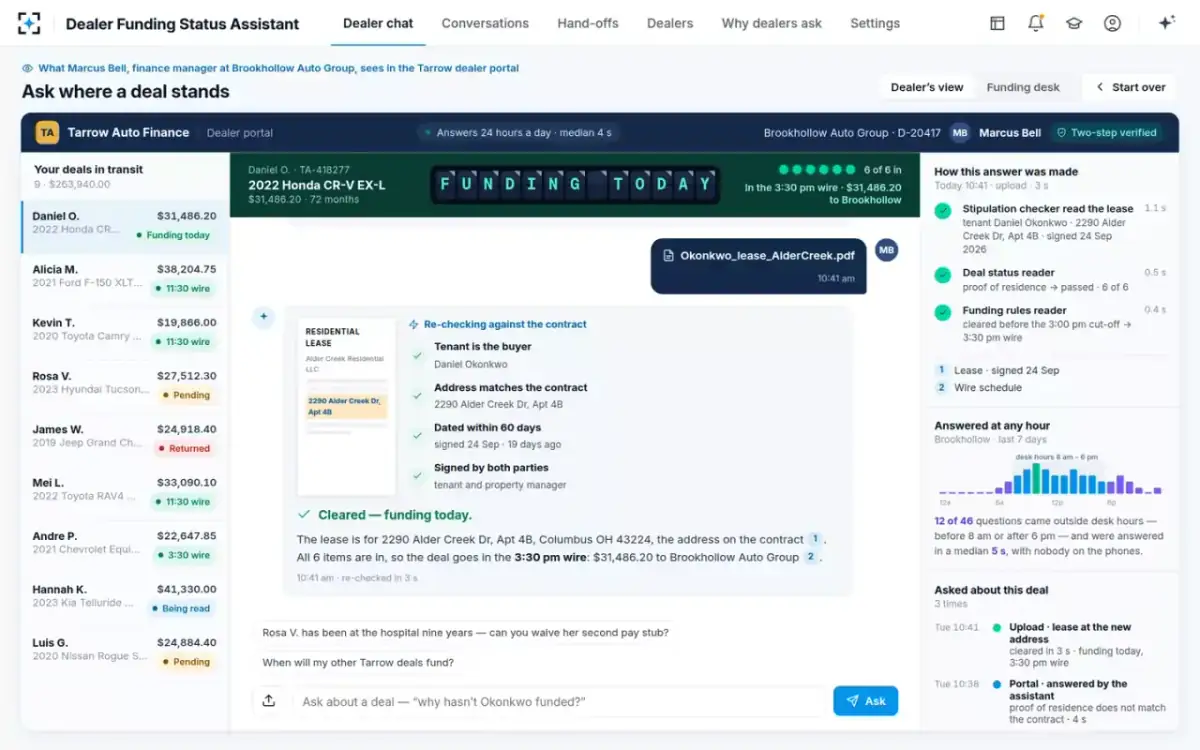
The useful answer to "why hasn't this funded?" has four parts: which stipulation is open, what is wrong with the document behind it, what would satisfy it, and how long is left before the batch closes. On the sample deal, a used SUV at $31,486.20, the F&I manager asked in the dealer portal at 10:38 am. The answer came in four seconds: proof of residence failed because the utility bill showed a previous address, a lease, bank statement or bill at the new address dated within 60 days would clear it, and the 3:00 pm cut-off was 4 hours 22 minutes away.
The manager uploaded the buyer's lease from the answer at 10:41. It was re-read in three seconds against four tests, tenant is the buyer, address matches the contract, signed within 60 days, signed by both parties, and the status board turned to Funding today, in the 3:30 pm wire. No analyst touched it. The interval that saved a day was three minutes long, and every minute of it was the dealer's.
The moment the Dealer Funding Status Assistant turns a pended contract to Funding today
What does a slow funding desk cost the lender?
Contracts, and eventually dealers. In indirect lending the lender is not committed until it buys the contract, so a dealer whose deals sit for days is free to send the next one to a lender who funds faster. The relationship manager at the sample lender, who looks after 64 dealers, used to learn that a dealer was struggling when its contracts stopped arriving.
The dealer's own clock makes the pressure sharper. A sold vehicle whose retail money has not arrived is still carried on the dealer's floor plan line, and the OCC notes that "dealers selling in large volume are usually granted a three-day leeway before proceeds from inventory sold must be received by the bank" (OCC Comptroller's Handbook, Floor Plan Lending). After that, the dealer risks being out of trust, which the handbook defines to include the case where "the bank cannot verify any links between contracts in transit and the sold inventory".
A dealer sells out of trust when the inventory is sold and the funds are not immediately remitted to the bank to retire the corresponding debt.
OCC Comptroller's Handbook, Floor Plan Lending
A retail lender that funds slowly is therefore pushing its dealers toward the edge of their wholesale terms, and a dealer under that pressure sends its best contracts to whoever pays fastest. The balance-sheet side of this, and why the floor plan lender watches the same number, is in contracts in transit.
Setting cut-offs and wire batches as a decision, not an inheritance
A funding calendar should be reviewed like any other policy, because it decides how many contracts fund the same day more directly than any staffing change. Most of its settings are trade-offs between the desk's reconciliation time and the dealer's selling day: a later afternoon cut-off catches the contracts that dealers finish after lunch, at the cost of a tighter window to reconcile and release before the network's deadline.
The settings that decide a lender's same day funding clock
| Setting | At the sample lender | The trade-off |
|---|---|---|
| Morning batch | Cut-off 11:00, wire 11:30 | An earlier cut-off funds overnight submissions sooner; a later one catches the morning's fixes |
| Afternoon batch | Cut-off 3:00 pm, wire 3:30 pm | Moving to 4:00 pm catches late-afternoon deals but leaves less time to fix a rejected payment |
| Holiday calendar | Federal Reserve holidays | Adding retail holidays protects staffing but gives dealers a day with no funding |
| Clearing on upload | Insurance, residence and identity re-checked when uploaded | Each stipulation added to the list is one more the dealer can clear without an analyst |
| Target for a question that needs a person, in the hour before a cut-off | 15 minutes | A tighter target saves contracts at the cut-off and costs analyst focus |
| A question asked a third time the same day | A person calls the dealer back | The third ask is the signal that the written answer is not working |
The wire time is the one setting worth a rule of its own. A lender that tells a dealer "in the 3:30 pm wire" has made a promise, and a promise broken by a reconciliation problem costs more goodwill than no promise at all. In the sample setup the assistant gives a wire time only when the schedule can keep it, and says "next batch" otherwise.
What should a lender measure on its funding clock?
The tail and the cause, not the average. A mean of 2.4 days that hides a 41% pend rate is two different populations wearing one number: clean contracts that fund the same day, and pended ones that take most of a week. The measures that move funding speed are the ones that point at a fix.
Six measures that tell a funding desk where same day funding is lost
- Pend rate by dealer, against the desk
The sample group pends 41% against 28%. The gap is a conversation with one dealer, not a desk-wide problem.
- Contracts submitted after the cut-off, by dealer
Thirty-one percent at the sample group: a day added to every one of those contracts however clean it is.
- Questions by reason, each with an owner
Insurance wording goes to the agencies, income documents to the dealer's F&I process, timing to the dealer agreement.
- Repeat asks on the same contract
Nine in a week at the sample group. A second ask means the first answer did not say enough.
- Time from upload to re-check
A fix read at 10:41 still makes the afternoon batch; the same page read tomorrow cannot.
- Analyst hours on status against hours on decisions
The hours given back are only real if they move to waivers, restructures and exceptions.
Who decides what: the assistant, the analyst and the team lead
Status is a fact; a waiver is a decision. The assistant can say which stipulation is open, what would satisfy it, and when the next batch closes, because each of those can be read from the contract, the documents and the funding calendar. It cannot waive a second pay stub, restructure a term from 75 to 84 months, or discuss rate or credit reasons; those go to a person with the whole deal attached.
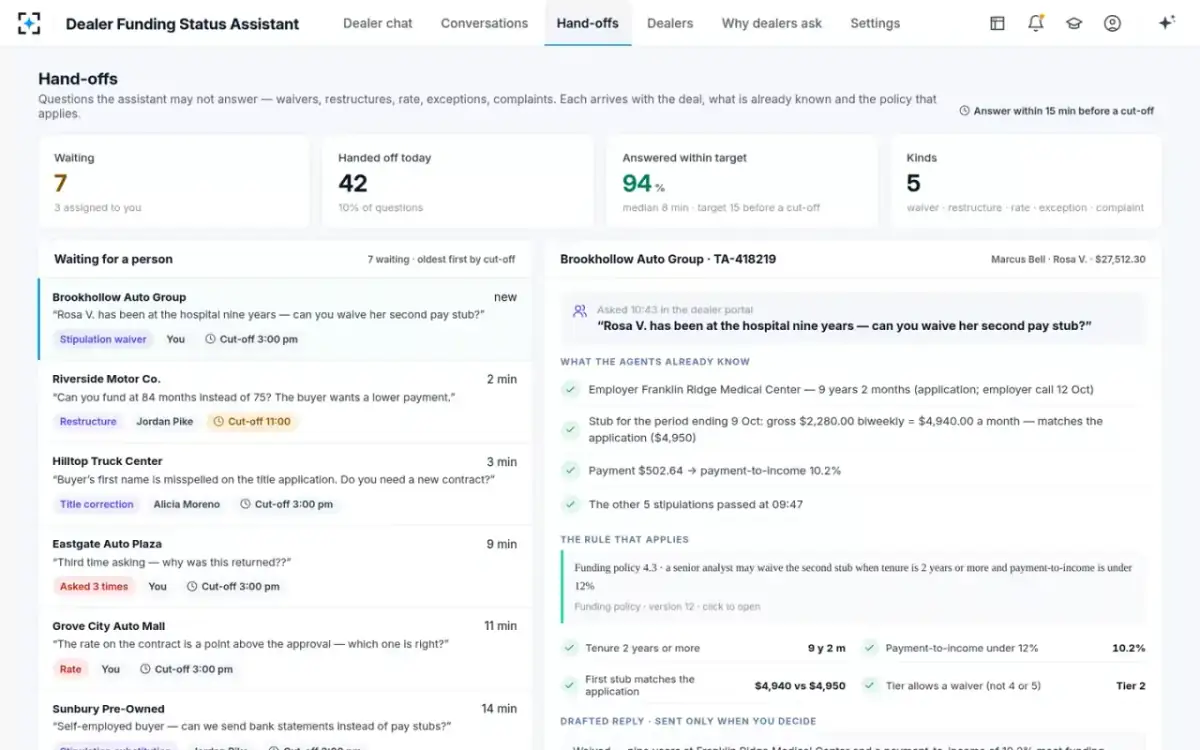
In the sample data a dealer asked whether the second stub could be waived for a buyer with nine years at a hospital. The question went to the senior funding analyst with what the agents already knew, nine years two months with one employer, $4,940 a month against $4,950 on the application, a payment-to-income of 10.2%, and the rule that applied. The analyst waived it with a recorded reason, and the answer reached the dealer in the same thread, nine minutes after the ask, in time for the 3:30 pm wire. What the assistant may say is a setting the funding team lead approves and versions; rate, credit reasons and declines are always a person.
Questions the assistant may not answer, oldest first by cut-off
Where the Dealer Funding Status Assistant fits
The solution sits between the dealer and the funding desk. Its agents confirm the asker is a verified user of the dealer, read the contract's status and stipulations, check each uploaded document against the stipulation it answers, and apply the lender's cut-offs and wire batches, answering in the portal, by email or by text. Questions grouped by reason go to the team lead with a fix and an owner; each dealer's pend rate, repeat asks and contracts in transit go to the relationship manager.
It does not fund, waive or decide. Funding analysts still clear exceptions and sign, the team lead still owns the cut-off and what the assistant may say, and the payment still leaves through the lender's own systems. What changes is how much of the desk's week goes to telling dealers what the desk already knows. The full picture of the channel is in indirect auto lending and the funding desk; to see the funding clock on your own dealers, start from Dealer Funding Status Assistant.
Questions people ask
What is same day funding in auto lending?
An indirect lender paying the dealer for a purchased contract on the day the contract clears its stipulations, rather than the next business day or later. It depends on the contract clearing before the lender's batch cut-off; the ACH and wire networks can settle the same day.
What cut-off times do auto lenders use?
Each lender sets its own, inside the payment networks' deadlines. The sample lender uses 11:00 and 3:00 pm cut-offs for 11:30 and 3:30 pm wires; the Federal Reserve's later same-day ACH window takes submissions to 4:45 p.m. eastern time, and Fedwire customer transfers to 6:45 p.m.
Do holidays stop same day funding?
Federal Reserve holidays do: the Fedwire Funds Service runs Monday to Friday excluding designated holidays, and ACH settles on business days. A lender should publish the holiday calendar it actually uses, because it is not the same list as a dealership's retail calendar.
Which stipulations most often delay funding?
In the sample lender's week, insurance with no or the wrong lienholder was 21% of dealer questions, proof of income 18% and cut-off timing 16%. Each is fixable in minutes when the dealer is told exactly what failed.
Why does a dealer care if funding takes three days?
Because the sold vehicle is still on its floor plan line until the retail money arrives. The OCC notes high-volume dealers are usually given a three-day leeway to remit sale proceeds; beyond that the dealer risks selling out of trust.
Can an automated assistant waive a stipulation?
It should not. Status and stipulation checks are facts the assistant can read; a waiver is a credit judgement. In the sample setup waivers, restructures, rate and credit reasons always go to a funding analyst, who records the reason and signs.