Indirect auto lending is lending through somebody else's shop. The buyer never speaks to the lender: they negotiate at a dealership, the dealership takes the credit application and sends it to several lenders at once, and the lender that wins the deal buys the signed contract from the dealership afterwards. The consequences run all the way through the business: the dealership is the one that meets the customer, the lender is the one that owns the loan and the regulatory exposure, and the only place the lender touches the deal before its money leaves is the funding desk. Botminds' Dealer Funding Status Assistant sits beside that desk and answers the dealership's question about a pending deal from the deal itself, so the analysts spend their day funding contracts rather than reading conditions down a telephone line.
Every figure here about the solution is its own sample data, on a fictional lender called Tarrow Auto Finance, fictional dealer groups and fictional people. The descriptions of the channel and its rules come from the OCC's Comptroller's Handbook, the CFPB's auto finance examination procedures and the Federal Reserve Bank of New York, linked where they appear.
What lands on one analyst in one day
40–50
contracts a senior funding analyst funds in a day, across a morning and an afternoon wire
25–35
dealer status calls that arrive on top of that, each one an interruption to funding
64
dealerships a single relationship manager looks after
412
dealer questions the desk received in one sample day, by portal, email and text
What is indirect auto lending?
It is the use of a retailer to find and sign up borrowers on the lender's criteria. The OCC's retail lending handbook gives the definition and, usefully, the two shapes it takes: "Indirect lending generally refers to the use of a third party to originate loans using a bank's underwriting criteria. The third party receives a fee for providing an acceptable borrower. Indirect lending typically takes one of two forms: (1) dealers or brokers may originate loans to borrowers, and banks then purchase the loans, or (2) dealers or brokers forward loan applications to banks that then originate the loans" (OCC, Retail Lending, version 2.0).
In cars, the first shape dominates. The same handbook describes the counterparty without romance: dealers are "Third-party retailers that generate loan applications to facilitate sales of their products, generally automobiles, boats, recreational vehicles, pools, and spas." A dealership is not in the lending business; it is in the business of selling a car this afternoon, and financing is how it does that.
This is also how most of the market works. The CFPB's examination procedures for auto finance put it in five words: "Most consumers who finance the purchase of an automobile use the indirect channel" (CFPB, Auto Finance examination procedures). The direct channel, a buyer who arranges a loan with their own bank first, exists, and it is a minority.
Scale matters here because the channel is a large share of a large number. The Federal Reserve Bank of New York's household debt report for the second quarter of 2026 put total household debt at $18.8 trillion and noted that "new delinquencies for auto loans and credit cards remain at elevated levels, a trend we'll continue to monitor" (Federal Reserve Bank of New York, 2026 Q2). A channel this big, originated by third parties and under pressure at the delinquency end, is a channel whose controls get examined.
Indirect and direct auto lending, side by side
The two channels differ in who meets the customer, who sets the price and how much the lender knows at the point of decision. That last difference is the one the regulator cares about.
Direct and indirect, who does each part
| The part | Direct: buyer to lender | Indirect: buyer to dealership to lender |
|---|---|---|
| Who takes the application | The lender, from the buyer | The dealership, usually on a shared platform that sends it to several lenders |
| Who decides the credit | The lender | The lender, on its own criteria, before a contract exists |
| Who sets the rate the buyer pays | The lender | The dealership, at or above the rate the lender will buy at |
| Who signs the contract with the buyer | The lender | The dealership |
| Who owns the loan afterwards | The lender | The lender, which buys the contract from the dealership |
| Who the buyer pays | The lender | The lender, which usually services the contract it bought |
| What the lender sees before deciding | A full application and a conversation | An application assembled by somebody whose incentive is to sell the car |
The handbook makes the risk gradient explicit, and its wording explains why funding desks exist at all rather than being an administrative accident.
Viewed in isolation, the least risky channel is a direct, full application from a borrower to a bank's loan officer. In this case, the loan officer has a complete summary of the applicant's financial condition, as well as the benefit of personal interaction. As the channels become further removed from direct contact, and as the information obtained directly from the applicant decreases, the level of risk tends to rise.
OCC, Retail Lending, version 2.0
A funding desk is the lender buying back some of that lost contact. It cannot interview the buyer, so it reads the documents the buyer produced and checks them against what the application claimed. That is the entire job, and every condition on an approval exists to make one of those checks possible.
Who is the creditor, and who buys the contract
On the paper the buyer signs, the creditor is usually the dealership. The dealership then assigns the contract to the lender, and from that moment the lender is the one owed the money. The OCC's floor plan glossary names the asset in the plainest possible terms: "Dealer paper: Retail sales contracts underwritten and sold by a dealer to a financing source, such as a bank or credit union" (OCC, Floor Plan Lending, version 1.2).
How the deal reaches the lender in the first place is mechanical and shared. The CFPB describes it: "Most dealers use a standardized platform ... to collect credit application information in a single system. In turn, these platforms route the credit information to lenders based on the criteria provided, and the lenders make a preliminary decision to offer or not offer credit and provide approval terms to the dealers' finance and insurance (F&I) departments" (CFPB, Auto Finance examination procedures).
Three things follow from that paragraph that are worth saying out loud, because they shape everything a funding desk does.
The lender's decision is preliminary. It is a decision about the applicant, taken on information the applicant gave the dealership, and it comes back with conditions attached. Those conditions are the lender's only chance to test what it was told, which is why a stipulation is not paperwork but a check.
The application went to several lenders. The dealership is shopping, and the OCC says so: "As with brokers, dealers often maintain relationships with several banks to obtain funding for even the least creditworthy consumers. Dealer compensation varies based on the bank's agreement with the individual dealer and the terms of the individual loan." A lender competing for a deal competes on price, on what it will approve and, more than most lenders realise, on how quickly its desk answers.
And the dealership, not the lender, controls the clock at the start. By the time a contract reaches a funding desk, the car may already have gone home. That is spot delivery, and what happens when the deal comes back.
What a dealer agreement has to say
Everything commercial between a lender and a dealership lives in one document, and the regulator's expectations of it are specific. The OCC's instruction on third-party origination is short: "Arrangements with brokers, dealers, or other third parties should include adequate due diligence and well-structured agreements that describe factors such as quality and volume expectations, and compensation parameters."
What a dealer agreement settles, and who feels it
| The term | What it decides | Who lives with it |
|---|---|---|
| Eligibility and programme rules | What the lender will approve, by tier, term and vehicle age | The dealership’s finance manager, deal by deal |
| Documentation standards | Which documents satisfy which condition, and in what form | The funding analyst, every day |
| Compensation | How the dealership is paid for arranging the financing | Both sides, and the buyer indirectly |
| Volume and quality expectations | How much paper, and how clean, before the relationship is reviewed | The relationship manager |
| Recourse or repurchase | Who absorbs a contract that should never have been bought | The lender’s credit committee |
| Who may ask about a deal | Which named people at the dealership may be told anything at all | The funding desk, on every single enquiry |
Buy rate, dealer reserve and recourse
Three terms carry most of the economics, and all three have settled definitions in the handbook rather than being industry slang.
The buy rate is the lender's price: "The interest rate a bank charges for loans purchased through third-party dealers. Used in indirect lending." The dealership may contract with the buyer above it, and the difference is held and paid out through the dealer reserve — "Bank-controlled, dealer-specific deposit accounts used to accumulate the difference, when applicable, between the interest rate paid by borrowers on indirect installment loans and the rate at which the bank purchased the contracts from the dealers," where "Collected funds are released to the dealers according to the terms of the dealer agreements."
Recourse decides who carries a contract that fails. The OCC sets out the two arrangements plainly, and the choice between them changes how hard a funding desk reads a file.
Recourse and nonrecourse, and what each does to the desk
Recourse: Require the dealership to repurchase the contract or pay any deficiency if the buyer does not perform.
Nonrecourse: Nothing: it carries the loss.
Recourse: Back to the dealership, which acquires title to the vehicle when recourse is exercised.
Nonrecourse: They stay with the lender.
Recourse: The lender, with a backstop.
Nonrecourse: The lender, with none — "the bank assumes full responsibility for underwriting the loan and carries all of the risk".
Recourse: A chargeback and an argument with a dealership it needs.
Nonrecourse: The loss, in full.
Recourse: The conditions still matter: recourse has time limits, and a lender that misses them "may forfeit its option to require repurchase".
Nonrecourse: The conditions are the only control there is.
What a funding analyst does between approval and wire
A funding analyst does not decide credit. The credit decision happened on the platform, hours or days earlier. The analyst decides whether the file in front of them is the deal the lender approved, and there are five things in that question.
First, is the paper right: signatures where they belong, the vehicle identification number matching, the amounts tying to the approval. Second, is each condition satisfied by the document sent for it: the insurance declarations page naming the right lienholder, two pay stubs that add up to the income claimed, a bill at the address on the contract. Third, does anything need an exception, and if so is it one this analyst may grant. Fourth, which wire batch can the deal still make. Fifth, and the part nobody plans for: tell the dealership all of the above, by telephone, while four other dealerships wait.
Only the third of those is judgement. The rest is reading, arithmetic and a schedule, and that division is the one worth remembering when anybody proposes to automate a funding desk. The income check alone is a worked example: a pay stub becomes a monthly figure by a fixed calculation, and the comparison against the application is a tolerance, not an opinion.
Why the bank still owns the compliance risk
Because buying a loan does not buy an excuse. The OCC is unambiguous that outsourcing the origination does not outsource the obligation, and it pairs that with an operational warning: "Loans sourced in any of these ways help minimize overhead expenses but increase the need for robust quality assurance, ongoing monitoring throughout the account's life cycle, and third-party risk management."
In practice that means three things a lender has to be able to show. That the loans it bought match the criteria it published; the examination question is whether "internal processes and controls provide certainty that all purchased loans are consistent with the bank's underwriting criteria". That its dealerships are monitored, by volume and by quality, not only by profitability. And that its exceptions are counted: a desk that waives the same condition for the same dealership forty times a month has rewritten the credit policy without telling anyone.
What that looks like in an examination is concrete. The CFPB's auto finance procedures list what examiners ask a lender to produce, and the dealer-facing items are explicit: "dealer agreements, due diligence and monitoring procedures, and origination (lending or leasing) procedures," alongside the underwriting guidelines and the management reporting that goes with them (CFPB, Auto Finance examination procedures). A lender that can produce the agreements but not the monitoring has answered half the question.
What a day on the desk looks like
Four seats share the day in the solution's sample data, and they want different things from it.
The four seats around one pending contract
Today
Funds 40–50 contracts a day across two wire batches, with 25–35 dealer status calls on top.
With agents
Gets only the questions that need her (waivers, restructures, rate), each with the deal, the policy and a drafted reply.
Still theirs: the decision, the reason and the signature
Today
Calls and emails the funding desk to find out why a contract is pending and what is still missing.
With agents
Asks in the portal at any hour, sees the document behind every line, and uploads the fix while he waits.
Still theirs: the relationship with the buyer
Today
Owns same-day funding and the afternoon cut-off, and hears the same dealer questions again and again.
With agents
Sees every question by reason, with a fix and an owner, and approves what the assistant may say.
Still theirs: what the lender is willing to say to a dealership
Today
Finds out a dealership is struggling when its deals stop arriving.
With agents
Sees each dealership’s questions, repeat asks and pend rate, with a fix at the source to send.
Still theirs: the decision to send it
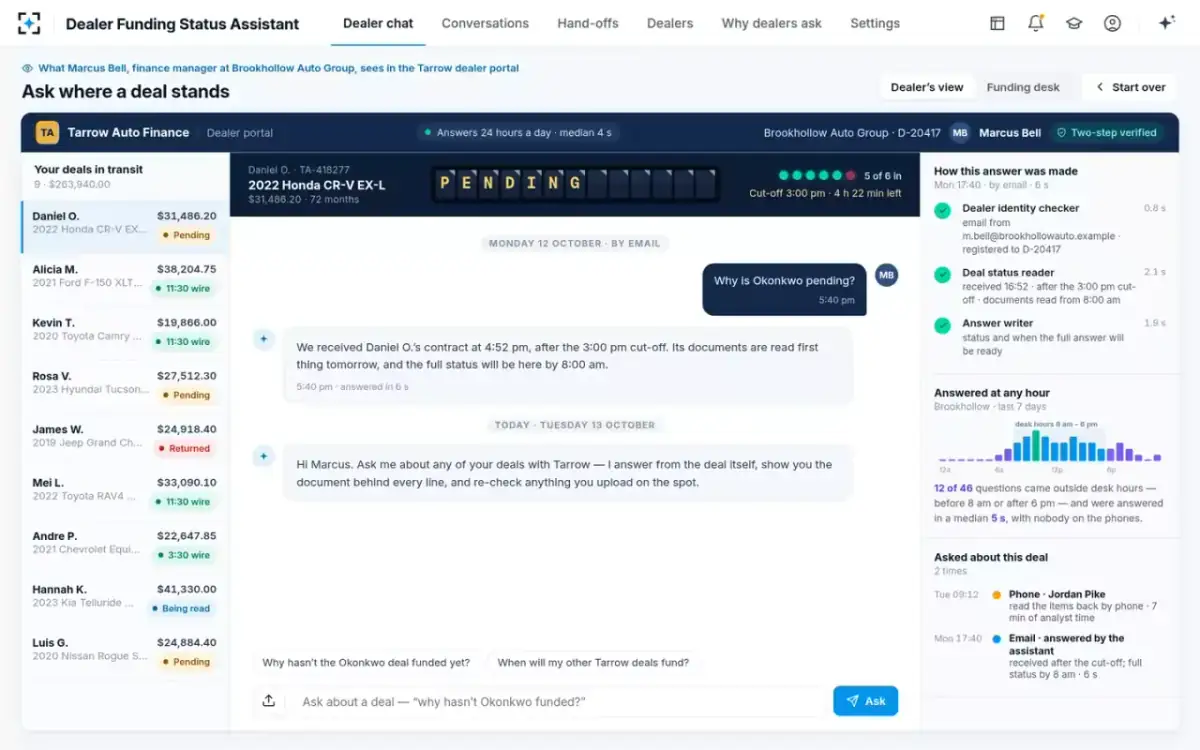
The desk and the dealership looking at the same deal
The work a desk can stop doing
Six specialist agents cover the mechanical half of the five checks and leave the third one alone. One confirms the person asking is a verified user of that dealership and that the deal belongs to them, masking the buyer to a first name and an initial. One reads the status, the conditions and the wire batch. One reads each document against the condition it answers and returns pass, review, fail or missing with the reason. One applies the cut-off, the wire schedule and the holiday calendar. One writes the reply in the dealership's words with a source on every line. The sixth routes anything needing judgement to the analyst the funding policy names. On a plain status question five of the six run, and the router stays out of it.
In the sample day, 371 of 412 questions were answered without an analyst, and the rest went to a named person with the deal, the rule and a drafted reply attached. The number worth watching is not the share answered, though, but what the desk does with the hours. Analyst time on status questions fell from 143 hours in the week before the assistant to 16 hours of hand-offs in a later week, which is about three and a half analysts back on funding contracts.
Every dealership, by how much it asks and why
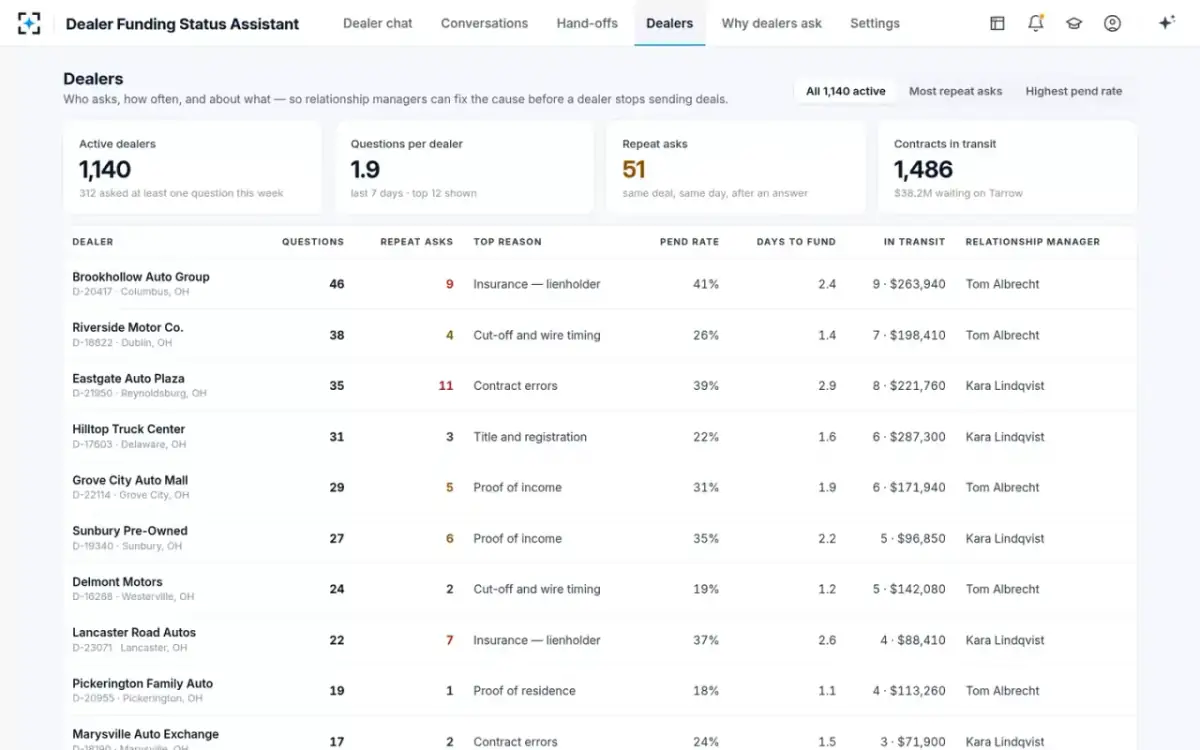
That last view is the one that changes the channel rather than the day. A dealership that asks forty-six questions in a week is not a nuisance; it is a signal, and in the sample data a third of its contracts arrive after the afternoon cut-off and a run of its deals carry the same insurance error. Fixing the agency that writes those policies removes the question, which is cheaper than answering it quickly. The lienholder wording on a declarations page is the worked example.
To see the desk, the dealerships and what goes to a person, start from Dealer Funding Status Assistant.
Questions people ask
What is the difference between direct and indirect auto lending?
In direct lending the buyer applies to the lender and the lender writes the loan. In indirect lending the buyer applies at a dealership, the dealership sends the application to several lenders, signs a retail instalment contract with the buyer, and the winning lender buys that contract. The buyer usually ends up paying the same lender either way; what differs is who met them, who set the rate and how much the lender knew when it said yes.
Who is the creditor on an indirect auto loan?
Typically the dealership is the creditor named on the contract, and the lender becomes the owner of the obligation when the contract is assigned to it. The OCC describes the lender's position as purchasing the contract as a holder in due course. For the buyer the practical answer is simpler: the party you pay, and the party that can repossess, is the lender whose name ends up on the title as lienholder.
What does a funding analyst do?
Checks that the signed contract is the deal the lender approved, and releases the money. That means reading the contract for errors, reading each document sent against the condition it answers, deciding or escalating any exception, working out which wire batch the deal can make, and telling the dealership where it stands. Only the exception is a judgement; the rest is reading against a standard.
What is dealer paper?
The OCC defines it as "Retail sales contracts underwritten and sold by a dealer to a financing source, such as a bank or credit union". In everyday use, a lender's "dealer paper" is the book of retail instalment contracts it has bought from dealerships, as distinct from loans it wrote directly with borrowers.
What is recourse in indirect lending?
A term in the dealer agreement letting the lender push a failed contract back. Under a recourse arrangement the lender may require the dealership to repurchase the contract or pay the deficiency if the buyer does not perform, and the dealership takes title to the vehicle. Under a nonrecourse arrangement the lender carries the whole risk. Recourse normally has time limits, and a lender that does not charge the contract back in time can lose the right.
How do banks oversee auto dealerships?
Through the dealer agreement, due diligence before signing it, and continuing monitoring of volume and quality afterwards. The OCC expects such arrangements to "include adequate due diligence and well-structured agreements that describe factors such as quality and volume expectations, and compensation parameters", and expects the bank's own controls to give certainty that the loans it bought match the criteria it published. In practice the live measures are a dealership's pend rate, its documentation failures by reason, and its exception volume.