Spot delivery is the sale of a car on the spot: the buyer signs, takes the keys and drives home before any lender has agreed to buy the contract. It is an ordinary practice, lawful as such, and common at weekends and evenings, when the people who can approve the financing have gone home and the buyer has not. It is also the arrangement behind the worst thing that can happen to a car buyer — a telephone call days later saying the deal did not hold. The distance between those two endings is almost entirely information: whether anybody can say, on the first morning, what the lender is actually waiting for. Botminds' Dealer Funding Status Assistant answers that question from the deal itself, naming the open condition, the document behind it and the wire the deal can still make.
Everything on this page about the product is the solution's own sample data, on a fictional lender, Tarrow Auto Finance, fictional dealer groups and fictional people. The law and the rulemaking history come from the Federal Register, the Fifth Circuit, the OCC and Regulation B, linked where they appear.
What a dealer can see about a delivered car, and cannot
6
statuses on a dealer’s own list of delivered, unfunded deals — Pending, Being read, Returned, 11:30 wire, 3:30 wire, Funding today
1of 6
is Returned: the lender will not buy that contract as it is written
305
of 2,180 dealer questions in one week were an error on the contract itself — a signature, a VIN or an amount
What is spot delivery?
Spot delivery is delivery of the vehicle before the financing is final. The buyer signs a retail instalment contract at the dealership, the dealership sends that contract to a lender it has an agreement with, and the lender decides whether to buy it. Until the lender buys it and wires the money, the dealership is the one carrying the car — the state a contract in transit describes from the balance sheet's side.
Nothing about that is unusual. In the indirect channel the dealer writes the paper and the lender buys it, so there is always a gap between the signature and the money. What spot delivery adds is that the car leaves during the gap. The buyer has a car, a payment book and an insurance policy, and the deal is still conditional on documents nobody has read yet.
Two words are worth separating at the start. Spot delivery is the practice. A conditional delivery agreement is the piece of paper that makes the practice work: a short contract saying the sale depends on the dealership obtaining financing on the stated terms, and setting out what happens if it does not. The first is a timing decision; the second is where the buyer's protection either exists or does not.
What a spot delivery agreement actually says
It says, in substance, that the deal is not done. A conditional delivery agreement normally states that the sale is contingent on the dealership assigning the contract to a lender on the terms the buyer signed, gives a period in which that must happen, and says what each side must do if it does not — return the car, return the down payment, return the trade-in, and account for the miles driven in the meantime.
What it does not do is come from a single national template. The period differs between agreements and between states; so does whether the dealership may charge for mileage, whether the trade-in may already have been sold, and whether the buyer must be told any of it in writing. There is no federal number here, and a guide that gave you one would be wrong in most of the country. Read the agreement in front of you, and read your own state's dealer statute beside it.
The Federal Trade Commission's own rulemaking record shows how unsettled this is. When the Commission consulted on motor-vehicle dealer practices, commenters asked it to require, among other things, "a written disclosure that the consumer must sign advising the consumer that financing is not final" and "setting a short deadline by which the dealer must either arrange financing or cancel the transaction" (FTC, 89 FR 590). Those are asks, not law. The Commission declined to go that far, and said why.
Regarding additional provisions that would require certain contractual measures, such as finality clauses or prohibitions against financing-contingent sales, the Commission is concerned that requiring specific contract provisions would obligate dealers that are not engaged in spot delivery to change their contracts even though their customers do not experience harm stemming from spot delivery practices.
Federal Trade Commission, 89 FR 590 (4 January 2024)
That sentence is the whole regulatory posture in one line: the practice is not the problem, and the Commission would not restrict it for the dealerships that run it honestly.
The three ways a spot-delivered deal ends
A delivered, unfunded deal has exactly three endings, and they are not equally likely. Most fund as written, within a few days, once the documents arrive. A smaller number are rewritten — a different lender, a different term, a different rate, a new signature. A small number are unwound, and the car comes back.
One delivered car, three endings
- Delivered, contract sentday 0
- Conditions read, one openday 1
- Document arrives, clearedday 2
- Wire to the dealershipday 2
- Delivered, contract sentday 0
- Will not buy at this term or rateday 1–3
- Second lender, or new termsday 3–5
- Buyer signs again, then fundsday 5+
- Delivered, contract sentday 0
- No lender will buy itday 1–7
- Car, down payment and trade-in returnedday 7+
In all three lanes the first day is identical, and the second stretch is waiting. The ending is decided by what is in the file; the buyer's experience is decided by whether anyone said so while there was still time to act.
Who may do what, at each stage of a delivered but unfunded deal
| Stage | The dealership | The lender | The buyer |
|---|---|---|---|
| Car delivered, contract signed | Holds the paper and the risk; owes its wholesale lender for the unit | Has approved the applicant, not yet bought the contract | Has the car and a signed contract that is conditional |
| Contract sent, conditions open | Chases the documents its own file is short of | Reads each document against the condition it answers | Usually hears nothing, and assumes the deal is done |
| One condition fails | Can fix it the same day if it is told which one | Returns the contract with a reason, not a decline | Can often supply the missing document in an hour |
| No lender will buy it as written | May shop it again, or ask the buyer to re-sign on new terms | Owes a notice under Regulation B if nobody extends credit | May walk away; what they get back is set by the agreement and state law |
| The deal is unwound | Takes the car back and settles the down payment and trade-in | Is out of the transaction entirely | Should be no worse off than before the test drive |
Is spot delivery legal, and where is the line?
As a practice, yes; the line is not the delivery, it is what the buyer is told about it. Sending a car home on a contingent contract is not prohibited by federal law, and some states regulate it in their dealer statutes. What the Federal Trade Commission has treated as deceptive is telling the buyer the deal is final when it is not, or keeping the down payment and the trade-in as though there were a right to.
The clearest statement of that line is the Commission's own, drafted when it still intended to make a rule. Its prohibited-misrepresentation list ran to seventeen items; two of them are this exact situation. A dealer was not to misrepresent "When the transaction is final or binding on all parties", nor "Keeping cash down payments or trade-in Vehicles, charging fees, or initiating legal process or any action if a transaction is not finalized or if the consumer does not wish to engage in a transaction" (16 CFR 463.3(h) and (i), as published).
The Commission then spelt out how the two worked together, and the passage is the best short description of the harm anyone has written.
Under these provisions, if a consumer is under the impression that the transaction is final, and the dealer subsequently causes the consumer to return the vehicle to the lot because the transaction was not final, or the dealer takes or threatens to take possession of the vehicle but refuses to return the down payment or trade-in vehicle, the dealer has violated either Sec. 463.3(h), by misrepresenting the finality of the transaction, or Sec. 463.3(i), by falsely representing, expressly or by implication, that the dealer has a legal basis to keep the down payment or trade-in vehicle in the event the transaction is not finalized, or both.
Federal Trade Commission, 89 FR 590
That rule is no longer on the books, for reasons set out in the next section. The conduct it described is still reachable — through state dealer statutes, state unfair and deceptive practices acts, and the general prohibition in section 5 of the Federal Trade Commission Act that the rule was meant to make specific. What changed is that there is no national, itemised standard to point a dealership at. What a spot-delivered deal is governed by today is the agreement the buyer signed and the law of the state it was signed in, and those vary.
The lender is not a bystander in this. In the indirect channel the contract is written by a third party and bought by the bank, and the OCC is explicit about where the obligation lands: "Regardless of the loan origination source, the obligation to comply with all applicable laws and regulations and manage associated risks (e.g., consumer protection, fair lending, and OFAC) remains with the bank" (OCC, Retail Lending, version 2.0). A lender whose dealers routinely deliver cars and then cannot find out for a week what is holding the money has a third-party problem, not a correspondence problem.
What is yo-yo financing, and how is it different?
Yo-yo financing is spot delivery plus a misrepresentation and, usually, pressure. The Commission defined both terms together, and the definition is worth having in front of you because the two are so often used as though they meant the same thing.
Spot delivery and yo-yo financing refer to situations where a dealer delivers a vehicle to a consumer on the spot before the financing or leasing has been finalized, leads a consumer to believe that the transaction is final, and then later directs the consumer to return the vehicle and engages in certain tactics, such as failing to return the consumer's trade-in vehicle while refusing to honor the finance or lease transaction, or pressuring the consumer to enter into a new transaction.
Federal Trade Commission, 89 FR 590
Three elements, in order: delivery before finality, a belief that the deal is final, and tactics afterwards. The first on its own is a scheduling problem. All three together is the abuse the practice is notorious for. A dealership that delivers on a conditional agreement, says plainly that it is conditional, and tells the buyer where the deal stands every day until it funds has done the first thing and none of the rest.
This matters commercially as well as ethically. A buyer called back to re-sign at a higher rate is a buyer who will not return, and a dealer whose deals come back is a dealer a lender's relationship manager eventually has to visit. In the solution's sample data one dealer group's contracts pend at 41% against 28% for the desk as a whole — not because its buyers are worse, but because a third of its contracts arrive after the afternoon cut-off and a run of them carry the same insurance error.
What the FTC tried to do about it, and what happened
Four events, over two years, and the end state is that there is no federal motor-vehicle dealer rule. The sequence is worth knowing, because guidance written in 2024 can still describe the rule as though it were coming into force.
The CARS Rule, start to finish
| When | What happened | Where it is written |
|---|---|---|
| 4 January 2024 | The Commission published the Combating Auto Retail Scams Trade Regulation Rule, adding 16 CFR part 463, to take effect on 30 July 2024 | 89 FR 590 |
| 22 February 2024 | With a petition for review pending, the Commission delayed the effective date "until further notice" | 89 FR 13267 |
| 27 January 2025 | The Fifth Circuit held the Commission had failed to issue an advance notice of proposed rulemaking, and vacated the rule | Nat’l Auto. Dealers Ass’n v. FTC, 127 F.4th 549 |
| 12 February 2026 | The Commission withdrew the rule, removing part 463 from the Code of Federal Regulations to conform it to the court’s decision | 91 FR 6507 |
The court's objection was procedural rather than substantive: the Commission had not issued the advance notice of proposed rulemaking that the court held its own rules required for a rule of this kind. The judgment ends in two sentences.
This was not harmless error. … We GRANT the petition for review and VACATE the CARS Rule. We decline to here address NADA's remaining substantive challenges to the Rule.
United States Court of Appeals for the Fifth Circuit, No. 24-60013, 27 January 2025
Read the last sentence carefully. The court did not say the prohibitions were wrong; it said it was not reaching them. The Commission's withdrawal notice says the same thing in administrative language — that it is "simply undertaking the ministerial task of conforming these Rules to the results ordered by the circuit courts" (FTC, 91 FR 6507). Anyone designing a dealer-facing process today should treat the vacated list as a good description of what regulators think bad looks like, and their own state's law as the thing that binds them. The delay notice of February 2024 is the only reason the rule never applied in the interim.
What the lender's side of the deal looks like
The lender sees none of the showroom. It sees a contract arrive, with conditions attached to its own approval, and it either buys the contract or does not. Two consequences follow that dealerships and buyers both tend to miss.
The first is that a returned contract is usually not a decline. A deal can come back because a signature is missing, a VIN is transposed or an amount does not tie — the credit decision is untouched and the fix takes minutes. In the sample week, 305 of 2,180 dealer questions were about exactly that class of error. What the dealer needs in that moment is the name of the failing item, which is what a stipulation is and why each one fails sets out in detail.
The second is that the paperwork obligations are specific, and they are not the dealer's to improvise. Where a dealership shops one application to several lenders, 12 CFR 1002.9(g) settles who has to write to the buyer: if the buyer takes credit from one of them, the others owe nothing; if nobody extends credit, or the buyer takes none of what was offered, every lender that took adverse action owes a notice, directly or through a third party. A deal that nobody buys is not a deal that quietly disappears.
Regulation B also covers the much commoner case, where the file is simply short of something. Where a file is short of something the applicant can supply, 12 CFR 1002.9(c) gives the creditor thirty days to act on the application or to send a notice of incompleteness instead — one that names what is needed, sets a reasonable period to provide it, and says what happens if it is not provided. That is the regulation describing, in its own terms, the thing a funding desk spends its day doing by telephone.
Where the deal goes badly wrong, who absorbs it depends on the dealer agreement. The OCC sets out the two shapes: "There are two basic arrangements for receiving indirect loans or sales contracts from dealers: recourse and nonrecourse. With recourse agreements, the bank purchases the contract from the dealer and may exercise recourse by requiring the dealer to repurchase the contract or pay any deficiencies in the event of nonperformance by the consumer" (OCC, Floor Plan Lending, version 1.2). Under a nonrecourse arrangement the bank "assumes full responsibility for underwriting the loan and carries all of the risk, even though the dealer handles the loan application, initial contact, and interview."
The cure is information, not a longer agreement
One instinct, when spot delivery goes wrong, is to lengthen the contingency window. That is the wrong lever. A longer window does not make the missing pay stub appear; it makes the buyer's uncertainty last three weeks instead of one, and it leaves the dealership financing the car for longer.
The lever that works is telling the dealer what is open, on the first morning, in terms specific enough to act on. Every one of the three endings improves. The ordinary case funds a day or two sooner. The rewritten case starts its second conversation while the buyer is still reachable and before the trade-in has moved. The unwound case — the one that produces the complaint — is caught in days rather than weeks, which is the difference between an awkward call and a buyer who has already insured, fuelled and shown off a car they are about to lose.
The same delivered deal, with silence and with an answer
Nobody says anything: That the contract was sent.
The dealer can ask, and get an answer: Which condition is open, what is wrong with the document behind it, and what would satisfy it.
Nobody says anything: Nothing, so they assume the deal is done.
The dealer can ask, and get an answer: That one document is outstanding and roughly when it will be settled.
Nobody says anything: When somebody finally rings — often after the trade-in has been sold on.
The dealer can ask, and get an answer: The same day, while every part of the deal is still reversible.
Nobody says anything: A demand, days later, with the car already in the driveway.
The dealer can ask, and get an answer: A choice, offered early, with the reason attached.
Nobody says anything: Nothing, until a complaint arrives.
The dealer can ask, and get an answer: Which of its own conditions and which dealers produce the most unfunded days.
What the Dealer Funding Status Assistant shows on day one
The assistant answers the dealer's question where the deal is, at any hour, without pulling an analyst off funding. On a plain status question five of its six agents run: one confirms that the person asking is a verified user of that dealership and that the deal belongs to them, one reads the status and the conditions, one reads each document received against the condition it answers, one applies the cut-off and the wire schedule, and one writes the reply with a source on every line. The sixth exists to route anything needing judgement to a named analyst, and on a status question it stays out of the way.
A delivered deal, as the funding desk sees it
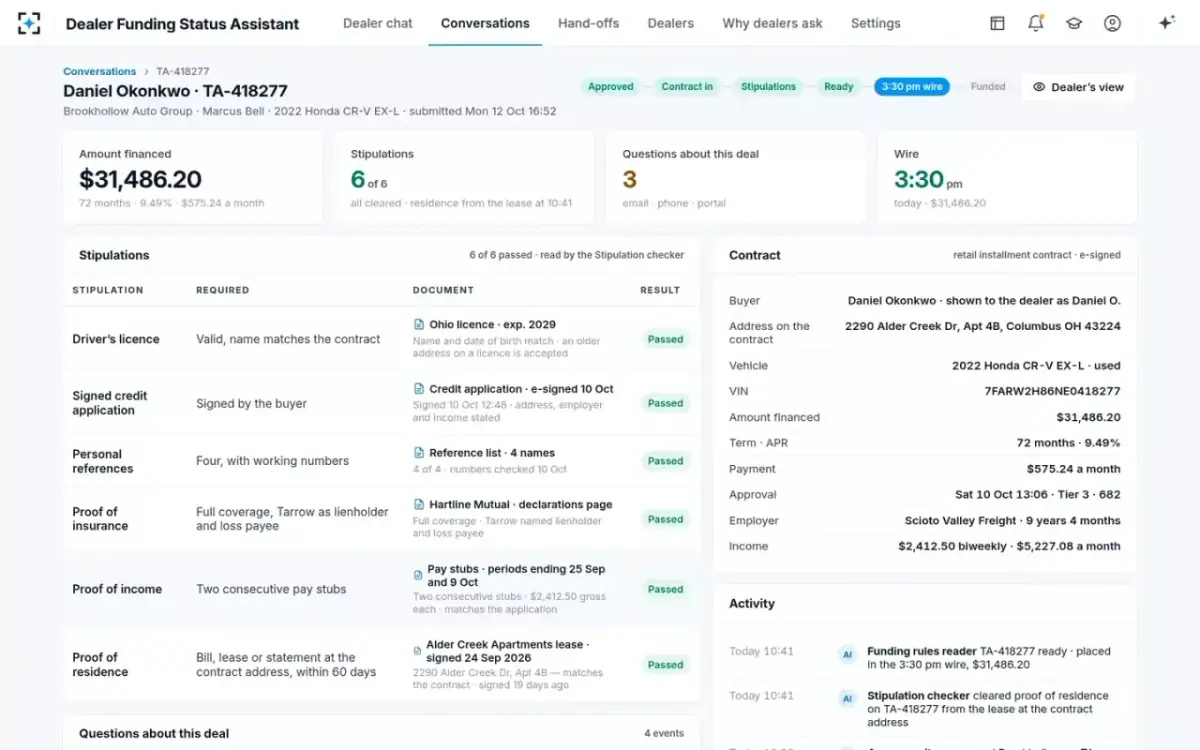
The status word a dealer sees matters more than it looks. A list that offers only Pending and Funded teaches a dealership to telephone, because Pending covers both "we have not opened it yet" and "we will not buy this". A list that distinguishes Being read, Returned and a named wire batch tells the dealership which of its delivered cars to worry about today — and same day funding on auto loans explains why that wire batch, not the payment system, is what sets the date.
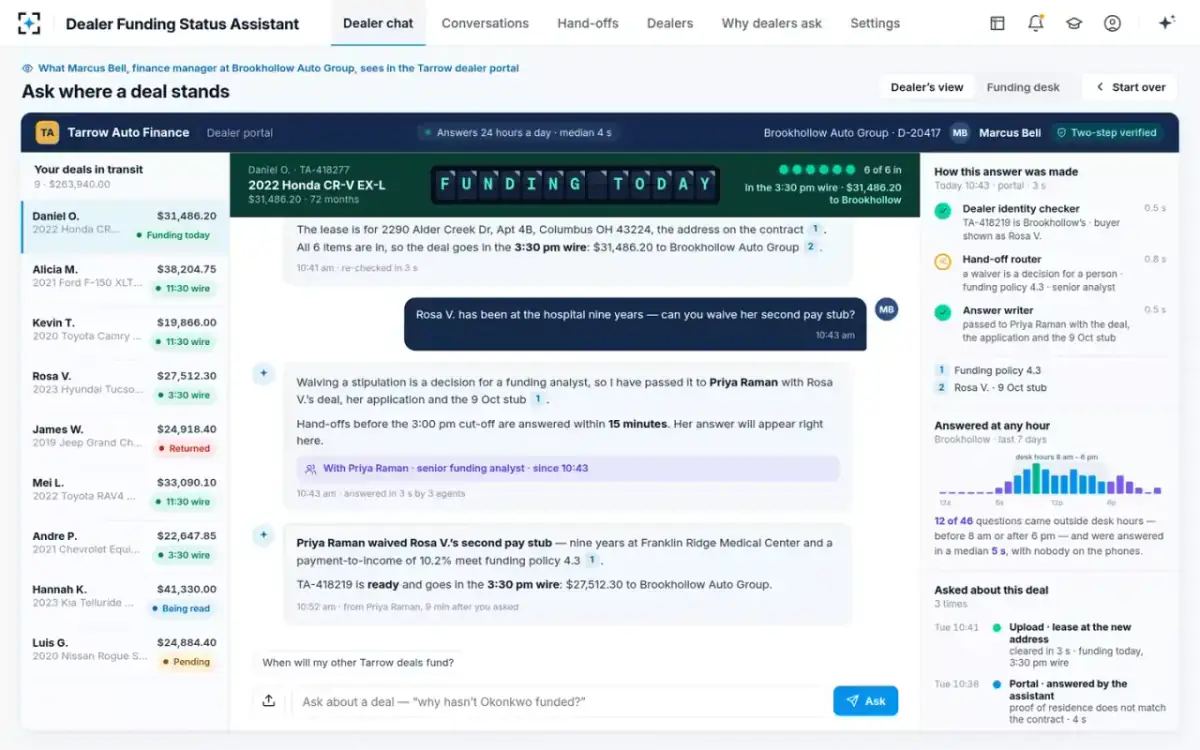
The limits are as important as the answers. No dealership sees another's deals. The buyer is shown as a first name and an initial. Rate, credit reasons and declines are never answered by an agent — they go to the analyst the funding policy names, with the whole deal and the rule that applies, and the decision and the reason come back into the same conversation the dealer was already in.
The analyst's decision, back in the dealer's thread
What a spot-delivered buyer should be told, and when
- That the financing is not final, before the keys change hands
In writing, in the buyer’s own words, and not only in the agreement’s small print.
- The date by which it must be settled
Whatever period the agreement gives, the buyer should be able to say it out loud.
- What happens to the down payment and the trade-in if it is not
Both come back. A dealership that cannot say so plainly is describing the thing regulators came after.
- Whether the trade-in has been sold on yet
This is the single fact that decides whether unwinding is clean or a dispute.
- What is actually outstanding, while it is outstanding
One missing document, named, is a solvable problem. "It is with the bank" is not.
- That re-signing is a choice, not a correction
A new rate or a longer term is a new deal, and the buyer may decline it and walk.
To see the status board, the conditions behind it and what goes to a person, start from Dealer Funding Status Assistant.
Questions people ask
Can a dealership take the car back after I drive it home?
If the sale was conditional on financing and the financing was never arranged, generally yes — the conditional delivery agreement is what gives the dealership that right, and the car goes back along with your down payment and trade-in. What a dealership may not do is tell you the deal was final and then take the car, or keep your money as though it had a right to. That combination is the conduct the Federal Trade Commission's withdrawn rule described as a misrepresentation of finality.
How long does a dealer have to find financing?
However long the agreement you signed says, which varies by agreement and by state. There is no federal period. Commenters asked the Commission to set "a short deadline by which the dealer must either arrange financing or cancel the transaction" and it declined, so the only deadline that binds anyone is the contractual one. If the agreement does not state a period, that is itself worth asking about before you take the keys.
What happens if financing falls through after I take the car?
One of two things. Either the dealership finds another lender, usually on different terms, and asks you to sign a new contract — which you may refuse — or the deal is unwound and you return the car. In both cases you should be no worse off than before: the down payment comes back, the trade-in comes back if it has not been sold, and nothing you signed obliges you to accept worse terms than the ones you agreed.
What is a conditional delivery agreement?
The short contract that lets a car leave before the financing is final. It states that the sale depends on the dealership assigning your contract to a lender on the agreed terms, gives a period for that to happen, and sets out what each side does if it does not. It is a different document from the retail instalment contract, and it is the one that decides what you are entitled to if the deal does not hold.
Do I get my down payment back if the deal is unwound?
Yes, and so should your trade-in. The Commission's vacated list treated a false claim of a right to keep either one as a prohibited misrepresentation in its own right. The practical complication is a trade-in the dealership has already sold on, which is why the first question to ask when a deal looks shaky is whether your old car is still on the lot.
Is spot delivery the same thing as yo-yo financing?
No. Spot delivery is the timing — the car goes home before the contract is bought. Yo-yo financing is spot delivery plus being led to believe the deal was final and then pressured afterwards. The Commission defined the two in one breath because the second is built on the first, but a dealership that says plainly that the deal is conditional, and keeps the buyer informed while it is, has done only the first.