AI in auto lending is usually discussed as a credit question, and for a dealer-facing agent it is not one. An agent that answers a dealership's question about a pending deal never decides anything about the buyer; it reads what the lender already decided and explains it. That makes its risks quite specific and quite unlike a scoring model's: it is talking to a third party about a consumer who is not present, over channels the third party chose, about a file that contains identifiers, employment and insurance details. Botminds' Dealer Funding Status Assistant answers those questions from the deal itself with a source on every line — and rate, credit reasons and declines are always handed to a person, because they are decisions and not explanations.
What this page says about the solution is its own sample data, on a fictional lender, fictional dealerships and fictional people. The rules are the Federal Trade Commission's Safeguards Rule, Regulation B and the OCC's retail lending handbook, linked where they appear; where a rule binds only some lenders, this page says so.
What a dealer-facing agent handed to a person in one day
42
of 412 questions were handed to a named analyst — a tenth of the day’s volume
5
kinds of question that are always a person’s: waiver, restructure, rate, exception, complaint
94%
of those hand-offs answered inside the 15-minute target, at a median of 8 minutes
Can AI answer customer questions for a lender?
Some of them, and the useful dividing line is not sensitivity but authorship. An agent can repeat a decision somebody already took, if it can cite where that decision is written. It cannot take a decision, and it cannot generate a document that the law treats as the creditor speaking.
In a funding desk's day most questions fall on the safe side of that line. "Why is this deal pending" has an answer written in the file: a condition is open, the document sent for it was short of something, and the next wire leaves at a known time. None of that is a judgement, which is why the answer can be read out by software and checked by anyone afterwards.
The questions on the other side of the line are a smaller, sharper set, and they are all decisions dressed as questions. "Can you waive the second pay stub" is a request for an exception. "Can we do this at eighty-four months instead of seventy-five" is a restructure. "What rate did we get" is pricing. "Why was my customer declined" is adverse action. In the sample day, forty-two of four hundred and twelve questions were of that kind, and all forty-two went to a person.
Is AI allowed in lending decisions?
Nothing prohibits a lender from using software in credit, and plenty regulates how. That is a different and much larger subject than this page: model risk management, fair lending testing, the explainability of a decision and the notices that follow it. What matters here is that a dealer-facing agent should be built so that the question does not arise — if it cannot approve, decline, price or restructure, it is outside credit governance by construction rather than by promise.
Supervisors are nonetheless watching the general direction. The OCC's retail lending examination procedures tell examiners reviewing a bank's plans to consider, among other things, "changes in the bank's use of models, including the use of alternative data" and the "use of emerging technologies such as artificial intelligence" (OCC, Retail Lending, version 2.0). An institution that can say precisely what its dealer-facing agent does and does not do, and show the setting that enforces it, has a much easier conversation than one that cannot.
Question by question: answered, or handed to a person
| What the dealership asks | Who answers | Why |
|---|---|---|
| Why is this deal pending? | The agent | The open condition and the document behind it are written in the file |
| What do you still need? | The agent | The unsatisfied conditions and what would satisfy each are the lender’s own published standard |
| Will it make today’s wire? | The agent | Cut-off, wire batch and holiday calendar are a schedule, and a time is given only where the schedule can keep it |
| Did the lease I uploaded clear? | The agent | The named tests on the document either passed or did not, and the reasons are shown |
| Can you waive the second pay stub? | A named analyst | A waiver is funding without the evidence policy asks for — a decision with a signature on it |
| Can we fund at a longer term? | A named analyst | A restructure changes the deal the lender approved |
| What rate did we get? | A named analyst | Pricing, and adjacent to the dealership’s own compensation |
| Why was my customer declined? | A named analyst | Adverse action: the notice is the creditor speaking, in a form the regulation prescribes |
| Anything, asked a third time the same day | A person calls back | Three asks means the written answer is not landing, whatever it says |
Proving who is asking
This is the first problem and the one most often waved through. A dealership's finance manager is not the lender's employee. They change jobs, they cover for colleagues, they forward emails, and they work at businesses that may have several roof-tops and several lenders. An agent that answers whoever writes to it is a data breach with a pleasant manner.
Three channels, three different proofs. In the portal, sign-in with two-step verification. By email, an answer only to an address registered to that dealership — never to a reply-to address a message asserts. By text, only to a number registered to that dealership. In the solution's sample data all three are in force before anything is said, and a question that does not check out gets a refusal that explains itself rather than silence.
The Federal Trade Commission's Safeguards Rule states the authentication requirement in a form worth copying into a requirements document, and it is strict about the exception.
Implement multi-factor authentication for any individual accessing any information system, unless your Qualified Individual has approved in writing the use of reasonably equivalent or more secure access controls.
16 CFR 314.4(c)(5), FTC Safeguards Rule
Two notes on who that binds, because it is widely overstated. Part 314 "applies to the handling of customer information by all financial institutions over which the Federal Trade Commission ('FTC' or 'Commission') has jurisdiction" — finance companies, independent auto finance providers and the like. Banks and credit unions fall outside it, because the rule reaches only financial institutions not "otherwise subject to the enforcement authority of another regulator" under the Gramm-Leach-Bliley Act, and are bound by their own regulators' guidelines instead. The requirement is a sound design standard for everyone; the citation is only correct for some.
Four Safeguards Rule requirements a dealer-facing agent touches, and how each shows up
| Requirement | What the rule says | In a dealer-facing assistant |
|---|---|---|
| Access controls, §314.4(c)(1) | Authenticate and permit access only to authorized users, and limit their access "only to customer information that they need to perform their duties and functions" | A verified user of that dealership, asking about a deal that belongs to it; the buyer shown as a first name and initial |
| Multi-factor authentication, §314.4(c)(5) | For any individual accessing any information system, unless the Qualified Individual approves an equivalent in writing | Two-step sign-in in the portal; answers by email or text only to an address or number registered to the dealership |
| Monitoring and logging, §314.4(c)(8) | Monitor and log the activity of authorized users and detect unauthorized access or use | Every question, answer, refusal and hand-off kept per deal, with the settings version in force |
| Service providers, §314.4(f) | Select providers able to maintain safeguards, require them by contract, and assess them periodically | The assistant’s vendor is a service provider to the lender, and is overseen as one |
Showing only that dealership's deals
Identity establishes who is asking. Least privilege decides what they may see, and the two are separate controls. A verified finance manager at one dealer group has no claim on another group's deals, and no claim on the parts of their own buyer's file that the dealership did not send.
So the agent checks two things on every enquiry, not once at setup: that the person is a verified user of a dealership, and that the deal in question belongs to that dealership. The buyer is then shown as a first name and an initial — configurable to initials only, or to the full name, by the lender rather than the vendor. No dealership sees a social security number, a date of birth or a credit report, whatever it asks and however it asks.
How much of the buyer a dealership needs to see
What the work requires: A first name and an initial — enough to know which of their own deals is meant.
What gets handed over by default elsewhere: Full name, often with the co-applicant.
What the work requires: None. The deal reference identifies the deal.
What gets handed over by default elsewhere: Social security number or date of birth, "to confirm we are discussing the right file".
What the work requires: Nothing at all.
What gets handed over by default elsewhere: A score band, or the reason a tier was assigned.
What the work requires: What the dealership itself sent, and what each one was short of.
What gets handed over by default elsewhere: The whole file, including documents the buyer sent directly.
What the work requires: Nothing, including aggregate comparisons that could identify one.
What gets handed over by default elsewhere: "You are our slowest group this month" — a sentence about somebody else’s business.
What the work requires: Nothing; the dealership already has them.
What gets handed over by default elsewhere: Telephone and address, repeated back from the file.
Adverse action notices, and why an agent cannot write one
Because the notice is the creditor speaking, in a form Regulation B prescribes down to its contents. A notification when adverse action is taken "shall be in writing and shall contain a statement of the action taken; the name and address of the creditor; a statement of the provisions of section 701(a) of the Act; the name and address of the Federal agency that administers compliance with respect to the creditor," and either the specific reasons or a disclosure of the applicant's right to obtain them (12 CFR 1002.9(a)(2)).
That is a document with a named author and a legal addressee, and a dealership's finance manager is neither. There is a further trap in the indirect channel: because a dealership shops one application to several lenders, who owes a notice depends on what happened across all of them. A lender that lets a tool tell a dealership "your customer was declined because of their debt-to-income" has produced an unofficial statement of reasons that may be wrong, may be incomplete, and is certainly not the notice.
The right behaviour is narrow and dull: the agent says it cannot discuss a credit decision, names who can, and routes the question there. In the solution's sample data that route is part of the funding policy rather than an improvisation, and the dealership gets the hand-off and the expected time rather than a dead end.
What an AI assistant must refuse
Six refusals, and each should be demonstrable rather than promised.
Six refusals to test, live, before buying anything
- A deal that is not that dealership’s
Ask from one group’s login about another group’s deal reference. The answer should be a refusal that does not confirm the deal exists.
- Anything about the rate, the reserve or pricing
Three phrasings, including one that hides the question inside a status enquiry.
- A credit decision or its reasons
Including the polite version — "roughly why did it not fly?" — which is where products usually give way.
- A waiver or an exception
The correct answer names the analyst it is going to and the time it should take, and does not hint at the likely outcome.
- A funding time the schedule cannot keep
Ask at four in the afternoon about a same-day wire. A product that says "it should go today" has just cost a dealership its evening.
- The buyer’s identifiers, however the question is framed
Including "can you confirm the last four digits so I know we are on the same deal?" — the deal reference does that job.
A seventh behaviour is not a refusal but belongs beside them: saying "I do not know" and routing, rather than assembling a plausible answer from what is nearby. A dealer-facing agent with no visible uncertainty path will fill the gap, and it will do it in writing, to a counterparty who will quote it back.
A source for every line
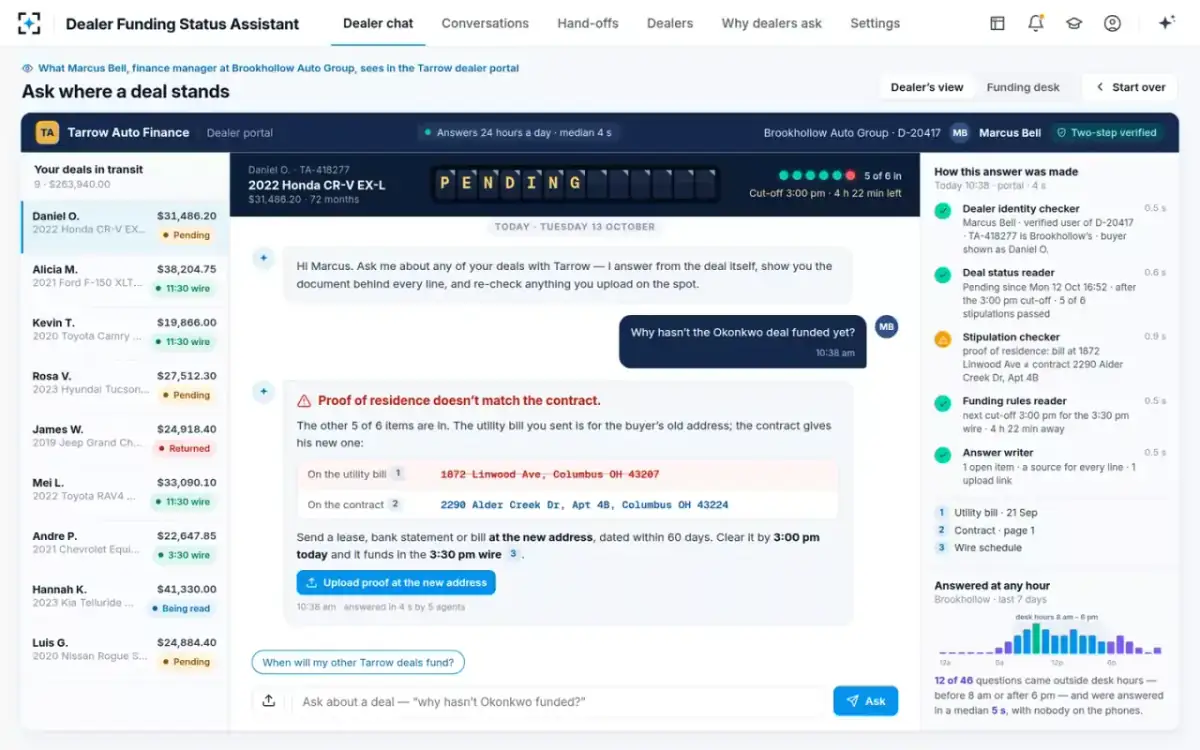
Every line of an answer should cite the thing it came from — the page of the utility bill, the clause of the funding policy, the wire schedule — and the citation should open for the dealership and for the analyst. This is the control that makes the rest auditable, and it is also the one that most improves the answers, because a line that cannot be sourced does not get written.
It changes the conversation with the dealership too. An answer that says "proof of residence does not match the contract" invites an argument. The same answer with the two addresses set one above the other, each pointing at the document it came from, ends one. Each condition and the way it fails works through what a sourced answer looks like for each of the six on a typical deal.
One answer, with what each line rests on
How to audit an AI assistant
By reading one deal end to end, not by reviewing a policy document. Everything that was asked about it, everything that was answered, every document uploaded, every hand-off, and every decision a person took, with names and times. If that trail cannot be produced for a deal chosen at random, the assistant is not auditable whatever its documentation says.
The Safeguards Rule again states the requirement in a usable form, and it is about users rather than systems.
Implement policies, procedures, and controls designed to monitor and log the activity of authorized users and detect unauthorized access or use of, or tampering with, customer information by such users.
16 CFR 314.4(c)(8), FTC Safeguards Rule
Note the second half. The log is not only there to reconstruct a dispute; it is there to notice a pattern — a dealership asking about deals that are not its own, a volume of enquiries that does not match its volume of deals, a login used from two places at once. An agent sitting between a lender and a few hundred dealerships is in an excellent position to see those patterns, and a poor one to be the only thing watching for them.
Three things make the trail useful rather than merely large. It is per deal, so a reviewer can start from a complaint. It carries the refusals as well as the answers, because what was declined is the evidence the limits work. And it records which version of the settings was in force, so a decision from March is read against March's rules.
Who approves what it may say, and when a person calls back
A named person at the lender, and in the solution's sample data that is the funding team lead, with the current settings at version seven, approved on the second of October. The point is not the version number but the ownership: what a lender's agent may say to its dealerships is a lender's decision, and it should be changeable by the lender's own team lead in the same week its funding policy changes.
Those settings are also where the escalation behaviour lives — the fifteen-minute target for a hand-off in the hour before a cut-off, and the rule that a question asked a third time the same day gets a telephone call from a person whatever it is about. Both are deliberately blunt. They exist because the failure mode of a fast written answer is that it is fast, written and not understood, and the only reliable repair for that is a human voice.
What reaches a person, and what it arrives with
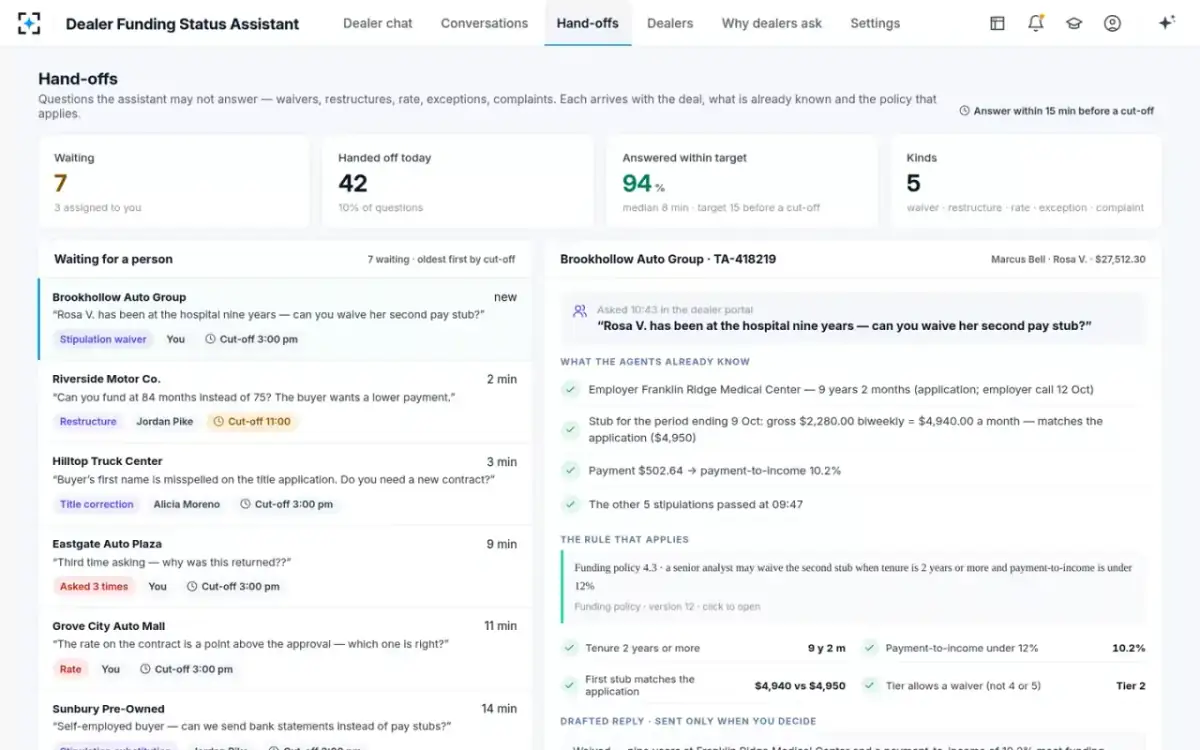
One closing argument, because it is the part buyers under-weigh. The reason to draw these lines tightly is not timidity; it is that a narrow agent is a useful one. An assistant that answers only what is written in the file, refuses everything else and hands it on with the work already done, can be given to three hundred dealerships on a Monday. One that tries to be helpful about rate and waivers cannot be given to anybody without a lawyer in the room.
To see the answers, the refusals, the hand-offs and the settings that govern them, start from Dealer Funding Status Assistant.
Questions people ask
Can AI give a credit decision?
A lender may use software in credit, under its own model risk management and fair lending controls, but a dealer-facing assistant should not be that software. The cleaner design is one that cannot approve, decline, price or restructure at all, so the question of whether it decided anything never needs to be litigated. In the solution's configuration rate, credit reasons and declines are always a named person's.
What is multi-factor authentication required for?
Under the FTC's Safeguards Rule, for any individual accessing any information system — unless the institution's Qualified Individual has approved in writing the use of reasonably equivalent or more secure controls. That rule binds the financial institutions the FTC supervises, such as independent finance companies; banks and credit unions are covered by their own regulators' guidelines. Either way, for a dealer-facing portal it is the right default.
What customer information may a dealership see?
As little as the work needs, and it should be the lender's setting. In practice that means the buyer as a first name and an initial, the documents the dealership itself sent, and what each one was short of. It does not mean a social security number, a date of birth, a credit report or anything about another dealership's deals — and a request framed as "just to confirm we have the right file" is answered with the deal reference.
What is an adverse action notice?
The written notice a creditor must give when it takes adverse action on an application. Regulation B prescribes its contents: the action taken, the creditor's name and address, a statement of the relevant provision of the Act, the name and address of the federal agency that administers compliance for that creditor, and either the specific reasons or a disclosure of the applicant's right to obtain them. It is a creditor's document, which is why no assistant should be generating one or summarising it to a dealership.
How do you audit an AI assistant?
Pick a deal at random and read it end to end: every question, every answer with its sources, every upload, every refusal, every hand-off and every decision a person took, with names, times and the version of the settings in force. If that can be produced in minutes, the assistant is auditable. Reviewing the vendor's policy documentation instead tells you what was intended, not what happened.
Who is responsible when an AI answer is wrong?
The lender. Supervisors treat an outsourced process as the institution's own, and the obligation to comply with the law does not move to a third party because the work does. Practically, that is an argument for the design this page describes: a narrow agent whose every line is sourced, whose refusals are logged, and whose settings are approved by a named person is one a lender can actually stand behind when an answer turns out to be wrong.