Auto finance software is the stack an auto lender runs between a credit application arriving and the last payment clearing: an origination system that decides credit, a servicing system that collects, and a funding operation in between that turns an approval into money in a dealership's account. Buy any three of those and you still will not have answered the question a dealership's finance manager asks six times a day — where is my deal, and what do you still need. That answer is a fourth, dealer-facing layer, and it is the thinnest part of the market. Botminds' Dealer Funding Status Assistant is that layer: it answers a dealership from the deal itself, with the open condition, the document behind it and the wire the deal can still make, and it hands anything needing judgement to a named analyst.
This page is written to be used against any vendor, including us. The product numbers in it are the solution's own sample data on a fictional lender and fictional dealerships, not results measured at a customer. The regulatory requirements come from the OCC, the CFPB and the Federal Trade Commission's Safeguards Rule, linked where they appear.
The two numbers this layer is designed to move
4s
to answer a dealership’s status question on the sample data, five agents, a source for every line
9in 10
status questions answered without an analyst: 371 of 412 on the sample day
16h
a week left on hand-offs, against 143 hours a week of status questions before
What auto finance software covers, and what it does not
Three things are well served by the market. Deciding credit is served: scorecards, decision engines, programme rules by tier, integration with the platforms dealerships already use. Booking and servicing are served: payments, collections, titles, total losses, payoffs. Reporting is served, sometimes lavishly.
What is thinly served is the conversation. Between approval and wire sits a stretch of days where the dealership has delivered a car, the lender has conditions outstanding, and the only channel between them is a telephone. Every lender has a funding desk for this; very few have anything that answers for it. The gap is structural rather than accidental. As the shape of the indirect channel shows, shared platforms long ago standardised how a credit application reaches a lender and how an approval comes back to a dealership's finance department. Nothing ever standardised the conversation afterwards, so every lender built the same thing privately: a desk, and a telephone number.
So the question to settle before you look at a single demonstration is which of the four layers you are short of. A lender whose analysts spend their day on dealer calls may find that the shortage is the fourth, not the first.
The four layers, and which one you are buying
The four layers of auto finance software
| Layer | What it decides or does | What it will not tell a dealership |
|---|---|---|
| Origination | Whether to approve the applicant, on what terms, with which conditions attached | Why the signed contract has not been bought yet |
| Funding operations | Whether the signed contract matches the approval, and releases the wire | Anything at all, unless a person types it |
| Servicing | Payments, collections, titles, payoffs, total losses, after the loan is booked | Nothing about a deal that has not funded; the loan does not exist there yet |
| Dealer-facing answers | Answers the dealership’s question about a pending deal, from the deal, with its sources | — this is the layer whose whole job is to tell a dealership |
A note on the layer nearest this one. A loan origination system decides credit; a dealer-facing answering layer explains a decision that has already been made. Those are different products with different risk profiles, and anybody selling you one as the other should be asked to be specific. The test is simple: ask whether the thing you are being shown can decline an application. If it can, it is an origination system and it belongs under your credit governance. If it cannot — and it should not be able to — it is an explanation layer, and what matters is identity, least privilege and accuracy.
What a dealer-facing layer has to do
Six jobs, and a product that does five of them is not useful. It has to prove who is asking before it says anything. It has to answer only about that dealership's deals. It has to name the open condition and what is wrong with the document behind it, rather than reporting a status word. It has to say what would satisfy the condition. It has to say which wire the deal can still make, using the real cut-off and holiday calendar rather than a promise. And it has to hand anything that is really a decision to a named person, with the deal and the rule attached.
The sixth is where products fail quietly. A layer that tries to be helpful about a rate, a credit reason or a waiver has walked out of explanation and into decision-making, and it has done so on the one channel where the counterparty's incentive is to push. What an agent may answer and what it may not works through that boundary question by question.
What this layer should answer, and what it should refuse
Answer, from the deal: Pending since when, which wire batch, how long before the cut-off.
Refuse, and route to a named person: —
Answer, from the deal: Which are satisfied, which is open, what the document sent was short of.
Refuse, and route to a named person: Whether to waive one.
Answer, from the deal: What would satisfy the open condition, and where to upload it.
Refuse, and route to a named person: Whether a substitute document is acceptable "just this once".
Answer, from the deal: The amount to be wired and the batch it goes in, where the schedule can keep it.
Refuse, and route to a named person: The rate, the reserve, or anything about pricing.
Answer, from the deal: Nothing.
Refuse, and route to a named person: Approvals, declines, reasons for a decline, restructures, term extensions.
Answer, from the deal: A first name and an initial, and the documents the dealership itself sent.
Refuse, and route to a named person: A date of birth, a social security number, a credit report, or another dealership’s deal.
Twelve questions to ask before you buy auto finance software
The first four are about truthfulness, the next four about security and control, the last four about whether it will still be useful in a year.
Twelve questions, and the answer you are listening for
- 1. Where does each line of an answer come from?
You want a citation to the deal or the document page, openable by the dealership and by your analyst. "Our model summarises the file" is not an answer.
- 2. Which of your published numbers were measured, and on whose data?
Design targets are legitimate; presenting one as a result is not. Ask for the measured ones and the denominator.
- 3. What does it do when it does not know?
It should say so and route to a person. A product that has no visible "I will not answer that" path will guess in front of your dealerships.
- 4. Show me it refusing a rate question.
Live, in the demonstration, in three different phrasings. This is the single most useful five minutes of any evaluation.
- 5. How does it know who is asking?
Portal sign-in with multi-factor authentication; email answered only from an address registered to that dealership; text only to a registered number.
- 6. How does it know the deal belongs to that dealership?
A check against your dealer directory and the deal itself, on every enquiry, not a one-time mapping at setup.
- 7. What buyer information can a dealership see?
It should be a setting you control, defaulting to the least — a first name and an initial — and it should never include identifiers or credit data.
- 8. What is logged, and can an examiner read it?
Every question, every answer, every upload, every hand-off and every decision, with who and when.
- 9. Who approves what it is allowed to say?
A named person at your lender, with versions and dates. If the vendor controls the wording, the vendor is writing your dealer communications.
- 10. What happens when your funding policy changes?
A setting change by your own team lead, the same week. Not a vendor release.
- 11. Which systems does it read, and does it write anything?
It should read your funding system, documents, wire schedule, policy and dealer agreements. A dealer-facing layer that writes statuses is a different risk conversation.
- 12. What does it cost when volume doubles?
Ask for the pricing shape, not the price: per question, per deal, per analyst seat, flat. The shapes behave very differently in a good quarter.
What it must never do
Four refusals, and all four are worth writing into a contract rather than trusting to good behaviour.
It must never show one dealership another's deal. This sounds obvious until you consider that a dealer group can have several roof-tops under one parent and several lenders in common, and that the person asking may have moved employer last month.
It must never answer a credit question. Rate, approval, decline and the reasons behind any of them are a lender's own decisions, and in the case of a decline they carry a notice obligation that belongs to a creditor and not to a tool.
It must never promise a funding time the schedule cannot keep. A dealership that reorganises its afternoon around a wire that does not go is worse off than one that was told nothing.
And it must never hold customer information more widely than the work needs. The FTC's Safeguards Rule, which binds the finance companies the Commission supervises, states the principle in the form worth putting in a requirements document.
Authenticate and permit access only to authorized users to protect against the unauthorized acquisition of customer information; and Limit authorized users' access only to customer information that they need to perform their duties and functions, or, in the case of customers, to access their own information.
16 CFR 314.4(c)(1), FTC Safeguards Rule
Note who that rule reaches. Part 314 applies to the financial institutions over which the Federal Trade Commission has jurisdiction, finance companies and the like, and not to those that answer to a different regulator under the Gramm-Leach-Bliley Act. If you are a bank or a credit union, your own regulator's guidelines bind you instead. Either way the rule is a good checklist, and a dealership is an "authorized user" in exactly its sense: "any employee, contractor, agent, customer, or other person that is authorized to access any of your information systems or data."
The security questions, written as acceptance tests
| What the rule expects | What to make the vendor show you |
|---|---|
| Authentication of authorised users, and least privilege | Two dealership logins from different groups, side by side, each seeing only its own deals |
| Multi-factor authentication for anyone reaching an information system | The second factor, live, and the written approval path if the vendor offers an equivalent control instead |
| Monitoring and logging of authorised users’ activity | The log for one deal: every question, answer, upload, hand-off and decision, with who and when |
| Secure disposal of customer information no longer needed | The retention setting, and who at your lender can change it |
| A named individual accountable for the programme | Whose name, on your side and on the vendor’s |
How to measure whether it worked
Four measures, and only the first is about the software. Take all four before you start, or you will be arguing about anecdotes in six months.
The return, as four terms you can measure
Analyst hours returned
(questions a week x minutes a question x share answered) / 60
Count the minutes before you buy anything: pick a week, log every status question and time twenty of them. In the sample data the figure was 4.5 minutes a question.
Funding team lead
Days to fund
days, before − days, after, on deals that pended on a document
Measure only the deals that pended for a document, or a change in mix will flatter you. The lever is the hours between a condition failing and the dealership hearing which one.
Funding operations
Questions removed at source
questions by reason, before − after
The cheapest answer is the question nobody asks. If one reason is a fifth of your volume, the fix is upstream of the desk and the measure should show it falling.
Dealer relationship management
What it costs you
integration + policy work + the approval of what it may say
The policy work is the real cost and it is yours, not the vendor’s: deciding what may be answered, what must be escalated, and to whom.
Team lead and compliance
Two traps in the measurement. Do not multiply an estimate by an estimate: in the solution's sample data, 143 analyst hours belongs to one week of 1,910 questions at 4.5 minutes each, and a later week's 2,180 questions is a different week — multiplying one by the other produces a number that means nothing. And do not measure the median answer time alone. A median of four seconds with a long tail of unanswered questions is worse for a dealership than a consistent twenty minutes.
What the measurement looks like in use
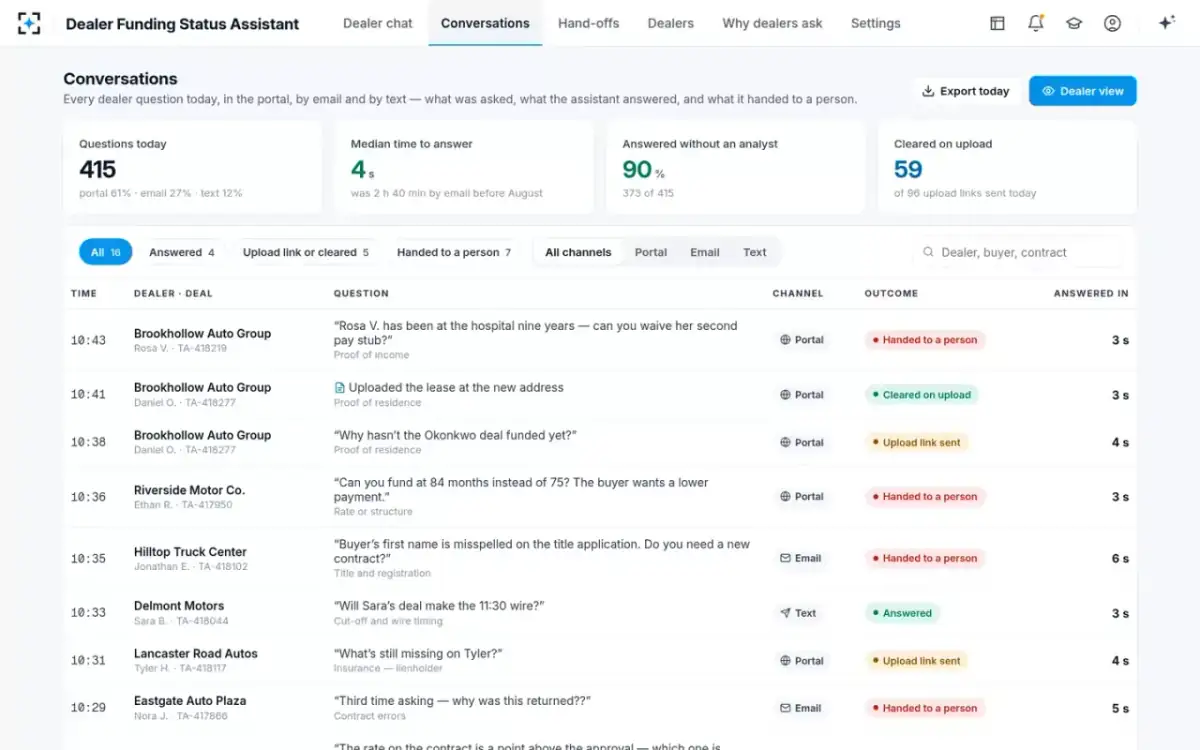
Where this solution fits, and where it does not
It fits when you already have an origination system and a funding operation, your approvals carry conditions, and your analysts are interrupted by dealerships asking where deals stand. It fits best when you have more than a handful of dealerships, more than one wire batch a day, and a documented funding policy — because what the assistant may say is read from that policy rather than invented.
It does not fit several situations, and it is worth being direct about them. It will not decide credit, so it is not an answer to slow approvals. It will not fix a documentation standard nobody wrote down: if your analysts disagree among themselves about what clears proof of residence, the first project is the standard, not the software. It will not help much at a lender with ten dealerships and one analyst who knows every deal by heart. And it cannot improve a funding time that is limited by a cut-off you set at two o'clock — that is a decision, and same day funding on auto loans sets out which parts of the clock are yours to move.
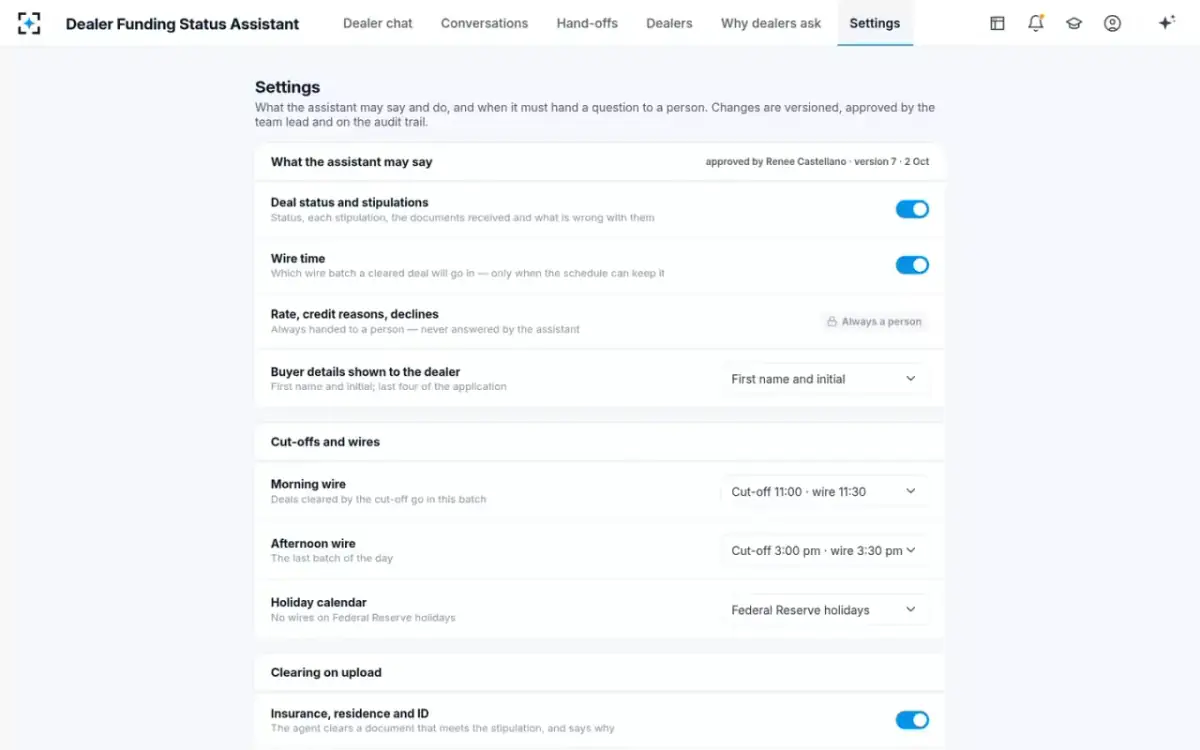
What it does change is the settings. The cut-offs, the wire batches, the holiday calendar, how much of the buyer's name a dealership sees, whether a document may clear a condition on upload and within what tolerance, how fast a hand-off must be answered in the hour before a cut-off, and what happens when a dealership asks the same thing a third time — all of those are your settings, versioned and approved by a named team lead, rather than a vendor's defaults.
The settings a lender keeps control of
What you bring to a pilot
A pilot that proves anything needs five things from the lender, and gathering them is a week of work that is worth doing whoever you buy from.
Your funding policy, written down, including who may grant which exception. Your documentation standard: what satisfies each condition, in what form, and within what age. Your wire schedule and holiday calendar. Your dealer directory, with who at each dealership may be told about which deals. And a sample of real past questions — a few hundred, across channels, with what the answer turned out to be — because that sample is the only honest way to test a dealer-facing layer before it talks to a dealership.
The OCC expects a bank's arrangements with third parties to rest on due diligence and on agreements that are specific about quality, volume and what each side is paid (OCC, Retail Lending, version 2.0). Applying the same discipline to a software vendor — named measures, named thresholds, named owners — produces a far better contract than a feature list does.
To see the answers, the refusals and the settings on real deals, start from Dealer Funding Status Assistant.
Questions people ask
What is auto finance software?
The systems an auto lender runs across the life of a loan: an origination system that takes applications and decides credit, a funding operation that checks the signed contract against the approval and releases the money, and a servicing system that collects payments and handles titles, payoffs and losses. A fourth layer — software that answers the dealership's question about a deal that has not funded yet — is a newer and much thinner part of the market.
What is the difference between a loan origination system and a servicing system?
An origination system works on applications and ends at the moment a loan is booked; it decides credit, holds the conditions attached to an approval and talks to the shared dealer platforms. A servicing system starts where the other stops: it carries the booked loan, takes payments, manages the title and handles delinquency and payoff. Neither of them knows anything useful about a contract that has been signed but not yet bought, which is the stretch a funding desk lives in.
How do you choose auto finance software?
Decide which layer you are short of before you look at products, then evaluate on refusals rather than features. The most informative part of any demonstration is watching the thing decline to answer a rate question, show one dealership's deals to another, or promise a wire its own schedule cannot keep. After that, measure: take your own baseline on analyst minutes a question, days to fund on document-pended deals, and question volume by reason.
What should a dealer portal do?
Prove who is signing in, show that dealership's deals and nothing else, name the open condition on each pending deal and what the document sent for it was short of, accept the replacement document in the same place, and say which wire the deal can still make. A portal that shows a status word and a telephone number has moved the telephone call, not removed it.
How much does auto finance software cost?
There is no honest single figure, because the four layers are priced in different shapes — per application, per booked loan, per seat, per question, or flat with volume bands. The useful question in an evaluation is not the price but the shape, and what happens to it when your volume doubles. Ask for the shape in writing, and model it against your best quarter rather than your average one.
Should you build this yourself?
Building the read-only part is genuinely feasible: a status lookup against your own funding system is, in our estimate, a small project. What takes the time is everything around it — identity for every channel a dealership uses, the reading of documents against conditions, the cut-off and holiday arithmetic, the refusals, the logging an examiner will read, and the settings that let your team lead change what may be said without a release. Price that list honestly before deciding, and note that the hardest items are the governance ones rather than the technical ones.