Contracts in transit are retail instalment contracts a dealership has signed with its buyers and sent to a lender, but for which the lender has not yet sent the money. The car has gone home, the buyer has started a loan, and the dealership is carrying the price of the vehicle until the lender buys the contract and wires. On a dealership's balance sheet the total sits with cash and receivables as a near-cash asset; on the lender's side it is a queue of deals waiting on documents. Botminds' Dealer Funding Status Assistant answers the dealer's question about that queue from the deal itself, naming the open condition, the document behind it and the wire the deal can still make.
Everything on this page about the product comes from the solution's own sample data: a fictional lender, Tarrow Auto Finance, a fictional dealer group, Brookhollow Auto Group, and fictional people. The market and regulatory figures come from the Federal Reserve, the OCC and the CFPB, linked where they appear.
The pipe the contracts move through
$211B
of new auto loans appeared on credit reports in a single quarter
$1.71T
of auto loan balances outstanding at the end of that quarter
$28B
that the quarter added to the outstanding balance
What is a contract in transit?
A contract in transit is a signed retail instalment contract that has left the dealership and not yet been paid for. The dealership has delivered the vehicle and taken an obligation from the buyer; the lender has approved the credit but has not yet bought that obligation. Until the wire arrives, the dealership is the one with money in the deal.
The underlying arrangement is what the OCC calls indirect lending: a process in which, as its retail lending handbook puts it, "a bank purchases loan contracts from a dealer or retailer as a holder in due course and collects principal and interest payments from the borrower" (OCC, Retail Lending, version 2.0). The same handbook describes the dealer's part plainly: dealers "take loan applications from their customers and 'shop' them to banks for approval and funding." Approval and funding are two different events, and the gap between them is the transit.
That gap exists because approval is a decision about the buyer and funding is a decision about the file. The CFPB's auto finance examination procedures describe what the lender attaches to its approval: "After evaluating the applicant, indirect auto lenders may provide the dealer with purchase eligibility criteria or stipulations, including but not limited to a risk-based 'buy rate'" (CFPB, Auto Finance examination procedures). Those stipulations are the conditions the file must satisfy before the lender will buy the contract. What a stipulation is and why each one fails is the subject of its own guide.
Whose money is it while the contract is in transit?
The dealership's, and usually its floor plan lender's as well. A new or used vehicle on the lot is normally financed by a wholesale line of credit, and that line is repaid out of the sale. The OCC's floor plan handbook describes the mechanics: "Upon sale of the inventory, the bank either requires cash from the dealer or receives proceeds from the indirect financing to retire the floor plan debt proportionally" (OCC, Floor Plan Lending, version 1.2).
So a contract in transit is a vehicle whose wholesale debt has not been paid off because the retail money has not arrived. The dealership is paying interest on a car it has already delivered; what each day of that costs, and how a lender's funding desk shortens it, is worked through in what each day in transit costs a dealership. Multiply that by a group's weekly volume and the position is material: in the solution's sample data, one dealer group has nine contracts in transit with one lender and $263,940.00 between them, which is nine cars it has delivered and not been paid for.
A dealership operates much like a cash-based business, and the essence of the dealership business model is to turn over inventory for cash proceeds in a relatively short time.
OCC, Floor Plan Lending, version 1.2
What does contracts in transit mean on a balance sheet?
It means a receivable that behaves like cash but is not cash yet, and the OCC treats it that way. Its measure of how long a dealership could survive without new sales, the cash burn ratio, puts contracts in transit directly beside unrestricted cash in the numerator.
Where contracts in transit sits in the OCC's cash burn measure
| Part of the ratio | What goes in it |
|---|---|
| Numerator, added | Unrestricted cash + contracts in transit + holdback + factory accounts receivable + inventory accounts receivable + new inventory |
| Numerator, taken away | Reserve for doubtful accounts + new floor plan debt outstanding |
| Denominator | Operating expenses less depreciation, plus cash interest paid, cash tax paid, current portion of long-term debt and curtailment paid, divided by days in the statement period |
| What the answer is | The number of days the dealership could sustain its current operations with no new sales |
That placement carries an assumption: the money is expected soon. The ratio treats contracts in transit as nearly cash because, in a normal week, it nearly is. A balance that ages stops being near cash and starts being a question, which is why the aged schedule, not the total, is the number worth reconciling.
Reading a contracts-in-transit aging, bucket by bucket
| Days since the contract was submitted | What it usually means | What to do |
|---|---|---|
| 0–3 | Normal transit: the file is being read, or waits for the next wire batch. | Nothing beyond knowing the lender’s cut-offs; a contract sent after one funds a day later. |
| 4–7 | A condition is open: a document is missing, stale or does not match the contract. | Find the open condition on each deal and send the document to the place the lender named. |
| 8–14 | The fix has stalled, or the deal is waiting on a credit decision such as a waiver or a re-structure. | Escalate by name; check whether the buyer can still meet the condition at all. |
| 15 and over | A deal that may not fund as written, and the units a floor plan check will ask about. | Decide: re-contract with the same lender, move the deal to another, or unwind it. |
Why the floor plan lender watches the same number
Because contracts in transit is the dealership's answer when a floor plan audit finds a car missing from the lot. The wholesale lender counts vehicles; a vehicle that is gone and unpaid is either sold and in transit, or sold out of trust. The OCC defines the second: "A dealer sells out of trust when the inventory is sold and the funds are not immediately remitted to the bank to retire the corresponding debt."
The test the examiner applies joins the two ideas together, and it is worth reading twice.
A dealer is considered to have sold out of trust if a floor plan check determines that the dealer failed to pay the bank for sold inventory within the required time frame and that the amount owed is in excess of the dealer's available cash balances, or if the bank cannot verify any links between contracts in transit and the sold inventory.
OCC, Floor Plan Lending, Appendix D
Two things follow for a dealership. First, there is a required time frame, and it is short: the handbook notes that "dealers selling in large volume are usually granted a three-day leeway before proceeds from inventory sold must be received by the bank." Second, a contract in transit only protects the dealership if the link between it and the sold unit can be verified. The handbook tells the floor plan lender's inspectors to do exactly that: "Banks should also verify that missing inventory reportedly sold and unpaid is related to contracts in process, and such contract-processing time should be reasonable. Inventory covered by the floor plan that is sold but not in process of payment represents a breach of trust by the dealer."
What a floor plan check asks about a missing unit, and what answers it
| The inspector’s question | What answers it | What looks like a warning |
|---|---|---|
| Is the unit on the lot? | The unit, or proof it is out on a test drive or at a body shop; the dealer may be asked to produce it within a reasonable time, two days in the handbook’s example | A unit nobody can locate |
| If it is sold, is it in transit? | A signed contract submitted to a named lender, with the date and the deal number | A sale with no contract, or a contract with no lender |
| Is the transit time reasonable? | A status from the lender: being read, a named open condition, or the wire it is in | An old contract with no stated reason for the delay |
| Does it tie to the floor plan line? | The VIN on the contract matching the floored unit | A contract that cannot be linked to the sold unit |
This is the part that makes the dealer's phone call to the funding desk something other than impatience. The F&I manager asking why a deal has not funded is often asking on behalf of a controller who has to explain the same unit to a different bank on Friday.
Why is my contract still in transit? The reasons, and who can fix each
A contract stays in transit for one of a short list of reasons, and each has a different owner. Reading the status off the deal, rather than asking whether anyone has looked, is what turns a chase into a fix.
The statuses a contract in transit can be in, and what each asks of the dealership
| Status | What it means | Who acts |
|---|---|---|
| Being read | The lender has the file and is checking it against the conditions. | Nobody yet; the answer comes from the lender. |
| Pending: a condition is open | One named document is missing, stale or does not match the contract. | The dealership, by sending that document to the deal. |
| Returned: a contract error | The contract itself must be corrected and re-signed. | The dealership and the buyer. |
| With an analyst | A question the file cannot answer: a waiver, a different term, a credit matter. | A named person at the lender. |
| Cleared, after the cut-off | Nothing is wrong; the contract missed today’s last wire. | Nobody; it funds in the next batch. |
| In a wire | Cleared and batched; the money moves at the wire time shown. | Nobody. |
On the sample data the reasons are concentrated. Of 46 questions one dealer group asked in a week, a third were about one condition: the insurance declarations page naming the lender as lienholder.
Why one dealer group asked about its contracts in transit, in one week
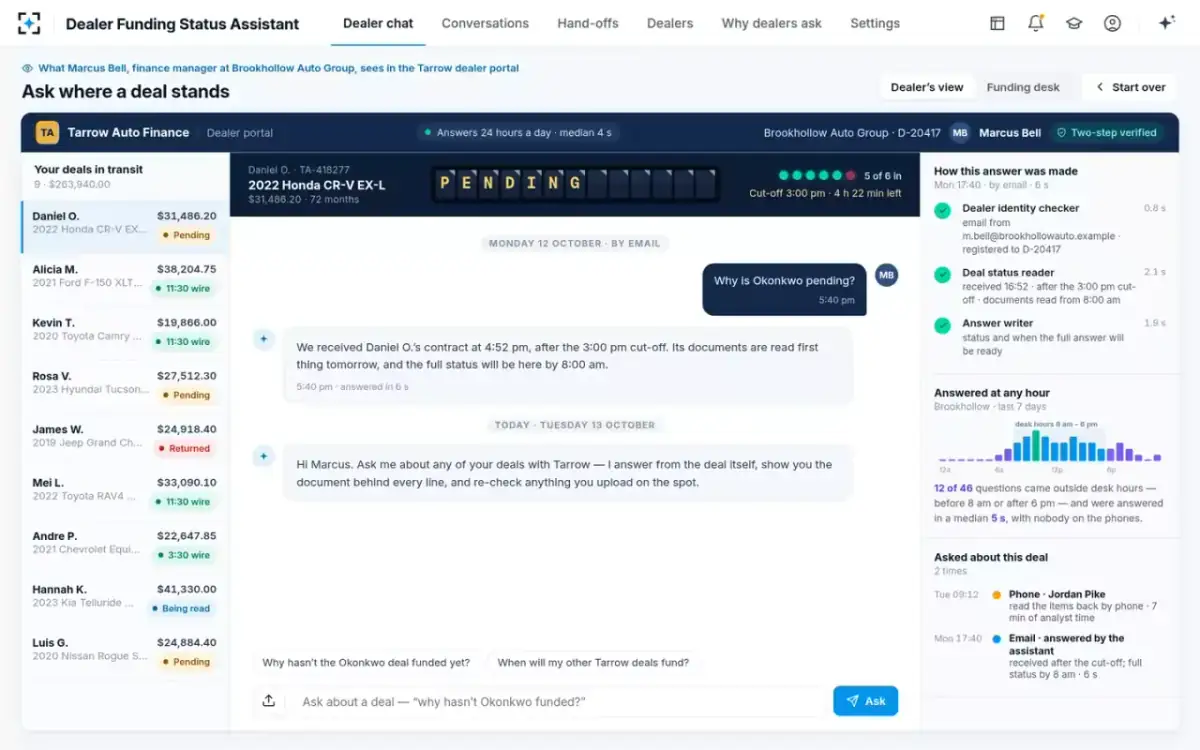
On one of those deals, a 2022 Honda CR-V EX-L financed at $31,486.20, five of the six conditions passed on submission. Proof of residence did not: the document sent showed 1872 Linwood Ave, and the contract showed 2290 Alder Creek Dr, Apt 4B. Nothing about the buyer or the credit decision was in doubt, and the money did not move until a lease at the contract address arrived. What each condition asks for, and why each fails, is in auto loan stipulations, from the dealership's side.
What the status question costs, asked by phone
The question costs the lender more than the answer is worth. In the solution's sample data the funding desk's week before the assistant went mostly into the conversation about the documents: taking the call, finding the deal, reading the conditions back and ringing the dealer afterwards.
On the solution's estimate, that was 143 analyst hours a week at 4.5 minutes a question, against 16 hours of hand-offs once dealers could ask the deal directly; the split is drawn in same day funding on auto loans. Two parts of it are worth separating. Reading a document against a condition is work that has to happen, and it is the work that makes the decision. Reading the result back down a telephone line is not: it is the same four facts, repeated to one person at a time, by someone who could be funding deals instead.
One deal, asked about twice, and the same deal asked about once
- Contract in, after cut-offMon 4:52 pm
- Emailed6 s
- Overnight
- Phoned next morning7 min
- Answered from the deal4 s
What a dealer sees instead of a phone call
How long should a contract stay in transit?
There is no regulatory figure, because the number is set by the lender's own funding policy and its cut-off schedule, not by law. The useful benchmarks are the ones either side of the gap. The wholesale lender's three-day leeway is one: a dealership that is routinely past it on a given lender's paper has a problem worth naming. The payment rails are the other, and they are much faster than most funding calendars admit — the Fedwire Funds Service runs to 7:00 p.m. eastern time, with transfers for a bank's customer accepted until 6:45 p.m. (Federal Reserve Board). Same day funding on auto loans works through the schedules in detail.
What is worth measuring is not the average but the tail. A book where most deals fund in a day and a handful sit for a fortnight is a book with a document problem, and the aged schedule names which dealers have it. In the solution's sample data, one dealer group's contracts pend at 41% against 28% for the desk as a whole, with 31% of its contracts arriving after the 3:00 pm cut-off — two different causes, each with a different fix.
Two ways to report the same queue
The total: One number: the dollars of contracts in transit at month end.
The aged schedule by reason: Every deal by age, with the open condition and the dealer it belongs to.
The total: Whether the number moved.
The aged schedule by reason: Which units are at risk on the next floor plan check, and why.
The total: Nothing; the lender does not see it.
The aged schedule by reason: Which of its own conditions produce the most unfunded days.
The total: A call to the funding desk.
The aged schedule by reason: A document, sent to the right place.
Answering the question without an analyst
The question "why has this not funded" has a short, checkable answer: which condition is open, what is wrong with the document behind it, what would satisfy it, and which wire the deal can still make if it is fixed. All four come from the deal itself. None of them is a credit decision.
That is the division the solution draws. Six specialist agents cover the mechanical half — confirming that the person asking is a verified user of that dealer and that the deal belongs to them, reading the status and the conditions, reading each document against the condition it answers, applying the cut-off and wire schedule, and writing the answer with a source on every line. The sixth routes anything that needs judgement to a named analyst. On a plain status question five of them run; the router stays out of it.
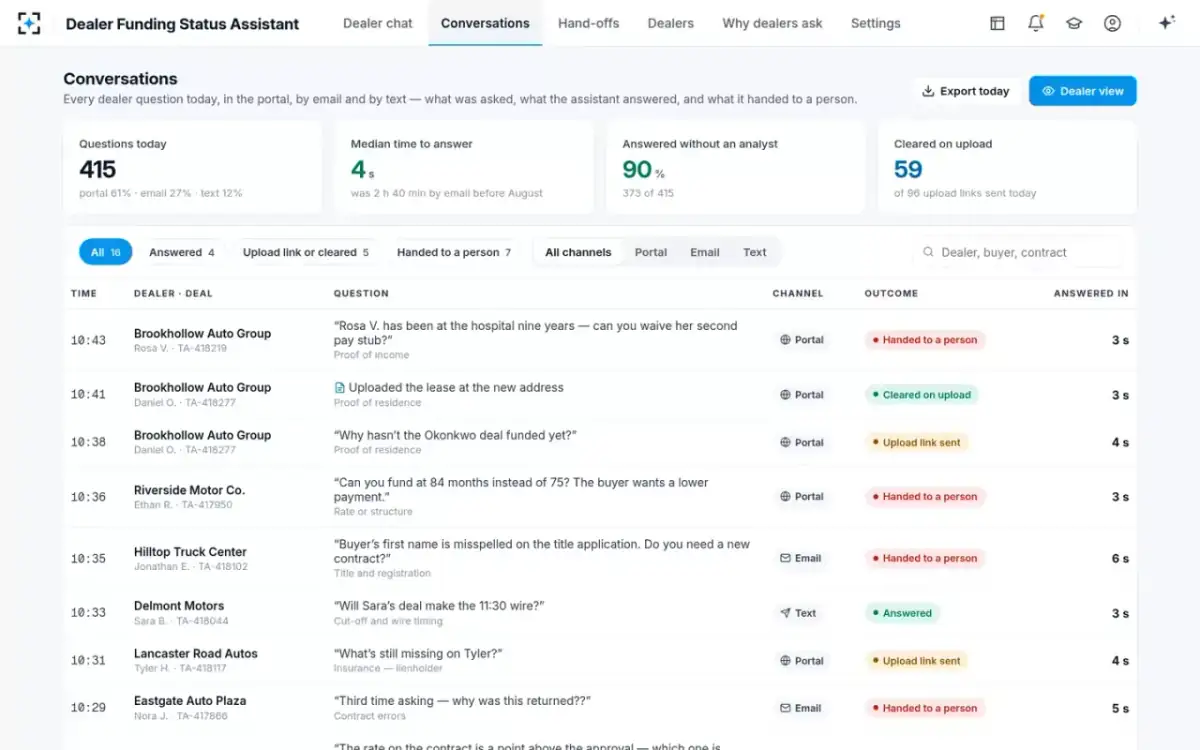
The limits matter as much as the work. No dealer sees another dealer's deal. The buyer is shown as a first name and an initial. Rate, credit reasons and declines are never answered by an agent. A waiver — the second pay stub a dealer asks to have dropped, for instance — goes to the analyst the funding policy names, with the whole deal and the rule that applies, and the decision is theirs.
Every question, every channel, in one place
What a dealership can do about its own transit days
- Age the schedule, do not just total it
A balance is a number; an aged schedule by lender and by open condition is a work list.
- Know each lender’s cut-off, not just its hours
A contract submitted after the cut-off funds a day later whatever the dealership does next.
- Fix the condition that recurs, not the deal in front of you
If one insurance agency keeps omitting the lienholder, the agency is the fix, not the file.
- Submit the file complete
Five of six conditions passing still means nothing moves. The last one is the whole delay.
- Ask where the deal is, not whether anyone has looked
A question that names the deal can be answered from it; a general chase cannot.
- Watch the tail, not the mean
The deals that sit for a fortnight are the ones a floor plan audit will find.
To see the status board, the conditions and the hand-offs on real deals, start from Dealer Funding Status Assistant.
Questions people ask
What does contracts in transit mean on a balance sheet?
It is a receivable: vehicles the dealership has sold and delivered, for which the financing lender has not yet paid. It sits with cash and other receivables as a current asset. The OCC's cash burn measure for dealerships adds contracts in transit to unrestricted cash in the same line, which is a fair summary of how the industry treats it — money that is expected within days.
How do you account for contracts in transit?
As a receivable: the amount the lender will pay for the contract is carried as contracts in transit until the funds arrive, and the floor plan debt on that unit is retired when the money lands. Because the balance is expected to clear in days, it is worth aging by lender and reconciling to the floor plan line, so that every sold, unpaid unit ties to a named contract; the dealership's accountant sets the recognition policy.
Who owns the car while the contract is in transit?
The buyer has the car under the retail instalment contract, and the contract gives the seller-creditor, the dealership, a security interest in it until the contract is assigned to the lender, which then holds it. How the lien is recorded on the title depends on the state. What is outstanding is payment to the dealership, which is why a delay in funding is a cash question for the dealership rather than a question about who has the car.
What does sold out of trust mean?
It is the wholesale lender's finding that a dealership sold a financed vehicle and did not remit the proceeds in time. The OCC's test has two limbs: the dealer failed to pay within the required time frame and owes more than its available cash, or the bank "cannot verify any links between contracts in transit and the sold inventory". The second limb is why an unexplained unfunded deal is more serious than it looks.
Why is my contract still in transit?
Almost always because one condition on the file is unsatisfied — most often the insurance declarations page, proof of income or proof of residence — or because the contract arrived after the lender's funding cut-off and is queued for the next batch. Both have specific answers that can be read off the deal, and neither requires a credit decision to explain.
What happens if a contract in transit is never funded?
The deal is rewritten or unwound. The dealership either finds another lender on terms the buyer accepts, or the vehicle comes back and the buyer's down payment and trade-in are returned, under the contract's terms and state law. The Federal Trade Commission has acted against dealers who, when financing fell through, pressured buyers into worse terms by threatening their down payments, which is why the unwind has to be handled exactly as the paperwork says. How that plays out at the dealership is in spot delivery and the deal that comes back.