Contracts in transit is the line a car dealership carries for vehicles it has sold and delivered but not yet been paid for by the finance source. The buyer has the car. The signed retail installment contract and the deal jacket are with the lender. The money has not arrived, and until it does the dealership still owes its floor plan lender for a vehicle that is no longer on its lot. Every day in that state costs the dealership interest on an asset it no longer has and costs the lender nothing at all, which is precisely why the line gets long. Botminds' Indirect Auto Contract Funding exists to shorten it: it reads each deal jacket the hour it is complete, checks the contract against its approval and funds the clean ones into the same day's wire.
The sample figures here come from a fictional book inside the solution — Sablewood Federal Credit Union, twelve dealerships, 837 deals funded in thirty days. The dealerships, buyers and deals are invented. The regulatory texts and the published rates are real, and every piece of arithmetic we do ourselves is labelled as ours.
The size of the gap, in public numbers
$211bn
of new auto loans appearing on credit reports in one quarter, most of them signed in a dealership
$41,705
average amount financed on a new car loan at finance companies, June 2026
7.00%
the bank prime loan rate on 21 October 2026, one of the indexes a floor plan line is priced over
What are contracts in transit, seen from the funding desk?
For the dealership, contracts in transit is a receivable: the amount finance sources owe for retail contracts submitted and not yet funded. How it is recorded, aged and reconciled is set out in contracts in transit as an asset, and why one is still waiting. For the lender, the same line is a measure of its own funding speed, booked on somebody else's balance sheet: every contract on it is a jacket the lender has received and not yet paid for.
The term is not dealership slang. It appears in the Comptroller of the Currency's own handbook on floor plan lending, in the test an examiner applies to a dealership's inventory: "The dealer's financial statement should show an inventory figure at least equal to the related floor plan liability as of the date of the financial statement. Unless the difference is represented by sales, factory receivables, or contracts-in-transit, a floor plan outstanding liability that is greater than the amount of inventory is an indication that the dealer may have sold out of trust" (OCC, Floor Plan Lending). Read that sentence from the retail lender's side and it says something uncomfortable: the contracts a lender has not yet funded are the explanation a dealership has to offer for a gap that otherwise looks like fraud.
How does a dealer pay off its floor plan when a car is sold?
Follow the cash. A dealership borrows against inventory on a floor plan line; the advance is repaid when the unit sells. "Upon sale of the inventory, the bank either requires cash from the dealer or receives proceeds from the indirect financing to retire the floor plan debt proportionally" (OCC, Floor Plan Lending). So the retail lender's payment is the thing that retires the wholesale debt. Until it lands, the dealership is paying for a car it has sold, and the retail lender has no asset on its books either, because it has not bought the contract yet.
Nobody in that chain is behaving badly, and nobody is being charged for the delay except the dealership. Floor plan interest "usually is payable monthly and is based on the average daily balance of the amount outstanding under the floor plan line", so the meter runs by the day, on the full advance, from the moment of delivery until the wire. The retail lender's cost of the same days is zero — it has not lent anything.
What does a contract in transit cost a dealer, per day?
The arithmetic is small per unit and large per month, which is exactly the shape of a cost that nobody fixes. Take one used vehicle floored at $30,000 — a round number we have chosen for the worked example, not a measured average — and carry it at three plausible rates.
The carry on one unsold-on-paper vehicle, per calendar day
The advance still outstanding
$30,000
The floor plan advance against the unit, which is not retired until the retail lender pays
The dealership
The rate, per year
× 7.00% to 11.00%
A floor plan line is priced over a short-term index, dealership by dealership; the bank prime loan rate stood at 7.00% on 21 October 2026
The floor plan lender
Divided by the days in a year
÷ 365
Interest accrues on the average daily balance of the line
The agreement
The carry
= $5.75 to $9.04 a day
On one unit, for every calendar day between delivery and the wire
The dealership
Now put the two clocks beside each other. In the solution's fictional sample book, the twelve dealerships waited a median of about 3.4 business days for funding before the solution went in — call it five calendar days once a weekend delivery is counted — and a median of 6.3 hours afterwards. Five days of carry on one unit is between $29 and $45; a quarter of a day is between $1 and $2.
What the wait costs one dealership on one vehicle, at three rates
Thirty dollars a car is not a number anyone escalates. It is, however, a number a general manager can feel across two hundred cars a month, and it arrives alongside a second cost that is harder to price: the salesperson who cannot be paid commission until the deal funds, the finance office that cannot close the month, and the buyer who calls on day four to ask whether the car is really theirs.
Why a slow retail lender makes a dealership harder to audit
"A dealer sells out of trust when the inventory is sold and the funds are not immediately remitted to the bank to retire the corresponding debt" (OCC, Floor Plan Lending). When a floor plan lender counts fewer cars on the lot than its line has financed, contracts in transit is one of the three explanations the OCC accepts for the gap, and each one has to be traced to a sold car. A slow retail lender therefore costs the dealership twice: the interest, and a larger balance to reconcile at every floor plan audit. How that reconciliation works, and what an examiner treats as a red flag, is the subject of the dealer-side guide to contracts in transit; from the funding desk the lesson is simpler: every hour a clean jacket waits is an hour on someone else's audit.
The lender's half of the clock is a cutoff, not a day
From the lender's side there is no "day" at all. There are wire batches, and a deal either makes the next one or waits for the one after. In the sample programme the batches go out at 11:00 and 15:00, funded thirty minutes before, so the real deadlines are 10:30 and 14:30. A jacket that is cleared at 10:31 is not thirty seconds late; it is four and a half hours late, and if it is cleared at 14:31 on a Friday it is three days late.
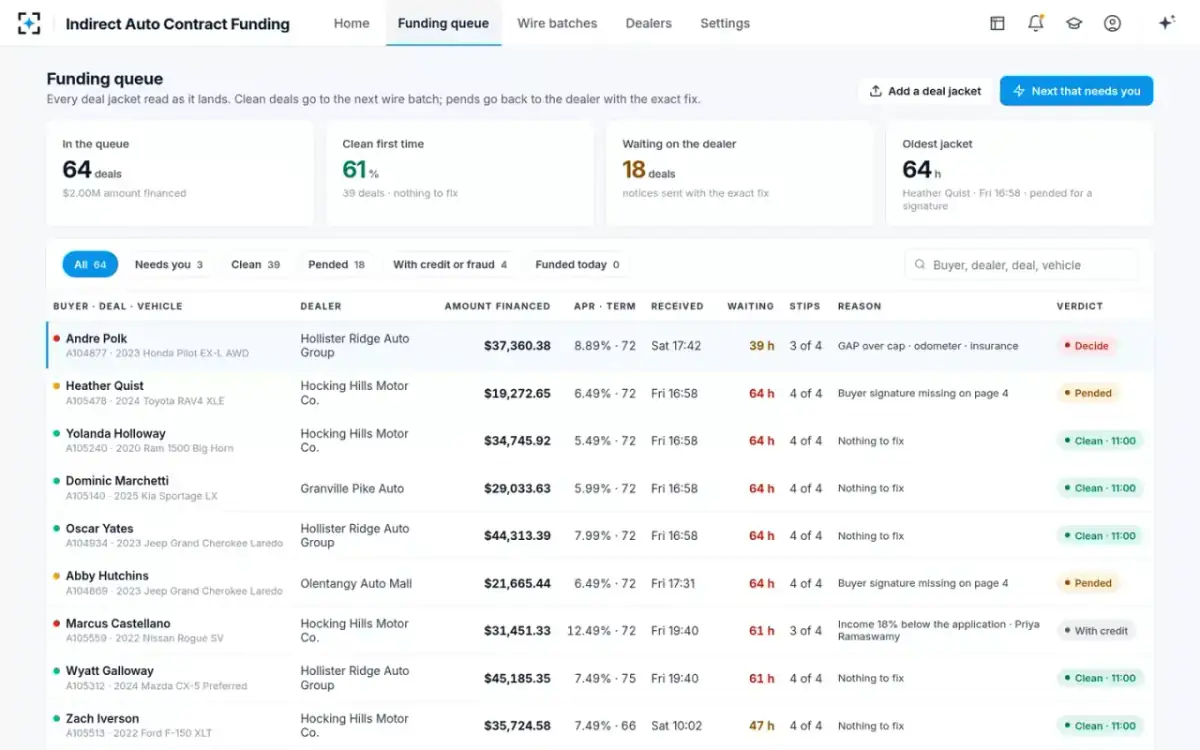
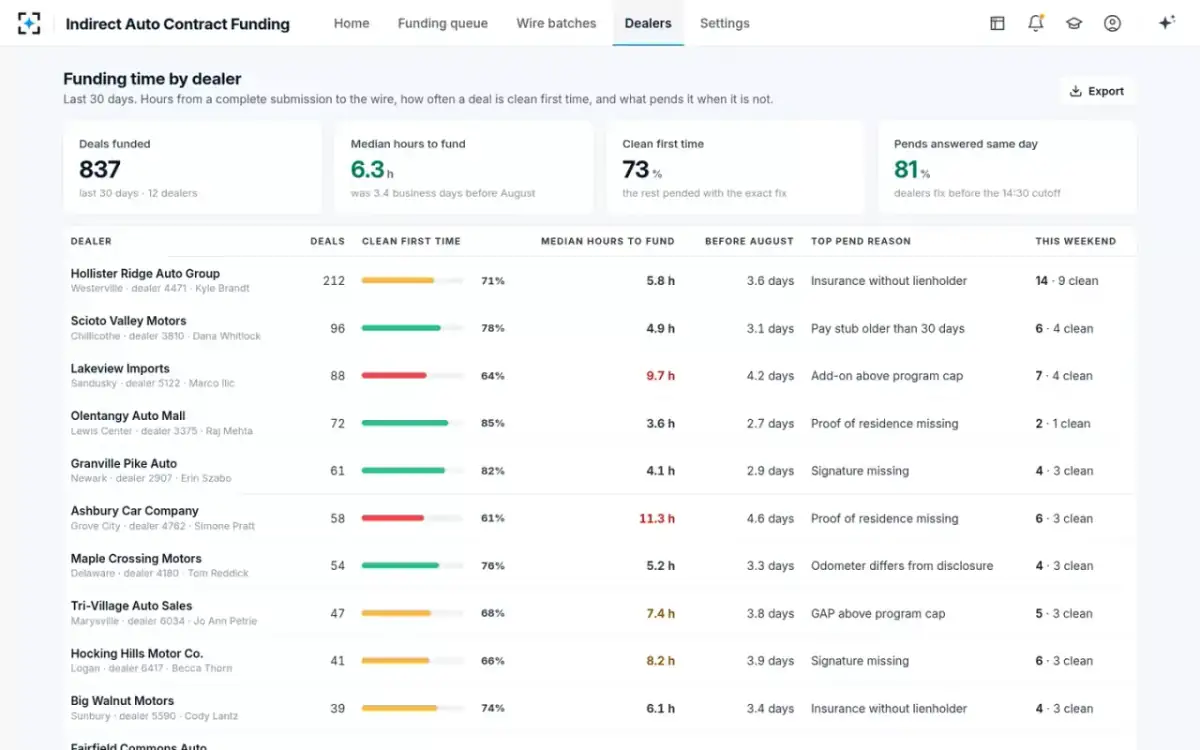
That is why the useful question is not "how long does funding take" but "what proportion of jackets clear before the next cutoff". The sample book answers it two ways: 61% of one weekend's 64 contracts were clean on first submission, and 81% of the pends were answered by the dealership before the 14:30 cutoff the same day.
One weekend's 64 contracts, by what the desk had to do with them
64 contracts received since Friday's cutoff
- Clean on arrival · 39 · 60.9%
- Pended with the fix named · 18 · 28.1%
- Needed a person: credit or fraud · 7 · 10.9%
Where the days actually go on one weekend of contracts
Split the wait into its parts and the surprise is how little of it is checking. On the solution's own estimate for a deal done by hand, more than a third of the elapsed time is the jacket sitting in a queue before anyone opens it, and another quarter is the round trip when something has to be fixed. The checking itself — laying eighteen terms beside the approval, reading four stipulation documents, recomputing the box — is half a day.
Where a deal's days go, by hand and with agents, drawn to scale
- Waiting to be opened1.5 d
- Checking against the approval0.5 d
- Clearing the stipulations0.5 d
- Pend, fix and re-sign1.0 d
- Missing the cutoff0.5 d
- Waiting to be opened
- Checking against the approval
- Clearing the stipulations
- Pend, fix and re-sign
- Missing the cutoff
Two of those five bars are pure waiting, and they are the two that automation removes without anyone having to decide anything differently. The third — pend, fix and re-sign — shrinks only if the notice the dealership receives is specific enough to act on in one pass, which is a writing problem as much as a processing one.
The queue, with the clock on every jacket
How a lender shortens the line
Four things shorten contracts in transit, and only one of them is about working faster.
Open the jacket when it arrives, not when someone reaches it. The largest single block of elapsed time is queue time, and it is created by batching work into a morning rather than by the work itself.
Check everything on the first pass. A deal pended twice costs two round trips, and the second one is usually for something that was visible in the original jacket. The point of reading all eighteen terms and all four stipulation documents at once is not thoroughness for its own sake; it is to make the pend complete.
Tell the dealership the fix, not the fault. "GAP over cap" is a status. "Re-sign with GAP at $995, which makes the amount financed $37,160.38 and the payment $667.81" is an instruction a finance manager can carry out before lunch. The difference between the two shows up directly in the proportion of pends answered the same day.
Publish the clock. A pend that says "if this arrives by 14:30 the deal funds in today's 15:00 wire" converts a vague wait into a deadline with a reward. The Comptroller's handbook notes the commercial reality driving all of this: "Dealers routinely transmit completed loan applications to multiple banks simultaneously. Dealers typically accept loans from banks offering the fastest response or the best buy rates" (OCC, Installment Lending). Speed is not a courtesy in indirect lending; it is part of the price.
Funding time, by dealership, with the reason each one waits
What a dealership can do from its side
Half of the transit time is created before the jacket is submitted. A finance office that sends a complete package the first time is measurably faster to be paid, and the sample book's spread — 61% clean first time at the weakest dealership against 85% at the strongest, and 11.3 hours to fund against 3.6 — is almost entirely a submission-quality spread rather than a lender-speed one.
The practical list is short: send the stipulation documents with the contract rather than after it; read the insurance card for the lienholder line before scanning it; check the odometer figure against the signed disclosure, which is the single most common copying error in a jacket; and make sure every signature line on every form is filled before the buyer leaves. What each of those documents has to prove is set out in the four stipulations and what clears them.
And on the lender's side, the person who turns a complete jacket into a wire is a specific seat with a specific day — the funding analyst. To see the queue, the cutoff clock and the funding-time report on real dealerships, start from Indirect Auto Contract Funding.
Questions people ask
What does "contracts in transit" mean at a car dealership?
It is the receivable for vehicles the dealership has sold and delivered but has not yet been paid for by the finance source. The contract has been submitted and the lender has not funded it. The balance is normal and expected; what matters is how large it is and how old.
How long do contracts stay in transit?
There is no published national figure, and it varies by lender, by dealership and by how complete the submission is. The useful measure is not an average but the share of deals funded before the next wire cutoff, because funding runs in batches rather than continuously. In the fictional sample programme here, the median was 6.3 hours and the slowest dealership's median was 11.3.
How does a dealer pay off its floor plan when a car is sold?
With the retail lender's payment. The OCC's floor plan handbook describes the floor plan lender either taking cash from the dealer or receiving "proceeds from the indirect financing to retire the floor plan debt". Until that wire arrives, the advance on the sold car stays outstanding and accrues interest on the daily balance.
Can a slow lender make a dealership look like it sold out of trust?
It can make the reconciliation harder. Selling out of trust is selling floored inventory without remitting the proceeds; a floor plan liability larger than inventory is a warning sign unless sales, factory receivables or contracts in transit explain it. The larger and older the transit balance a slow lender leaves, the more cars the dealership has to trace to a funded contract at audit.
Who pays for the days a contract spends in transit?
The dealership. Floor plan interest accrues on the average daily balance of the line until the advance is retired, and the retail lender's payment is what retires it. The retail lender's own cost for those days is nothing, because it has not advanced anything yet.
How can a lender reduce contracts in transit without cutting corners?
By removing the waiting rather than the checking: open each jacket as it lands instead of in a morning batch, check every term and every stipulation document on the first pass so a pend is never repeated, write the pend as an instruction with the arithmetic in it, and name the cutoff the fix has to beat. None of those relaxes a single underwriting condition.