Clearing auto loan stipulations at funding is what turns a conditional approval into a paid contract: a conditional approval on an auto loan holds only once its stipulations are met. The stipulations are the conditions a lender attaches to the credit approval: the documents it wants to see before it will pay the dealership for the contract. On an indirect deal they almost always come down to four — proof of income, proof of residence, proof of insurance and a valid identity document — each tied to something the underwriter assumed when the decision was made. They are not administrative tidying. An approval that assumed $6,250 a month of income is an approval of a payment that fits $6,250 a month, and until a document proves the income the approval is provisional. Botminds' Indirect Auto Contract Funding reads each stipulation document as the deal jacket lands, clears the ones a document genuinely proves, and sends the rest back to the dealership with the exact fix and the time it has to arrive.
Everything shown here comes from a fictional sample book inside the solution: Sablewood Federal Credit Union, twelve dealers, and one weekend of 64 contracts. The buyers, dealerships and documents are invented; the rules quoted are real and linked where they appear.
What stipulations decide, on one weekend of contracts
4of 4
stipulations on a typical approval: income, residence, insurance, identity
18of 64
contracts sent back to the dealership over one sample weekend, each with the fix named
30days
the outside clock a lender has under Regulation B to act on a completed application
What are auto loan stipulations?
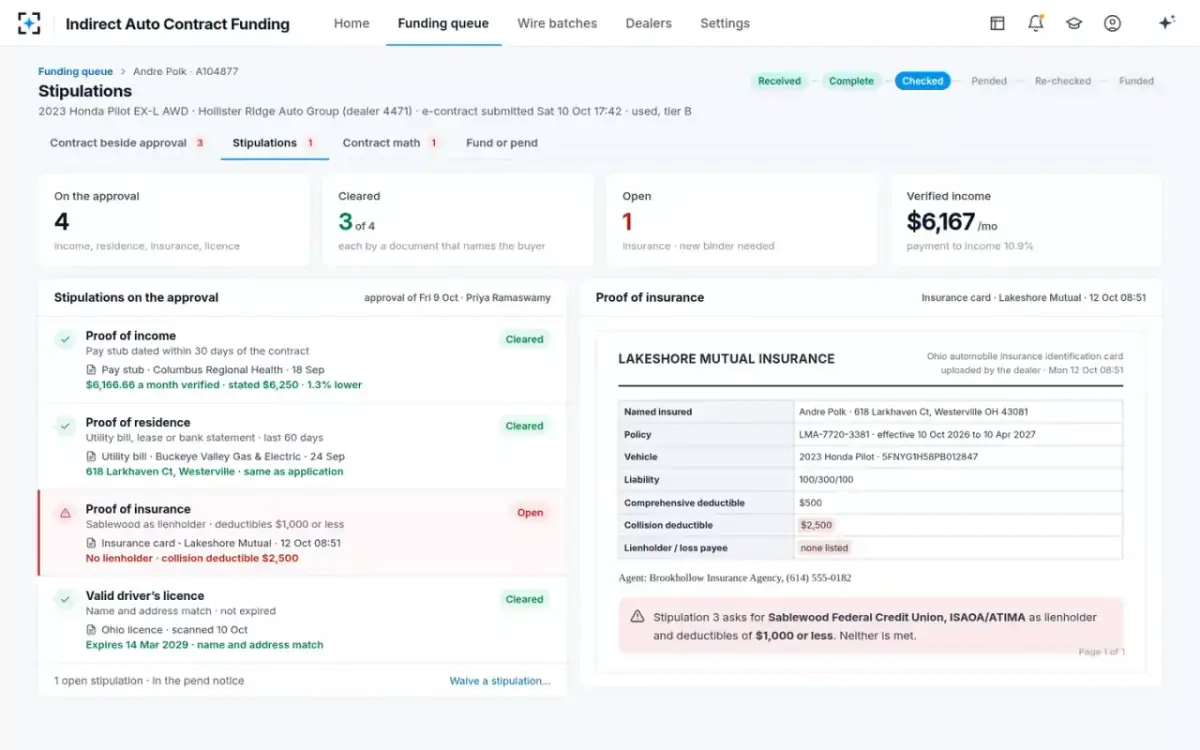
A stipulation — "stip" on every funding desk — is a condition written onto the approval by the person who approved it. Each one names an assumption the decision rests on and the kind of document that would prove it. The approval for the sample deal carries four: a pay stub dated within thirty days of the contract, proof of residence from the last sixty days, an insurance card naming the credit union as lienholder with deductibles of $1,000 or less, and an unexpired driving licence whose name and address match the application.
Stipulations exist because an indirect decision is made on information the lender did not gather. The dealership keyed the application; the lender scored it in minutes while the buyer was still in the showroom. The Comptroller's installment lending handbook describes what then has to happen: "The bank disburses loan proceeds to the dealer after the bank verifies document accuracy" (OCC, Installment Lending). NCUA is more specific about what verification means in practice, listing among the controls a credit union should have "quality control processes to ensure the credit union receives perfected liens, proof of insurance, and other necessary documentation, in addition to verifying the completeness, accuracy and validity of loan deals" (Letter to Credit Unions 10-CU-15).
The four stipulations that appear on almost every approval
The four are not interchangeable. Each proves a different thing, each has its own freshness rule, and each fails in its own way.
The four stipulations, the document that clears each, and what fails it
| Stipulation | What it proves | What clears it | What fails it |
|---|---|---|---|
| Proof of income | That the verified income supports the payment the approval allowed. | A pay stub dated within 30 days of the contract, showing year-to-date earnings and the employer; or tax returns and bank statements for the self-employed. | A stub older than the rule, a stub in a different name, or verified income more than the policy tolerance below what was stated. |
| Proof of residence | That the buyer lives where the application says, which is where the car and the notices go. | A utility bill, lease or bank statement from the last 60 days at the application address. | A document in a parent's or spouse's name only, a post-office box, or an address that does not match the licence. |
| Proof of insurance | That the collateral is covered and the lender is named on the policy. | A binder or card naming the lender as lienholder or loss payee, with physical damage cover and deductibles inside the limit. | No lienholder named, a deductible above the ceiling, cover that starts after delivery, or liability-only cover. |
| Valid identity | That the person who signed is the person who was approved. | An unexpired government photo identity document whose name and address match the application. | An expired licence, a different middle initial on the contract, or an address that was updated after the application. |
What documents clear a stipulation, and what fails one
The single rule that does most of the work is that the document has to name the buyer. A pay stub for the co-buyer does not clear the buyer's income stipulation. A utility bill in a landlord's name proves the address exists, not that the applicant lives there. An insurance card that lists the vehicle but no lienholder proves the car is insured and proves nothing about the lender's interest in it.
The second rule is that the document has to be read, not received. On the sample deal the insurance card is genuine, current and names the right car — and it fails anyway: the lienholder line reads "none listed" and the collision deductible is $2,500 against a $1,000 ceiling. A desk that ticks "insurance received" clears that stipulation. A desk that reads the card does not.
Four stipulations, three cleared, one read closely enough to fail
Proof of income: how fresh, and how close to the application
Two tolerances sit inside the income stipulation, and only one of them is usually written down. The first is freshness: the sample lender wants a stub dated within thirty days of the contract, which is a frequent cause of a pend when a deal is signed three weeks after the approval. The second is the gap between stated and verified income. The sample lender allows 5%; the deal above came in 1.3% below stated, so it clears. A deal that came in 18% below, as another contract on the same weekend did, is not a stipulation problem at all — it is a different application from the one that was approved, and it goes back to the credit analyst.
The reason a lender cares about the exact figure is that the payment is measured against it. The Consumer Financial Protection Bureau's auto finance data pilot, covering roughly 33.8 million loans originated between 2018 and 2022, put the average payment-to-income ratio at 8.2% for buyers with no trade-in, 7.7% where a trade-in had positive equity and 9.8% where negative equity was financed (CFPB, Negative Equity in Auto Lending). The sample deal sits at 10.9% of verified income against a programme ceiling of 15%, which is comfortable — but it would not be if the verified figure were the one the applicant estimated rather than the one the stub shows.
Proof of residence and identity: the name-and-address test
These two stipulations are a single test done twice, and they fail together more often than either fails alone. The question is whether one consistent identity runs through the application, the licence, the contract, the insurance and the title application. A middle initial that appears on the licence and not the contract is a five-minute fix at the dealership and a title problem six weeks later if nobody notices.
Address is the one that moves. A buyer who moved between applying and signing has a licence at the old address, a utility bill at the new one and a contract at whichever the finance office typed. The lender needs the notices, the title and the car to agree, so the stipulation is not satisfied by any single document but by the set of them pointing at one address. On the sample deal the Ohio licence, the utility bill and the contract all read 618 Larkhaven Ct, Westerville, which is what lets the identity and residence stipulations clear in the same pass.
Insurance: the lienholder line and the deductible ceiling
Of the four, insurance is the stipulation that most often arrives looking complete and fails anyway, and it is the top pend reason at the busiest dealership in the sample book. The lender is asking for three separate things on one card: that physical damage cover exists, that the lender is named as lienholder or loss payee — usually with the formula "its successors and assigns as their interests may appear" — and that the deductibles are inside the programme ceiling. A $2,500 collision deductible is not a clerical problem; it is $1,500 of the lender's collateral that the buyer would have to find in cash after a loss.
The top pend reason at each of ten dealers in the sample book
The limits that travel with the stipulations: loan-to-value, payment to income and the rate cap
Stipulations are the document half of the approval. The other half is a set of numbers the contract itself has to respect, and the Comptroller's handbook explains why they are set at deal level rather than borrower level: indirect underwriting criteria "should also include deal-related considerations, such as LTV/advance rate limitations and other collateral-based guidelines (new versus used, size of the transaction, down payment, and options financed). Together, these factors dictate the maximum amount financed, interest rate, and term of the loan" (OCC, Installment Lending).
The rate cap comes from the same place. A lender publishes a rate sheet carrying "the bank's buy rate … the maximum customer rate (interest rate the dealer can charge the customer), and term limits based on the age of the collateral", and the difference between the two is where the dealership's participation comes from. On the sample deal the buy rate is 6.89% and the contract rate 8.89% — exactly at the two-point markup cap, which is a pass, not a breach, and worth stating plainly because it is the kind of line a reader misreads at speed.
Loan-to-value is the limit most often missed at the dealership, because it moves with a number nobody at the desk controls. The CFPB's pilot found average loan-to-value of 101.7% where there was no trade-in, 89.1% with a positive-equity trade-in and 119.3% where negative equity was rolled in, with a median of 119.6% in that last group; 12% of the loans in the dataset financed negative equity. A buyer who is $5,000 underwater does not fail a stipulation — they fail the ceiling, and that is a credit question, not a document one.
A pend, written as the fix rather than the fault
Is a pend the same as a denial? What the rules call it
No, and the distinction has a regulation behind it. Regulation B treats an application that is incomplete "regarding matters that an applicant can complete" as its own category: the creditor may either act on it or send a notice of incompleteness "specifying the information needed, designating a reasonable period of time for the applicant to provide the information, and informing the applicant that failure to provide the information requested will result in no further consideration being given to the application" (12 CFR 1002.9(c)(2)). A pend sent to the dealership for a missing binder is the working version of that notice; if the lender relies on it as one, what reaches the buyer has to meet the rule: in writing, naming what is needed and the time allowed.
Two more lines of the same regulation shape what a funding desk may say. The clock to act runs thirty days from a completed application (§1002.9(a)(1)), so a stipulation that has never been satisfied has not started it. And an offer on different terms is not adverse action where "the creditor makes a counteroffer (to grant credit in a different amount or on other terms) and the applicant uses or expressly accepts the credit offered" (§1002.2(c)(1)(i)) — which is why a re-signed contract at a corrected price is a different event from a decline, and has to be recorded as one.
There is a consumer-protection reason to keep that boundary sharp. In a 2016 action against nine related Los Angeles-area dealerships, the Federal Trade Commission alleged that when third-party financing fell through, the dealers called buyers back, falsely told them they had to sign new, less favourable financing, and threatened their down payments or trade-ins if they refused (FTC, Deal or no deal?). A pend that names a document and a deadline is the opposite of that: it is the lender saying exactly what is missing, in writing, with the deal otherwise intact.
Can a lender waive a stipulation, and who may waive it?
Sometimes a stipulation cannot be met and the deal is still good: a buyer who has just started a job has no thirty-day stub, a cash buyer's utilities are in a spouse's name. A waiver is the right answer in those cases and the wrong answer as a habit, and the supervisory view is that it belongs to the person who made the credit decision, not to the desk that is trying to hit a wire cutoff. NCUA's letter is explicit that "exceptions to the indirect loan policy should be infrequent", that they should be approved by the people responsible for running the programme, and that they should be "reported to the board of directors for their review" (10-CU-15).
One stipulation comes with a federal consequence attached, and is worth knowing before anyone reaches for a waiver. The Military Lending Act does not reach "any credit transaction that is expressly intended to finance the purchase of a motor vehicle when the credit is secured by the vehicle being purchased" (32 CFR 232.3(f)(2)(ii)). A covered-borrower check and a contract that stays inside that exemption is a funding check in its own right, and it is the reason add-on pricing and cash-out requests are looked at harder on a servicemember's deal than on anyone else's.
The package that clears all four stipulations the first time
- A pay stub dated inside the lender's window, in the buyer's name
Count the days from the contract date, not the application date; a stub that was fresh when the deal was approved may not be when it is signed.
- Year-to-date earnings on the stub, not just the period
It is what lets the desk verify an annualised figure instead of multiplying one good fortnight.
- A residence document at the address on the contract
Utility bill, lease or bank statement inside the window, in the buyer's name, with the address written the same way as the licence.
- An insurance binder naming the lender as lienholder
With the full legal name, the loss-payee address, comprehensive and collision cover, and both deductibles inside the ceiling.
- Cover that starts on or before the delivery date
A policy effective the Monday after a Saturday delivery leaves the collateral uninsured for two days.
- An unexpired photo identity document that matches the contract exactly
Same spelling, same middle initial, same address as the application, the contract and the title paperwork.
- Anything unusual explained in the submission, not discovered later
A new job, a name change or a spouse's utility account costs one line of explanation now and a day of chasing later.
What happens to a deal once the stipulations are clear
Clearing the stipulations is not the same as being fundable. The contract still has to match the approval term by term, and the two can disagree even when every document is in. On the sample weekend 39 of 64 contracts had nothing to fix at all and went straight into the eleven o'clock wire; the remaining 25 split between document problems the dealership could fix that day and terms that had drifted off the approval.
Two deals from one sample weekend: stipulations clear, contracts do not agree
Yolanda Holloway · 2020 Ram 1500: 4 of 4 cleared on first submission.
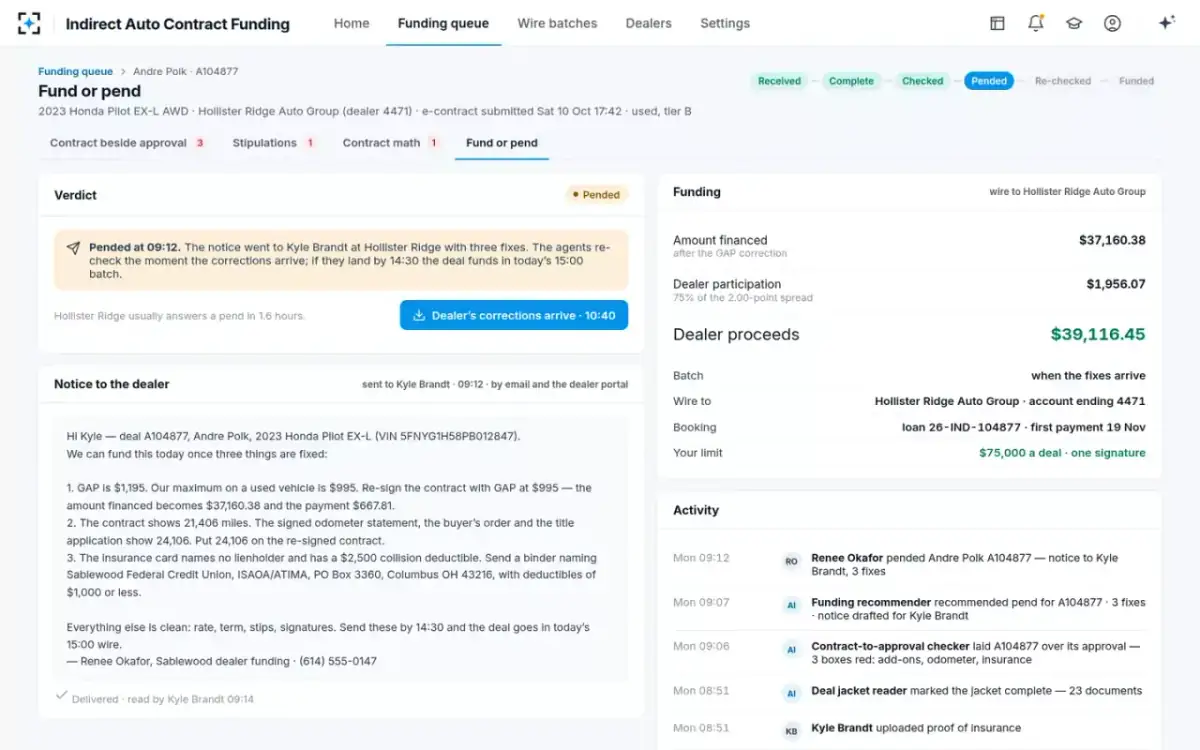
Andre Polk · 2023 Honda Pilot: 3 of 4 cleared; insurance open for no lienholder and a $2,500 collision deductible.
Yolanda Holloway · 2020 Ram 1500: All ten parts match.
Andre Polk · 2023 Honda Pilot: Fourteen of eighteen terms match; add-on price, odometer and insurance drift.
Yolanda Holloway · 2020 Ram 1500: Funds it in one click, $34,745.92, into the next wire.
Andre Polk · 2023 Honda Pilot: Sends one notice with three fixes and the time they have to arrive.
Yolanda Holloway · 2020 Ram 1500: No — nothing left the approval.
Andre Polk · 2023 Honda Pilot: No — every fix keeps the deal inside the approval it already has.
Yolanda Holloway · 2020 Ram 1500: Funded the same morning.
Andre Polk · 2023 Honda Pilot: Re-signed and funded the same afternoon.
What a signed contract has to carry before any of this starts is set out in the anatomy of the contract itself, and the reason the clock matters so much to the dealership is the days it waits to be paid. The dealership's side of the same conditions, who clears them in the finance office, how long it has and how the open one is told to the dealer, is in auto loan stipulations, from the dealership's side. To see the four stipulations cleared document by document, start from Indirect Auto Contract Funding.
Questions people ask
What does "stipulation" mean on a car loan approval?
It means a condition attached to the approval: a document the lender wants to see before it will fund. The usual four are proof of income, proof of residence, proof of insurance and a valid identity document. The approval is real, but it is conditional, and the condition is the stipulation.
How recent must a pay stub be to clear an income stipulation?
There is no federal rule; each lender sets the window in its own programme, thirty days from the contract date in the sample programme here. Lenders also set a tolerance for how far verified income may fall below what was stated on the application — five per cent in the sample programme here — and a larger gap goes back to the underwriter rather than being cleared at the funding desk.
Why must the lender be named on the buyer’s insurance?
Because the car is its collateral. Naming the lender as lienholder or loss payee puts it on the policy, so a claim payment for the car is made with the lender's interest protected, and under the usual loss-payable wording it can be told if the policy lapses. Lenders also cap deductibles, $1,000 in the sample programme, because a deductible the buyer cannot pay after a loss is a car that never gets repaired and a loan that goes bad.
What happens if a stipulation is not met?
The deal pends: the lender tells the dealership exactly what is missing and by when, and the dealership gets it from the buyer. Where a lender relies on that as Regulation B's notice of incompleteness, the notice must be in writing, specify the information needed and give a reasonable period to supply it. If nothing arrives, the lender has no further obligation on the application and the dealership has to find another finance source or unwind the sale.
Is a pend the same as being declined?
No. A decline is adverse action on the credit decision and carries a statement of reasons. A pend says the decision stands and a document is missing. Keeping the two apart matters to the buyer, who has not been turned down, and to the lender, whose Regulation B clock and adverse-action records depend on which event actually happened.
Can a lender waive a stipulation?
Yes, but it is a credit decision, not a funding shortcut. NCUA's letter 10-CU-15 says exceptions to an indirect lending policy "should be infrequent", approved by the people who run the programme and reported to the board; and "no credit union should delegate loan approval authority to a third party", so the dealership cannot waive one either. The dealership gathers; the lender reads and, rarely, waives.