Indirect lending software is the system that stands between a credit approval and a wire: it reads the deal jacket a dealership sends, lays the signed contract over the approval, clears the stipulations, applies the dealer programme and hands a funding analyst a verdict with its evidence. Buying one is a decision about operations rather than technology, and so is starting one. Almost everything that makes an implementation slow is a sentence nobody has written down — what counts as a current pay stub, which deductible is too high, what happens when the trade-in payoff moves between approval and signing. The implementations that go fastest are the ones that arrive with those sentences already written, and this guide is the list. It is the intake list for Indirect Auto Contract Funding, and it is largely the same list whatever you buy.
The settings, dealerships and figures shown here are a fictional sample book inside the solution, used to make the list concrete. They are sample data, not a measured result from a customer.
The intake list: what to have written down before the first week
- The dealer programme, as a table of limits
Rate markup cap, advance limits by programme and tier, payment-to-income, add-on caps per product and in total, participation terms. One row per rule, with its current value.
- The stipulation rules and their tolerances
Which conditions you set, what document satisfies each, how fresh it must be, how close verified income has to be to stated, and what a document must name.
- The required-document list, by state and channel
What makes a jacket complete in Ohio is not what makes one complete in Texas, and an electronic package is not the same list as a scanned one.
- Your contract forms, and every variant in circulation
Each provider's form, each revision a dealership still has in a drawer, and the add-on forms that travel with them.
- The approval, as data rather than a document
Approved amount, buy rate, markup cap, term, advance limit, income test and the stipulations, in fields — not a PDF to be read again.
- Three to six months of closed deals, pends included
The funded ones prove you can say yes. The pended ones, with their reasons, are the only part of the sample that tests anything.
- The cutoffs, and who signs
Wire times, how long before each one a deal must be funded, each analyst's limit, and the threshold above which a second person releases.
- The people, and what each is allowed to do
Funding analysts and their limits, supervisors, credit analysts who own off-approval decisions, relationship managers who see dealer reporting.
What indirect lending software has to know before it can check anything
A verification system is only as useful as the standard it checks against, and in indirect lending that standard has three layers. The credit approval is the first: a specific decision about a specific applicant, with its own ceilings and conditions. The dealer programme is the second: the limits that apply to every deal from that dealership under that programme and tier. The policy is the third: the rules that apply to all of it, and the places where an exception has to be somebody's decision.
Supervisory expectation already assumes all three are written. NCUA's indirect lending guidance expects a credit union to "Establish portfolio limitations in terms of net worth, and in aggregation with other lending products" and to "Determine the level of lending and collection staff sufficient to operate and monitor the program" (NCUA, Letter to Credit Unions 10-CU-15). The Comptroller's handbook asks for the same shape at portfolio level: "Beyond individual loan underwriting standards, banks should also implement prudent portfolio mix and concentration limits. For example, guidelines should be established for credit risk/grades, new versus used, loan terms, manufacturer and model, and dealers" (OCC, Installment Lending, Comptroller's Handbook). If those exist as policy documents, most of the first layer of configuration is transcription. Where they exist only as practice, the implementation is the occasion on which they get written — which is uncomfortable and valuable in roughly equal measure.
The dealer programme, as settings
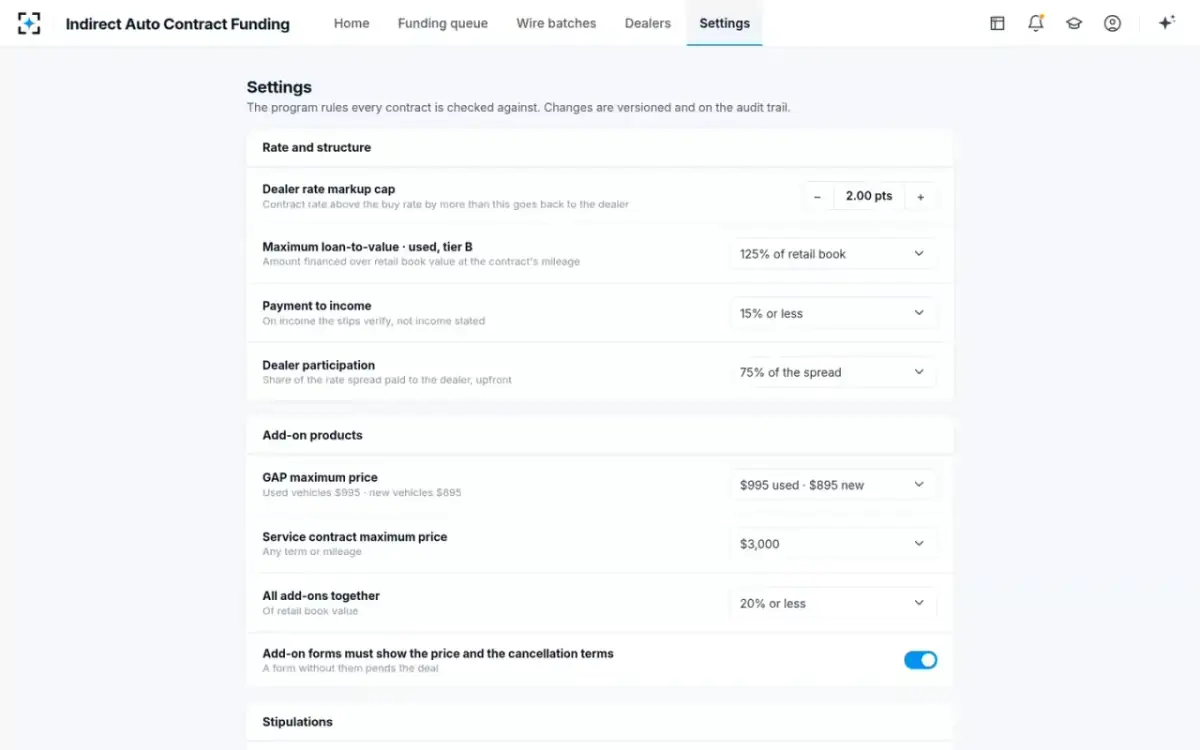
The most useful single artefact to produce before a project starts is one table: every limit the desk applies, its current value, the options it could take, and who may change it. In the sample programme it looks like the list below, and the shape is more important than the values.
The dealer programme in Indirect Auto Contract Funding, setting by setting
| Setting | Value in the sample programme | What happens when it is wrong |
|---|---|---|
| Dealer rate markup cap | 2.00 points over the buy rate, adjustable in quarter points to 3.00 | A contract written above the cap is a compliance and compensation problem found after the dealership has been paid. |
| Maximum advance, used, tier B | 125% of retail book value at the contract's mileage | Set too high and every thin deal passes; set against the wrong mileage and the percentage is simply incorrect. |
| Payment to income | 15% or less, measured on income the stipulations verify rather than income stated | Measuring against stated income turns the test into a formality. |
| Stated against verified income | Within 5%; a larger gap goes to a credit analyst | Too tight and the desk drowns in referrals; too loose and the income stipulation stops meaning anything. |
| GAP and service contract maxima | $995 used and $895 new; $3,000 for a service contract; 20% of book for all add-ons together | An over-cap product funded is an advance the programme never authorised. |
| Insurance | Lienholder named, deductibles $1,000 or less | The most common single pend reason in the sample book, and the easiest to coach a dealership out of. |
| Wire batches | 11:00 and 15:00, funded 30 minutes before each | A cutoff nobody can see is a cutoff dealerships miss and then argue about. |
| Second release threshold | Above $1,000,000 a supervisor releases the batch too | Set too low and it becomes a rubber stamp; set too high and a large batch moves on one signature. |
| Fund clean deals without an analyst | Off — an analyst signs every deal, clean or not | The setting that decides whether anyone can say whose decision a funded deal was. |
The programme rules as settings in Indirect Auto Contract Funding
The stipulation rules, and the tolerances inside them
Stipulations are where the undocumented knowledge lives, and the questions that expose it are always the same. How old may a pay stub be, and is the clock measured to submission or to the day the jacket became complete? Does a joint utility bill clear proof of residence when the buyer is the second name on it? What counts as verified income for someone paid fortnightly, or on commission? Is a binder acceptable in place of a policy, and for how long? Which deductible applies — comprehensive, collision, or the higher of the two?
Nobody has the answers to all of those written down, and three experienced analysts will give three different answers to at least one of them. That is normal, and it is better found in week one than in a disagreement about a funded deal. The practical method is to take your last fifty pends, write the rule each one applied, and circulate the list to the desk: the rows that come back with disagreement are the rules that need a decision before anything is configured. What each of the four common stipulations actually asks for is set out in the stipulations guide.
The documents you have to be able to send us
The second practical blocker is mechanical: getting the jacket out of wherever it currently lands. Most lenders have two or three routes — an e-contracting channel that delivers a structured package, a dealer portal upload, and an inbox that receives the rest — and each one has its own quirks. A dealership that prints two deals into one file, a scanner that produces a single long image, a portal that renames documents on upload: all of these are ordinary, and all of them are better discovered in week one with real files than in week six with a test fixture.
What to supply is simple to describe and worth doing early: a few hundred real jackets, exactly as they arrived, with nothing renamed, tidied or removed, and the approval for each. The messy ones are the valuable ones.
The past deals a pilot needs, and why they must include the pends
A sample of funded deals is a sample of deals with no exceptions in them — that is why they funded. Measuring a verification system on those tests one thing: whether it can say yes. The deals that carry information are the ones your desk stopped, with the reason it recorded, because each one is a case where somebody already decided what the right answer was.
So the extract to ask your own team for is: every deal over three to six months, funded and pended, with the credit approval, the jacket as received, the verdict, and the pend reason where there was one. In the sample book 73 per cent of deals were clean first time over thirty days and 61 per cent on the weekend shown, which means a sample of a few hundred deals carries somewhere around a quarter to two-fifths exception jackets — enough to see patterns in the common reasons and a handful of each of the rare ones. How to run that sample as a measured test, rather than a demonstration, is the subject of the guide on proving it on closed deals.
Going live dealership by dealership
The sensible shape of a first month is not a switch. It is a parallel run on a few dealerships, where the desk works as it always has and the system produces its verdict beside them, so that disagreements are visible without anything being at stake. Then the first dealerships move: pick two or three with high volume and clean packages, so the first live week is not also the week you learn about the hardest paperwork in the programme. The thinner dealerships come later, after the rules they break most often have been tuned.
A first six weeks for a programme that brings its rules already written
- Programme as a table of limits
- Stipulation tolerances agreed
- Deal extract pulled
- Settings and document routeswk 1–2
- Replay on closed dealswk 2
- Parallel run, 2–3 dealershipswk 3–4
- First dealerships livewk 5
- Widenwk 6
One decision is worth making before the first dealership goes live rather than after: whether clean deals still need an analyst's signature. In the sample programme that setting is deliberately off, so every deal is signed by a person, clean or not. The argument for keeping it off during a first quarter is not caution for its own sake — it is that an analyst who signs every verdict sees the ones that look wrong, and that early signal is worth more than the minutes it costs. Where that line sits in the supervisory texts is set out in the due diligence guide.
The first report to ask for: clean first time, by dealership
Of everything the desk can measure, one number does the most work in the first ninety days. Clean first time — the share of a dealership's jackets that need no fix — is simultaneously a measure of the dealership's finance office, a measure of how clearly your pend notices explain themselves, and the best available predictor of how long that dealership's deals will take to fund. In the sample book it averages 73 per cent and ranges from 61 to 85 per cent across twelve dealerships, which is a far wider spread than most programmes expect to find.
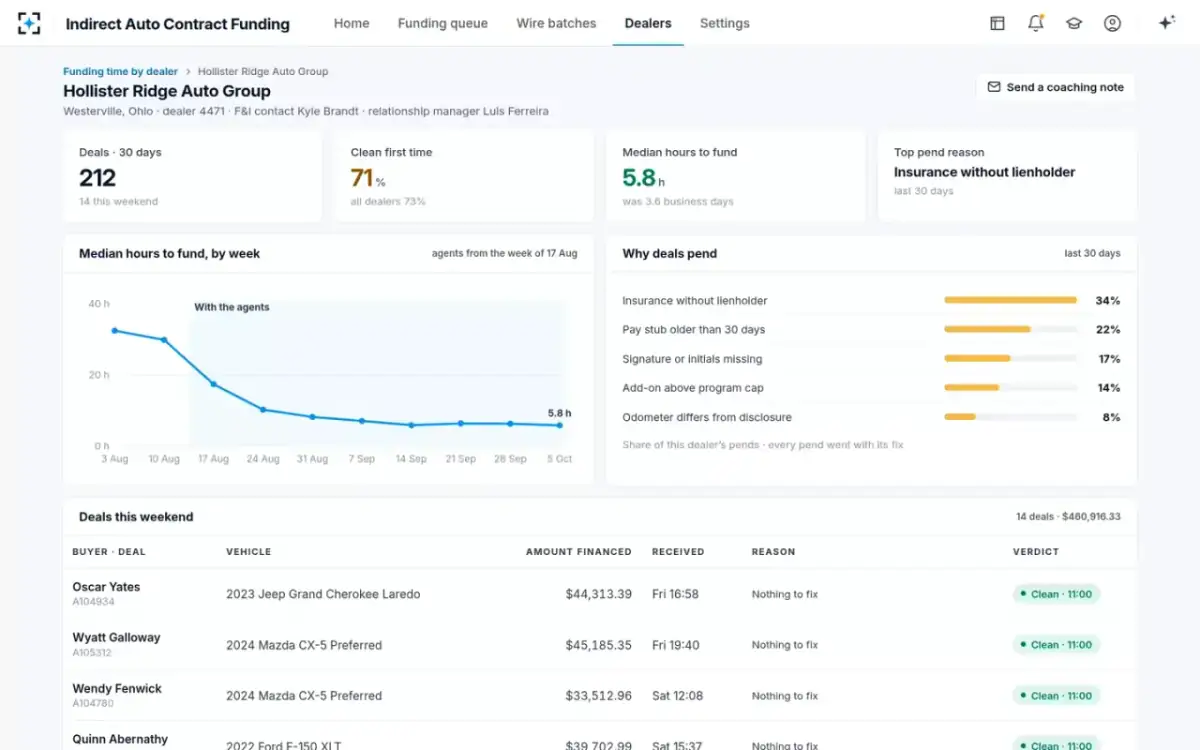
One dealership's scorecard, read
Deals · 30 days
212Volume first, because every other figure is noise at low volume. Fourteen of these arrived over one weekend.
Clean first time
71%Against 73% across all twelve dealerships. Two points below average is a coaching conversation, not a problem.
Median hours to fund
5.8 hAgainst 3.6 business days before. This is the number the dealership feels and the one it compares between lenders.
Top pend reason
34%Insurance without a lienholder named — a third of this dealership's pends. One habit in one finance office, and the most movable number on the card.
The second report to ask for is the pend-reason mix behind that rate, because it turns a score into an action. A dealership whose pends are a third insurance binders does not need a general conversation about paperwork quality; it needs one sentence about what the binder has to name. That is a note a relationship manager can send in five minutes, and it moves a number nobody could previously see.
A dealership's thirty days in Indirect Auto Contract Funding
What to measure after thirty days
Thirty days in, the honest review has four questions, and only one of them is about the software. How many deals did an analyst overrule, and on which rules — the rules with the most overrides are either wrong or ambiguous. Did clean first time move at the dealerships that received coaching notes. What is the elapsed time now, measured from a complete jacket to the wire rather than from the approval. And did anything get funded that should not have — the sampled re-read that nobody enjoys and everybody needs.
The sample book's own thirty days
837deals
funded across twelve dealerships in thirty days in the fictional sample book
73%
clean first time overall, with a spread from 61% to 85% between dealerships
6.3h
median hours from a complete jacket to the wire, against 3.4 business days before
81%
of pends answered by the dealership the same day, before the afternoon cutoff
Over a longer horizon the supervisory texts suggest two more measures, and they are worth putting in the diary at the start rather than discovering in an examination. NCUA's guidance says "The most effective method of evaluating the performance of a vendor is through an analysis of the vendor's static loan pool data", and that "Credit unions should regularly test for compliance with the contract terms by comparing delinquency, loan losses, and rates of return to previous results and budget levels" (NCUA, Letter to Credit Unions 10-CU-15). Funding speed is an operational number; the pools those deals sit in are the credit one, and a programme that improves the first while quietly loosening the second has not improved.
None of this is a long project. It is a short one preceded by a piece of writing that most lenders have been putting off, and the writing is useful whether or not any software is ever installed. To see the programme as settings on contracts of your own, start from Indirect Auto Contract Funding.
Questions people ask
What do you need to set up indirect lending software?
Your dealer programme as a table of limits, your stipulation rules with their tolerances, the required-document list for each state and channel you fund, your contract forms and every variant still in circulation, the credit approval as data rather than a PDF, three to six months of closed deals including the pends, your wire cutoffs, and the people with their funding limits and release thresholds. Six of those eight are documents that already exist somewhere.
How long does indirect lending software take to go live?
The configuration itself is weeks rather than months; the variable is how much of the programme is already written down. A lender that arrives with its limits, tolerances and document list agreed can expect settings and document routes in the first fortnight, a replay on closed deals, a parallel run on a few dealerships, and the first dealerships live after that. A lender that has to agree its tolerances during the project adds that time to the front.
What rules do you have to configure?
The rate markup cap, advance limits by programme and tier, payment to income and which income it is measured on, the tolerance between stated and verified income, add-on price caps per product and for all add-ons together, insurance requirements including the lienholder line and the deductible ceiling, document freshness windows, wire batch times and how long before each a deal must be funded, analyst funding limits, and the threshold above which a second person releases a batch.
What data does a funding automation pilot need?
Real jackets exactly as they arrived — nothing renamed, tidied or removed — with the credit approval for each, the verdict your desk recorded, and the pend reason where there was one. Cover every state form and submission channel you fund. A sample of funded-only deals tests nothing but the ability to say yes, because deals with exceptions in them are precisely the ones that did not fund.
How do you measure clean first time?
As the share of jackets from a dealership that needed no fix before funding: no pend, no re-sign, no additional document. Measure it per dealership and over a rolling window, because the aggregate hides the spread — in the sample book the overall figure is 73 per cent while individual dealerships run from 61 to 85 per cent, and almost all of the improvement available is in the lower half of that range.
What should a dealer scorecard show?
Four things, in this order: volume over the period, clean first time against the all-dealer average, median hours to fund against what it was before, and the top pend reason as a share of that dealership's pends. Volume first because the other three are noise at low volume, and the pend reason last because it is the one that tells a relationship manager what sentence to write.