A GAP waiver is an agreement, bought with the car and financed inside the loan, under which the finance company gives up the difference between what the borrower still owes and what the insurer pays after the vehicle is written off. An indirect lender usually puts a maximum price on it in its dealer programme ($995 on a used vehicle in the sample programme below), and a signed contract that carries a GAP waiver above that maximum does not fund as signed. The reason is not consumer-protection housekeeping. The price of the waiver is part of the amount financed, the amount financed sets the advance against the car, and a lender that funds an over-cap waiver has quietly lent more against the same collateral than its own credit policy allows. Indirect Auto Contract Funding is built to catch that before the money moves, not after.
The deal used throughout this page comes from a fictional sample book inside the solution — Sablewood Federal Credit Union, a 2023 Honda Pilot sold by Hollister Ridge Auto Group to a buyer named Andre Polk. The people, the dealerships, the credit union and the deals are invented. The rules are real and linked where they are relied on.
What add-ons cost, in the regulator's own loan-level data
72.9%
of servicemember auto loans originated 2018–2022 included at least one add-on product; 71.8% of non-servicemember loans
$3,334
average add-on spend on a new vehicle where an add-on was bought, against $3,196 for non-servicemembers
$3,021
the same figure on a used vehicle, against $2,961 for non-servicemembers
What is a GAP waiver?
Guaranteed asset protection comes in two shapes. A GAP waiver is a contractual amendment to the credit agreement itself: the creditor agrees in advance that if the vehicle is a total loss, it will waive the shortfall between the physical damage insurer's settlement and the outstanding balance. A GAP insurance policy is a separate contract of insurance between the borrower and an insurer, which pays the borrower, who then pays the lender. In a dealership the two are often sold off the same menu page at the same price, and the buyer experiences no difference. The lender does, because a waiver is an amendment to the paper it is about to buy.
The reason a buyer wants either is the arithmetic of a new car's first two years. A vehicle financed at a high advance against its value, over a long term, with negative equity rolled in from a trade-in, is worth less than its balance for much of the early schedule. The waiver closes that distance. The Consumer Financial Protection Bureau describes the products it studied as covering "the difference between what a borrower owes on a vehicle loan and the vehicle's value in the event of a total loss due to an accident or theft" (CFPB, Auto lending to servicemembers).
GAP waiver vs GAP insurance: the difference that matters to a lender
For a funding desk the distinction decides three practical things: which document has to be in the deal jacket, whose signature clears it, and what happens to the price if the contract is re-signed. A waiver travels on an addendum to the retail installment contract and is cancelled through the creditor. Insurance travels on a policy or certificate and is cancelled through the insurer or its administrator. A jacket that contains a waiver addendum but prices the product as insurance — or the reverse — is a jacket whose refund path does not match its paperwork.
Two products with one name, read from the funding desk
| GAP waiver | GAP insurance | |
|---|---|---|
| What it is | An amendment to the credit agreement: the creditor waives the shortfall. | A contract of insurance between the borrower and an insurer. |
| Who owes the benefit | The holder of the contract — the lender that bought the paper. | The insurer, which pays the borrower or the lienholder. |
| What is in the jacket | A signed waiver addendum naming the price and the term. | A policy or certificate, and evidence the premium was paid. |
| How it is cancelled | Through the creditor, usually pro rata on early payoff or total loss. | Through the insurer or the administrator named on the certificate. |
| Where the price sits | In the itemisation of amount financed, financed at the contract rate. | Also in the itemisation when financed, but as a premium. |
| Why a lender caps it | It is the lender's own waiver: the price raises the advance it holds. | Same advance effect, plus a third party has to perform. |
One further difference matters in a dealership that sells to members of the armed forces, and it is dealt with in its own section below: the two products have had a different relationship with the Military Lending Act, and the change in 2020 is visible in the regulator's own origination data.
How common add-ons are, and what they cost
Add-ons are the normal case, not the exception. In the CFPB's loan-level pilot data, "Looking at new vehicle purchases, servicemembers were again slightly more likely than non-servicemembers to purchase add-on products, 71.2 versus 68.9 percent, respectively (a difference of 2.3 percentage points). Among used vehicle purchases, a higher, but near identical share of servicemembers and non-servicemembers purchased add-on products (75.0 percent and 75.4 percent, respectively)" (CFPB, January 2025). Three quarters of used-car contracts carry something priced in the finance office.
Share of auto loans carrying at least one add-on product, 2018–2022
What is bought has also changed. The warranty, service and maintenance family is the biggest by share — around 60 per cent of servicemember loans in the period — and other products, from wheel and tyre cover to key replacement, rose from 18.9 per cent of loans in January 2018 to 28.8 per cent in December 2022. A funding desk sees the consequence as a longer add-on block on the buyer's order and more prices to check against more caps.
Why a lender caps the price rather than the product
A cap is a strange-looking control until you see where the number lands. The lender is not saying the product is bad; it is approving its own purchase. The Comptroller of the Currency puts the credit logic of indirect underwriting plainly: "indirect criteria should also include deal-related considerations, such as LTV/advance rate limitations and other collateral-based guidelines (new versus used, size of the transaction, down payment, and options financed). Together, these factors dictate the maximum amount financed, interest rate, and term of the loan" (OCC, Installment Lending, Comptroller's Handbook). Options financed is the handbook's name for the add-on block, and it sits in the same sentence as the advance rate for a reason.
So the programme usually carries three limits at once, and an add-on can break any of them: a price ceiling per product, a ceiling on all add-ons together as a share of book value, and the loan-to-value limit the whole advance has to live inside. In the sample programme the second of those is 20 per cent of retail book and the third is 125 per cent for a used vehicle on tier B.
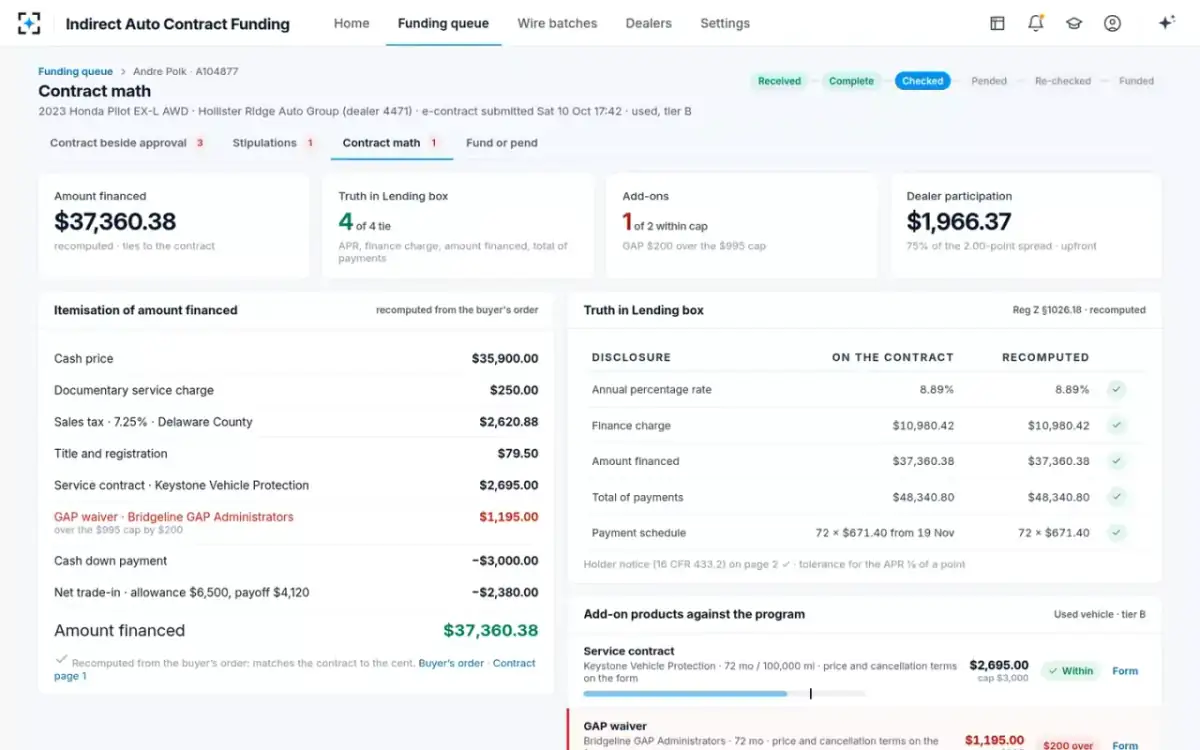
One deal's add-on block, checked against the programme in Indirect Auto Contract Funding
| Product | On the signed contract | Programme maximum | Verdict |
|---|---|---|---|
| Vehicle service contract | $2,695 | $3,000, any term or mileage | Within the cap |
| GAP waiver | $1,195 | $995 on a used vehicle, $895 on a new one | $200 over — the deal pends |
| Both products together | $3,890 against retail book of $33,800 — 11.5% | 20% or less of retail book value | Within the cap |
| Advance against the car | $37,360.38 against retail book of $33,800 — 110.5% | 125% of retail book, used, tier B | Within the cap |
| Add-on forms themselves | Price and cancellation terms shown on each form | A form without them pends the deal | Satisfied |
Note what the table does not say. The deal is not off its credit approval. The advance is inside the loan-to-value limit, the rate is at the markup cap and not over it, the term is inside the programme and the payment is inside the income test. One product price is wrong. That is a documentation problem with a same-day fix, and the whole value of noticing it at the funding desk rather than at the audit is that it stays one.
What an over-cap add-on does to the amount financed, the payment and the loan-to-value
Two hundred dollars does not sound like a reason to send a signed contract back to a dealership. Follow it through the form and it stops being one number. The price of the waiver is a line in the itemisation of amount financed; the amount financed is the base the finance charge is computed on; the finance charge and the amount financed together give the total of payments; the total of payments divided by the term gives the payment; and the payment is what the income test is measured against. One correction moves all of them.
What $200 moves on one signed contract
Amount financed
$37,360.38 → $37,160.38
The waiver price is a line in the itemisation, so the base falls by exactly the overcharge.
Checked against the $37,500 approval
Finance charge
$10,980.42 → $10,921.94
A smaller base at the same 8.89% over the same 72 months costs $58.48 less in interest.
The disclosed federal box
Total of payments
$48,340.80 → $48,082.32
Amount financed plus finance charge; the total sale price falls by the same $258.48.
The disclosed federal box
The monthly payment
$671.40 → $667.81
Payment to verified income moves from 10.9% to 10.8%, well inside the 15% limit.
The stipulation on income
The loan-to-value moves too, from 110.5 per cent of retail book to 109.9 per cent, which on this deal changes nothing because both are far inside the 125 per cent limit. On a thinner deal it is the whole argument. An advance already at 124 per cent with a waiver priced $200 over is an advance the programme never authorised, and the only moment anybody can see that is while the contract and the approval are side by side. How the rest of that overlay works is the subject of the guide on the retail installment contract itself.
The add-on block, checked against the programme in Indirect Auto Contract Funding
The re-sign, and the forms that have to be signed again with it
Correcting a price is not a pen-and-initials job. The waiver price appears on the retail installment contract and on the product's own addendum, and Regulation Z's treatment of these products is conditional on what that addendum says. Charges for debt cancellation coverage may be left out of the finance charge only if "the debt cancellation or debt suspension agreement or coverage is not required by the creditor, and this fact is disclosed in writing" and "the fee or premium for the initial term of coverage is disclosed in writing" (12 CFR 1026.4(d)(3)). A repriced waiver is a different fee for the initial term, so the disclosure that carried the old price no longer describes the product being sold.
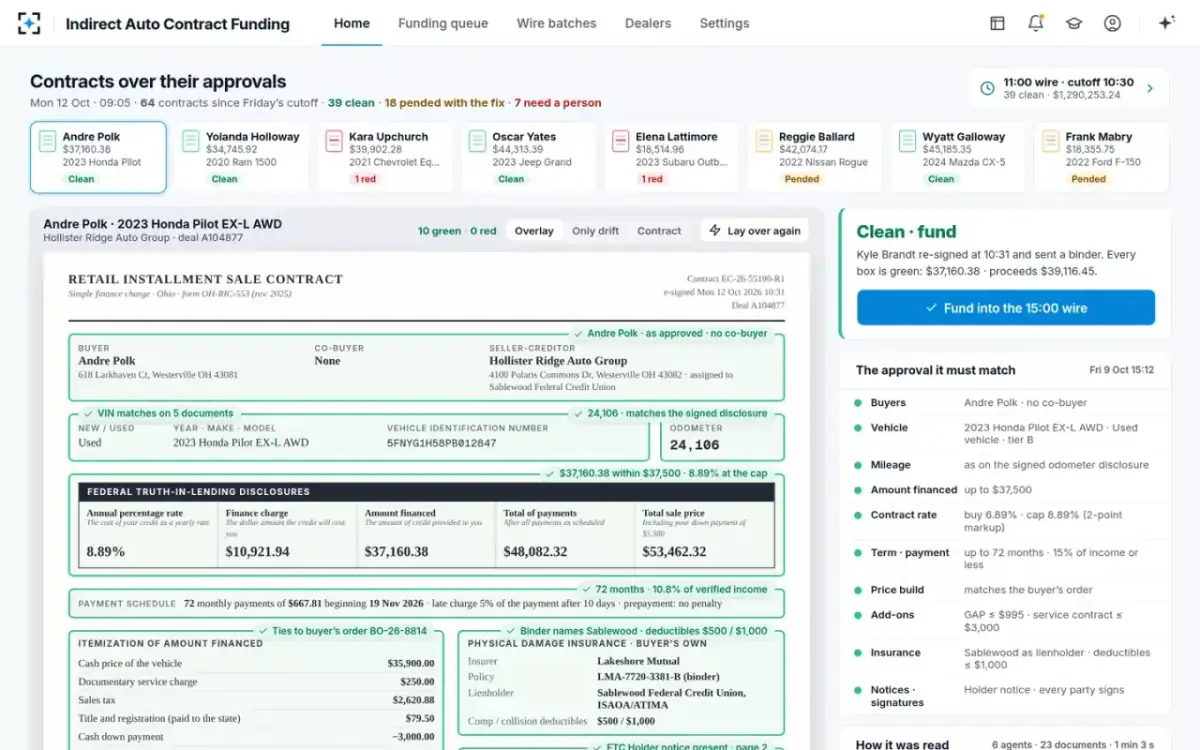
That is why a programme rule like add-on forms must show the price and the cancellation terms is not clerical fussiness: it is the condition on which the price was kept out of the finance charge in the first place. A re-signed contract with a corrected waiver price needs a corrected waiver form signed beside it, and the buyer has to sign both. On the sample deal the dealership did exactly that at 10:31 the same morning, and the corrected contract went back over the same credit approval.
One contract, as signed on Saturday and as re-signed on Monday
As signed in the finance office: $1,195 — $200 above the used-vehicle maximum
As re-signed at the programme maximum: $995 — at the maximum
As signed in the finance office: $37,360.38
As re-signed at the programme maximum: $37,160.38
As signed in the finance office: 8.89%, at the two-point markup cap
As re-signed at the programme maximum: 8.89%, unchanged
As signed in the finance office: $671.40 over 72 months
As re-signed at the programme maximum: $667.81 over 72 months
As signed in the finance office: 10.9%
As re-signed at the programme maximum: 10.8%
As signed in the finance office: —
As re-signed at the programme maximum: The contract and the waiver addendum carrying the new price
As signed in the finance office: Pend, with the fix named in the notice
As re-signed at the programme maximum: Ten boxes green, funded into the next wire
GAP, the Military Lending Act and the exemption a funding desk relies on
An indirect auto lender relies on an exemption most of the time without thinking about it. The Military Lending Act's rule excludes from "consumer credit" — and therefore from its 36 per cent military annual percentage rate and its other requirements — "any credit transaction that is expressly intended to finance the purchase of a motor vehicle when the credit is secured by the vehicle being purchased" (32 CFR 232.3(f)(2)(ii)). A purchase-money vehicle loan secured by the vehicle sits outside the rule.
What has moved is the question of what else can be financed inside that transaction without disturbing the exemption. The CFPB records the change and its effect in one footnote and one chart: "In 2020, the Department of Defense (DoD) withdrew previous guidance that had stated that if a loan includes financing for GAP products, it will lose its exemption under the MLA." The behaviour changed with it. "GAP product purchases were under 10 percent of all servicemember auto loans originated for much of 2018 and all of 2019. But after the first quarter of 2020, GAP purchases rose to over 40 percent of servicemember auto loans originated and remained there until the end of 2022" (CFPB, section 3.3).
One withdrawn interpretation, and what happened to a product
under 10%
of servicemember auto loans originated carried a GAP product for much of 2018 and all of 2019
over 40%
after the first quarter of 2020, and it stayed there to the end of 2022
36%
the military annual percentage rate ceiling a purchase-money vehicle loan sits outside
None of this makes the price check optional. The rule says what may be financed inside an exempt transaction; the programme says what the lender will pay for it. A desk that treats a cap as a compliance obligation will waive it under pressure. A desk that treats it as a credit limit will not.
What a dealership can do about a cap
Dealerships are not powerless in front of a maximum, and the useful responses are all available before the buyer leaves. The first is to price at the cap from the beginning, which requires the finance office to know whose paper the deal is going to before the menu is presented — not always possible, and the single most common cause of an over-cap price is a deal that moved lenders after the product was sold. The second is to take the difference out of the dealership's own margin on the product, which is what usually happens on a re-sign. The third is to ask the lender to look at the cap itself, with evidence: a programme maximum set three years ago against product costs that have moved is a reasonable thing to raise with a relationship manager.
What does not work is sending the same contract back unchanged with a note. A cap that is waived once on a Friday afternoon is a cap that is argued about every Friday afternoon afterwards, and the programme loses the ability to say what its advance against a used car actually is.
The corrected waiver on the re-signed contract, laid over the same approval
The cap is one rule of a programme that is mostly made of rules like it, each dull on its own and each capable of putting a deal on hold: freshness windows on documents, a lienholder line on an insurance card, a mileage that has to agree across five forms. What a desk does with those, and what it costs when they are found late, runs through the odometer guide and the guide on writing a dealer programme down as settings. To see the add-on panel on contracts of your own, start from Indirect Auto Contract Funding.
Questions people ask
How much does a GAP waiver cost?
Prices are set by the dealership within whatever ceiling the finance source imposes in its programme; there is no single market figure. The sample programme on this page allows $995 on a used vehicle and $895 on a new one. For scale, the CFPB's loan-level data put average total add-on spend — all products together, not GAP alone — at $3,334 on a new vehicle and $3,021 on a used one among borrowers who bought any add-on.
Is there a cap on what a dealer can charge for GAP?
Usually a contractual one, set by the lender in its dealer agreement or programme and applied to every contract it buys; state law on GAP pricing varies and should be checked state by state. The contractual cap is the one a funding desk enforces daily: the price on the signed contract is compared with the programme maximum for that vehicle type, and a contract above it is pended for a re-sign rather than funded and corrected later.
What happens if an add-on is priced above the lender's maximum?
The deal does not fund as signed. The lender sends the dealership a notice naming the product, the price, the maximum and the corrected figures, and the finance office re-signs the contract and the product's own form with the buyer at the lower price. On the sample deal that took about ninety minutes and the corrected contract went into the afternoon wire; nothing went back to the credit analyst, because nothing about the credit decision had changed.
Do add-ons affect the amount financed and the monthly payment?
Yes, whenever they are financed rather than paid for in cash. The price of each product is a line in the itemisation of amount financed, so it increases the base that interest is charged on, the finance charge, the total of payments and the payment itself. On the sample deal a $200 overcharge carried $58.48 of extra interest over 72 months and $3.59 a month on the payment.
Does financing GAP affect the Military Lending Act exemption?
The Department of Defense withdrew, in 2020, earlier guidance stating that financing GAP would cost a vehicle loan its exemption. The rule itself excludes from consumer credit any transaction expressly intended to finance the purchase of a motor vehicle where the credit is secured by that vehicle. Lenders should take their own advice on how the exemption applies to their programmes; the CFPB's data shows GAP purchases by servicemembers rising from under 10 per cent of originations to over 40 per cent after the change.
What is a service contract cap, and how is it different?
It is the same kind of limit applied to the vehicle service contract — the extended warranty — and it is usually a larger number because the product is. The sample programme allows $3,000 at any term or mileage. A programme can also cap all add-ons together as a share of the vehicle's book value, 20% in the sample one, which catches a deal where every individual product is inside its own ceiling but the block as a whole has pushed the advance too high.