A retail installment contract is the single document a car buyer and a dealership sign to buy a vehicle on credit: it sets the cash price, the amount financed, the annual percentage rate, the term and the payment, and it gives the seller a security interest in the car. It is a credit sale, not a loan — the dealer is the creditor named on the face of it, for about as long as it takes to shake hands — and the dealer then assigns the contract to a bank, a credit union or a finance company, which pays the dealer and collects the payments. That assignment is why the form matters so much: Botminds' Indirect Auto Contract Funding lays each signed retail installment contract over the credit approval it is supposed to match and recomputes the numbers on its face, because the lender that buys the contract buys every error on it too.
The examples on this page come from a fictional sample book inside the solution: Sablewood Federal Credit Union, twelve dealers, and one deal — Andre Polk's 2023 Honda Pilot from Hollister Ridge Auto Group. The people, the dealerships, the credit union and the deals are invented. The rules, and the quotations from them, are real and linked where they appear.
Three numbers that decide whether a signed contract is fundable
$10
how far the disclosed finance charge may sit from the true one, on an amount financed above $1,000
⅛point
the tolerance on the annual percentage rate in an ordinary transaction
10pt
the minimum type size for the Holder notice, in bold face, on the contract itself
What is a retail installment contract?
A retail installment contract — in most states a retail installment sale contract and security agreement — is the instrument by which a dealer sells goods on deferred payments and keeps a lien on them until the payments are made. For a vehicle it carries the buyer and any co-buyer, the seller-creditor, the vehicle and its identification number, the mileage, the price build, the federal Truth in Lending disclosures, the payment schedule, the insurance the buyer must carry, the add-on products bought with the car, the legal notices and the signatures.
Two things follow from the word sale. The first is that the dealership, not the bank, is the creditor at the moment of signing, and the Truth in Lending disclosures on the form are the dealer's disclosures. The second is that the contract is assignable: the box on the front that reads "assigned to" is where the finance source's name goes, and the moment it is filled in the bank or credit union steps into the dealer's shoes. The Federal Reserve Bank of New York counted $211 billion of new auto loans appearing on credit reports in the second quarter of 2026, against auto balances of $1.71 trillion; most of that paper starts life as a retail installment contract signed in a dealership on a Saturday.
Retail installment contract vs a car loan: who is the creditor
People use "car loan" for both arrangements, and for the monthly payment it makes no difference. For everyone handling the paper it makes all of it. In a direct loan the bank lends money to the buyer, the buyer pays the dealer, and the bank's own disclosures govern. In a retail installment contract the dealer extends the credit and then sells the resulting receivable.
Two ways to finance the same car, and what changes for each party
Direct loan from a bank or credit union: The bank. Its loan documents, its disclosures, its staff.
Retail installment contract assigned to the same lender: The dealership, named as seller-creditor on the face of the contract.
Direct loan from a bank or credit union: The bank's system, on terms the bank set.
Retail installment contract assigned to the same lender: The dealership's contract form, filled in at the dealership.
Direct loan from a bank or credit union: The bank, before it disburses.
Retail installment contract assigned to the same lender: The bank, after the fact, against an approval it issued earlier.
Direct loan from a bank or credit union: From the borrower's loan proceeds, like any buyer.
Retail installment contract assigned to the same lender: By the lender, on assignment, with any dealer participation.
Direct loan from a bank or credit union: The car sale and the loan are separate transactions.
Retail installment contract assigned to the same lender: The Holder notice carries claims against the dealer through to the lender.
Direct loan from a bank or credit union: Caught before the money moves.
Retail installment contract assigned to the same lender: Caught only if the lender re-reads the contract before it funds.
The practical consequence is the one the Comptroller of the Currency states plainly in its installment lending handbook: "Once the dealer accepts a bank's loan, the dealer and customer complete the loan, title, and lien documents. The dealer forwards all documents, including the original loan application, to the bank. The bank disburses loan proceeds to the dealer after the bank verifies document accuracy. Quality control (QC) plays a key role throughout this process" (OCC, Installment Lending). The verification is not a courtesy; it is the step that stands between an approval and a payment.
The eight blocks of the form, and what each one must say
Contract forms differ by state and by provider, but the blocks are the same everywhere, because the same federal and state rules put them there. Reading a contract in this order is also the order in which errors appear: identity first, then the car, then the money.
Reading a retail installment contract in the order errors show up
| Block | What it must carry | What goes wrong |
|---|---|---|
| Buyer, co-buyer, seller-creditor | Legal names and addresses as the approval has them; the dealership as seller-creditor; the assignment line. | A co-buyer on the contract who was not on the approval, or dropped from it. |
| Vehicle and identification number | Year, make, model, trim, new or used, and the seventeen-character VIN. | A VIN that differs by one character from the buyer's order or the title application. |
| Odometer | The reading at transfer, whole miles, matching the signed odometer disclosure. | Transposed digits — the single most common copy error in a jacket. |
| Price build | Cash price, fees, taxes, trade-in allowance and payoff, cash down. | A trade-in payoff that moved between the approval and the signing. |
| Truth in Lending box | Annual percentage rate, finance charge, amount financed, total of payments, total sale price. | A box that does not recompute from the price build above it. |
| Payment schedule | Number, amount and timing of the payments. | A first payment date more than 45 days out, changing the finance charge. |
| Add-on products and insurance | Each optional product, its price, its term, and the physical damage insurance required. | An add-on priced above the lender's programme maximum. |
| Notices and signatures | The Holder notice, state notices, and a signature from every party in every place. | One unsigned line on page four, found after the wire. |
The Truth in Lending box, and what has to tie
The federal box is five figures and a payment schedule, and every one of them is derived from the price build further down the page. Regulation Z requires the disclosures to "reflect the terms of the legal obligation between the parties" (12 CFR 1026.17(c)(1)) — that is, the contract as signed, not the quote the finance office ran an hour earlier.
The federal box on one signed contract, recomputed from the price build
| Disclosure | On the contract | Recomputed | The rule |
|---|---|---|---|
| Annual percentage rate | 8.89% | 8.89% | §1026.18(e); accurate within ⅛ of a point, §1026.22(a)(2) |
| Finance charge | $10,980.42 | $10,980.42 | §1026.18(d); accurate within $10 above $1,000 financed |
| Amount financed | $37,360.38 | $37,360.38 | §1026.18(b), built as the rule sets out |
| Total of payments | $48,340.80 | $48,340.80 | §1026.18(h); 72 × $671.40 |
| Total sale price | $53,720.80 | $53,720.80 | §1026.18(j); total of payments plus the $5,380 down |
| Payment schedule | 72 × $671.40 from 19 Nov | 72 × $671.40 | §1026.18(g) |
The tolerances are worth knowing exactly, because they decide whether a difference is a correction or a conversation. A finance charge is treated as accurate if it is within $10 of the true figure on an amount financed above $1,000, and within $5 at or below it (§1026.18(d)(2)). An annual percentage rate "shall be considered accurate if it is not more than 1/8 of 1 percentage point above or below" the rate computed under the rule, or a quarter point in an irregular transaction (§1026.22(a)). Those are tolerances on the disclosure, not permission to misprice: a contract whose rate is right but whose finance charge is $40 light is a contract that has to be redone.
The same rule governs the re-sign. Because the disclosures must reflect the legal obligation the buyer actually signed (§1026.17(c)(1)), a corrected price or a repriced add-on cannot be fixed by a note in the file: the finance office reprints the contract with the new figures and the buyer signs again. That is why a pend that asks for a corrected price has to ask for a re-signature as well, and why the lender lays the new contract over the same approval before funding.
The box, recomputed beside the contract that carries it
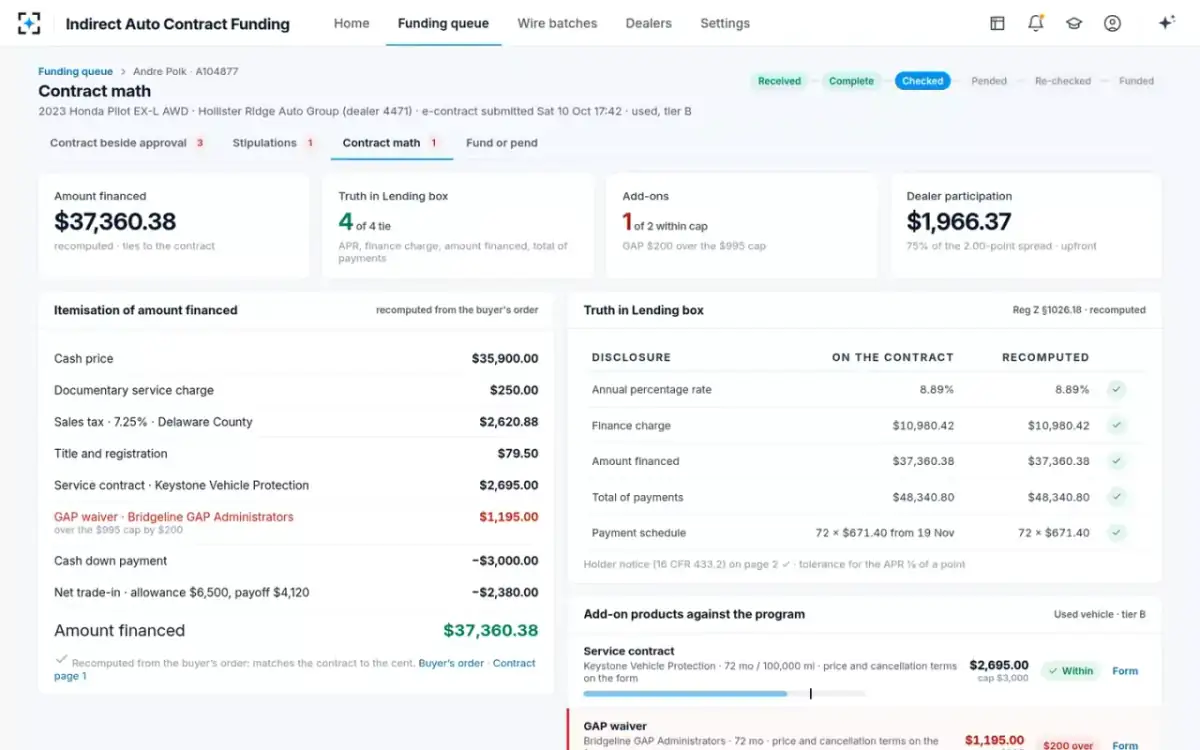
How the amount financed is calculated, line by line
The amount financed is the number everything else hangs on, and Regulation Z builds it in three steps: start from the cash price less any downpayment, add the other amounts financed that are not part of the finance charge, and subtract any prepaid finance charge (§1026.18(b)). The rule also entitles the buyer to a written itemisation of it, broken into the proceeds paid to the buyer, the amount credited to the buyer's account, the amounts paid to other people on the buyer's behalf, and the prepaid finance charge (§1026.18(c)(1)).
One contract's amount financed, built from the buyer's order
Cash price of the vehicle
$35,900.00
The agreed price before fees and taxes
Buyer's order
Fees and taxes
+ $2,950.38
Documentary service charge $250.00, sales tax at 7.25% $2,620.88, title and registration $79.50
Buyer's order
Optional products
+ $3,890.00
Service contract $2,695.00 and GAP waiver $1,195.00, each with its own signed form
Finance office
Cash down
− $3,000.00
Paid at signing
Buyer
Net trade-in
− $2,380.00
Allowance $6,500.00 less a payoff of $4,120.00
Buyer
Amount financed
= $37,360.38
The figure the box must show, and the figure the approval caps at $37,500
The contract
Two lines in that build do more work than their size suggests. The net trade-in is a difference between two numbers the dealership controls, and a payoff quoted ten days earlier is not the payoff today. The optional products line is the one a lender's programme caps: here the GAP waiver is $200 above the maximum for a used vehicle on this tier, which moves the amount financed, the payment and the total of payments together, and sends the contract back to be signed again. The odometer line on the same contract went wrong in a different way.
The Holder notice, and why the lender cares most
Near the signatures, in capitals, sits the notice that explains the whole exercise. The Federal Trade Commission's Holder Rule makes it an unfair or deceptive practice for a seller to take a consumer credit contract that does not carry it "in at least ten point, bold face, type" (16 CFR 433.2(a)).
ANY HOLDER OF THIS CONSUMER CREDIT CONTRACT IS SUBJECT TO ALL CLAIMS AND DEFENSES WHICH THE DEBTOR COULD ASSERT AGAINST THE SELLER OF GOODS OR SERVICES OBTAINED PURSUANT HERETO OR WITH THE PROCEEDS HEREOF. RECOVERY HEREUNDER BY THE DEBTOR SHALL NOT EXCEED AMOUNTS PAID BY THE DEBTOR HEREUNDER.
The Federal Trade Commission's Holder Rule, 16 CFR 433.2(a)
The rule exists so that a buyer with a complaint about the car is not told to take it up with a dealership that has already been paid; it preserves the buyer's claims and defences against whoever holds the paper (FTC, Holder in Due Course Rule). For the finance source the sentence is an instruction: whatever the dealership said, promised, mispriced or left blank travels with the contract, and recovery is capped at what the buyer has paid. A funding desk that reads the contract carefully is not being pedantic about someone else's paperwork — it is reading paperwork that is about to become its own.
The signatures, and the ones people miss
A contract can be arithmetically perfect and still unfundable because a line is blank. The signatures to find are the buyer's and any co-buyer's on the contract itself, their initials wherever the form calls for them, the dealership's signature as seller-creditor, a separate signature on each optional product form, the odometer disclosure, and — where the state requires it — the title application and any power of attorney. On the solution's fictional weekend, two of the eighteen pended deals were pended for nothing but a missing signature on page four.
Electronic contracting changes where the signature lives, not whether it has to be there. Regulation Z allows the disclosures to be given electronically, "subject to compliance with the consumer consent and other applicable provisions of the Electronic Signatures in Global and National Commerce Act" (§1026.17(a)(1)). What an e-contract removes is the courier; what it does not remove is the check. The package still has to be complete, and the lender still has to look.
What happens when the contract and the approval disagree
A credit approval is a set of limits: an amount financed up to a figure, a rate at or below a cap, a term, a loan-to-value ceiling, a payment as a share of verified income, and the stipulations that have to be cleared. A signed contract is a fact. When the two differ, the question is which kind of difference it is.
The Comptroller's handbook sorts exceptions into three families — credit policy, credit scoring and documentation, the last covering "bank requirements related to the loan application, deal/transaction information, insurance, or collateral perfection or valuation" (OCC, Installment Lending). A documentation exception is fixable by the dealership before the next wire. A credit policy exception is not: it is a new decision, and it belongs to the person who made the first one. NCUA puts the same line more bluntly for credit unions: "no credit union should delegate loan approval authority to a third party" (Letter to Credit Unions 10-CU-15), and exceptions "should be infrequent", approved by the people who run the programme and reported to the board.
The approval, laid over the contract it is meant to match
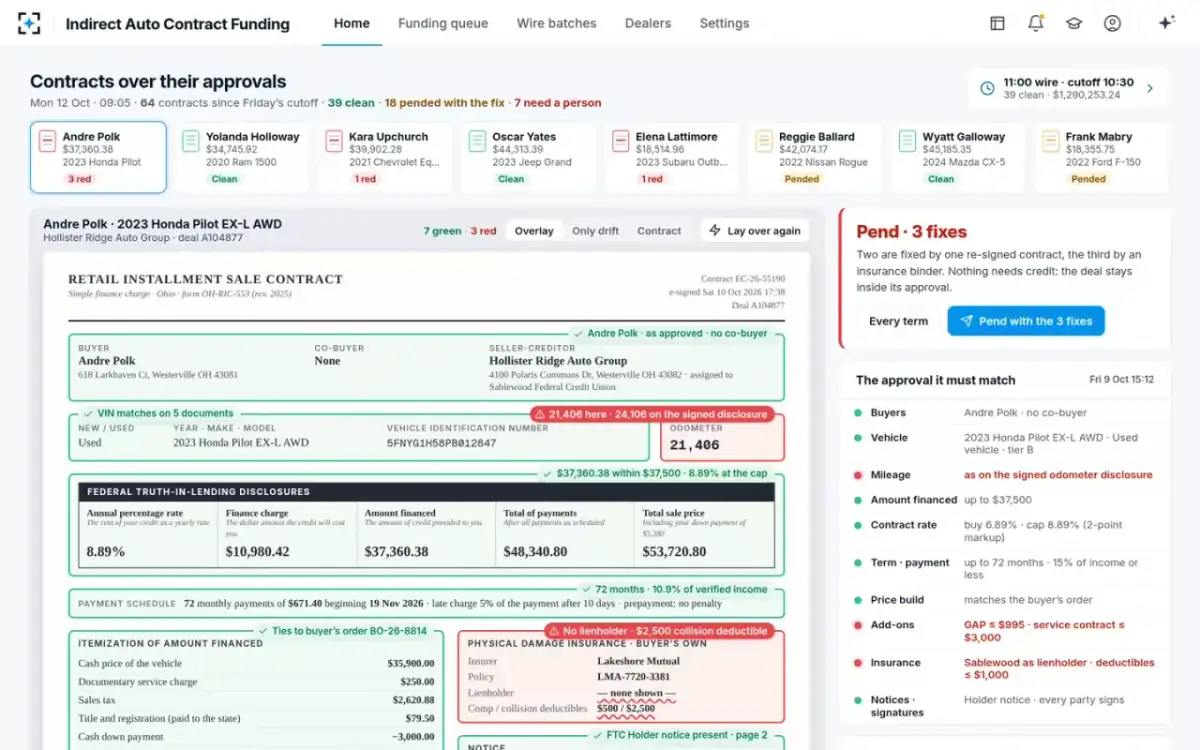
That is the shape of the work: most contracts are clean, and proving it takes longer than fixing the ones that are not. What the funding seat spends its day on, and what a day of waiting costs the dealership in contracts in transit, follow from that one fact. To see the recomputation and the approval overlay on real paper, start from Indirect Auto Contract Funding.
Questions people ask
What is the difference between a retail installment contract and a loan?
A retail installment contract is a credit sale: the dealership sells the car on deferred payments, takes a security interest in it and is named as the creditor, then assigns the contract to a bank, credit union or finance company. A direct loan is money lent by the bank to the buyer, who then pays the dealership in cash. The buyer's payment can be identical either way; what differs is who makes the disclosures, who checks the paper and whose name is on the lien.
Who is the seller-creditor on a retail installment contract?
The dealership. It appears on the face of the contract as seller-creditor because it is extending the credit at the moment of signing, and the Truth in Lending disclosures on the form are made in its name. The assignment box beneath it names the finance source that buys the contract, usually the same day or the next business day.
What has to be on the Truth in Lending box of a car contract?
The annual percentage rate, the finance charge, the amount financed, the total of payments and — in a credit sale — the total sale price, together with the number, amounts and timing of the payments. Regulation Z sets each one out in 12 CFR 1026.18, and requires the figures to reflect the terms of the legal obligation between the parties rather than an earlier quote.
What is the Holder notice on a car contract?
It is the paragraph in capitals, required in at least ten point bold face by the Federal Trade Commission's Holder Rule, telling any holder of the contract that it takes the paper subject to the claims and defences the buyer could raise against the dealer, with recovery capped at what the buyer has paid. Its absence is itself a defect in the contract.
What happens if a number on the signed contract is wrong?
It depends on which number and by how much. Regulation Z treats a finance charge as accurate within $10 on an amount financed above $1,000 and an annual percentage rate within an eighth of a point, so a trivial difference is not a violation. Anything outside that, or any term outside the credit approval, means a corrected contract: the finance office reprints it, the buyer signs again, and the lender lays the new contract over the same approval before funding.
Can a retail installment contract be signed electronically?
Yes. Regulation Z permits the disclosures to be delivered electronically subject to the consumer consent provisions of the E-Sign Act, and most high-volume dealerships now submit signed contracts and the supporting documents as an electronic package. Electronic submission removes the courier and the scanner; it does not remove the lender's verification, which is still what stands between the approval and the payment.