Auto loan origination software is the system that takes an application from a dealership, prices it, scores it, applies the lender's credit policy and returns a decision with its conditions — an approved amount, a buy rate, a term, a loan-to-value ceiling and a list of stipulations. It is the part of indirect lending that has been automated hardest and demonstrated best, and in a competitive market it has to be: dealerships send one application to several finance sources at once and take the first good answer. Then the buyer signs, the paperwork arrives, and a different kind of work begins — proving that the contract somebody signed on a Saturday is the deal that was approved on Friday. That second step is where Botminds' Indirect Auto Contract Funding works, and it is the step most buying processes never examine.
The deal, the dealerships and the credit union in the figures below are a fictional sample book inside the solution; the public figures beside them are linked to their sources.
Two systems, two jobs: deciding and proving
The origination system: An application, a credit bureau file and a vehicle.
The funding desk: A deal jacket of signed documents, plus the approval the system issued.
The origination system: Will we lend, how much, at what rate, on what conditions?
The funding desk: Is the thing that was signed the thing we approved?
The origination system: Seconds to a decision, a high hit rate with dealerships.
The funding desk: Hours to a wire, with no defect funded.
The origination system: Speed and consistency of the credit answer.
The funding desk: Evidence, and the cost of being wrong.
The origination system: The dealership, immediately — it goes elsewhere.
The funding desk: The dealership days later, and the lender for the life of the loan.
The origination system: On a demonstration of the decision engine.
The funding desk: Inherited with the origination system, or built out of people.
What auto loan origination software does
Strip the category down and an auto loan origination system does five things. It receives applications from dealerships and aggregators. It decisions them against the lender's credit policy and scorecards. It prices them from a rate sheet. It returns an approval with conditions attached. And it holds the record of that decision for everything downstream. The Comptroller's handbook describes the pricing half exactly: "The rate sheets include the bank's buy rate (the interest rate the bank charges for the loan), the maximum customer rate (interest rate the dealer can charge the customer), and term limits based on the age of the collateral (new and used, model year)" (OCC, Installment Lending, Comptroller's Handbook).
Those three numbers are worth holding on to, because they are the ones a funding desk later has to prove were respected. The buy rate is what the lender wanted. The maximum customer rate is what the dealership was allowed to write. The difference between them, within the cap, is the dealership's compensation on the deal — and it is also the single easiest thing to get wrong on a contract signed at eight o'clock on a Saturday evening.
Where the origination system stops
It stops at the decision. That is not a criticism; it is the system's boundary, and most of them are explicit about it. What arrives afterwards is a package of documents that the origination system did not produce, cannot validate line by line, and in many cases never sees in full: a signed retail installment contract on a form the dealership's provider prints, a buyer's order, the stipulation documents, add-on forms, an odometer disclosure, a title application, an insurance card. The decision lives in one system; the evidence that the decision was honoured lives in a pile.
The Comptroller's handbook describes that handover in a single unglamorous sentence — the dealership forwards the documents, and the lender releases the proceeds once it has verified that they are accurate — and a whole operating function is hidden inside it. Whoever does the verifying is the funding desk, whether or not anybody has called it that, and in most lenders it is a group of people and a spreadsheet standing between a decision made in seconds and a payment made in days.
The step after the approval, as Indirect Auto Contract Funding shows it
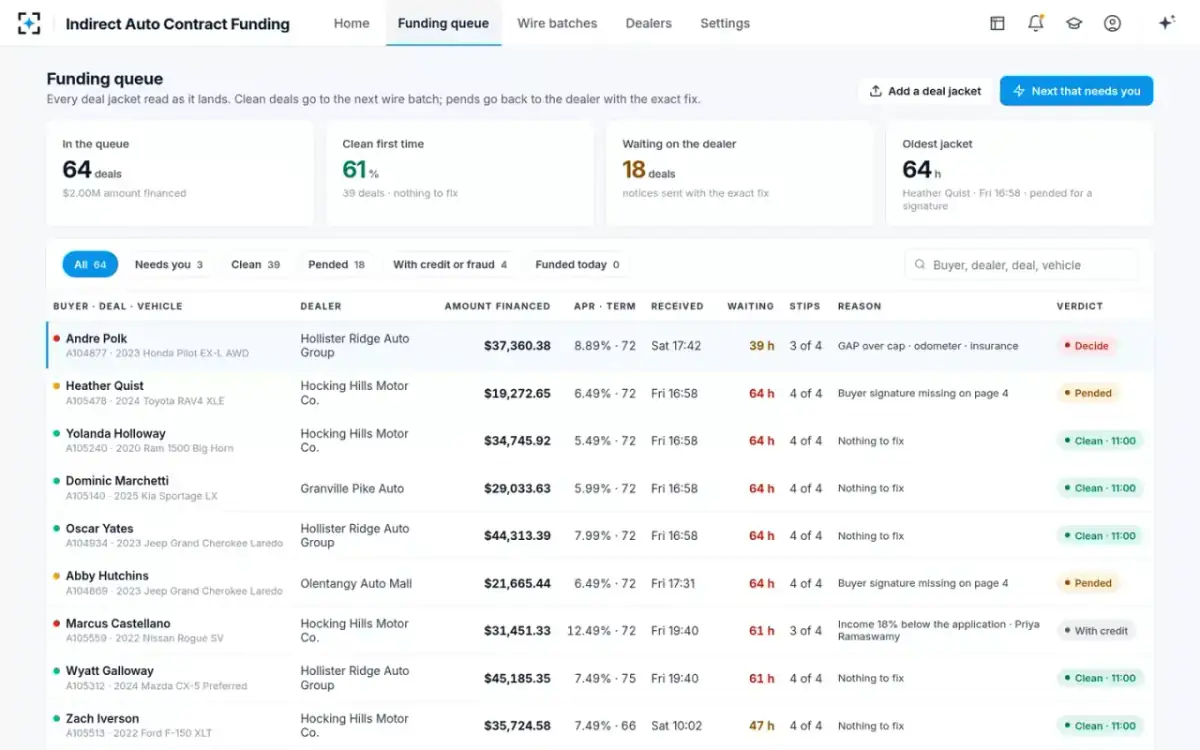
What indirect auto lending adds that direct lending does not
In direct lending the borrower comes to the lender, the lender's own staff prepare the documents on the lender's own forms, and the money moves when the lender is satisfied. Indirect lending inverts all three. The borrower is introduced by a dealership, the documents are prepared by that dealership on its own provider's forms, and the lender is asked to pay a business partner rather than a customer — on the strength of paperwork it had no hand in making.
Three consequences follow, and they are the whole reason the funding step exists as a distinct function. The first is that the lender buys a contract rather than writing one, so defects in it become the lender's defects. The second is that the lender is paying a dealership, with its own cash-flow pressures and a floor plan line running meanwhile, which turns a verification delay into somebody else's financing cost. The third is competitive: the dealership chooses where the next deal goes, and it chooses partly on how the last one was handled after the approval.
The eleven questions to ask about the funding step
Put these to any vendor whose demonstration ended at the decision, and to your own team about the process you already run. None of them is answerable with a screenshot.
Eleven questions for the step between the approval and the wire
- What arrives, and in what state?
Which channels, which file types, how a multi-deal upload is split, what happens to a photograph of a pay stub.
- Who decides the jacket is complete?
Completeness is a judgement about a required-document list, and the list differs by state, product and channel.
- Which terms are checked against the approval, and how many?
Ask for the list. "We validate the contract" and "we compare eighteen terms to the approval" are different products.
- How is each stipulation cleared?
Name matching, date windows, income tolerances, lienholder and deductible tests — and what happens when a document does not name the buyer.
- Is the amount financed recomputed, or read?
Reading the disclosed figure tests nothing. Rebuilding it from the price build is the test.
- Where do programme caps live?
Add-on maxima, markup caps, loan-to-value by programme and tier — as settings with a version history, or as code somebody has to change.
- What does the dealership receive when a deal pends?
A reason code, or a notice in plain sentences naming each fix and the cutoff it has to beat.
- What happens when the corrected contract arrives?
A full re-check against the original approval, or a spot check of the fields that changed.
- Who funds, and who releases?
Which decisions are a person's, what the signature records, and whether a second signature is a setting or a story.
- What goes back to the servicing system, and how?
Booking data is the point where a funding error becomes a servicing error nobody can see.
- What does it measure, by dealership?
Clean first time, hours to fund, pend reasons and how fast pends are answered — the four numbers a relationship manager needs.
Replace or sit beside: what the answer usually is
Almost always, beside. The origination system holds the credit decision, the scorecards and the dealer-facing application flow, and replacing it to get a better funding step is an expensive way to solve a problem that is not in it. What the funding step needs from the origination system is narrow and usually already available: the approval and its conditions, the programme and tier, the rate sheet that applied, and a way to send back a booked deal.
The systems around one indirect deal, and what each one holds
| System | What it holds | What the funding desk needs from it |
|---|---|---|
| E-contracting and dealer submission | The signed contract and the jacket as the dealership sent it. | The documents, intact, with the deal they belong to. |
| Loan origination system | The credit approval, its conditions and the rate sheet applied. | The approval and its stipulations, as data rather than a PDF. |
| The deal jacket itself | The buyer's order, add-on forms, odometer disclosure, title application and stips. | Everything — this is the evidence being tested. |
| Dealer agreements and programme rules | Markup caps, add-on caps, advance limits and participation terms. | The current version of each rule, and the one in force when the deal was approved. |
| Loan servicing system | The booked loan and its payment history. | A clean booking handover, and nothing else. |
| Treasury and wires | The money, and the cutoffs it moves on. | A batch built before each cutoff and released by a person. |
What the dealership sees, and why it decides where the next deal goes
A lender's reputation with a dealership is made twice. The first time is at the decision, where the Comptroller's handbook records that dealerships send one application to several lenders at once and take the one that answers fastest or prices best. The second time is after the signing, in how long the money takes and how workable the pends are — and that is the half a buying process rarely measures, because the origination system has already reported success.
The finance manager's experience of a pend is the sharpest version of this. A notice that says documentation exception — see portal costs that office a call, a hunt and probably a day. A notice that says which product is priced over, what the corrected figures become, what mileage to put on the re-signed contract, what the binder has to name, and that the deal makes the afternoon wire if it all arrives by half past two, costs it twenty minutes. The deals are identical; the relationship is not.
Dealer reserve, participation and who is paid what
The money that moves at funding is not only the loan. The dealership is also paid its share of the rate spread, and how that is handled is a term of the dealer agreement rather than a universal practice. The handbook describes the common arrangement: "dealer reserves, which are bank-controlled deposit accounts funded by the difference between the customer contract rate and the bank buy rate are maintained and distributed per the terms in the dealer agreement" (OCC, Installment Lending). Some programmes pay the participation upfront with the wire instead, and some split it.
What reaches the dealership on one funded deal in Indirect Auto Contract Funding
Amount financed
$37,160.38
The corrected contract, inside the $37,500 the credit approval allowed.
Set by the contract
Dealer participation
+ $1,956.07
75% of the two-point spread between the buy rate and the contract rate, paid upfront with the wire.
Set by the dealer agreement
Dealer proceeds
= $39,116.45
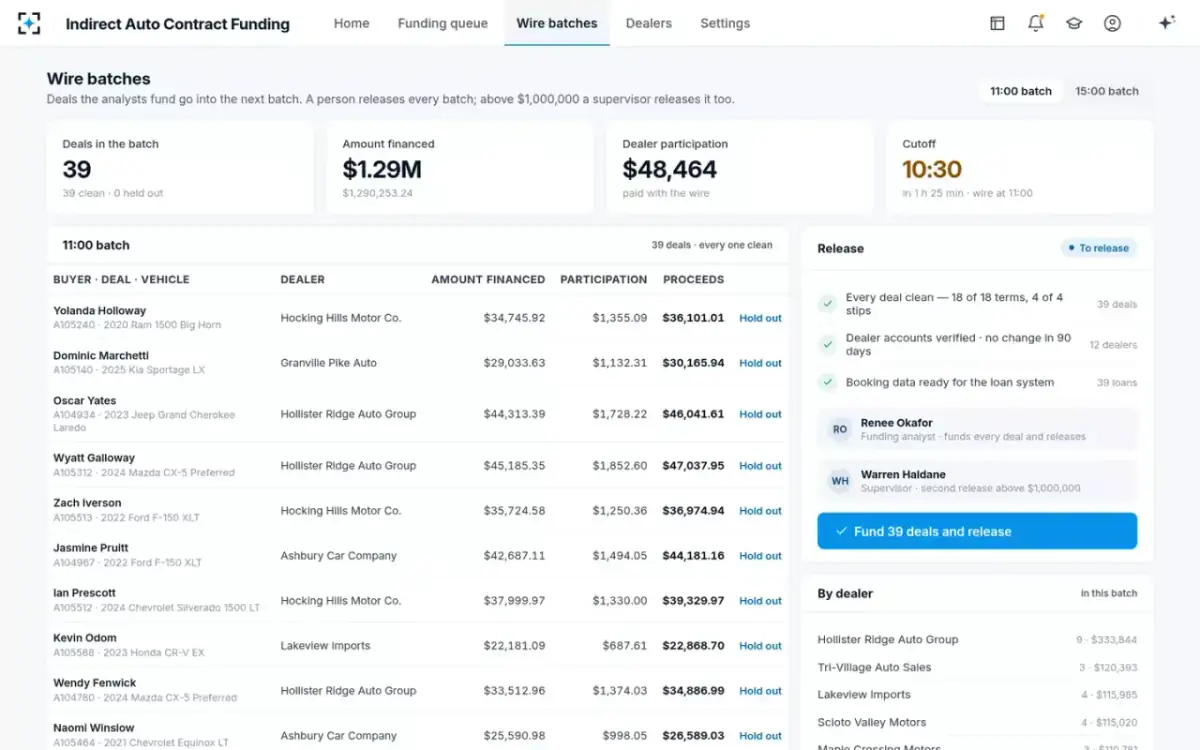
What the wire actually carries for this deal, against $48,464 of participation across a 39-deal batch.
Released by a person
Whoever asks the eleven questions should ask a twelfth about this: does the system compute participation from the contract as signed, or from the contract as corrected? Getting that wrong does not show up as an error; it shows up as a reconciliation the dealership does at the end of the month.
What good looks like, in numbers you can ask for
The handbook lists what a bank should be tracking per dealership, and the list doubles as a specification for the reporting you should expect: "monthly and year-to-date application volumes (received, approved, and booked)", "credit quality, exception rates, and performance of booked loans", "early payoffs", "average margins" and "relationship profitability". Notice that exception rates sits in the middle of a list of credit measures. The funding desk is where exception rates are made.
Three numbers worth putting on the table before you buy
3.00%
of auto loan balances (annualised) flowed into serious delinquency in the second quarter of 2026, against 2.93% a year earlier
6.3h
median hours to fund across the fictional sample book, against 3.4 business days before
$48,464
of dealer participation paid with one 39-deal wire batch in the same sample book
The wire batch, built before the cutoff in Indirect Auto Contract Funding
So the question to carry into a buying process is not whether your origination system is good. It is what you are doing with the hours after it answers. If the honest description of that step is a team of people proving that clean deals are clean, the improvement available is large and it is operational, not analytical. What that team actually does all day is set out in the guide to the funding seat; how to test a system that claims to do it is in the guide on proving it on closed deals; and what you need to bring on the first day is in the go-live guide. To see the step on contracts of your own, start from Indirect Auto Contract Funding.
Questions people ask
What does an auto loan origination system do?
It receives applications from dealerships and aggregators, decisions them against the lender's credit policy and scorecards, prices them from a rate sheet carrying the buy rate, the maximum customer rate and term limits by collateral age, returns an approval with its conditions, and holds that decision as the record everything downstream refers to. Its job ends when the decision is issued.
Does an origination system fund the deal?
Not usually, and not in the sense that matters. Funding means proving that the signed contract and its supporting documents match the approval and the dealer programme, then releasing money to the dealership. Most origination systems hold the approval and some document storage but do not line the signed contract up against the decision term by term, recompute the amount financed, check add-on prices against caps or build the wire batch.
What is the difference between origination and funding?
Origination answers a question about a person and a vehicle: will we lend, how much, at what rate, on what conditions. Funding answers a question about a document: is this signed contract the deal we approved, and is the evidence for its conditions actually here. The first is a credit decision made before the paperwork exists; the second is a verification made on paperwork the lender did not prepare.
What should auto lending software do after the approval?
Take the jacket as it arrives, decide whether it is complete, lay every term of the signed contract beside the approval, recompute the amount financed from the price build rather than reading the disclosed figure, test each add-on against its cap, clear or fail each stipulation against the document that is supposed to prove it, hand a person a verdict with its evidence, draft the dealer notice when the answer is no, and build the wire batch when the answer is yes.
What is indirect auto lending?
Lending where the borrower is introduced by a dealership rather than coming to the lender directly: the dealership takes the application, sends it to several finance sources, sells the car on credit under a retail installment contract and assigns that contract to the lender that bought the deal. The lender pays the dealership rather than the customer, and buys a contract it did not draft.
Can you add funding automation to the system you already have?
Usually, and that is the common shape. The funding step needs the approval and its conditions as data, the documents as the dealership sent them, the current programme rules, and a way to hand a booked deal to servicing. None of that requires replacing the origination system, and replacing it is an expensive way to fix a problem that is not inside it.