In the indirect auto funding verification process, the auto loan funder (funding analyst, funding specialist or contract funder, depending on the lender) is the person who decides whether a signed dealership contract is paid. The credit decision has already been made by an underwriter, often in minutes, while the buyer was still in the showroom. The funder's job starts when the deal jacket arrives: read every document, lay the signed retail installment contract beside the approval it is meant to match, clear the stipulations, recompute the Truth in Lending box, and then either fund the deal into the next wire or send it back to the dealership with the exact fix. Botminds' Indirect Auto Contract Funding is built around that seat: six agents do the reading and the arithmetic, and a funding analyst still signs every deal.
The day described below comes from a fictional sample book inside the solution: Sablewood Federal Credit Union, four named people, one Monday with 64 contracts in it. The people and the credit union are invented. The occupational data and the supervisory texts are real and linked where they appear.
The seat, in the federal occupation data
169,100
people employed in the loan interviewer and clerk occupation the role sits in, 2025
−1%
or lower: projected change in employment for the occupation over 2025–2035
What does an auto loan funder do?
The federal occupational taxonomy describes the work in one line, and it describes the seat better than most procedure manuals: "Verify and examine information and accuracy of loan application and closing documents." The top work activity listed for the occupation is "Evaluating information to determine compliance with standards" (O*NET 43-4131.00). That is the whole job. Everything else is detail about which documents and which standards.
In indirect auto lending the standards come from two places. The approval sets the deal's own limits: an amount financed ceiling, a rate cap, a term, a loan-to-value limit, a payment as a share of verified income, and the stipulations. The dealership programme sets what the paper has to look like: add-on price maximums, insurance requirements, documentation standards. The funder checks the signed contract against both and is the last person to do so before money leaves the institution.
Why a separate seat exists at all is set out in the Comptroller's installment lending handbook: "The bank disburses loan proceeds to the dealer after the bank verifies document accuracy. Quality control (QC) plays a key role throughout this process" (OCC, Installment Lending). The verification is not optional and it is not the dealership's to perform, which is the reason the job survives in every indirect programme, whatever it is called.
Funder, processor, underwriter: the difference between the three seats
These three titles are used loosely and sometimes interchangeably, and the distinction is worth getting right because it decides who may say no, and to what.
Three seats, three different kinds of decision
| Seat | What they decide | What they may not do | When they touch the deal |
|---|---|---|---|
| Underwriter or credit analyst | Whether to extend credit, on what terms, with which stipulations. | Fund a deal, or waive a documentation standard that is not theirs. | Minutes after the dealership submits the application, before the contract is signed. |
| Processor or loan clerk | Nothing. Assembles, indexes and chases the documents. | Clear a stipulation or accept a term outside the approval. | Continuously, as documents arrive. |
| Funder or funding analyst | Whether the signed contract is what was approved, and whether to pay the dealership. | Change a credit decision, approve an off-approval term, or release a wire alone above the policy limit. | When the jacket is complete, against the cutoff for the next wire batch. |
| Funding supervisor | The second signature on large releases and on the exceptions the policy reserves. | Approve their own release. | At the batch, and on any deal above the analyst's limit. |
The line that matters most is between the funder and the underwriter. NCUA's guidance on indirect programmes states it flatly: "no credit union should delegate loan approval authority to a third party", and exceptions to the indirect loan policy "should be infrequent", approved by the people who run the programme and reported to the board (Letter to Credit Unions 10-CU-15). A funder who quietly accepts a contract $900 over the approved amount financed has made a credit decision they were not given.
The four seats between an approval and a wire
In the sample programme four people stand between a credit decision and a payment, and each wants something different from the same deal.
The four seats around one funding desk, before and after the checking is automated
Today
Opens 64 jackets on a Monday and spends most of the day proving that clean deals are clean, then writes pend notices in whatever words there is time for.
With agents
Funds the all-green contracts with one click and works only the exceptions, with the dealership notice already drafted and the arithmetic in it.
Still theirs: The fund-or-pend decision on every deal, clean or not, within her own funding limit.
Today
Is asked to co-release a wire batch without being able to see that every deal inside it is clean.
With agents
Sees eighteen of eighteen terms and four of four stipulations on every deal in the batch before co-releasing it.
Still theirs: The second signature above the policy threshold, and the meaning recorded with it.
Today
Finds out that a contract drifted from her approval after it has funded, if at all.
With agents
Receives every deal that moves off its approval, and every stipulation waiver, before funding, and none of the ones that stay inside it.
Still theirs: Every credit decision, every waiver, every re-decision.
Today
Hears that a dealership is unhappy when its volume drops.
With agents
Sees each dealership's clean-first-time rate, hours to fund and top pend reason, and coaches before the business moves.
Still theirs: The relationship, the programme terms and the decision to put a dealership on watch.
A funder's Monday, hour by hour
The shape of a funding day is set by the wire cutoffs, not by the volume. In the sample programme the batches leave at 11:00 and 15:00 and are funded thirty minutes before, so a Monday has two deadlines in it and everything arranges itself around them.
One deal through one Monday, from the first look to the wire
- Read, checked and decided · 09:05–09:12
- With the dealership: re-sign and binder · 09:12–10:401 h 28 min
- Re-checked, funded and batched · 10:40–11:0020 min
Read that again and the job becomes clear. Of one hour and fifty-five minutes, seven were the desk's: two to read and check 23 documents, five to review the drafted verdict and send it. An hour and a half was the dealership re-signing a contract and sending a new insurance binder, and the last twenty minutes were the re-check, the funding and the batch. A funder's productivity is not how fast they read. It is how often a pend comes back right the first time, which depends almost entirely on how the pend was written.
Around that one deal sat 63 others: 39 clean, funded one by one into the eleven o'clock wire; 18 pended with the fix named; and 7 that needed a person for a credit or fraud question rather than a document.
How many funding seats there are, and why the count is falling
There is no occupational code for auto funding on its own. The closest federal category is Loan Interviewers and Clerks, which also covers mortgage and commercial loan clerks: 169,100 people employed in 2025, with employment projected to decline by 1% or lower over the decade to 2035 (O*NET 43-4131.00). What sets a funding seat apart within it is the funding limit it carries: the more a person may release on their own signature, the further the role sits from the clerical end of that occupation and the nearer to the underwriter's.
The projected decline is the honest part of this page. The clerical half of the work (opening, sorting, indexing, keying, chasing) is what document automation removes, and that half is a large share of the headcount. What does not shrink is the number of decisions: every deal still has to be funded or pended by someone with the authority to do it, and the supervisory texts give no sign of that changing. A programme that grows volume without growing the decision seat is a programme whose funders spend more of their time on judgement and less on photocopies.
The part of the day that is pure proving
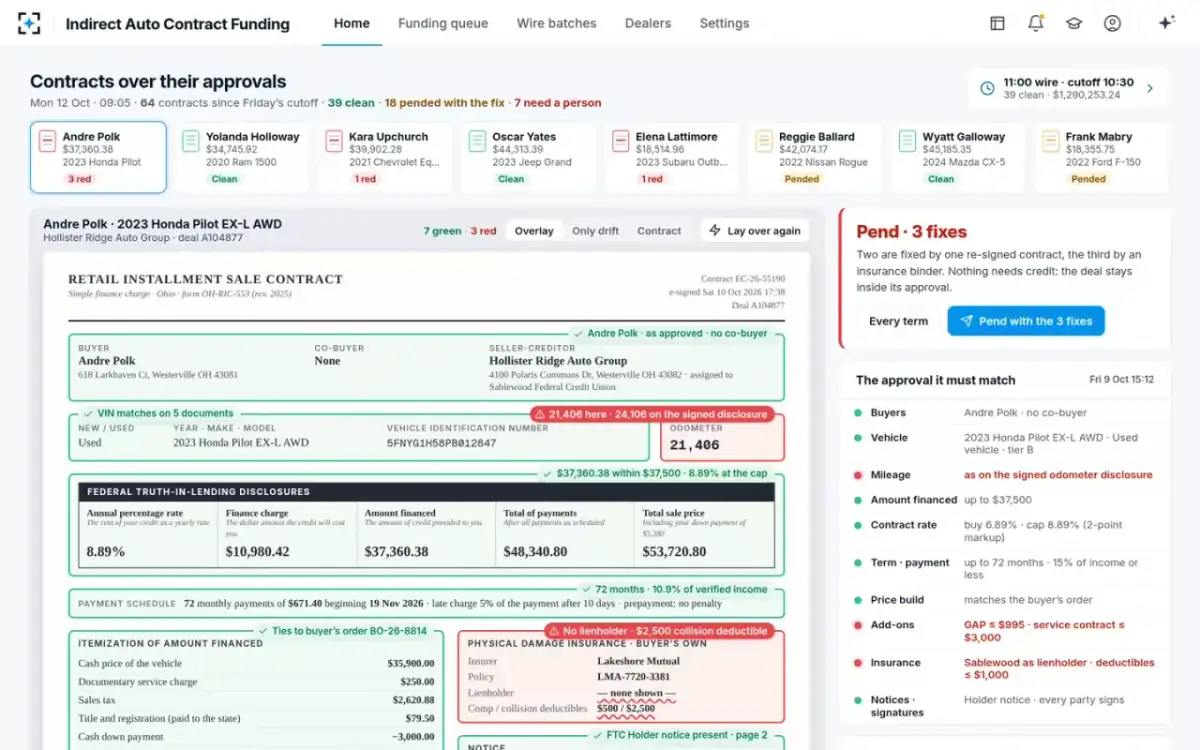
On the sample Monday, 39 of 64 contracts had nothing wrong with them at all. Under a manual process each of those still has to be opened, read, compared term by term against its approval, and have four stipulation documents examined: work whose only possible output is "yes, as expected". That is where most of a funding day goes, and it is work nobody chose: it is the cost of not knowing in advance which deals are the clean ones.
It is also the work with the worst attention profile. A person who has proved nineteen consecutive clean deals is not reading the twentieth as carefully as the first, and the twentieth is the one with the transposed odometer reading. The argument for having agents do the first pass is not that they are cleverer than a funder; it is that the ninety-fifth jacket of the day gets the same reading as the first.
The Monday a funder actually opens on
What changes when the checking is done by agents
Three things, in the sample programme. The reading moves: six agents sort and read the jacket, lay eighteen terms beside the approval, clear the stipulations against the documents that prove them, and recompute the Truth in Lending box (on the sample deal, 23 documents in 1 minute 3 seconds). The writing moves: the pend notice arrives drafted, with the corrected amount financed and payment already worked out, so the version the analyst sends is specific enough to act on in one pass. And the ordering moves: the deals that need a person rise to the top instead of arriving in the order they were submitted.
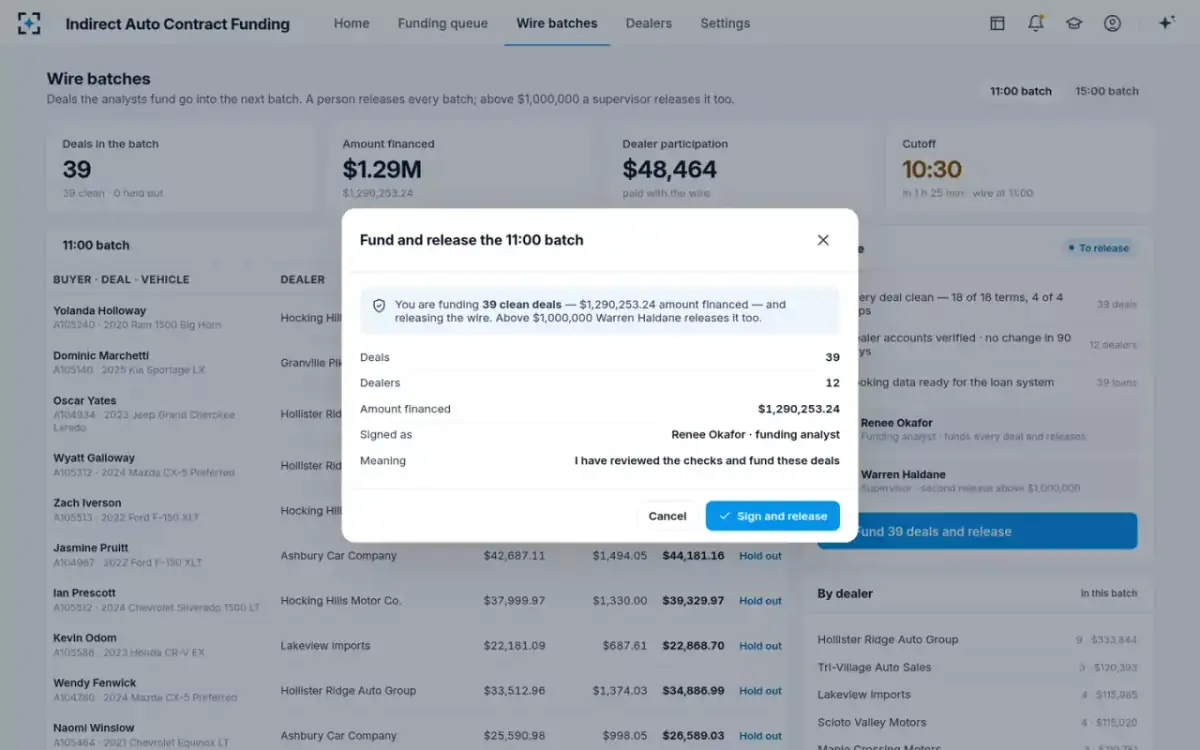
What does not move is the decision. Every deal, clean or not, is funded or pended by the analyst; above the policy threshold the supervisor co-releases the batch; anything outside the approval goes back to the credit analyst who made it. That is not a product preference; it is the shape the supervisory expectations leave available, and it is also the shape that keeps the job interesting.
The release, and the second signature on it
The decisions that stay with a person, and how to design the seat
When a lender designs the funding seat, the duties that matter are the ones a machine cannot hold: the fund-or-pend call and its limit, the judgement about whether a difference is a documentation problem or a credit one, the referral to the credit analyst, the second signature, and the conversation with a dealership whose clean-first-time rate is falling. Those are what is left when the keying goes, and they are what the programme should write down.
Seven questions a lender should be able to answer about its funding seat
- What is the funder’s limit, and whose signature is needed above it?
A real limit, written down, is the difference between a decision seat and a data-entry seat.
- Who decides whether a difference is documentation or credit?
If the answer is "the funder, informally", the programme has delegated credit authority without meaning to.
- What happens to a deal that needs a stipulation waived?
It should go to the person who made the decision, be recorded as an exception and be reported, not cleared at the desk against a cutoff.
- How is a pend written, and who writes it?
A notice that names the fix and the arithmetic comes back right the first time; one that names the fault comes back twice.
- What are the wire cutoffs, and what share of deals make the first one?
The cutoff, not the day, is the real deadline, and the share that beats it is the honest productivity measure.
- What is measured about the funder?
Deals funded per day rewards speed on clean deals; clean-first-time, pends answered the same day and errors found after funding reward the actual job.
- Who talks to the dealerships, and with what data?
A funder who can see a dealership's top pend reason can fix a recurring problem once instead of pending it forty times.
One more rule belongs on the wall above the desk. A pend is not a decline: Regulation B treats an incomplete application as its own category, with a written notice that specifies what is needed and gives a reasonable period to supply it (12 CFR 1002.9(c)). Keeping those two events apart is part of the job, and what each stipulation actually asks for is where it starts. The form the whole day is spent reading is set out in the contract, block by block. To see the seat as the solution builds it, start from Indirect Auto Contract Funding.
Questions people ask
What is the difference between a loan funder and a loan processor?
A processor assembles and chases documents and decides nothing. A funder decides: whether the signed contract matches the approval, whether the stipulations are cleared, and whether the dealership is paid. In small shops one person does both, but the authority is what distinguishes the role, not the task list.
Is an auto loan funder the same as an underwriter?
No. An underwriter makes the credit decision: whether to lend, on what terms and with which conditions. A funder checks that the contract the buyer actually signed is the deal that was approved. A funder who accepts a term outside the approval has made a credit decision they do not hold the authority for, which is exactly what indirect lending guidance warns against.
What should a lender train its auto loan funders on?
Close reading of documents, comfort with the arithmetic of an amount financed and a payment schedule, enough knowledge of Regulation Z and Regulation B to know which differences matter, and the judgement to tell a documentation problem from a credit one. The under-rated skill is writing: a pend notice that a finance manager can act on in one pass saves more time than any amount of reading speed.
Will AI replace auto loan funders?
It replaces the reading, not the decision. The federal projection for the wider clerk occupation is a small decline over the decade, and document automation is plainly part of that. What stays is the fund-or-pend call, the referral of anything outside the approval, and the second signature on large releases, because no supervisory text contemplates a programme in which approval authority sits with a machine or a dealership.
Who signs off a funded deal?
A funding analyst, within a stated personal limit: $75,000 a deal in the sample programme here. Wire batches are released by a person as well, and above a policy threshold, $1,000,000 in the same programme, a second person co-releases. Both signatures are recorded with what they mean.