An odometer discrepancy is a difference between the mileage recorded in one place and the mileage recorded in another for the same vehicle at the same moment — most often between the signed federal odometer disclosure and the retail installment contract, the buyer's order or the title application that were prepared beside it. In a dealership deal jacket the reading is written out four or five times within an afternoon, by two or three different people, and a single transposition is enough to put a wrong mileage on a title that will follow the car for the rest of its life. Botminds' Indirect Auto Contract Funding reads every document in the jacket and compares the figure wherever it appears, which is why a transposed reading shows up as an exception before the dealership is paid rather than after the title application has been filed.
The deal followed here is a fictional sample in the solution: Andre Polk's 2023 Honda Pilot, bought from Hollister Ridge Auto Group and financed by Sablewood Federal Credit Union. The buyer, the dealership and the credit union are invented. The federal requirements quoted are real and linked where they appear.
What the rule asks of one number
5
places the mileage is typically written and signed in a single dealership transaction
5years
that a dealer must retain every odometer disclosure statement it issues and receives
0tenths
the reading is disclosed in whole miles: tenths are not part of it
What is an odometer discrepancy?
There are two quite different things people mean by the phrase, and a funding desk has to tell them apart in the first minute.
The first is a discrepancy between the odometer and the vehicle's actual mileage — a broken instrument, a replaced cluster, a rolled-back reading. Federal law handles that case explicitly: if the transferor knows the reading "does not reflect a valid mileage display or differs from the mileage and that the difference is greater than that caused by odometer calibration error", the disclosure must say so and must carry "a warning notice to alert the transferee that a discrepancy exists between the odometer reading and the actual mileage" (49 CFR 580.5(e)(3)). The disclosure box on every title has a tick for it, and the state brands the title accordingly.
The second — far more common, and the one this page is about — is a discrepancy between documents: the same car, the same afternoon, two different numbers on two pieces of paper. Nobody has tampered with anything. Somebody typed 21,406 where the signed disclosure says 24,106.
The five places the mileage is written in one afternoon
Follow the number from the dashboard to the state. On a typical retail sale it is read once and transcribed four more times, by hand or by keystroke, into documents that are then signed by different people at different moments.
The chain one odometer reading passes through before a lender ever sees it
| Where the number is written | Who writes it | What it becomes | Why it can go wrong there |
|---|---|---|---|
| Read from the dash | A salesperson or technician | A figure on the appraisal or the delivery sheet | Nobody signs anything at this point, so nothing checks it |
| Keyed to the buyer's order | The desk, building the price | The mileage beside the VIN and the trim | It is now a copy of a copy, and the car may have been driven since |
| Printed on the contract | The finance office | The vehicle description the lender will lend against | Keyed again, often from the buyer's order rather than from the disclosure |
| Signed on the federal disclosure | Buyer and seller together | The certified reading, with a criminal warning printed beside it | The only one of the five that both parties sign — and the one that governs |
| Typed on the title application | The title clerk | The permanent state record of the vehicle's mileage | After this it is slow and expensive to change |
| Compared across all five | The funding desk | An exception, or a clean deal | This is the first moment all five copies are in one place at one time |
That last point is the whole argument of this page. Until the deal jacket reaches the lender, no single person has ever had all five documents open at once. The salesperson has the dash. The desk has the buyer's order. The finance office has the contract and the disclosure. The title clerk has the application. The funding desk is the first — and before the title is issued, the last — place where they meet.
What federal law requires on the odometer disclosure statement
The federal odometer rules are short and specific. In connection with a transfer of ownership the transferor must disclose the mileage to the transferee on the title itself — and, where the transferor is the person in whose name the vehicle is titled, "on the electronic title or the physical title, and not on a reassignment document" (49 CFR 580.5(c)). The disclosure must be signed, must carry the transferor's printed name, and must include five further items.
What the federal odometer disclosure must carry, and what it means in a jacket
| The rule requires | In the deal jacket | What makes it fail |
|---|---|---|
| The odometer reading at the time of transfer, not including tenths of miles | The figure on the disclosure, which governs the others | A reading written with tenths, or a reading copied from an older document |
| The date of transfer | The delivery date, which should match the contract | A disclosure dated before the contract was signed |
| The transferor's printed name and current address | The dealership as it appears on the dealer agreement | A trading name that does not match the licensed entity |
| The transferee's printed name and current address | The buyer exactly as named on the contract | A missing co-buyer, or an address updated on one form only |
| The identity of the vehicle: make, model, year, body type and VIN | The same VIN that appears on the contract and the title application | A single transposed character in the seventeen |
| A statement referencing federal law, warning that failure to complete the disclosure or providing false information may result in fines or imprisonment | Printed on the form itself, beside the signature | An old form without the statement |
| A certification that the reading is the actual mileage — or that it exceeds the mechanical limit, or is not actual | One of three boxes, ticked | No box ticked, which is the commonest defect of all |
Two further obligations sit behind the form. The transferee has to sign it too and be given a copy (§580.5(f)), and dealers must keep every disclosure they issue and receive for five years, held "in an order appropriate to business requirements and that permits systematic retrieval", with electronic copies "retained in a format which cannot be altered and which indicates any attempts to alter it" (49 CFR 580.8(a)). A jacket missing the signed disclosure is not merely incomplete for the lender; it is a record the dealership is required to hold and does not.
What causes an odometer discrepancy, and why most of them are copying errors
Fraud exists, and it is the reason the rules read as they do. But in a retail jacket submitted for funding, the overwhelmingly likely explanation for two different readings on the same afternoon is one of four mundane ones.
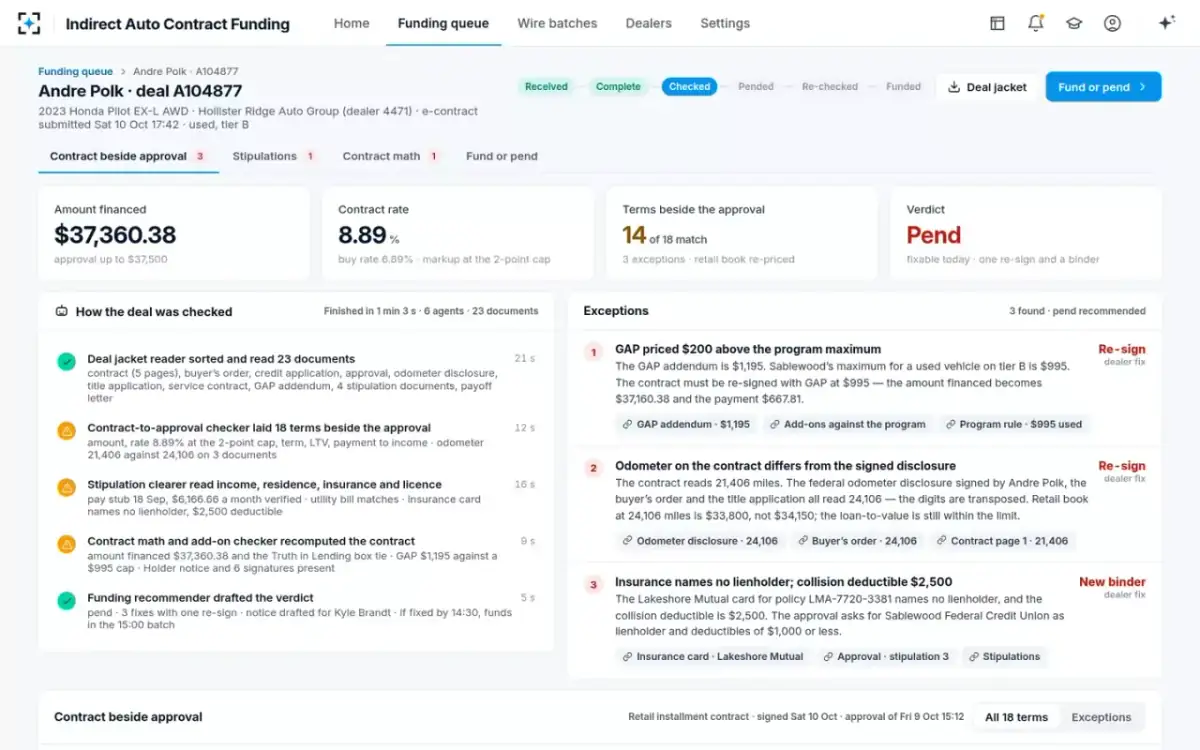
Transposition. Two adjacent digits swap. On the sample deal the contract reads 21,406 where the signed disclosure, the buyer's order and the title application all read 24,106: the 1 and the 4 have changed places. It is the classic keying error, it survives a proofread because the number still looks plausible, and it is the single most common difference the sample programme sees.
Staleness. The figure was taken at appraisal or at trade-in inspection and the car was then driven — to a detailer, on a test drive, home for the weekend on a spot delivery. A reading from Thursday on a contract signed Saturday is not the mileage at transfer.
The wrong source. A clerk copies from the appraisal sheet rather than the signed disclosure, or from last year's service record, or from a listing.
A real difference. Occasionally the reading genuinely is not the mileage — a replaced instrument cluster, a car whose six-digit display has rolled over. That is the case the certification boxes exist for, and it is not a case a funding desk may resolve by preferring one document over another.
What a discrepancy does to the title, and to the value
The mileage on the title application becomes the mileage on the title, and it travels with the car. A title carrying a reading that is 2,700 miles below the truth will be contradicted at the next sale by the service history and the next disclosure, and the next buyer will be told the car has a mileage discrepancy — which is how a typing error turns into a branded history and a price haircut years later.
There is a nearer consequence for the lender. Mileage is an input to the vehicle's book value, and book value is the denominator of the loan-to-value limit the credit approval set. On the sample deal the retail book at the correct 24,106 miles is $33,800 rather than $34,150 at the figure on the contract — a $350 difference, which moves the loan-to-value from 109.4% to 110.5% against a programme ceiling of 125%. Here it changes nothing. On a deal already at the ceiling it changes everything, and that is the reason the figure is checked rather than assumed.
Three exceptions on one deal, and the mileage among them
How the funding desk catches it before the title application
Catching a transposition needs no cleverness, only simultaneity: the figure has to be read from every document that carries it, in the same pass, and compared. That is precisely the work the Comptroller's handbook describes as the condition for payment — "The bank disburses loan proceeds to the dealer after the bank verifies document accuracy" (OCC, Installment Lending) — and the work NCUA lists among the controls a lender must have, "verifying the completeness, accuracy and validity of loan deals" (Letter to Credit Unions 10-CU-15).
The odometer check, in the order that resolves it fastest
- Find the signed federal disclosure first, not the contract
It is the document the rule governs and the one both parties signed; everything else is a copy of it.
- Read the figure from every document that carries it
Disclosure, contract, buyer's order, title application, and any power of attorney used to complete the disclosure.
- Check which certification box is ticked
Actual mileage, exceeds mechanical limits, or not actual mileage. An unticked box is a defect whatever the numbers say.
- Count the documents on each side of the difference
Three documents at 24,106 and one at 21,406 is a copying error on the one; two against two is a question for the dealership.
- Re-price the vehicle at the correct reading
Book value moves with mileage, and the loan-to-value limit is measured against book value, not against the price.
- Check the VIN in the same pass
A jacket where one document was copied carelessly often has a second field copied carelessly too.
- Decide which document has to be re-signed, and say so
A contract with the wrong mileage needs a corrected contract, signed again; a disclosure with the wrong mileage needs a corrected disclosure.
What has to happen to fix it
The fix depends on which document is wrong, and the rule is that the signed federal disclosure is not something anybody corrects informally. If the contract carries the wrong figure and the disclosure is right, the contract is reprinted with the correct mileage and signed again. If the disclosure itself carries the wrong figure, a corrected disclosure has to be executed by the same parties — not amended with a pen.
Re-signing a contract has a second consequence worth planning for. Regulation Z requires the disclosures to reflect the legal obligation the buyer actually signs (12 CFR 1026.17(c)(1)), so any change to the price build means a reprinted contract with every figure recomputed, not a corrected line. A mileage correction on its own does not move the rate; a mileage correction bundled with a repriced add-on usually moves the payment, so the sensible practice is to send the dealership every fix at once and have one corrected contract come back.
One deal, before and after the corrections arrived
Contract EC-26-55190, signed Saturday 17:38: 21,406 miles, against 24,106 on the signed disclosure, the buyer's order and the title application.
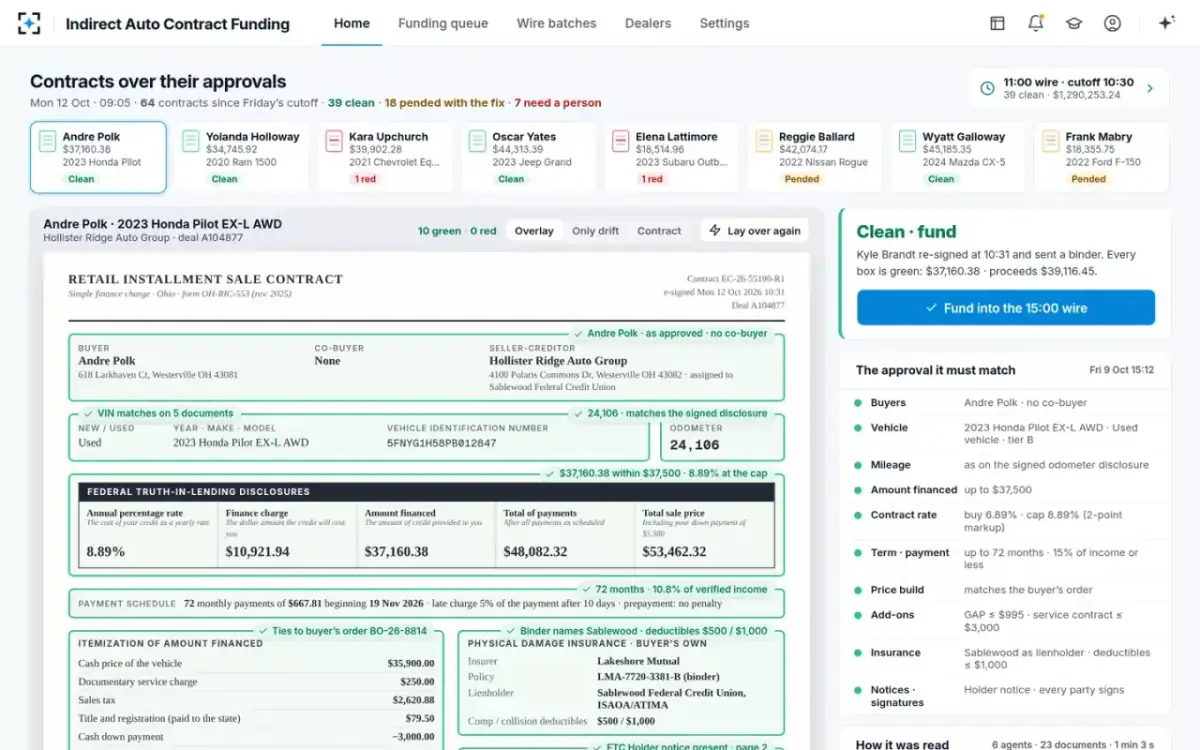
Contract EC-26-55190-R1, re-signed Monday 10:40: 24,106 miles, matching all four documents.
Contract EC-26-55190, signed Saturday 17:38: $34,150 at the figure on the contract.
Contract EC-26-55190-R1, re-signed Monday 10:40: $33,800 at the correct mileage.
Contract EC-26-55190, signed Saturday 17:38: GAP waiver at $1,195, $200 above the programme maximum for a used vehicle on this tier.
Contract EC-26-55190-R1, re-signed Monday 10:40: GAP waiver at $995, within the maximum.
Contract EC-26-55190, signed Saturday 17:38: $37,360.38.
Contract EC-26-55190-R1, re-signed Monday 10:40: $37,160.38.
Contract EC-26-55190, signed Saturday 17:38: No lienholder named; collision deductible $2,500.
Contract EC-26-55190-R1, re-signed Monday 10:40: Lender named as lienholder; deductibles $500 and $1,000.
Contract EC-26-55190, signed Saturday 17:38: Pend, with three fixes and the afternoon cutoff named.
Contract EC-26-55190-R1, re-signed Monday 10:40: Ten of ten parts green; funded at 10:44 into the 15:00 wire.
The corrected contract, laid over the same approval
Which vehicles are exempt from odometer disclosure
Not every transfer needs a disclosure, and knowing the exemptions saves a pend that should never have been raised. Under 49 CFR 580.17, no odometer mileage need be disclosed for a vehicle with a gross vehicle weight rating of more than 16,000 pounds, a vehicle that is not self-propelled, a vehicle manufactured in or before the 2010 model year that is transferred at least ten years after 1 January of its model year, or a vehicle manufactured in or after the 2011 model year that is transferred at least twenty years after that date. The rule gives its own worked example: for transfers occurring during calendar year 2031, model year 2011 or older vehicles are exempt.
The twenty-year rule is the one that has changed practice. Vehicles from the 2011 model year onwards carry a disclosure obligation far longer than older ones did, so an older used car that would once have been exempt now needs the form — and a dealership working from habit rather than from the rule will leave it out.
The mileage is one of eighteen terms the desk lays beside the approval; what the rest of them are, and what the contract itself has to carry, is set out in the anatomy of a retail installment contract, and the documents that clear the conditions attached to the approval are in the four stipulations. To see the comparison run across a whole deal jacket, start from Indirect Auto Contract Funding.
Questions people ask
What happens if the odometer on my car contract is wrong?
If the signed federal disclosure is right and the contract is wrong, the contract is reprinted with the correct mileage and signed again — it is a correction, not a dispute. If the disclosure itself is wrong, a corrected disclosure has to be executed by the same parties, because it is a signed federal form and not something anyone may amend with a pen.
Is an odometer discrepancy the same as odometer fraud?
No. A discrepancy between documents is usually a transposed or stale figure copied between forms on the same afternoon. Odometer fraud is knowingly misrepresenting mileage, and the federal disclosure carries a printed warning that providing false information may result in fines or imprisonment. The documents look similar; the states of mind do not.
Who has to sign the odometer disclosure?
The transferor signs and prints their name, certifying the reading; where more than one person is a transferor only one need sign. The transferee then signs the statement, prints their name, and must be given a copy. On an electronic title the state has to provide a means of making the completed disclosure available to both parties.
Does an odometer discrepancy brand the title?
If the transferor certifies that the reading is not the actual mileage, the disclosure must carry a warning notice and the state records that status, which follows the vehicle. A discrepancy between a contract and a disclosure that is corrected before the title application is filed does not brand anything — which is why the correction has to happen before the paperwork goes to the state.
How many miles of difference matter?
Any difference between documents matters, because the question is not the size of the gap but which figure is going on the title. Federal law asks for the reading in whole miles, without tenths, and requires a warning where the reading differs from the real mileage by more than calibration error. For a lender there is also a valuation question: book value moves with mileage, and the loan-to-value limit is measured against book value.
Which vehicles do not need an odometer disclosure?
Vehicles rated above 16,000 pounds gross vehicle weight, vehicles that are not self-propelled, model year 2010 and older vehicles transferred at least ten years after 1 January of their model year, and model year 2011 and newer vehicles transferred at least twenty years after that date. The twenty-year rule means most used cars on a dealership lot today still need the form.