Auto loan stipulations are the conditions an indirect lender attaches to its approval, and until every one of them is satisfied the lender will not buy the contract or send the money. They are not part of the credit decision; that has already been made. They are the lender's proof that the person, the income, the address, the vehicle and the insurance are what the application said they were. Botminds' Dealer Funding Status Assistant reads each document against the stipulation it answers and tells the dealer, in the dealer's own words, which condition is still open and what will clear it.
The product examples here are sample data on a fictional lender, Tarrow Auto Finance, and fictional dealers and buyers. The rules and quotations are the CFPB's, the OCC's and Regulation B's, linked where they appear.
What are stipulations on an auto loan?
They are purchase conditions. In indirect auto lending the dealer, not the lender, signs the contract with the buyer, and the lender then buys that contract. The CFPB's examination procedures for auto finance describe the sequence directly: "After evaluating the applicant, indirect auto lenders may provide the dealer with purchase eligibility criteria or stipulations, including but not limited to a risk-based 'buy rate' that establishes a minimum interest rate at which the lender is willing to purchase a retail installment sales contract executed between the consumer and the dealer for the purchase of the vehicle" (CFPB, Auto Finance examination procedures, June 2015).
The same passage explains why they arrive as a list rather than a conversation: "With the relevant eligibility criteria and stipulations, the dealer selects the indirect lender that will provide the financing." A dealer shops one application to several lenders; each replies with terms and a list of what it will need. The dealer picks. The list that comes back with the chosen approval is the stipulation list, and from that moment the deal is a document exercise.
In the trade they are "stips". Both words mean the same thing, and both are worth knowing because the dealership and the lender often use different ones for the same line.
Where the desk's week goes, by the reason a dealer asked
21%
insurance: no lienholder, or the wrong one
18%
proof of income
14%
contract errors: signatures, VIN, amounts
9%
proof of residence
Where the word comes from, and who sets it
The lender sets it, in writing, before the dealer sees it. The OCC expects the arrangement between a bank and the dealers it buys from to be explicit about exactly this. Its retail lending handbook tells examiners to check that "contracts clearly specify credit criteria, loan documentation standards, collateral valuation requirements, reporting requirements, quality control reviews, and other methods that allow the bank to assess compliance with agreements, bank policies, and laws and regulations, including those intended to protect consumers" (OCC, Retail Lending, version 2.0).
Loan documentation standards is the phrase that becomes a stipulation list. The handbook also explains why the standard is non-negotiable at the funding stage: examiners are to confirm that "internal processes and controls provide certainty that all purchased loans are consistent with the bank's underwriting criteria." A deal that funds with an unsatisfied condition is a loan the bank bought on terms it did not set.
That is also why the number of conditions rises as the credit weakens. A near-prime file, in the handbook's own description, is one with "evidence of increased risk" such as "unverifiable income, credit problems recently resolved, or problems requiring a waiver or exception to the bank's current underwriting criteria." More doubt, more proof.
The six stipulations on one sample deal
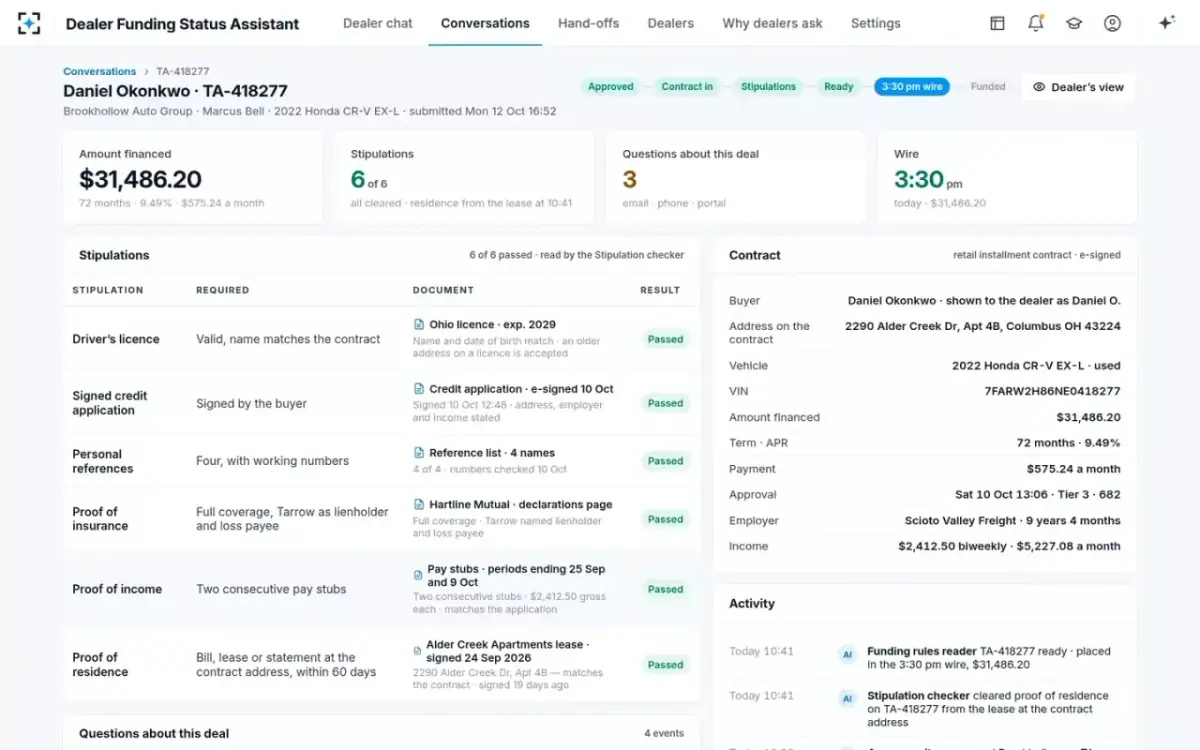
Lists vary by lender and by credit tier, but the shape is consistent. Here is one deal in the solution's sample data — a 2022 Honda CR-V EX-L, $31,486.20 financed over 72 months at 9.49% — with its six conditions and what each actually tests.
Six conditions, what each tests, and the document that answers it
| Condition | What it really tests | What arrived on this deal |
|---|---|---|
| Driver's licence | That the buyer exists and is the person on the contract. An old address on the licence is accepted; a different name is not. | Ohio licence, expiring 2029, name matching the contract |
| Signed credit application | That the buyer, not the dealership, stated the income, employer and address the approval rests on. | Credit application e-signed on 10 October at 12:48 |
| Personal references | That the buyer can be reached if the loan goes quiet. Four names, with numbers that connect. | Four names, numbers checked on 10 October |
| Proof of insurance | That the lender’s security interest is insured: full coverage, the lender named as lienholder and loss payee. | Insurer declarations page naming the lender as lienholder and loss payee |
| Proof of income | That the income on the application is real and recurring. Two consecutive stubs, so one unusual period cannot carry the file. | Stubs for periods ending 25 September and 9 October, $2,412.50 gross each |
| Proof of residence | That the buyer lives where the contract says, within the last 60 days. | A lease at the contract address, signed 24 September |
Read that way, the list stops looking like paperwork. Each line closes one gap between what the application asserted and what can be shown. The OCC puts the principle in a single sentence: "Banks relying on customer assertions rather than direct verifications face greater uncertainty, assume an inherently higher quantity of credit risk, and should have enhanced risk management practices to compensate."
Why each stipulation fails, and what passes instead
Failures are repetitive. A funding desk sees the same half-dozen every week, and almost all of them are produced somewhere other than the deal in front of it — at an insurance agency, in a payroll system, at a landlord's office.
The common failures, and the wording that clears each one
| Condition | How it usually fails | What clears it |
|---|---|---|
| Proof of insurance | Lienholder omitted, or the agency names a different entity; liability only, with no comprehensive and collision; the policy starts after the contract date. | A declarations page naming the lender exactly as the dealer agreement states, with comprehensive and collision in force on the contract date. |
| Proof of income | One stub instead of two; a stub whose monthly equivalent is outside the tolerance against the application; a year-to-date figure that does not reconcile; a stub with no employer name. | Two consecutive stubs from a named employer whose monthly equivalent matches the application within the lender’s tolerance. |
| Proof of residence | A bill at a previous address; a document older than the window; a name that is not the buyer’s; a screenshot with no date. | A lease, bank statement or utility bill at the contract address, dated inside the window, in the buyer’s name. |
| Contract itself | An unsigned line; a VIN that differs from the approval; an amount financed that does not match the approved structure; a missing co-buyer signature. | A complete contract whose VIN, amount, term and rate match the approval, signed by everyone named on it. |
| Title and registration | Lien not recorded, or recorded in the wrong name; an out-of-state title still with the prior lienholder. | Evidence that the lien has been applied for in the lender’s name in the correct jurisdiction. |
| References | Numbers that do not connect; references who are the same household as the buyer. | Four contactable references outside the household. |
Two of these account for most of the traffic on their own. The insurance declarations page is the single largest reason dealers call, at 21% of the week's questions in the solution's sample data — the lienholder wording and why it fails so often is worked through separately. Income is next, at 18%, and has its own arithmetic and its own verdicts.
The week's dealer questions, by the condition behind them
Can a lender add stipulations after approval?
Yes, and this is where most of the friction between dealer and desk comes from. An approval is conditional on the file matching the application; when a document shows something the application did not, the lender may ask for more. A stub that shows a different employer, an address that has changed since the credit report was pulled, a vehicle whose VIN does not match the one approved — each of these can produce a new condition after the dealer thought the list was closed.
What a dealer is entitled to is not fewer conditions but an honest list. If the lender knows on Monday that it will also need a second stub, saying so on Monday costs nothing and saves a day. The solution's sample data shows what the alternative costs: before the assistant, a median of two hours forty minutes to answer a dealer by email, and the same deal asked about three or four times.
The deal as the funding desk sees it
How long does a dealer have to clear stipulations, and what if they are never met?
As long as the lender's approval stays valid, which the approval itself states, and in practice no longer than the buyer will wait with a car in the drive. The regulatory clock behind it is Regulation B's: a creditor must act within "30 days after receiving a completed application" (12 CFR 1002.9(a)(1)(i)), and an application missing documents the applicant can supply may instead get a written notice of what is needed and by when. How that distinction works on the lender's side, and why a pend is not a decline, is set out in conditional approval on an auto loan.
For the dealership the useful clock is shorter: the lender's wire cut-offs. A condition cleared by 3:00 pm at the sample lender goes in the 3:30 pm wire; cleared at 3:10 pm, it funds tomorrow. A stipulation that will never be met ends with the deal rewritten with another lender or unwound, and the sooner the store knows which condition is open, the more of those options it still has.
Who clears each stipulation at the dealership, and who they need
| Stipulation | Who in the store owns it | Who they need outside the store | The usual delay |
|---|---|---|---|
| Proof of insurance naming the lender | F&I manager | The buyer’s insurance agent, to reissue the declarations page | The agency’s turnaround |
| Proof of income | F&I manager | The buyer, for the second stub, or the employer | A pay cycle, if the second stub does not yet exist |
| Proof of residence | F&I manager | The buyer, for a bill or lease at the contract address | Hours, if the buyer has the document on a phone |
| Contract errors | F&I manager and the buyer | Nobody else: re-sign in the store | Getting the buyer back in |
| Title and lien | Title clerk | The motor vehicle office, or a prior lienholder for a payoff | Days, longest for an out-of-state title |
| References and application | F&I manager | The buyer | A phone call |
When a stipulation cannot be met: asking for a waiver
Some conditions cannot be satisfied in time. The buyer has been at the same employer nine years but the second stub is three weeks away; the co-buyer is deployed; the title is held by an out-of-state lienholder who will take a fortnight. Asking the lender to fund anyway is asking it to lend on different terms, and the OCC's retail lending handbook treats that as a policy exception whose approval authority is "generally in writing". From the dealership's side, the useful thing is to ask once, with the reason and the evidence, so the person who may say yes has what they need; who that is, and how a lender decides, is covered in the lender's guide to conditional approval. In the sample data, a waiver request on the second pay stub went to the senior analyst the funding policy names and was decided in nine minutes, with the reason shown to the dealer.
Who does what between a contract arriving and a wire leaving
Agent
Identity checkConfirms the person asking is a verified user of that dealer and that the deal belongs to that dealer.
Never: shows a deal to another dealer, or a buyer’s date of birth, social security number or credit report
Agent
Status readReads the deal: status, every condition, timestamps, returns and the wire batch it sits in.
Never: changes a status
Agent
Document checkReads each document against its condition and returns pass, review, fail or missing, with the reason.
Never: re-decides income, or clears a condition that needs a person
Agent
Schedule checkApplies the cut-off, wire batches, holidays and the dealer agreement to say when a cleared deal funds.
Never: promises a funding time the schedule cannot keep
Agent
The answerWrites the plain answer with a source on every line and an upload link for each missing item.
Never: gives a rate, a credit reason or a decline
A person decides
Funding analystDecides waivers, restructures, exceptions and anything asked a third time, with the deal and the policy in front of them, and signs the reason.
Reading the documents as they arrive
The cheapest moment to check a document is the moment it lands. A declarations page read at 10:41 that fails at 10:41 gives the dealer four hours to fix it before the cut-off; the same page read next morning costs a day. In the solution's sample data a lease uploaded from inside an answer was checked against four tests — the tenant is the buyer, the address matches the contract, the document is dated within the window, it is signed by both parties — and cleared in three seconds, moving the deal into that afternoon's wire.
What that requires is not speed for its own sake but a written test per condition. "Proof of residence" is not a test; "a lease, bank statement or utility bill at the contract address, dated within 60 days, in the buyer's name" is. The same sentence tells the dealer what to send, tells the reader what to check, and tells the analyst what was checked when they come to decide an exception.
Two ways to tell a dealer the same thing
The usual answer: "Still pending stips."
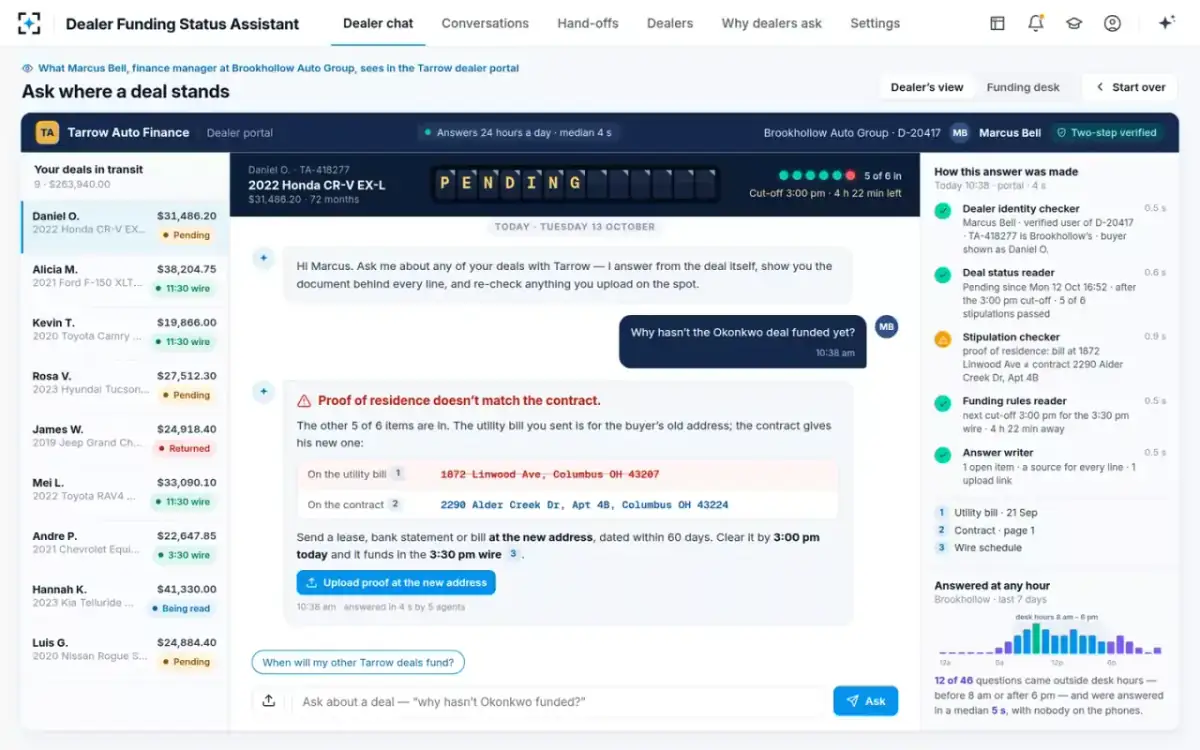
An answer from the deal: "Proof of residence does not match the contract: the bill says 1872 Linwood Ave, the contract says 2290 Alder Creek Dr, Apt 4B."
The usual answer: Call back and ask which one.
An answer from the deal: A lease, bank statement or bill at the new address, dated within 60 days, uploaded here.
The usual answer: A second call, and an analyst off funding.
An answer from the deal: Nothing, and the dealer can act immediately.
The usual answer: Unstated.
An answer from the deal: "Cleared by 3:00 pm goes in the 3:30 pm wire."
What a clean submission carries
- A contract whose VIN, amount, term and rate match the approval
Mismatches here are not document problems; they are a different deal from the one approved.
- Every signature, including the co-buyer’s
A missing signature is the most avoidable return on the list.
- Two consecutive pay stubs from a named employer
One stub cannot show that income recurs, which is what the condition is for.
- A declarations page naming the lender exactly as the dealer agreement states
Comprehensive and collision in force on the contract date, not from the following week.
- Residence proof in the buyer’s name at the contract address
Dated inside the lender’s window, with the date visible on the document itself.
- Submission before the cut-off
A complete file after the cut-off is a complete file that funds tomorrow.
The same deal, answered to the dealer
To see the conditions, the documents behind them and the hand-offs on real deals, start from Dealer Funding Status Assistant. For the clock that sits over all of it, see same day funding on auto loans.
Questions people ask
What does "stips" mean in indirect auto lending?
"Stips" is dealership shorthand for stipulations: the documents and conditions a lender requires before it will buy a signed contract. They are issued with the approval and are separate from the credit decision. A deal can be approved and still not fund because a stip is open.
What documents does a lender need to fund a car loan?
Typically the signed contract and credit application, a valid driver's licence, proof of insurance naming the lender, proof of income, proof of residence, references and evidence that the lien has been applied for. The exact list comes from the lender's documentation standard for that credit tier and is attached to the approval the dealer accepted.
How long does a dealer have to clear stipulations?
As long as the lender's approval stays valid, which the approval states, and the lender's wire cut-offs decide which day a cleared deal funds. Regulation B separately requires a creditor to act within 30 days of a completed application, or to send a written notice of incompleteness that specifies what is needed and designates a reasonable period to supply it.
Can a lender add stipulations after approval?
Yes, where a document shows something the application did not. A stub naming a different employer, an address that has changed, or a VIN that does not match the approval can each produce a new condition. What a dealer should expect in return is the full revised list at once rather than one item at a time.
Who clears stipulations at a dealership?
The finance and insurance manager, usually with a title or funding clerk. They collect the documents from the buyer, the insurance agency and the employer, and send them to the lender's funding desk. On the lender's side a funding analyst reads each document against the condition it answers and decides whether it passes.
What is a conditional approval on a car loan?
An approval that will become a purchase once named conditions are satisfied. The credit decision is made; what remains is proof. It is not a guarantee of funding: if the documents contradict the application, the lender may revise its terms or decline to buy the contract, and the deal is then rewritten or unwound.