The flood insurance minimum coverage a lender must require is the lesser of three numbers, not two: the outstanding principal balance of the loan, the maximum limit available for that type of structure under the National Flood Insurance Program, and the insurable value of the structure itself. The common shorthand — the lesser of the loan balance and the NFIP maximum — collapses the last two into one, and gets the right answer only when the building is worth more than the statutory limit. On a $30,000 equipment shed securing a $300,000 loan it is wrong by $270,000. Botminds' Collateral Insurance & Lien Tracking works the test out for each building on a loan, from the determination and the collateral schedule, and shows the arithmetic beside the policy in force.
This page follows the FDIC's text at 12 CFR part 339; the OCC, Board, FCA and NCUA rules are the same in substance at their own citations. The bank, buildings and loan in the examples are fictional sample data from the solution. The rules, the statutory limits and the quotations are real.
Flood insurance minimum coverage: the three numbers, in order
The regulation gives the outer frame. A supervised institution "shall not make, increase, extend, or renew any designated loan unless the building or mobile home and any personal property securing the loan is covered by flood insurance for the term of the loan", and "the amount of insurance must be at least equal to the lesser of the outstanding principal balance of the designated loan or the maximum limit of coverage available for the particular type of property under the Act" (12 CFR § 339.3(a)).
That sentence is where the two-part shorthand comes from, and it is accurate as far as it goes. What it does not say on its face is what "the maximum limit of coverage available" means. The agencies unpack it in the flood questions and answers, and the unpacking is the whole point: the maximum amount of insurance available under the NFIP is itself "the lesser of: The maximum limit available for the type of structure; or The 'insurable value' of the structure" (Interagency Q&A, Amount 5).
The required amount, term by term
1 · Outstanding principal balance
the loan(s) secured by the building
The balance today, not the original commitment. On a revolving facility, follow your own policy for how the limit is treated — and re-test on every increase, extension and renewal.
From the loan system
2a · Statutory maximum for the structure type
$500,000 non-residential; $250,000 for a 1–4 family residential building
Set by statute per building, with separate contents limits. A multifamily or other residential building has its own limit.
42 U.S.C. § 4013(b)
2b · Insurable value of the structure
the cost to replace or repair the building
The building alone — not the land, and not the purchase price. Where it is below the statutory limit, it is the ceiling.
From the appraisal, the hazard policy or a replacement-cost estimate
= The required amount
lesser of 1 and (lesser of 2a and 2b)
Worked for each building separately, then added across the buildings securing the loan.
The three-part test, Q&A Amount 5
How do you calculate the required flood insurance for one building?
Take the agencies' own example, which exists precisely because the shorthand fails on it. The outstanding loan principal balance is $300,000. The maximum limit available for the type of structure is $500,000, because the building is non-residential. The insurable value of the equipment shed securing the loan is $30,000. The agencies conclude: "the minimum amount of insurance required by the Regulation for the equipment shed is $30,000" (Amount 5).
Run the shorthand over the same facts and you get $300,000 — the lesser of the balance and the $500,000 limit — which is ten times the building's worth. The error is not academic in either direction. Requiring too much forces a borrower to buy coverage that can never pay out, and an over-insured building is a borrower complaint with a regulator's answer behind it. Requiring too little is the more common and more serious case, and it is what examiners cite.
Now run it on the sample bank's own loan. Copperline Business Park, loan CL-40817, has $7,912,400 outstanding, and Building C at 4420 Copperline Pkwy sits in Zone AE. The building is non-residential, so the statutory limit is $500,000, and its insurable value is well above that. The inner comparison therefore resolves to $500,000, and the outer comparison — $7,912,400 against $500,000 — gives a required amount of $500,000. Here the shorthand and the full test agree, which is exactly why a desk can use the shorthand for years and never find out that it is wrong.
The same test, two buildings: where the shorthand breaks
The two-part shorthand: Lesser of $300,000 and $500,000 = $300,000 required.
The three-part test: Maximum available = lesser of $500,000 and $30,000 = $30,000. Lesser of $300,000 and $30,000 = $30,000 required.
The two-part shorthand: Lesser of $7,912,400 and $500,000 = $500,000 required.
The three-part test: Maximum available = lesser of $500,000 and the insurable value = $500,000. Lesser of $7,912,400 and $500,000 = $500,000 required.
The two-part shorthand: Right once, by accident. Wrong by $270,000 on the shed.
The three-part test: Right in both cases, because it asks what the building is worth before it asks what the loan is.
What counts as "insurable value", and where lenders get it wrong
Insurable value is the cost of replacing or repairing the structure — the building, not the parcel. Three substitutions cause most of the errors.
The first is using the appraised value of the property. That number includes the land, and on a commercial site the land can be most of it; a $2.4 million appraisal on a building worth $900,000 to rebuild produces a requirement nobody can buy. The second is using the purchase price, which carries the same problem plus whatever the market was doing that month. The third, subtler one is using the hazard policy's building limit without asking how it was set: a blanket limit across a schedule of locations tells you what the carrier will pay in total, not what any single building is worth.
The defensible sources are the ones a reviewer can follow: a replacement-cost estimate, the itemised building values behind a commercial property schedule, or an appraisal that separates improvements from land. Whichever is used, the file should say which — because when an examiner disagrees with a required amount, the argument is almost always about this number rather than about the arithmetic.
The statutory maximums: residential, non-residential, contents
The limits come from the National Flood Insurance Act and are set per building, with contents limits of their own. For a non-residential building, additional coverage is made available "up to an aggregate liability … of $500,000, and coverage shall be made available up to a total of $500,000 aggregate liability for contents owned by the building owner and $500,000 aggregate liability for each unit within the building for contents owned by the tenant" (42 U.S.C. § 4013(b)(4)). For a residential building designed for one to four families the ceiling is $250,000, and residential contents are available up to $100,000.
The statutory limits, per building
| Structure or property | Maximum made available | Where it comes from |
|---|---|---|
| Non-residential building | $500,000 aggregate liability per building | 42 U.S.C. § 4013(b)(4) |
| Contents owned by the owner of a non-residential building | $500,000 aggregate liability | 42 U.S.C. § 4013(b)(4) |
| Contents owned by a tenant, per unit in a non-residential building | $500,000 aggregate liability for each unit | 42 U.S.C. § 4013(b)(4) |
| Residential building designed for 1–4 families | $250,000 aggregate liability per building | 42 U.S.C. § 4013(b)(2) |
| Residential contents | $100,000 | 42 U.S.C. § 4013(b)(3) |
Two practical notes. Contents are a separate requirement with a separate test, and they are required only where personal property secures the loan — a loan secured by the building alone does not require contents coverage, but a loan whose collateral includes inventory or equipment inside a building in a special flood hazard area does. And private flood insurance that meets the regulation's definition may be accepted in place of an NFIP policy; the required amount is calculated the same way, because the test is written against what the programme makes available, not against what the borrower bought.
Do you need flood insurance on every building on the property?
Every building that secures the loan and sits in a special flood hazard area, yes. The agencies answer the question and then answer the arithmetic that follows it: "the lender must determine the amount of insurance required on each building and add these individual amounts together" (Amount 6).
This is where portfolios actually go short, because it is the one step that cannot be done from the loan system. The loan has one balance; the collateral has several buildings; the determination is per building; and the insurable values differ. A desk that works from the loan record will compute one number and compare it with one policy limit. A desk that works from the collateral schedule computes several and adds them.
Four buildings, one loan: the required amount is built per building
Allocating one total across several buildings — and the trap in it
The agencies permit flexibility about how the total is spread: "the amount of total required flood insurance can be allocated among the secured buildings in varying amounts, but all buildings in an SFHA must be covered in accordance with the statutory requirement" (Amount 6). That is useful on a schedule where one building is far more exposed than another.
The trap is in the second half of the sentence. Allocation is not permission to leave a building out. Every building in a special flood hazard area that secures the loan must carry coverage, and the allocation has to respect each building's own ceiling — moving $200,000 of a total onto a building whose insurable value is $80,000 buys nothing, because the excess could never be paid. A desk that allows allocation should therefore record the allocation per building, not just the total, and re-test it whenever the schedule changes.
On the sample bank this is a setting: the required flood amount is computed per building by default, with allocation across buildings available where the agreement and the policy support it. Either way the working is kept per building, so a reviewer can see which building each dollar is doing its work on.
When the loan balance is the smallest number, and when it is not
The balance binds on small loans against large buildings — a $180,000 loan secured by a warehouse worth $3 million requires $180,000 of flood cover, not $500,000. It stops binding as the loan amortises past the relevant ceiling, and that is a quiet source of over-insurance on long-held commercial loans: a requirement set at origination and never re-tested asks the borrower to keep buying a limit the loan no longer justifies.
The test runs again at every trigger the regulation names — when a designated loan is made, increased, extended or renewed — and good practice re-tests it at each renewal of the policy as well, because the inputs move even when the loan does not. A building added to the collateral, a map change that brings a building into a special flood hazard area, a loan increase, or a new replacement-cost estimate each change the answer.
The borrower-facing notice uses the shorthand, which is worth knowing when a borrower quotes it back at you. The sample notice in the regulation's appendix tells the borrower that "at a minimum, flood insurance purchased must cover the lesser of: (1) the outstanding principal balance of the loan; or (2) the maximum amount of coverage allowed for the type of property under the NFIP" (12 CFR part 339, appendix A). It is a notice to a borrower, not a calculation method for a lender; the insurable-value cap lives inside limb (2).
What a shortfall means on day one, and what it means at renewal
A shortfall found before a loan is made, increased, extended or renewed is a condition: the loan may not close until adequate coverage is in place. A shortfall found mid-term is a force-placement matter — the determination triggers the notice, and the notice starts the 45 days, with the lender ultimately purchasing the difference rather than a whole policy. The two look the same on a screen and are governed differently, so the desk's first question on any shortfall is which of the two it is.
Mid-term shortfalls arrive from four directions, and only one of them involves the borrower doing anything: a renewal written at a lower limit, a loan increase, a building added to the collateral, and a map change. Each of those is an event the desk has to see without being told. How the 45 days are counted covers what happens next, including the remapping case, where the map's effective date is the determination date.
The required amount, worked out per building, beside the cover in force

Writing the requirement into the loan agreement so it survives a renewal
The regulation sets a floor. The loan agreement is where a bank can set something a tracking desk can actually enforce, and the drafting choice that matters most is whether the clause states a number or states a test. A clause that names $500,000 is a clause that will be wrong after the next map change, the next building, or the next appraisal. A clause that requires flood insurance "on each building securing the loan that is located in a special flood hazard area, in an amount not less than the greater of the amount required by applicable law and the full insurable value of that building" survives all three.
Three more provisions earn their space. Require the declarations page, not a certificate, as evidence of flood cover — the regulation itself treats a declarations page with the policy number and the insurer's details as sufficient confirmation. Require notice to the bank of any reduction in limit or change of carrier. And require the borrower to deliver evidence a set number of days before expiry, so the bank's own lead time has contractual force.
Five inputs a flood determination needs before the number can be trusted
- The building, identified
Address and structure, matched to the collateral schedule. One address with four buildings is four determinations.
- The zone, from the standard determination form
And whether the community participates in the programme. A non-participating community changes what is available.
- Whether the structure is residential or non-residential
It selects the statutory limit — $250,000 or $500,000 — and the contents limits that go with it.
- The insurable value of that building
Replacement or repair cost of the structure alone, with the source on the file: estimate, schedule or appraisal net of land.
- The outstanding principal balance, today
Plus whether personal property inside the building also secures the loan, which adds a contents test of its own.
One loan's requirements and collateral, in Collateral Insurance & Lien Tracking
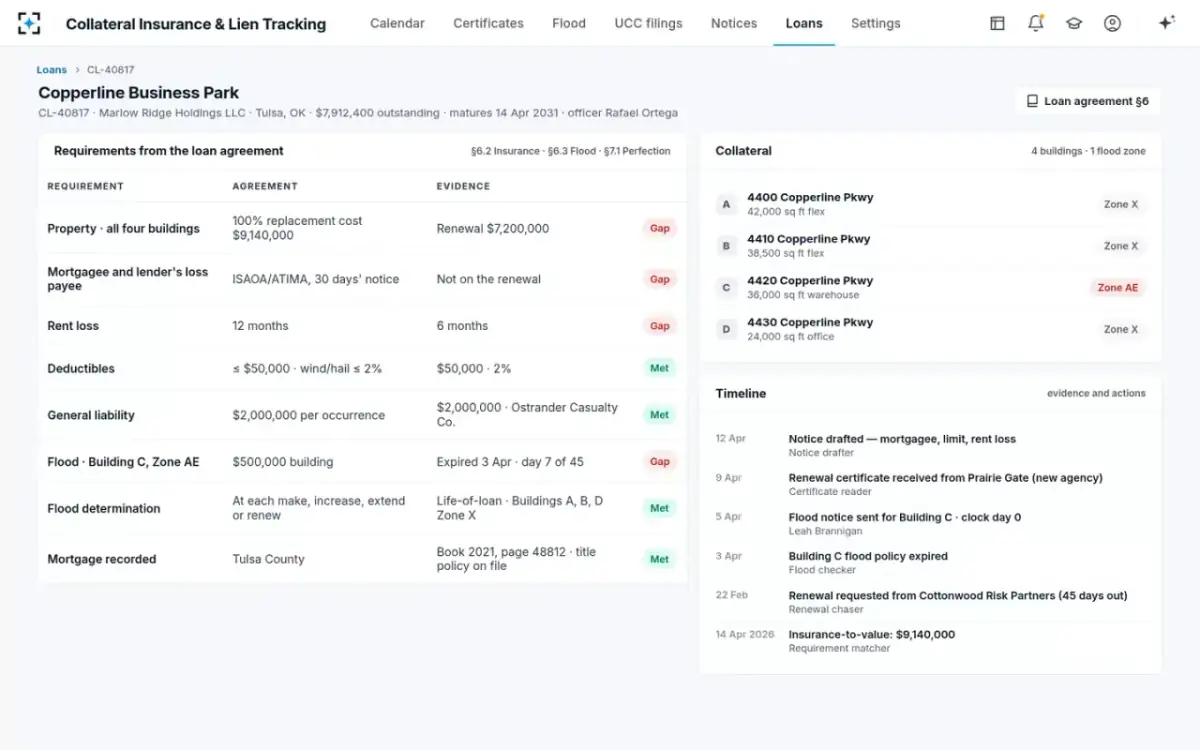
A note on the sample data: the solution's own flood screen describes the required amount for Building C as the lesser of the $7,912,400 principal and the $500,000 maximum available. That is the shorthand, and on this building it lands on the right answer because the insurable value exceeds the statutory limit. The full test is the one written above, and it is the one to apply on a shed. To see determinations, required amounts and clocks on one screen, start from Collateral Insurance & Lien Tracking.
Questions people ask
How much flood insurance does a lender require?
The lesser of the outstanding principal balance of the loan and the maximum amount of insurance available under the NFIP, where the maximum available is itself the lesser of the statutory limit for that structure type and the building's insurable value. For a non-residential building the statutory limit is $500,000; for a one-to-four family residential building it is $250,000. The test is applied to each building securing the loan and the amounts are added.
What is insurable value for flood insurance?
The cost of replacing or repairing the structure itself. It excludes land, which is why an appraised property value is the wrong input — on many commercial sites the land is most of the appraisal. Acceptable sources are a replacement-cost estimate, the itemised building values behind a commercial property schedule, or an appraisal that separates improvements from land. Whichever is used should be on the file, because disputes about a required amount are usually disputes about this number.
What is the maximum flood insurance for a commercial building?
$500,000 of building coverage per building under the National Flood Insurance Program, with up to $500,000 for contents owned by the building owner and up to $500,000 for each unit's tenant-owned contents. A borrower who needs more than that buys excess flood coverage in the private market; the lender's regulatory requirement is still measured against what the programme makes available.
Can flood coverage be allocated across buildings?
Yes, in varying amounts, provided every building in a special flood hazard area that secures the loan is covered in accordance with the statutory requirement. Allocation cannot be used to leave a building uncovered, and it cannot put more on a building than that building's own ceiling allows. Record the allocation per building and re-test it when the collateral schedule changes.
Is contents coverage required for flood?
Only where personal property also secures the loan. If the collateral is the building alone, no contents requirement arises from the flood rules, whatever is inside it. If inventory, equipment or other contents in a building in a special flood hazard area secure the loan, contents coverage is required and is tested the same way, against its own statutory limits.
What if the loan balance is higher than the maximum coverage available?
Then the maximum available is the required amount, and the loan is legitimately under-covered relative to its balance. This is the normal position on large commercial buildings: a $7.9 million loan on a non-residential building requires $500,000 because that is all the programme makes available. Banks that want the rest of the exposure covered require excess flood insurance as a matter of credit policy, in the loan agreement, rather than as a regulatory requirement.