Collateral protection insurance is cover a lender buys on collateral its borrower promised to insure and did not. It protects the lender's interest in the property, it is charged to the borrower under the loan agreement, and it is the end of a sequence rather than a decision taken on its own. The question practitioners actually need answered is never "may we place it" but "which rulebook is this loan under, and what has that rulebook already required us to send" — because a commercial mortgage, a residential mortgage and a building in a flood zone answer it three different ways. Botminds' Collateral Insurance & Lien Tracking reads the evidence, works out which requirement is unmet, drafts the notice with the clause it breaks, and stops: a person sends it, and the servicing manager approves any placement that follows.
The worked examples come from a fictional sample bank running the solution — Kestrel Valley Bank, 1,846 commercial loans, $2.31 billion. The people, banks, borrowers and agents are sample data; the regulations are real and linked where they appear.
From a lapse found to a placement charged, and who does each step
Agent
Certificate readerReads the renewal, declarations page or endorsement field by field and says what is missing.
Never: Never marks an illegible field as read.
Agent
Requirement matcherCompares what arrived with the agreement’s own requirement and with last year’s evidence.
Never: Never relaxes a requirement to make the evidence fit.
Agent
Notice drafterDrafts the borrower notice and the agent request, each gap cited to the clause it breaks.
Never: Never sends. Nothing leaves the bank unapproved.
A person decides
Tracking specialistReads the draft, corrects it, approves and sends it. The clock, where there is one, starts here.
Agent
Renewal chaserAsks again at the second lead time, and shows what has and has not come back.
Never: Never contacts a borrower in workout without the officer.
A person decides
Servicing managerApproves the placement, or accepts an exception with a reason that is reviewed again in 90 days.
Agent
Flood checkerWorks out the required amount per building and drafts the placement request.
Never: Never places cover itself.
What is collateral protection insurance, in the lender's words
It is a policy the lender takes out, in its own name, on property it has lent against, because the borrower has not produced the cover the loan documents require. The borrower is charged for it — usually by adding the premium to the loan balance or to an escrow account — and the lender is the one insured. Lenders and their carriers call the same arrangement collateral protection insurance, lender-placed insurance, creditor-placed insurance and force-placed insurance, and the word a desk uses is mostly a function of which part of the market it grew up in.
The right to place it comes from the loan agreement, not from any regulation. A commercial mortgage or security agreement will say, in the insurance covenant, that if the borrower fails to maintain the required cover the lender may obtain it and add the cost to the indebtedness. Where that sentence is missing or narrower than the desk assumes, there is no placement right to exercise, however obvious the gap. That is the first thing to read, and it is read far less often than the certificate is.
Is collateral protection insurance the same as force-placed insurance?
In substance yes; in regulation, not quite. "Force-placed insurance" is a defined term in Regulation X, which governs the servicing of residential mortgage loans. There it "means hazard insurance obtained by a servicer on behalf of the owner or assignee of a mortgage loan that insures the property securing such loan". Collateral protection insurance is the older, broader trade phrase, used on auto lending, equipment finance and commercial real estate alike, including on loans Regulation X never touches.
So the two names describe the same act and carry different consequences. If the loan is a residential mortgage being serviced, the defined term applies and § 1024.37's notice sequence and charging rules apply with it. If it is a commercial loan — the loans in the sample bank's book — § 1024.37 does not reach it, and the governing documents are the agreement and state law. Reading a Regulation X compliance checklist onto a commercial mortgage produces notices nobody is owed; reading a commercial habit onto a residential mortgage produces a charge that could not lawfully be assessed.
What it covers, and what it deliberately does not
A placed policy is built for the lender, and every difference from the borrower's own cover follows from that. It is not a cheaper version of the policy that lapsed; it is a narrower product sold to a different customer.
A placed policy against the policy it replaces, row by row
| What is at stake | The borrower’s own policy | The policy the lender places |
|---|---|---|
| Whose interest is insured | The borrower’s, with the lender added by a mortgagee or lender’s loss payee clause. | The lender’s interest in the property. The borrower is not an insured. |
| Liability cover | Usually part of the same programme, or a companion policy. | None. A placed policy is property cover only; a slip-and-fall claim is uninsured. |
| Contents, equipment, stock | Insured to the limits the borrower chose. | Not insured unless the lender specifically places it and pays for it. |
| Rent loss or business interruption | Commonly twelve months on a commercial property, as the agreement requires. | Not included. The income that services the loan is unprotected. |
| Basis of settlement | Replacement cost where the agreement requires it. | Often actual cash value, and capped at the loan balance rather than the cost to rebuild. |
| Who is paid on a claim | Borrower and lender, under the mortgagee clause. | The lender, up to its interest. Anything above it is not the borrower’s to claim. |
| What it costs | Priced on the individual risk, after underwriting. | Priced on a book of risks nobody inspected, with no underwriting of this building. |
The practical reading is that a placed policy protects the bank's balance sheet and almost nothing else. A borrower who is content to let the lender insure the building has, without being told clearly, dropped liability cover, contents and rent loss, and has moved from replacement cost to a settlement basis that will not rebuild. That is why the strongest desks treat a placement as a failure to be explained, not a control that worked.
When may a lender place it? The three rulebooks, in order
Ask which rulebook the loan sits under, and read them in this order: the agreement, then flood, then Regulation X if it applies. They are not alternatives; a residential mortgage on a building in a special flood hazard area is under all three at once, and each has its own trigger.
Three rulebooks, three different answers to the same question
What it governs: Every secured loan. On a commercial loan it is usually the only source of the right to place cover at all.
What it requires before cover is placed: Whatever the insurance covenant says: the required cover, the evidence, any cure period, and the right to add the premium to the balance. Read the clause before the certificate.
What it governs: Any loan secured by a building in a special flood hazard area, commercial or residential.
What it requires before cover is placed: Notice to the borrower on determining that cover is absent or insufficient, then a 45-day wait before the lender must purchase. The duty is to place, not merely a right to.
What it governs: The servicing of residential mortgage loans. It does not reach commercial lending.
What it requires before cover is placed: A reasonable basis to believe the borrower has not complied, a 45-day notice, a 15-day reminder sent no earlier than 30 days after the first, and cancellation with a refund when evidence arrives.
The order matters because the agreement can be stricter than the rules and often is. A commercial agreement that requires replacement-cost cover with a named mortgagee clause and twelve months of rent loss sets a bar no regulation sets, and a lender that places only what the flood rule requires has satisfied the regulator and not the covenant. The reverse is also true: an agreement that is silent on flood does not excuse the lender from part 339.
The notices that must come first on a residential mortgage
Where § 1024.37 applies, the charge, not the placement, is what the rule regulates, and it regulates it through two notices and a minimum interval. The servicer "may not assess on a borrower a premium charge or fee related to force-placed insurance unless the servicer has a reasonable basis to believe that the borrower has failed to comply with the mortgage loan contract's requirement to maintain hazard insurance" — so the evidence of non-compliance has to exist before anything is sent, not be assembled afterwards.
Then the sequence. The first notice must be delivered or placed in the mail "at least 45 days before a servicer assesses on a borrower such charge or fee". The reminder must go "at least 15 days before a servicer assesses on a borrower a premium charge or fee related to force-placed insurance", and the same paragraph adds the constraint that is most often missed: a servicer "may not deliver to a borrower or place in the mail the notice required by paragraph (c)(1)(ii) of this section until at least 30 days after delivering to the borrower or placing in the mail the written notice required by paragraph (c)(1)(i) of this section".
The Regulation X sequence, drawn to scale: why 45 days is the floor and not the target
- First notice sent · day 030 days before the reminder may go out
- Reminder window opens · day 3015 days minimum before the charge
- First notice to reminder36 days
- Reminder to earliest charge15 days
Two practical consequences fall out of the drawing. The first is that the two notices are not interchangeable and cannot be combined: sending one letter that says everything on day 0 does not satisfy the reminder requirement. The second is that the schedule is recoverable but not compressible. A servicer that sends the reminder late simply charges later; a servicer that sends it on day 20 has sent a letter that does not count and will have to send another.
Why flood keeps its own clock, and why that clock is not this one
Flood is carved out of the Regulation X definition. The rule lists what does not constitute force-placed insurance and begins with "Hazard insurance required by the Flood Disaster Protection Act of 1973". So nothing on the timeline above governs a flood placement, and a desk that files both under one procedure will serve one of them wrongly.
The flood rule runs on its own terms: the lender notifies the borrower on determining that a designated loan has no flood cover or too little, waits 45 days, and must then purchase — a duty rather than a right — with the cost chargeable from the date the cover lapsed. The counting is specific enough to deserve its own page, and how the 45 days are counted works through where the clock starts, what stops it and what day 46 requires. The amount is a separate calculation again, set out in the lesser of three numbers.
In the sample bank the distinction is built into the settings rather than left to memory. The bank's own renewal lead times are configurable — a first request to the agent of record 45 days before expiry, a second at 15 days — while the row for the flood notice to placement is not a choice at all, and says so: fixed by regulation.
What it costs the borrower, and what the lender may charge
What the lender may charge is set by the rulebook that applies. On a residential mortgage, charges related to force-placed insurance may be assessed only on the reasonable basis described above and only after the notice sequence. On a commercial loan, the agreement decides: whether the premium is added to the balance, whether it bears interest at the note rate or the default rate, and whether the lender may also recover its costs of obtaining the cover.
Why the premium is high has structural answers rather than a single number. Placed cover is written on a portfolio basis without underwriting the individual building, so the price carries the uncertainty of not having looked. It is placed on a population selected precisely for having let insurance lapse, which is not a random sample of buildings. It is bought by the lender, who is not paying it, from a market the borrower did not shop. And it is often issued with cover backdated to the lapse, so the premium buys a period already elapsed. Those four reasons are the ones a borrower is entitled to hear before the charge appears, and between them they explain the direction of the price.
What stops it: evidence, and what counts as evidence
Proof of cover stops it, and the useful question is which documents count. The flood rule is explicit about the minimum a lender must accept when a borrower proves its own cover after a placement: the institution or its servicer must accept a declarations page carrying the existing policy number and the identity and contact details of the insurer or agent (12 CFR § 339.7(b)(2)). A desk that insists on the full policy before it will stop a flood clock is asking for more than the rule allows.
Outside flood, the agreement sets the bar, and the documents form a hierarchy a tracking desk should be explicit about. The policy itself is best. A declarations page is good and is what most agents send. An endorsement is the right document when the gap is a clause rather than a limit — the mortgagee wording, an additional insured, a location schedule. A binder is evidence with an expiry date on it, and the sample bank accepts one for 30 days before it counts as nothing. A certificate of insurance is the weakest of the five and the one most often produced, because it summarises a policy without conferring anything under it; what a certificate holder actually gets is the difference between a document that looks like evidence and a document that is.
What must be on file before anybody may place cover
- The clause that permits it
The insurance covenant in the agreement, quoted, with the section number — not a general belief that lenders may do this.
- The requirement, as the agreement states it
Perils, limit, basis of settlement, deductible ceiling, rent loss, the exact mortgagee wording, and which buildings it applies to.
- The evidence that is missing, and why it is missing
Lapsed, never produced, produced and short, or produced and naming the wrong party. Each needs a different letter.
- Every request already sent, with its date
To the agent of record and to the borrower, with what came back. A placement with one unanswered email behind it will not survive a complaint.
- The notices the rulebook requires, in the right order
On a residential mortgage, both § 1024.37 notices with their dates. On a flood loan, the determination and the notice. On a commercial loan, whatever the agreement specifies.
- The named person who approved it
At the sample bank, the loan servicing manager. Placement is a decision, and decisions have a name and a date against them.
A drafted request, each gap cited to the clause it breaks
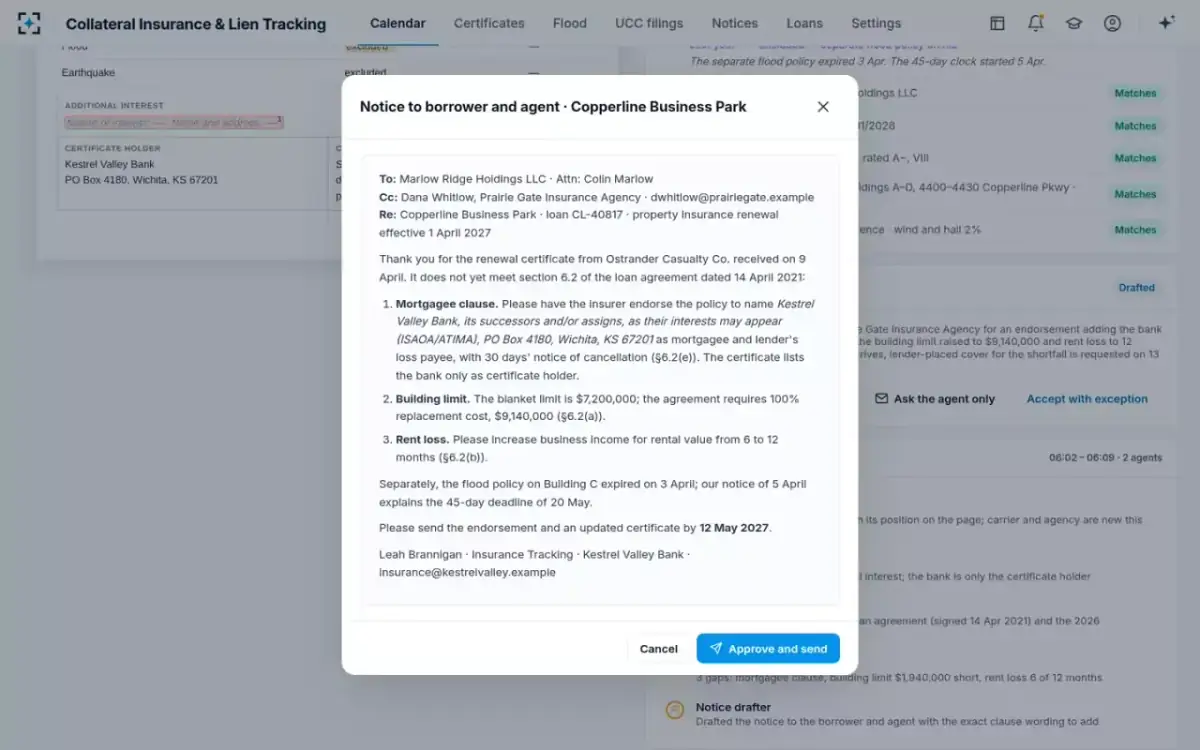
The desk's real job: making placement unnecessary
Every placement is the end of a chase that did not work. That framing changes what a tracking desk measures. The number worth watching is not how promptly cover is placed but how rarely it has to be, and the inputs to it are the lead times, the quality of the first letter and whether anybody re-reads the wording at renewal rather than only the dates.
Who finds the lapse, who drafts, who signs, and who tells the borrower
Today
Keys dates and limits from about 40 certificates a day, and a certificate only says a policy exists — not that the bank is still named on it.
With agents
Starts from a read certificate with every gap cited to the agreement, and approves the drafted notice or request.
Still theirs: Sends every letter. The agents never do.
Today
Owns the determinations and the clocks, and has to show an examiner the day the bank knew, building by building.
With agents
Watches every running clock on one screen, with the required amount already worked out per building.
Still theirs: Decides when a determination is right, and when a borrower’s evidence answers it.
Today
Signs placements and accepts exceptions, and has to gather the certificate, the agreement and the dates before he can.
With agents
Sees each requirement, the evidence and the full timeline on one page before approving.
Still theirs: Approves every placement and every exception, with a reason that is read again in 90 days.
Today
Hears about a placement from the borrower, after the premium appears on the statement.
With agents
Sees the chase while it is still a chase, and can make the call that stops it.
Still theirs: Owns the conversation. A placement the borrower first learns of from a statement is a relationship problem, not a servicing one.
Everything waiting for a person: requests, notices and placement approvals

The flood clocks, each with the day a person started it

Placement, done properly, is slow, documented and rare. It is also the clearest test of whether a tracking desk is reading documents or filing them: the bank that notices a dropped mortgagee clause in March does not place cover in July. To see the chase, the drafts and the approvals on one book, start from Collateral Insurance & Lien Tracking.
Questions people ask
Does collateral protection insurance protect the borrower?
No. It insures the lender's interest in the property, and the borrower is not an insured under it. It carries no liability cover, normally no contents and no rent loss or business interruption, and it frequently settles on actual cash value rather than replacement cost. A borrower who is paying for placed cover is paying for protection that will not rebuild the building or defend a claim brought against them.
Can a lender charge the borrower for collateral protection insurance?
Where the loan agreement says so, yes — that clause is the source of the right. On a residential mortgage being serviced, Regulation X adds conditions: there must be a reasonable basis to believe the borrower has failed to maintain the required hazard insurance, and the two notices must have gone out in the prescribed order before any premium charge or fee is assessed. Flood placement is governed separately again, by the flood rules rather than by § 1024.37.
Why is collateral protection insurance so expensive?
Because of how it is bought rather than any single markup. It is written without underwriting the individual property, on a population of risks selected for having let cover lapse; it is purchased by a party who is not paying for it, from a market the borrower did not shop; and it is often backdated to the lapse, so part of the premium buys a period that has already passed. The size of the difference depends on the programme and the property, which is why a borrower should be told the placed premium before it is charged.
How do you avoid having insurance placed on your loan?
Send the evidence the agreement asks for, in the form it asks for, before the lender's second request. A declarations page naming the lender in the exact mortgagee wording, at the required limit, for the right locations, answers most requests outright. Where only a clause is wrong, an endorsement fixes it faster than a new certificate. On a flood loan, a declarations page carrying the policy number and the insurer's contact details is enough to confirm cover.
Who at the bank approves a placement?
A named person, and it should never be the system that found the gap. At the fictional sample bank the loan servicing manager approves every placement and every exception, with the requirement, the evidence and the full timeline of requests on one page in front of him. Accepting a gap instead of placing cover is also a decision: it leaves the loan knowingly outside its covenant, so it carries a reason and comes back for review after 90 days.
What happens to a placed policy when the borrower sends proof of cover?
It comes off, and money goes back. The flood rules require the institution to notify the insurer to terminate the placed cover and to refund the premiums the borrower paid, within 30 days of receiving confirmation that the borrower's own cover exists; Regulation X requires cancellation and a refund of charges for overlapping periods on the loans it governs. On a commercial loan the agreement sets the mechanics, which is a good reason to check that it sets them at all.