AI insurance tracking means giving software the reading. A certificate arrives as a PDF from one of several hundred agents; something has to open it, find the named insured, the mortgagee and loss payee boxes, the limits per location, the deductibles and the dates, compare all of it with what the loan agreement requires and with what last year's evidence said, and write down where every value came from. That is the work, and it is the half of insurance tracking that keying dates into a tracker never touched. Botminds' Collateral Insurance & Lien Tracking does it with six agents — and stops before four acts that stay with named people, because sending a borrower notice, filing a financing statement, placing cover and accepting an exception are decisions, and a system that blurs reading into deciding is not faster, it is an examination finding with a good interface.
The examples below come from a fictional sample bank as it runs through the solution: Kestrel Valley Bank, 1,846 commercial loans, $2.31 billion, 3,706 financing statements in 14 states. The people, banks, borrowers and agents are sample data.
One document's Monday morning: from the agent's email to a letter a person sends
Agent
Certificate readerOpens the PDF, finds every field, and writes down the page and position each value was read from.
Never: Never marks an illegible field as read, and never treats a certificate holder as a mortgagee.
Agent
Requirement matcherReads the loan agreement’s own insurance section and compares the evidence with it, and with last year’s.
Never: Never relaxes a requirement; an exception needs a person and a reason.
Agent
Notice drafterWrites the letter: each gap, the clause it breaks, the wording to add, the date the response is due.
Never: Never sends.
A person decides
Tracking specialistReads the draft against the certificate beside it, corrects it, approves and sends.
A person decides
Flood compliance officerDecides whether a determination is right, and sends the notice that starts a 45-day clock.
A person decides
Loan servicing managerApproves any placement, and any exception that leaves a loan knowingly short.
AI insurance tracking: what the agents actually do
Four things, and it is worth being plain about each because the category name hides them. They read documents that were designed for a human eye — certificates on the standard forms, declarations pages, endorsements, binders, flood determinations, filing office acknowledgments. They extract the agreement's requirements, which are prose in a credit document rather than fields in a system. They compare the two, including against what the same borrower produced a year ago. And they draft the correspondence that follows, with the gap and its clause set out.
What they do not do is invent a verdict where the document does not support one. A tracking system's value is in the comparisons it makes, and a comparison is only worth having if the system will also say "I could not read this" and "this is not the document you asked for". Those two sentences are harder to build than the extraction, and they are the ones a reviewer should test first.
Six agents, one at a time: reader, matcher, flood checker, filing watcher, chaser, drafter
Six narrow agents, each with a stated limit, beat one general assistant for the same reason six narrow procedures beat one: the limits are legible. A reviewer can read what each may never do and check it, which is not true of a prompt.
Six agents, what each does, and what each may never do
| Agent | What it does | What it may never do |
|---|---|---|
| Certificate reader | Reads certificates, declarations pages and endorsements field by field — named insured, mortgagee and loss payee wording, limits, deductibles, locations and dates. | Never marks an illegible field as read. Cites page and position for every value. Never treats a certificate holder as a mortgagee. |
| Requirement matcher | Extracts each loan’s insurance and collateral requirements from its agreement and compares the evidence with them, and with last year’s evidence. | Never relaxes a requirement. Exceptions need a person and a reason. |
| Flood checker | Reads flood determinations, works out the required amount per building, and runs the clock from notice to placement. | Never places cover. The clock starts only when a person sends the notice. |
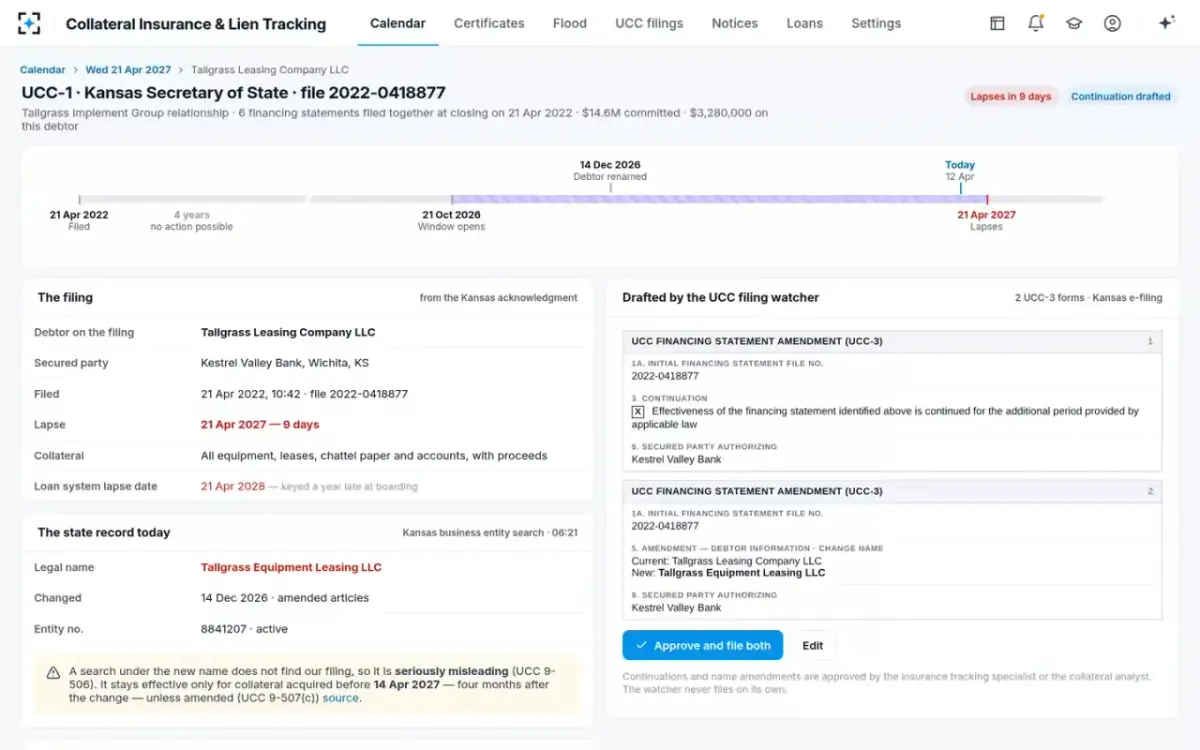
| Filing watcher | Tracks every financing statement’s lapse date and window against the state acknowledgment, watches debtor names, and drafts the UCC-3 forms. | Never files without approval. Never drafts before the window opens. |
| Renewal chaser | Asks the agent of record for renewal evidence 45 days before expiry, and again with the borrower 15 days before. | Never contacts a borrower in workout without the officer. |
| Notice drafter | Drafts borrower notices, agent requests and placement requests with each gap cited to the agreement. | Never sends. A placement request needs the servicing manager. |
Notice what the third column is made of. Every limit names an act, not a confidence threshold. "Never files without approval" is checkable by looking at who filed; "only acts when it is sure" is not checkable at all. A limit that cannot be audited from the outside is a preference, and preferences drift.
Can AI read insurance certificates reliably?
Reliably enough to be worth doing, and never reliably enough to be the last word — which is why the output of reading is a draft rather than an action. A certificate is a dense, variably completed form on which the interesting content is often in free text: the description of operations box carrying the mortgagee wording, a schedule of locations attached as a second page, an endorsement number that modifies a limit stated above it. Reading those well is a different problem from pulling an expiry date out of a header, and it is the problem that matters, because the expiry date was never what went wrong.
The useful test of reliability is not an accuracy percentage quoted by a vendor. It is a replay: take fifty certificates the bank has already processed, including the awkward ones — a scan of a fax, a renewal from a new carrier, a certificate for a borrower whose entity name changed, one with a schedule of twelve locations — and compare what the system says with what the file says. Where the two differ, the interesting cases are not the misreads but the places where the system was confident and wrong, and the places where the bank's own file was wrong and the system was right. Both happen in a sample that size.
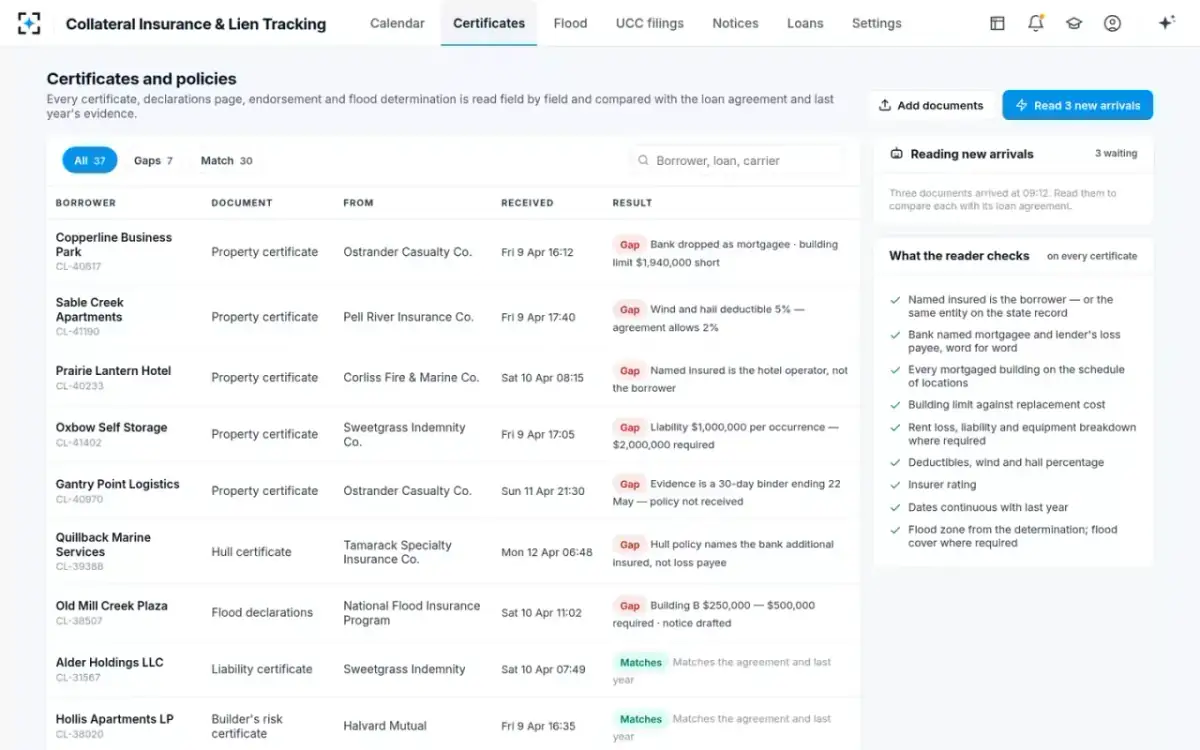
One Monday's reading: 37 documents, and what the seven gaps were
37 documents received since Friday
- Match the agreement — 30 · 81%
- Gap — 7 · 19%
The seven gaps, by what was wrong
- Bank not in the right clause — 2 · 28.6%
- Limit below the agreement — 2 · 28.6%
- Deductible outside the agreement — 1 · 14.3%
- Wrong named insured — 1 · 14.3%
- Binder instead of the policy — 1 · 14.3%
None of those seven is a date problem. Two are clause wording, two are limits, one is a deductible, one is the wrong party and one is the wrong document altogether. A tracker that stores dates and limits would have caught the two limit gaps at best, and passed the other five as current — including the renewal that dropped the bank as mortgagee.
The four acts reserved to a person, and why each one is reserved
Sending, filing, placing and excepting. Each is reserved for a specific reason rather than a general caution, and the reasons are worth separating because they justify different controls.
Sending, because it starts clocks and makes statements. A borrower notice is a communication from the bank, and in flood it is more: the regulatory clock to placement runs from the notice, so the day it goes out is a date an examiner will read back. A system that sends on its own decides when the bank's own obligations begin.
Filing, because the window is unforgiving and the form is a legal act. A continuation is effective only inside its window, and § 9-510(c) disposes of a late one in a single sentence: a continuation filed outside the six-month period is ineffective. There is no partial credit, no cure and no appeal, which is precisely the kind of act that should have a name against it. The window itself is set out on the continuation statement page, and where the lapse date it runs from comes from is its own question.
Placing, because it spends the borrower's money on cover the borrower did not buy. It is the one act on the desk the borrower feels directly, and it is governed by the agreement, the flood rules and, on a residential mortgage, a notice sequence. When a lender may place cover sets out which rulebook applies to which loan.
Excepting, because it is a deliberate decision to stay out of compliance. Accepting a gap is the only one of the four that leaves the file worse on purpose. It needs a reason in words, a named approver and a date to be looked at again — at the sample bank, the servicing manager and 90 days.
What should a human approve, and what evidence should they see first?
The four acts above, and the evidence should be the thing that was read, not a summary of it. The difference is the whole governance question in miniature. An approver shown "Copperline renewal: 3 gaps — approve?" is approving the system's reasoning. An approver shown the certificate with the three fields highlighted, the agreement section beside each, and last year's certificate under it, is approving the bank's own conclusion about its own document.
The same renewal, handled two ways
A tracker that keys dates and limits: Carrier, policy number, expiry date, building limit. The fields the form has.
A system that reads the document: Every field, including the mortgagee and loss payee boxes, the schedule of locations, the deductible and the endorsement numbers.
A tracker that keys dates and limits: The carrier name in a field. The renewal still looks current.
A system that reads the document: A comparison against last year: the clause that was there and is not, at the limit it was at.
A tracker that keys dates and limits: A row in a report, and the PDF if they go and open it.
A system that reads the document: The certificate with the gaps marked in place, each citing the clause it breaks and showing last year’s value.
A tracker that keys dates and limits: A standard renewal reminder, if anyone writes one.
A system that reads the document: A letter naming the three gaps, the exact wording to add and the date the endorsement is due.
A tracker that keys dates and limits: Keying, and then re-reading the agreement by hand when something looks wrong.
A system that reads the document: Reading the draft. The keying and the comparison are already done.
A tracker that keys dates and limits: The decision, and the liability for the one nobody looked at.
A system that reads the document: The decision, with the evidence for it in one place.
Citing the page and the position: why every value carries its source
Every value the reader produces carries where it was read from — which document, which page, which position on it. That sounds like an implementation detail and is in fact the feature that makes the rest defensible. A value with a position can be checked in seconds by a person who does not trust it. A value without one can only be trusted or re-done.
It also changes what a disagreement costs. When the bank's figure and the agent's figure differ, the argument is usually about which document each side is reading. A limit cited to page two, the schedule of locations, ends that argument immediately — frequently in the agent's favour, which is worth saying, because a desk that only ever uses citations to win is not using them honestly.
The rule carries into evidence the bank must accept as well as evidence it wants. For flood, the regulation is specific: a declarations page showing the policy number and the insurer or agent, with contact details, is enough, and the institution must accept it (12 CFR § 339.7(b)(2)). A system whose evidence rules are stricter than the regulation's is not being careful; it is being wrong in a direction that costs the borrower money.
The illegible field, the missing endorsement, and the agent that says so
The three answers a reading agent must be able to give are "here is the value", "I could not read this" and "this is not the document you asked for". The second is the one most systems are bad at, because a confident wrong answer and a confident right answer look identical in a report.
In the solution the certificate reader never marks an illegible field as read. A scan whose deductible column has been cut off at the margin produces a gap called unreadable, not a deductible of zero, and the letter that follows asks for a legible copy rather than accusing the borrower of a breach they may not have committed. The matcher behaves the same way at the other end: a requirement it cannot find in the agreement is reported as not found, not as satisfied.
The third answer is more common than it sounds. A borrower whose endorsement was requested sends a fresh certificate instead, because that is what an agent can produce in an afternoon. A borrower asked for the permanent policy sends another binder. A borrower asked for flood sends the property declarations page. In each case the document is real, current and not responsive, and a desk that files it as evidence has closed a gap that is still open.
Thirty-seven documents, each with its verdict
Where the work speeds up, and where it must not
The speed comes from the reading and the comparison, and it is large because that is where the hours were. On a commercial property renewal that comes back short, the sample bank's own estimate puts chasing the agent at an hour and a half by hand, keying at three quarters of an hour, checking the wording against the agreement and last year at another hour and a half, and drafting the letter at an hour — against a quarter of an hour, six minutes, a quarter of an hour and a quarter of an hour with agents doing the mechanical part.
Review and send does not move. It is half an hour before and half an hour after, and that is the design rather than a shortfall. The person reading the draft is the control; shortening their half hour is the one saving nobody should want. A system that advertises end-to-end automation of this desk is advertising the removal of the only step an examiner will ask about.
The federal banking agencies put the point in one line of their third-party guidance: using a third party does not reduce a bank’s responsibility to meet its obligations, which apply just as if the bank did the work in-house (Interagency Guidance on Third-Party Relationships, 88 FR 37920, 9 June 2023).
That is the whole of the buying argument, read correctly. Software does not take on the bank's obligation; it changes who does the typing. Whatever the system reads, drafts or watches, the enforceability of the claim and the adequacy of the monitoring remain the bank's — which is also what the Interagency Guidelines Establishing Standards for Safety and Soundness ask of loan documentation: that it show the loan being properly administered and monitored (12 CFR part 364, appendix A).
What to put in writing before any of this runs on your loan book
Nine lines, and they fit on one page. They are worth drafting before a demonstration rather than after one, because they turn a product conversation into a procedure conversation, which is the conversation the second line will have with you anyway.
The authority boundary, written as nine rules you could hand to an examiner
- No agent sends correspondence to a borrower or an agent of record.
Drafting is allowed and encouraged. Sending is a human act with a name and a time against it.
- No agent files anything with a filing office.
Continuations and amendments are approved by the tracking specialist or the collateral analyst, and the approval is what triggers the filing.
- No agent places insurance.
A placement request is drafted with its evidence attached; the loan servicing manager approves it.
- No agent accepts an exception.
A gap stays a gap until a named person records a reason. Every exception has a review date.
- No requirement is relaxed to make evidence fit.
Where the evidence is short, the finding is a gap — not a re-interpretation of the covenant.
- Every extracted value carries its document, page and position.
So any value can be checked against the source in seconds, by someone who was not there.
- An unreadable field is reported as unreadable.
Never as absent, never as zero, and never silently defaulted to last year’s value.
- A regulatory clock starts on the day a person sent the notice.
Not when the draft was written, not when the gap was found. The date in the file is the date on the letter.
- Every change to a rule is kept as a new version, with who changed it.
Lead times, ratings, binder acceptance and filing deadlines are the bank’s settings, and an examiner will ask what they were at the time.
A drafted filing, waiting for the approval that makes it real
The honest pitch for AI insurance tracking is narrower than the category name and much more useful: it reads the documents nobody had time to read, compares them with the agreement nobody had time to re-open, and writes the letter — then hands all of it to the person whose job it has always been to decide. To see where the line falls on a real book, start from Collateral Insurance & Lien Tracking.
Questions people ask
Can AI read insurance certificates?
Yes, including the parts that are not fields: the mortgagee and loss payee boxes, the description of operations text, attached schedules of locations and endorsement numbers that modify limits stated elsewhere on the form. Reliability varies most with scan quality and with how much of the meaning is in free text, which is why the right output is a draft a person reads, and why a system that cannot say "I could not read this" is the wrong system.
Should a bank let software send a borrower notice?
No, and flood is the clearest case for why. The regulatory period to placement runs from the notice to the borrower, so the day it is sent is a date the bank will have to stand behind. Drafting the letter is work; deciding that today is the day the bank starts its own clock is a decision, and it should have a person's name on it.
Can software force place flood insurance?
It should not, and in this solution it cannot: the flood checker works out the required amount per building and drafts the request, and the loan servicing manager approves the placement. Placing cover charges a borrower for a policy they did not buy and that does not protect them, and it is the single act on the desk most likely to produce a complaint. It belongs to a person.
How do you stop a system from relaxing a loan requirement?
By making relaxation a different act from matching, owned by a different person. The matcher compares evidence with the requirement and reports a gap; it has no authority to decide the requirement meant something looser. Accepting the gap is an exception, which needs a named approver, a written reason and a review date — so the two can never be confused in the file afterwards.
How does an agent cite where a value came from?
By recording the document, the page and the position on the page beside the value, so the finding can be opened on the original and checked. It matters most when the bank and the agent of record disagree: citing a limit to the schedule of locations on page two settles in seconds what otherwise becomes a week of email, sometimes in the agent's favour.
Is AI allowed to file a UCC continuation?
Nothing prohibits it, and it is still a poor idea. A continuation filed outside its six-month window is ineffective under § 9-510(c) — not late, not curable, simply nothing — and the consequence of getting it wrong is an unperfected lien. In this solution the filing watcher drafts the forms and never files; the tracking specialist or the collateral analyst approves, and the approval is what sends them to the state.