A UCC continuation statement is the filing that keeps a lender's own financing statement alive past its five-year term — and the law allows it only in a six-month window that opens 54 months in, not at any point before. Cornell's text of UCC §9-515 is exact about both halves: "a filed financing statement is effective for a period of five years after the date of filing," and "a continuation statement may be filed only within six months before the expiration of the five-year period" (UCC §9-515). Outside that window, the statute gives a lender no second chance. Botminds' UCC Lien Search tracks every financing statement a lender holds against that clock and prepares the continuation before the window opens, so the filing that protects a loan is never the one nobody remembered.
The five-year rule sounds like a distant deadline until a lender counts how many filings it is carrying at once. The fictional sample lender in UCC Lien Search, a mid-size equipment and asset-based finance shop, holds 1,284 active filings across its loan book, each with its own filing date, its own five-year clock, and its own six-month window somewhere on the calendar. Rachel Dunmore, its (equally fictional) Head of Documentation and Collateral, is the person who has to know where every one of those windows falls. "If one of our own filings lapses, we're unsecured and nobody notices," is how she puts the risk, and it is the right way to put it: a lapse is not an event that shows up anywhere unless someone is watching for it.
How long does a UCC financing statement last?
Five years from the date it was filed, full stop, for an ordinary UCC-1 financing statement. The clock runs from the filing date the office stamps on the record, not from the date the loan closed or the date the lender signed the security agreement, and it is the same five years in the uniform text of Article 9 that the states have adopted. A financing statement filed on 3 March 2026 lapses on 3 March 2031 unless a continuation is filed first.
Three filing types run on a different clock, and a lapse calendar has to know the difference. Under §9-515(b), a financing statement filed in connection with a manufactured-home transaction or a public-finance transaction is effective for 30 years if it says so on its face. Under §9-515(f), a filing against a transmitting utility, such as a power or pipeline company, that indicates it is one is effective until a termination statement is filed. A reminder system built only around five years will flag those filings decades early, or forever. For the ordinary commercial filing this guide is about, five years is the number to put on the calendar.
What is a continuation statement, and when can you file one?
A continuation statement is a short filing — far shorter than the original UCC-1 — that tells the filing office to keep the existing financing statement effective for another five years. It does not restate the collateral or the parties; it points back to the original filing by its file number and asks for five more years on the clock. Filed on time, it carries the lien forward without a gap.
The timing is the part that catches lenders out, because it runs in one direction only. Cornell's text is unambiguous: a continuation "may be filed only within six months before the expiration of the five-year period specified in subsection (a)" (UCC §9-515). A lender that tries to file early, at month 40 or month 48, gets nothing for it: the filing office may refuse the record, and if it is accepted anyway, §9-510(c) says that "a continuation statement that is not filed within the six-month period prescribed by Section 9-515(d) is ineffective". A lender that misses the window entirely — filing in month 61 instead of month 54 to month 59 — has nothing left to continue; the filing has already lapsed, and filing in the sixth year of its life has to start over as a brand-new financing statement, which gets a brand-new priority date.
The five-year life of a filing, and the six-month window inside it
- Effective, continuation not yet available54 months
- Continuation window — the only 6 months it can be filed6 months
What happens when a filing lapses?
Nothing happens, and that is exactly the danger. A lapsed financing statement is not flagged, rejected, or returned to the lender — it simply stops being effective, on schedule, with no notice to anyone. The filing office does not call the secured party. The debtor has no obligation to mention it. The lender finds out, if it finds out at all, the next time someone runs a search against that collateral and the lender's own filing is no longer on the list.
What the lender loses the moment the clock runs out is the thing the filing existed for. Under §9-515(c), "upon lapse, a financing statement ceases to be effective and any security interest ... that was perfected by the financing statement becomes unperfected", and the security interest "is deemed never to have been perfected as against a purchaser of the collateral for value". A secured lender is a purchaser for value, so the lapse does more than let future filers in ahead. A junior lender that filed in year three, behind the lapsed lender for two years, is now ahead of it, as if the senior filing had never existed. The lender's loan does not change. Its collateral position does, instantly and silently.
Why the six-month window matters more than the five-year date
Treating "five years from filing" as the only date worth tracking is how lenders miss continuations, because the number that actually controls the lender's next action is the open date of the six-month window — 54 months after filing, not 60. A calendar built around the lapse date alone tends to surface the filing with weeks to spare, or not at all, because nobody checks continuation eligibility until something else prompts a review.
The more useful way to run a lapse calendar is to track two dates for every filing: the day the window opens, which is the day a continuation becomes something that can be prepared and queued for sign-off, and the day it closes, which is the lapse date itself and the point past which nothing can save the filing. UCC Lien Search's default is to flag filings 120 days before lapse — inside the six-month window with room to prepare the continuation, route it for approval, and still file with weeks to spare rather than days.
One lender's filings, on one lapse calendar
1,284
active financing statements tracked on the lapse calendar
120days
before lapse that a continuation is prepared for approval
5yrs
the statutory life of an ordinary financing statement
What a lapse actually costs: priority lost to filings made since
The dollar cost of a lapse is not a late fee; it is whatever a court or a bankruptcy trustee decides the lender's collateral position is worth once every later-filed secured party is read ahead of it. Picture a lender whose financing statement against a borrower's equipment lapsed eighteen months ago, unnoticed. A second lender had filed against the same equipment two years before the lapse, knowingly in second place; since the lapse, a third has filed against "all assets". The second lender now ranks first, because the lapsed filing is deemed never to have perfected against it, and the third ranks ahead of the lapsed lender too. If the lapsed lender files again today it perfects from today, behind both. If the borrower defaults and the collateral is liquidated, it is paid only after both of the other claims are satisfied in full, on collateral it once held first.
The OCC's own guidance to examiners names the mechanism directly: "a banker overseeing ABL collateral needs a tickler system to alert the bank to file continuation statements for financing statements (UCC filings), which generally expire after five years. If the bank does not continue the statements, the lender's security interest is at risk" (OCC, Comptroller's Handbook, Asset-Based Lending). The same handbook's examination questions ask directly: "Does the bank maintain a system to verify lien perfection and monitor lien expirations on a regular basis?" A tickler that tracks only the lapse date, and not the window in which the bank can act, answers that question badly.
None of this requires the borrower to have done anything wrong. A lapse can happen to a performing loan, a borrower current on every payment, with collateral worth exactly what it was worth at closing — the failure is entirely on the secured party's side of the paperwork. That is part of why examiners treat it as a control weakness rather than a credit event: it is not a sign the loan went bad, it is a sign the lender's own process did.
Tracking hundreds of filings without missing one
A single filing is easy to track by memory. A portfolio of 1,284 is not, and the failure mode at scale is not forgetting every filing — it is one filing, out of hundreds, slipping past because a spreadsheet went stale, a person left, or a filing from an acquired book was never added to the calendar in the first place. A lapse calendar has to be complete, current, and checked often enough that a 120-day lead time is actually 120 days and not discovered at day 40.
What a lapse calendar needs to track for every filing a lender holds
- The original filing date and file number
The number a continuation statement has to reference; without it, the continuation cannot be filed.
- The lapse date, five years out
The hard deadline. A continuation filed even one day after this date has nothing left to continue.
- The window-open date, six months before lapse
The earliest a continuation can be filed. Flagging only the lapse date leaves no lead time to prepare.
- Who approves the continuation before it is filed
A named person, every time — continuations are prepared for sign-off, never filed on their own.
- Every amendment since the original filing
A continuation references the financing statement as currently amended; an outdated reference can be rejected by the filing office.
- Debtor name changes against the filing
A name change can make a filing seriously misleading before it lapses, which is its own clock (see below).
In the solution, the debtor identity checker and the continuation workflow sit on the same record as the original search, so a filing's lapse date, its amendments, and its debtor's current legal name are read from one place rather than reconciled by hand across a spreadsheet and the filing office's own database. Rachel Dunmore's book shows all 1,284 filings on one lapse calendar, with continuations prepared for her approval as each window opens — the preparation is automatic, the filing is not.
Our filings: the lapse calendar for everything a lender holds
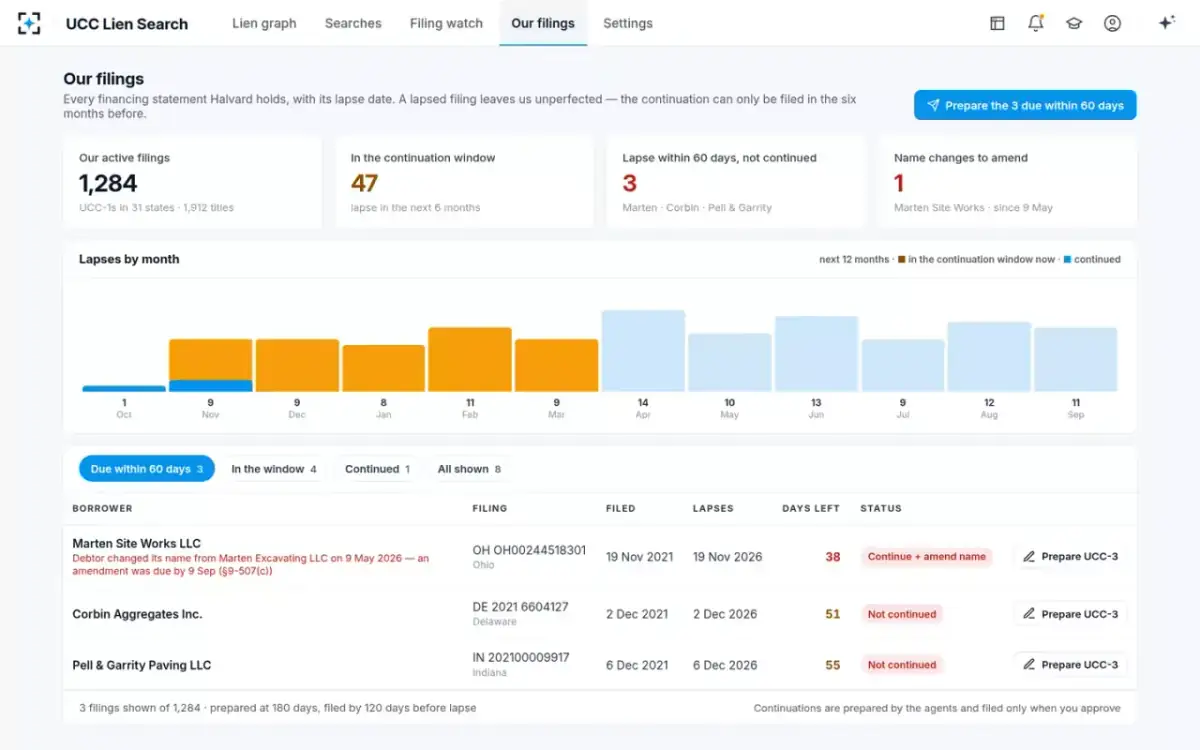
From 120 days before lapse to a filed continuation
Agent
Lapse calendarFlags every filing 120 days before it lapses, inside its six-month window, reading the filing date and any amendments on record.
Agent
Continuation drafterPrepares the continuation statement referencing the original file number and any amendments, ready for review.
A person decides
Rachel Dunmore approvesReviews the prepared continuation and the filing it extends, then approves it for filing.
Never: files, amends or terminates anything on her own
Agent
Filed with the registryThe approved continuation is filed with the original filing office, and the new lapse date — five years further out — is written back to the lapse calendar.
What a debtor's own name change does to a filing you hold
A continuation keeps a filing alive against the calendar; it does nothing about a filing that has become hard to find because the debtor renamed itself. Those are two separate risks, and a lapse calendar that tracks only dates misses the second one. UCC §9-507 gives a renamed debtor's old filing a grace period of its own: "the financing statement is effective to perfect a security interest in collateral acquired by the debtor before, or within four months after, the filed financing statement becomes seriously misleading" (UCC §9-507). After four months past the name change, new collateral the debtor acquires is no longer covered by the old filing at all — continuation or not.
That four-month window runs independently of the five-year continuation clock, and it is shorter and easier to miss, because nothing about a continuation deadline prompts anyone to ask whether the debtor's name on file still matches its name on the record. A documentation team that renews on schedule but never checks for name changes can hold a perfectly continued filing that has quietly stopped covering anything the debtor bought in the last three months. UCC Lien Search's debtor identity checker flags a name change against every filing on the lapse calendar, not only against new searches, so a rename is caught on the filing it affects, not just the next time the file comes up for a fresh search. What a debtor name change does to a filing, and the four-month window it opens, works through the mechanics in full.
Can you file a continuation too early?
You can try, but it does not count. The six-month window is a floor as well as a ceiling: the filing office may refuse an early continuation, and under §9-510(c) one filed before month 54 of a 60-month term is ineffective even if accepted, whatever the lender's reason for filing early. A lender anxious about missing a deadline cannot simply file ahead of schedule to be safe; the statute gives no credit for early filing, only a penalty for late filing. The only way to be "early" safely is to have the continuation prepared well before the window opens and ready to file the moment it does — which is the entire purpose of a lead-time flag like the 120-day default, rather than trying to beat the calendar by filing outside the window the law allows.
This is also why a continuation's own accuracy matters at filing time, not just its timing. A continuation that references the wrong file number, or fails to account for an amendment filed since the original statement, can be rejected by the filing office even inside the window — and a rejection discovered after the window has closed is functionally the same as a lapse. Preparing the continuation early enough to catch and fix a rejection, rather than filing in the window's final days, is part of what the lead time buys.
There is also a cost to over-correcting the other way: flagging every filing at the full five years with no triage leaves a documentation team drowning in reminders for filings that are nowhere near due, which is its own way of missing the one that matters. A lead time measured in months, applied consistently across a book of over a thousand filings, is what makes the difference between a calendar a team actually reads every week and one that gets skimmed and set aside.
Continuations are one half of keeping a lender's own book clean; the other half is making sure every filing against someone else's collateral was found in the first place, under every name a debtor has used. What a UCC lien search actually finds, and what it misses sets out the registries a search reaches and the ones it doesn't. To see the lapse calendar, the continuation workflow and the name-change flags on one filing book, start from UCC Lien Search.
Questions people ask
How much does a UCC continuation statement cost?
Each state's filing office sets its own fee for a UCC-3 continuation and publishes it on its fee schedule, so check the office where the original UCC-1 was filed. The cost that matters far more than the fee is the cost of missing the window: a lapsed filing cannot be revived by paying anything, only re-filed from scratch with a new, later priority date.
Can you file a UCC continuation statement early?
No. Under UCC §9-515, a continuation may be filed only within the six months immediately before the five-year period expires. A continuation submitted before that window opens is not effective, whatever the lender's intent in filing it ahead of schedule.
What happens if a UCC filing lapses before a continuation is filed?
The financing statement stops being effective on its five-year anniversary, with no notice to the secured party. Under UCC §9-515(c) the security interest is then deemed never to have been perfected against a purchaser for value, so even a junior lender that filed before the lapse moves ahead. A fresh financing statement can be filed, but it starts a new five-year clock and a new, later priority date; it cannot recover the priority the lapsed filing held.
Do you need a new UCC filing after a borrower's name change?
Not automatically, but the clock changes. The existing filing stays effective for collateral the debtor already had, and for new collateral acquired in the four months after the name became seriously misleading (UCC §9-507). An amendment correcting the debtor's name on file is the way to stop relying on that four-month window for everything acquired afterward.
How many years does a UCC-1 financing statement last without a continuation?
Five years from its filing date for an ordinary commercial financing statement, under UCC §9-515(a). A statement that says it is filed in connection with a manufactured-home or public-finance transaction lasts 30 years, and one against a transmitting utility lasts until it is terminated.
Who should own the lapse calendar at a lending institution?
A named person with documentation or collateral-management responsibility, not a shared mailbox or an individual loan officer's personal tracker. The OCC's handbook says a banker overseeing asset-based collateral "needs a tickler system" for continuations (OCC, Comptroller's Handbook, Asset-Based Lending), because a system that depends on one person remembering is the one that fails when that person is out, busy, or gone.