Choosing a UCC lien search company means choosing who is going to read every filing's collateral clause against every serial number on a closing's collateral schedule — not just who is going to run the searches. The two sound like the same job; they are not. A search company can reliably pull filing images from every state UCC office, county recorder and title system a lender names; whether anyone, or anything, then matches each image's collateral description against the actual machines, invoices and VINs on the deal is the part that decides whether the lender knows what it is funding against. Botminds' UCC Lien Search is built around that second part — reading the collateral clause and matching it serial by serial — and this guide sets out what to ask any provider, vendor-built or in-house, before a closing depends on the answer.
Nothing about choosing a vendor changes who is on the hook if the search misses something. Federal banking regulators have been explicit on this point in the context of any third party a bank relies on: "a banking organization's use of third parties does not diminish its responsibility to meet these requirements to the same extent as if its activities were performed by the banking organization in-house" (Federal Reserve, FDIC and OCC, Interagency Guidance on Third-Party Relationships). A lender that outsources the search still owns the result of the search, which is exactly why the questions in this guide matter more than the vendor's brochure.
What a UCC search company actually delivers
At minimum, a search company runs the request across the registries named — state UCC filing offices, county recorders, title systems — and returns what each office's own search logic finds, typically as filing images or a structured summary of what was on file as of the search date. UCC §9-506 anchors why that search logic matters: a financing statement with a minor name error is still effective if "a search of the records of the filing office under the debtor's correct name, using the filing office's standard search logic, if any, would disclose" it (UCC §9-506). A search run under the wrong name, or against the wrong state, can miss a filing the office's own logic would have found under the correct one — which is why the identity and search-plan step that precedes any search matters as much as the search provider chosen to run it.
What a basic search delivers, in other words, is raw material: a stack of filing images and a certified "as of" date. It does not, by itself, tell a closing officer whether any of those filings reach the specific machines on the collateral schedule, whether a title still shows a different lienholder, or whether an "all assets" filing three weeks old was disclosed by the borrower. That reading and matching is the layer a search company may or may not provide, and it is the layer this guide is really about.
UCC lien search company or software: what's the real difference?
A traditional search company is a service: a request goes out, a person or a batch process runs the searches, and results come back as documents for the lender's own staff to read. Software that reads the collateral clause and matches it against the schedule, by contrast, does the reading itself and returns findings — this filing reaches this serial, this title still shows a lienholder — rather than only documents for someone else to interpret. In between sit search companies that layer some matching on top of their searches, and in-house teams that run searches through a vendor but do the collateral-clause reading by hand.
The distinction that actually matters for a closing is not company-versus-software as a label; it is whether the collateral clause gets read against every serial on the schedule by something accountable for getting it right, or whether that reading is left to whoever has time on the day before funding. A fast, cheap search that returns unread filing images has moved the risk, not removed it.
What to check before you trust a vendor with a closing
The questions below apply whether the provider is a dedicated search company, a module inside broader loan software, or an in-house team using a vendor's raw search feed. None of them are about price or turnaround alone; all of them are about whether the output can actually be trusted the morning of a closing.
Eight questions to ask a UCC search provider before a closing depends on it
- Does it search under every name the debtor has used?
A name change missed in the search plan can leave a live filing under a former name entirely unfound.
- Does it read the collateral clause, or only return the filing image?
A PDF of a filing is not the same as knowing whether that filing reaches this deal’s specific collateral.
- Does it match collateral by serial or VIN, not just by category?
An “all assets” filing and a serial-named filing both need to be checked against every unit on the schedule.
- Does it check titles and tax liens, or UCC filings only?
A clean UCC search can still miss a lienholder on a certificate of title or a county tax lien.
- How current is the thru date when funding actually happens?
A search run two weeks before a delayed closing is stale; ask whether a bring-down search runs automatically before money moves.
- Who is accountable if the search misses a filing?
Get this in writing — regulatory guidance is clear that using a vendor does not shift the bank’s own responsibility.
- Can you see the underlying filing, not just a summary?
If the evidence lives only in a vendor portal, the bank cannot show it to an examiner, counsel, or a court later.
- What happens when the search finds something undisclosed?
Ask what the provider does — and who it escalates to — when a filing the borrower never mentioned shows up.
Does the vendor match collateral by serial, or just return filing images?
This is the single question most worth pressing on, because it is the one a sales conversation is most likely to gloss over. A search company that "covers UCC, county and title records" has described its reach, not its reading. Ask specifically: when your search returns a filing that names collateral by category — "all equipment," "all assets" — does anything compare that category against the serial numbers and VINs on your own collateral schedule, or is that comparison left to your own staff once the images arrive?
On Botminds' fictional sample deal, the answer to that question is what separated 31 cleared machines from six that had to be held. The collateral matcher tested all 37 scheduled units against every live filing and title the search plan reached, and found two excavators named by serial in a filing the borrower never disclosed, a leased cone crusher under a lessor's filing, two titled trucks still showing a different lienholder, and a wheel loader whose serial didn't match its own plate. A provider that returns filing images without running that match leaves exactly this work — reading nine filings against 37 serial numbers, by hand, under closing-day pressure — to whoever on the lender's staff has to do it instead.
What reading the collateral clause against the schedule found, on one deal
9
filing and title records returned by the search, seven of them live
4of 7
live claims that were not on the borrower’s financing disclosure
69s
for six agents to search six registries, read nine records and match 37 serials and VINs
Who is accountable if a search misses a filing?
Ask this question before signing a vendor agreement, not after a missed filing surfaces in a bankruptcy proceeding. Interagency regulatory guidance leaves no room for a bank to point at its vendor instead of answering for the result itself: a bank's "use of third parties does not diminish its responsibility to meet these requirements to the same extent as if its activities were performed by the banking organization in-house" (Federal Reserve, FDIC and OCC guidance). Whatever a vendor's contract says about its own liability, the bank's regulatory and legal exposure for a missed lien does not move with it.
That makes the vendor's own process — not just its contract terms — the thing worth scrutinizing. A provider that can show exactly which registries it searched, under which names, on what thru date, and exactly how collateral was matched against the schedule gives a bank something to stand behind if a dispute ever arises. A provider that returns only a results letter with no visible methodology gives the bank nothing to defend its own diligence with, vendor liability clause or not.
What bank regulators expect you to verify about any third party you rely on
The same interagency guidance, issued on 7 June 2023, describes oversight as a life cycle with five stages: planning, "due diligence and third-party selection", contract negotiation, ongoing monitoring, and termination, wrapped in independent reviews, documentation and accountability. A signed contract filed away covers one stage of five. Applied to a lien search provider, that means periodically testing the provider's output against known filings, confirming registries searched match what was promised, and keeping the thru dates and search scope on file for every deal, not just trusting that the vendor relationship is sound because nothing has gone wrong yet.
The FDIC's examination modules for commercial and industrial lending reflect the same expectation from the examiner's side. They tell examiners to "review the bank's lien perfection procedures" and list what those procedures should consider, from UCC filings and "recorded lien on vehicle titles" to boat mortgages filed with the Coast Guard and aircraft liens filed with the FAA (FDIC, Commercial and Industrial Lending). A search provider whose package stops at state UCC offices covers the first line of that list. An examiner asking to see the procedures wants evidence of a process, including how a vendor's work is checked, not a vendor's name.
Search company, in-house review, or agentic software — who reads the collateral clause
Typical delivery: Named in the engagement; coverage varies by vendor and package tier.
What a closing needs: Confirmed per deal, including county recorders and titles, not UCC offices alone.
Typical delivery: Often left to the lender’s own staff once filing images arrive.
What a closing needs: Matched by serial or VIN against every scheduled unit, before closing day.
Typical delivery: One search date, unless a bring-down is separately ordered.
What a closing needs: Thru date tracked against a maximum age, with a bring-down automatic before every advance.
Typical delivery: Returned in the results; flagging them to credit or counsel is manual.
What a closing needs: Escalated automatically to a named credit or counsel contact the moment one is found.
Typical delivery: Vendor portal or a results letter.
What a closing needs: The original filing image, open at its collateral clause, on the deal record itself.
None of this means a bank has to build its own search software to meet that standard. It means the bank's diligence on a vendor has to go beyond a demo and a price sheet: ask to see the provider's methodology document, ask how it would have handled a specific past exception the bank's own team already caught, and ask what evidence package it hands back on a deal where something was found. A provider confident in its own matching will usually be glad to walk through exactly this; one that hedges on the question is telling the bank something about where its real coverage ends.
Turnaround, freshness and the bring-down search before funding
Turnaround time gets most of the attention in vendor comparisons, and it matters less than freshness at the moment money actually moves. The OCC's guidance states plainly that "the bank should conduct a lien search before the initial funding of an ABL facility and periodically thereafter" (OCC, Comptroller's Handbook, Asset-Based Lending) — the word "periodically" is doing real work there, because a search run weeks before a delayed closing can be stale by the time funds actually disburse. The question to ask any provider is not only how fast the first search comes back, but whether a bring-down search — a fresh check against the same registries, right before funding — runs as a matter of course or has to be separately requested and paid for.
UCC Lien Search's default rule is that a search's certified thru date may be no older than 10 days when money moves, and a bring-down runs automatically before every funding and every subsequent advance. A provider whose pricing treats the bring-down as an upsell, rather than the point of the whole exercise, is optimizing for the wrong half of the transaction.
Lien searches: every deal, its registries, thru date and what the search found
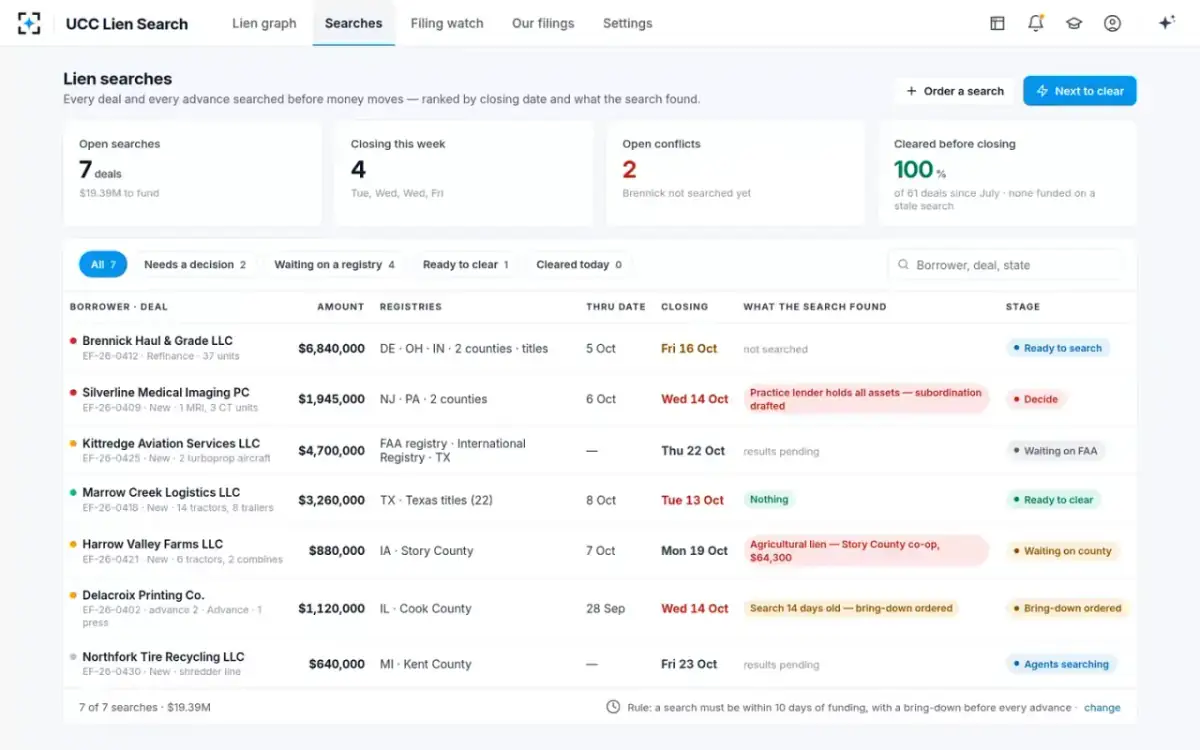
Questions to ask before you switch providers
Switching costs real time at a bad moment if it happens mid-deal, so the better approach is testing a new provider against deals already closed — ones where the lender already knows what every filing and title turned out to show — before relying on it for a live closing. Ask the provider to run the same search on a past deal and compare its matched output, not just its filing list, against what the lender's own team already found by hand. A provider that reproduces the known exceptions correctly has earned a live test; one that returns only images for the lender's team to re-read has not demonstrated the part that actually matters.
It is also worth asking how a provider's search plan handles a debtor that has changed its legal name, since a plan built around the current name alone can miss a filing still sitting under a former one. UCC debtor name changes, and the four months that can cost a lender works through what a search plan needs to get right. And because a vendor comparison is only as good as the underlying registries themselves, what a UCC lien search actually finds, and what it misses sets out which records any search — company, software, or in-house — actually reaches.
What stays the bank's own responsibility, no matter who runs the search
- Verifying the search covered the right registries, under the right name. A vendor's standard package is not automatically the right scope for every deal.
- Confirming the collateral clause was actually matched against the schedule. Receiving filing images is not the same as knowing what they claim against this deal's assets.
- Keeping the thru date current at the moment money moves. A stale search is the bank's exposure regardless of who ran it.
- Escalating anything undisclosed to credit and counsel. A vendor finding something is not the same as the bank acting on it.
- Being able to show an examiner, counsel or a court the underlying evidence. A results letter alone is a weaker record than the filing itself, open at its collateral clause.
Price and speed are the easiest things to compare between providers, and the least predictive of which one will catch the filing that matters on the deal that matters. Start from whether the provider reads the collateral clause against the schedule, matches by serial and VIN rather than category alone, and keeps a bring-down current at funding — then compare price among the providers that clear that bar. To see the matching, the escalation and the evidence trail together, start from UCC Lien Search.
Questions people ask
How do I choose a UCC search company?
Start with whether it reads every collateral clause against your schedule by serial or VIN, not only whether it returns filing images quickly. Then confirm which registries it covers beyond state UCC offices — county recorders and title systems matter on equipment deals — and how it handles a bring-down search before funding.
How accurate is a UCC search company?
Accuracy depends on two separate things: whether the search covers every registry and former name a debtor should be checked under, and whether anything then matches the collateral clauses found against the specific assets on the deal. A search can be run accurately and still fail the deal if nobody reads what it returned against the schedule.
What registries does a UCC search company cover?
At minimum, the state UCC filing office in the debtor's state of organization. A thorough search also reaches county recorders for fixtures, tax liens and judgments, and certificate-of-title records for titled equipment like trucks and trailers. Coverage varies meaningfully between providers and package tiers — ask explicitly rather than assuming.
Who is responsible if a UCC search misses a filing?
The lender, regardless of who ran the search. Federal interagency guidance states that a bank's use of third parties does not reduce its own responsibility to the standard it would meet doing the work in-house. A vendor's contract may allocate liability between the bank and the vendor, but it does not change the bank's exposure to regulators, counterparties or courts.
Is a UCC search the same whether I use a company or do it myself?
The search mechanics are the same — both reach the same filing offices. What differs is whether the collateral clause gets read against your specific schedule, by serial or VIN, with enough rigor and documentation to stand behind at a closing. That reading, not the search request itself, is where providers actually differ.