An asset-based lending platform, in its most common form, is built to run the borrowing base: track eligible receivables and inventory, apply advance rates, calculate availability, and manage draws against a facility. That is real and necessary work, and most platforms built for ABL do it well. What most of them were never built to do is read a UCC filing's collateral clause or match a serial number against a title record — the part of collateral risk that lives in state filing offices and county recorders rather than in the borrower's own reported numbers. Botminds' UCC Lien Search is built specifically for that gap: it searches the registries, reads what each filing claims, and matches every scheduled asset to it, so lien search and collateral clearance becomes a requirement a lending platform is actually evaluated on, not an assumption buried inside "collateral management."
The OCC's Comptroller's Handbook on asset-based lending is direct about why this matters to the credit itself, not just to operations: "the bank must protect itself from potential losses by using specific, enforceable language in the collateral documents," and "a lien search discloses any other party that has filed a security interest in collateral. It is especially important to uncover purchase money interests and tax liens, because they can take priority over the bank's lien" (OCC, Comptroller's Handbook, Asset-Based Lending). A borrowing-base engine that never asks whether anyone else already has a claim on the same collateral is answering half the question an ABL facility depends on.
What an asset-based lending platform is supposed to do
At its core, ABL software exists to turn a constantly changing collateral pool into a dependable number: how much can this borrower draw today. That means ingesting borrowing base certificates, tracking eligible and ineligible receivables and inventory against the credit agreement's own definitions, applying the advance rate, and flagging when availability falls short of what the borrower wants to draw. Mature platforms add workflow around covenant tracking, reporting to participants or syndicate partners, and audit trails for every change to the base calculation.
The OCC's handbook describes the category in the same terms. "Automated systems from third-party vendors link the borrower's financials with the bank," it says, and "most systems have the ability to analyze the financials against the bank's borrowing base formula and calculate the current borrowing availability." It credits them with "lower losses from credit risk and fraud" when "properly implemented", and it is candid about why banks buy them: tracking ABL collateral "can be a manual, time-intensive process prone to human error and fraud. Many banks find this type of monitoring difficult and have sustained losses as a result" (OCC, Asset-Based Lending). Nothing in that description reaches the filing office.
All of that is collateral management in the accounting sense: tracking what the borrower reports the collateral is worth. It is a different job from collateral verification: checking whether the collateral is legally free of other claims and physically what it is reported to be. A platform can run flawless borrowing-base math on a receivables pool that a second lender has already perfected a security interest against, because nothing in the math asks the registry question at all.
What it usually doesn't do: read a filing, match a serial
Reading a UCC filing's collateral clause and testing it against a specific serial number or VIN is specialized, document-heavy work that looks nothing like borrowing-base arithmetic, and most ABL platforms simply route around it — either by assuming the lender orders lien searches through a separate vendor relationship, or by surfacing search results as an attached document with no structured matching behind it. The software tracks that a search was ordered and received; it rarely tracks what the search actually found against this deal's specific collateral.
That gap is not a minor feature omission. It means the platform that calculates exactly how much a borrower can draw against $10,112,000 of scheduled collateral has no way of knowing that $824,000 of it is already claimed by serial number in another lender's filing — the borrowing base math simply assumes the full amount is clean unless someone manually excludes it after reading the search results elsewhere.
Why that gap is exactly where double pledging gets through
Double pledging — the same collateral pledged to more than one lender — succeeds precisely because borrowing-base software and lien search live in separate systems, checked at separate times, by separate people. A borrowing base certificate reports what the borrower says it owns free and clear; a lien search, run separately and often later, is where a competing claim would actually surface. When the two are not connected, a borrower's certificate can sail through the software's eligibility checks while a search sitting in someone's inbox — or never run at all for this draw cycle — would have caught the conflict immediately.
This is not a hypothetical gap. The SEC's complaint against Tricolor's former executives alleges a "multi-year scheme to defraud investors by double pledging hundreds of millions of dollars of subprime auto loans to multiple asset-backed securities (ABS) offerings and lenders", with the loans represented as "free and clear of any other liens" (SEC, 18 August 2026). Software built to calculate availability from the borrower's own reports takes that representation as its input; it was never positioned to test it. How double pledging happens, and how it's caught works through that case and the detection mechanics in full.
The pattern repeats across the kinds of exceptions a lien search is specifically designed to catch. A title still showing a prior lienholder, a lessor's true-lease filing on equipment the borrower is reporting as owned, a federal tax lien that outranks the bank's own security interest — none of these show up anywhere in a borrowing-base certificate's numbers. They show up only in the registries, and only if something actually goes and reads them against the specific collateral on the schedule. Software that stops at the borrowing-base math has, by construction, nowhere to surface any of this.
What a borrowing base calculation needs from a lien search
A borrowing base number is only as reliable as the exclusions built into it, and a lien search's real contribution to ABL software is supplying those exclusions with evidence, not just a yes-or-no flag. For every asset in the collateral pool, the base calculation needs to know: is this asset reached by any live filing or title lien other than the lender's own, and if so, for how much. Without that input, "eligible collateral" is a category defined by the borrower's own representation, which is the exact representation a lien search exists to test.
Where lien search sits in the ABL stack
| Stack layer | What it answers | Where it usually lives |
|---|---|---|
| Borrowing base calculation | How much can this borrower draw today, against reported collateral? | Core ABL software |
| Advance rate and eligibility rules | What percentage of reported collateral counts, and under what exclusions? | Core ABL software, as a settings table |
| Lien search and collateral clearance | Does anyone else already have a legal claim on this specific collateral? | Often a separate vendor, or not connected to the base calculation at all |
| Field exam | Is the collateral physically there, in the condition and quantity claimed? | A scheduled on-site process, feeding findings back manually |
Connected properly, a cleared or held status from the lien search becomes an input the borrowing base respects automatically — a held asset is excluded from eligible collateral until it clears, rather than relying on someone remembering to subtract it by hand after reading a search result in a different system. On the fictional sample deal, that connection is what turned $10,112,000 of scheduled OLV into $7,569,000 of actually cleared collateral, supporting $6,055,200 at an 80% advance rate. The same 80% applied to the full schedule, with no lien findings behind it, gives $8,089,600, enough to fund the whole $6,840,000 request and overstate support by $2,034,400 (our arithmetic on the sample figures).
Building the requirements: search rules, advance rate and signers, as settings
A lender adopting software for this should expect its own policy — not the vendor's defaults — to govern how collateral clearance actually works. UCC Lien Search treats its rules as settings precisely for this reason: which registries get searched for a registered organization, how many years of former names get checked, how fresh a search must be before funding, how serials get matched, the advance rate applied to cleared collateral, who gets escalated when an undisclosed filing turns up, how often the funded book gets watched, and how far ahead of lapse a continuation gets filed.
What to ask any ABL software about how it handles liens
- Is lien search a connected input to the borrowing base, or a separate attached document?
If it’s separate, someone has to remember to apply the finding by hand every time.
- Can your own search rules be configured, not just the vendor’s defaults?
Registries searched, former-name window and freshness should match your credit policy, not a generic template.
- Does a held asset automatically exclude from eligible collateral?
A clean connection means the base calculation reflects a hold the moment it’s found, not after a manual update.
- Who is escalated when an undisclosed filing is found, and how fast?
A finding that sits in a queue until someone checks it defeats the purpose of running the search at all.
- Does the funded book get watched after closing, or only searched at origination?
A new filing against a funded borrower is a risk from the day it’s recorded, not from the next scheduled review.
What a pilot on your own collateral schedule should prove
Before committing to any ABL software's lien search capability, test it against a collateral schedule the lender already knows the answer for — a closed deal where every filing, title and exception is already documented from the lender's own prior diligence. A pilot worth trusting reproduces those known exceptions correctly: the serials that were held, the titles that still showed a lienholder, the filings that were undisclosed. A pilot that returns a clean result on a schedule the lender knows has issues has failed the test, however polished its interface.
Worth proving specifically: that the search plan handles a debtor's former names and registered-organization state correctly — a plan built around only the current legal name can miss filings a correct plan would find (see UCC debtor name changes, and the four months that can cost a lender) — and that undisclosed filings actually route to a named person rather than simply appearing in a report nobody is required to read.
How long does it take to go live?
Timelines vary by how much of the lender's own data the pilot needs: past collateral schedules and past search results to validate against, the credit policy's specific search and advance-rate rules to configure as settings, and the registries and former-name conventions the lender's book actually requires. UCC Lien Search is built and deployed from those inputs — the search rules, credit policy, clearance memo format and a sample of past schedules and searches — and goes live once every check has passed, typically after a pilot run on one of the lender's own deals first.
Go-live: from requirements to the first deal run on your own schedule
- Search rules and credit policy configured as settingsRequirements
- Pilot run against a known, already-diligenced dealPilot
- First live deal, under full approval controlsLive
It is worth being specific about what "pilot" should mean here, because the word gets used loosely. A real pilot runs the software's search and matching against a deal with a known, documented outcome and compares results line by line — not a sample demo deal the vendor supplies, and not a general description of the platform's capabilities. If the pilot cannot reproduce findings the lender's own team already has in hand, no amount of polish in the rest of the platform should carry the decision.
What you bring: policy, past schedules, past searches
A pilot is only as good as what it is tested against, which means the lender's own inputs matter more than any vendor's demo data. Bringing an actual credit policy — advance rates, who signs off on exceptions, escalation rules for undisclosed filings — lets the configuration reflect how the lender actually wants exceptions handled, rather than a generic default. Bringing past collateral schedules and the searches already run against them gives the pilot a known answer to check against, which is the only way to actually validate accuracy rather than take a vendor's word for it.
ABL software with built-in lien matching vs. bolted-on search
Bolted-on search: In a separate search result; excluding it from the base is a manual step.
Connected lien search: Automatically excludes the held asset from eligible collateral.
Bolted-on search: Appears in the search report; escalation depends on someone reading it.
Connected lien search: Escalated to a named credit or counsel contact the moment it is found.
Bolted-on search: Re-run at the next scheduled periodic review.
Connected lien search: Watched nightly; a new filing against a funded borrower alerts by morning.
Bolted-on search: Tracked separately, often in a spreadsheet.
Connected lien search: On a lapse calendar with continuations prepared ahead of the window.
Search rules as settings: registries, freshness, advance rate, signers
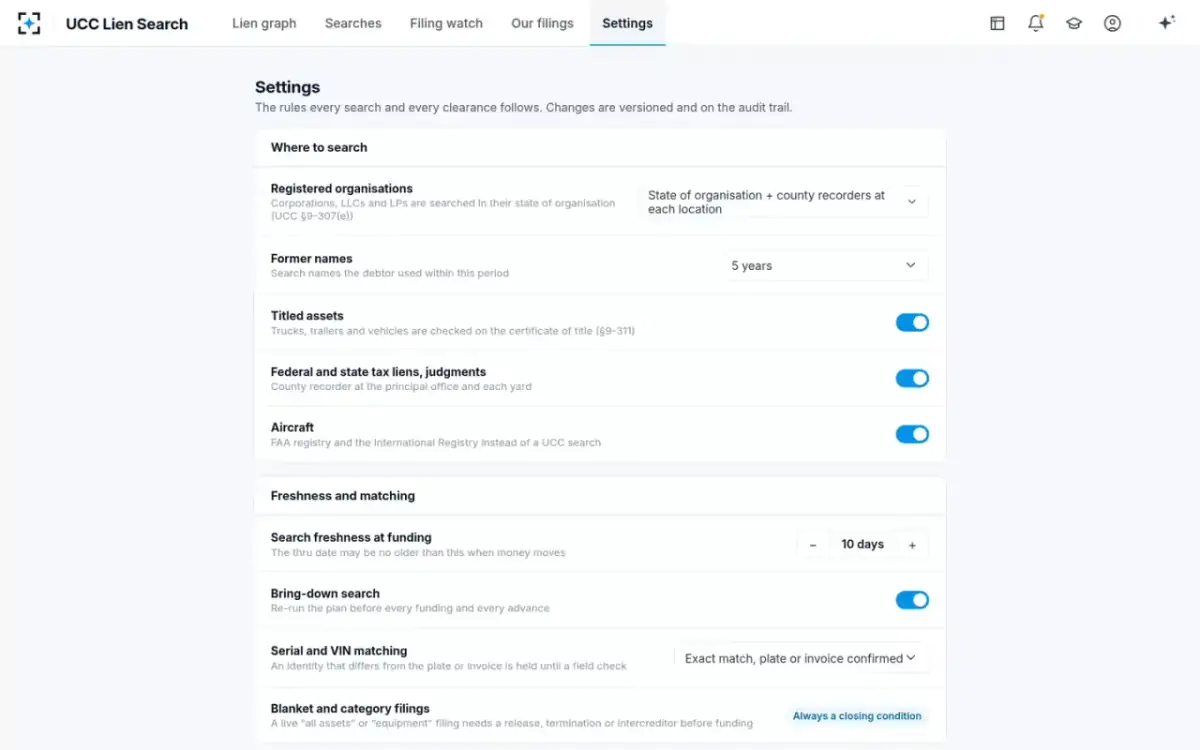
Lien search and collateral clearance is not a module to assume exists inside whatever ABL platform a lender already runs; it is a requirement to test for explicitly, against the lender's own data, before a facility's borrowing base depends on it. Once it is connected, watching the funded book after close is the other half of the job — what changes when collateral is watched nightly instead of periodically covers that half. To see the search, the matching and the connected borrowing base together, start from UCC Lien Search.
None of this is an argument for buying a single platform that claims to do everything. A lender's borrowing-base engine, its lien search and collateral clearance capability, and its field-exam scheduling can live in different systems and still work as one stack, as long as the handoffs between them are built, not assumed — a held asset actually excludes from the base, an undisclosed filing actually reaches a named person, a field exam's findings actually feed back into the next search plan. The requirement is the connection, not the vendor count.
Questions people ask
What is an asset-based lending platform?
Software built to track a borrower's eligible collateral, apply advance rates, and calculate how much the borrower can draw against an asset-based facility. Core platforms focus on the borrowing-base math; lien search, collateral clearance and field-exam tracking are often separate capabilities a lender has to evaluate on their own.
What should asset-based lending software track?
At minimum: eligible and ineligible collateral by the credit agreement's own definitions, the advance rate and resulting availability, covenant compliance, and an audit trail of every change. A complete stack also connects lien search findings so a held asset is automatically excluded, and watches the funded book for new filings after closing.
Asset based lending software vs excel: when does a spreadsheet stop being enough?
A spreadsheet can track a borrowing base for a handful of relationships, but it has no connection to a live registry search and depends entirely on someone manually updating it when a lien search finds something. Once lien findings need to change availability the day they are found, rather than at the next manual update, the spreadsheet's update step becomes the point most likely to fail; the OCC calls manual collateral tracking "prone to human error and fraud".
How long does it take to go live with ABL lending software?
It depends mainly on how much of the lender's own data — past schedules, past searches, and the specific search and advance-rate rules in its credit policy — needs to be configured and validated through a pilot before the first live deal. A pilot tested against a deal the lender has already diligenced is the fastest way to validate accuracy before going live.
What should ABL software's lien search capability be tested against before buying?
A collateral schedule from a closed deal where the lender already knows every filing, title and exception from its own prior diligence. A pilot that correctly reproduces those known exceptions has demonstrated real accuracy; one that returns a clean result on a schedule known to have issues has not.