A UCC debtor name change, a company renaming itself on its formation record, can quietly cost a secured lender its perfection on everything the debtor acquires more than four months after the change, unless the lender catches it and files an amendment within those four months. The rule is not about punishing sloppy paperwork; it exists because every other lender's ability to find a prior claim depends on searching under the debtor's name, and a name the filing office's own search cannot connect to the correct debtor is, for practical purposes, invisible to the next lender who searches honestly. Botminds' UCC Lien Search reads the formation record for the exact legal name and every former name on it, and flags a borrower's name change the day it is found rather than the day someone notices a filing has gone stale.
The example below is a fictional sample deal: Brennick Haul & Grade LLC, a Delaware company that changed its name in March 2023, with a collateral schedule that spells the name slightly differently again. The company is invented; the statutes governing what happens next are real and linked where they appear.
What name does a UCC filing actually require?
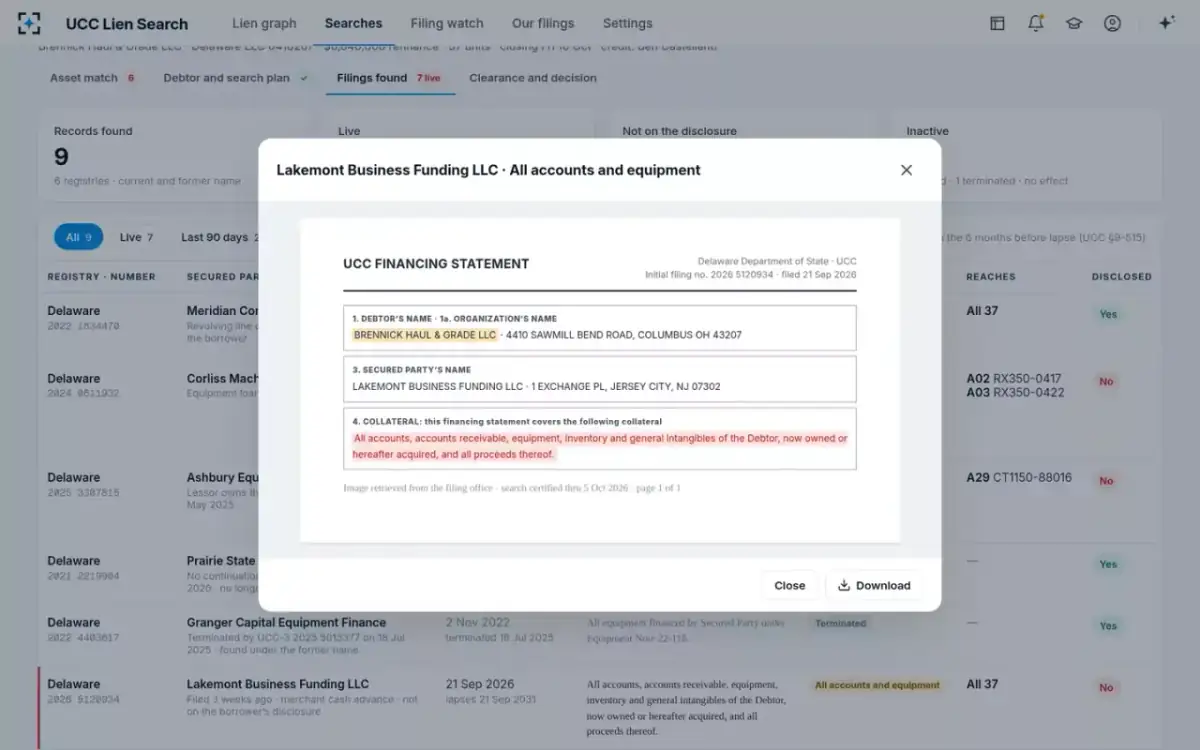
For a registered organization — an LLC or corporation, as most commercial borrowers are — a financing statement is sufficient on the debtor-name requirement "only if the financing statement provides the name that is stated to be the registered organization's name on the public organic record" of its jurisdiction of organization (UCC §9-503). That is a narrower standard than it first sounds: not the name on the loan agreement, not the name on a business card or a collateral schedule, not a trade name or a "doing business as" — the name on the formation document itself, exactly as the secretary of state's office has it on file. A filing under any other version of the name is good only if the next test, the filing office's search logic, rescues it.
Combined with the other two requirements a financing statement must meet — naming the secured party and "indicat[ing] the collateral covered by the financing statement" under UCC §9-502 — the debtor's name is the field most likely to drift quietly over a loan's life, because unlike the collateral description, nothing about day-to-day servicing forces anyone to look at it again.
Where the debtor's name actually sits on the filing
What is "standard search logic," and what does it forgive?
Not every naming error invalidates a filing, and the test for which ones survive is specific: whether the filing office's own standard search algorithm, searching under the debtor's correct name, would still surface the filing despite the error. The UCC states the forgiveness directly: "If a search of the records of the filing office under the debtor's correct name, using the filing office's standard search logic, if any, would disclose a financing statement that fails sufficiently to provide the name of the debtor in accordance with Section 9-503(a), the name provided does not make the financing statement seriously misleading" (UCC §9-506(c)). This is a mechanical test, not a fairness test: it asks what the filing office's own search would return, not what a reasonable person would have figured out.
Filing offices publish the rules their search applies, and the rules are more forgiving of some errors than lenders expect and less forgiving of others. Delaware's Division of Corporations, for example, publishes a list of UCC "noise words" its search disregards (Delaware UCC search): entity endings such as LLC, INC, CORP and COMPANY, and short words such as AND, THE and OF. Under that list, a filing against "Brennick Haul & Grade" with the LLC left off would still be found by a search for "Brennick Haul & Grade LLC", while one against "Brennick Hauling & Grade LLC" would not, because "Hauling" is a different word.
Standard search logic: what it forgives, and what it doesn't
Words the office lists as noise. In Delaware that includes entity endings such as LLC and INC and short words such as AND and THE, so "Brennick Haul & Grade" and "Brennick Haul & Grade LLC" search alike.
A different word, an added or dropped word that is not on the noise list, an abbreviation the office does not expand, or a name the debtor stopped using. "Hauling" for "Haul" is enough to make the search return nothing.
Not a judgment call: the specific filing office's published search rules, which differ from state to state and are worth reading, and testing, rather than assuming.
What makes a UCC filing "seriously misleading"?
A name error that standard search logic would not forgive makes a financing statement "seriously misleading", and under §9-506(a) a seriously misleading financing statement is not effective. The lender is then unperfected, which is worse than ranking late: an unperfected security interest loses to any perfected one under §9-322(a)(2), and to a lien creditor who attaches first under §9-317(a)(2), which in a bankruptcy is how the trustee is treated. The rule runs backward from the harm it guards against: a later lender searching the correct name and finding nothing has no way to know an earlier claim exists, so the law puts the cost on the filer who got the name wrong, not on the searcher who did everything right.
What happens when a debtor changes its name?
A genuine name change, the debtor renaming itself with the state through an amendment to its formation document, is treated more gently than a filing that was wrong from the start, because the filing was correct when made and became wrong afterward through no fault of the filer. Under §9-507(c) the filing stays effective for collateral the debtor already owns and for collateral it acquires in the next four months, even if the lender never notices. What the lender loses, unless it amends within the four months, is everything the debtor acquires after them.
The exact name, the former name, and the search plan built around both
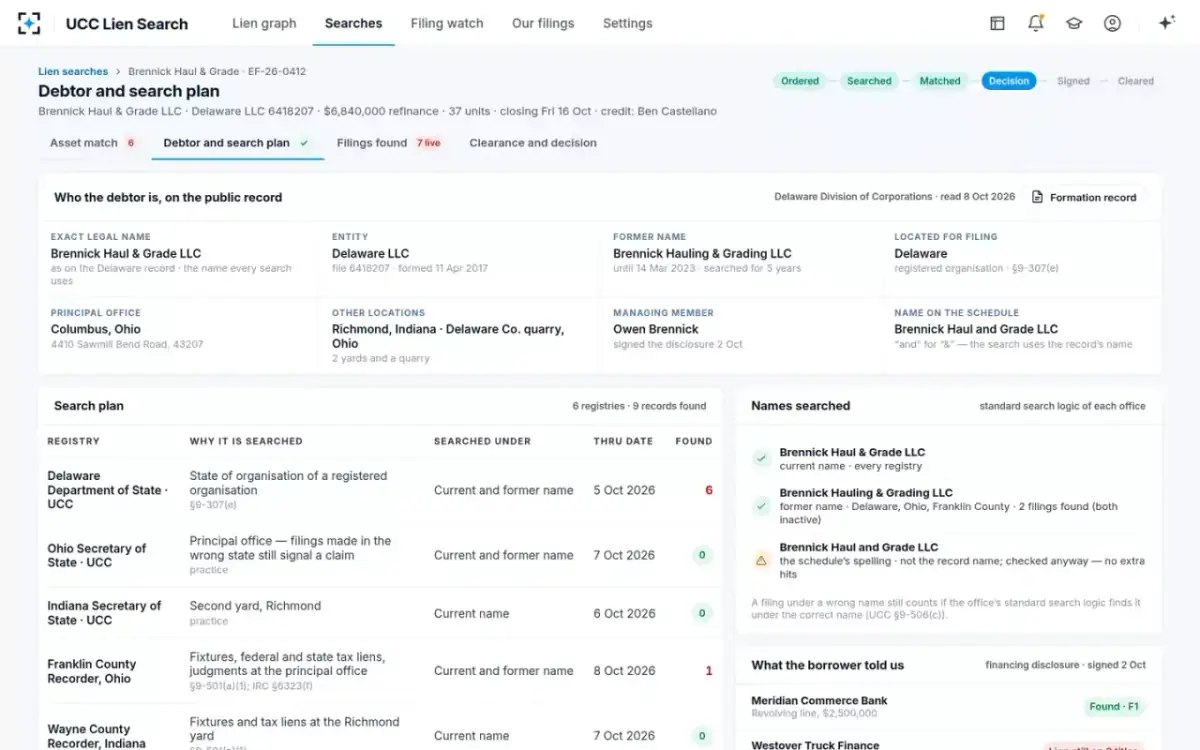
Brennick Haul & Grade LLC was named Brennick Hauling & Grading LLC until 14 March 2023, a real name change filed with the Delaware Division of Corporations, not a typo on anyone's part. A lender who filed against "Brennick Hauling & Grading LLC" before that date had a perfectly correct filing on the day it was made; the question the law actually asks is what happens to that lender's priority after the rename, not whether the original filing was ever defective.
The four-month window, and what it does and doesn't protect
The UCC gives a secured party a grace period after a debtor's name change, and it is drawn by when the debtor acquired the collateral. Under UCC §9-507(c) the filing "is effective to perfect a security interest in collateral acquired by the debtor before, or within four months after, the filed financing statement becomes seriously misleading", and "is not effective to perfect a security interest in collateral acquired by the debtor more than four months after" that date, "unless an amendment to the financing statement which renders the financing statement not seriously misleading is filed within four months". In plain terms: collateral owned at the change, or acquired in the next four months, stays covered either way; anything acquired after the four months is covered only if the amendment went in on time.
The four-month clock, from the date a name change makes a filing seriously misleading
- Covered by the original filing regardless of whether an amendment is ever filedNo clock runs
- Acquired within 4 months of the change: covered, amendment or not0–4 months
- Acquired after 4 months: covered only if the amendment was filed within the 4 monthsPast 4 months
That distinction is easy to misread as "a lender has four months to fix the filing, and nothing is lost if it is late". A late amendment does restore coverage going forward, from the day it is filed, but collateral the debtor acquired between the end of the four months and the amendment was unperfected in that gap, and a creditor that perfected against it then can rank ahead. The four months is the deadline for continuous coverage of new collateral, not a safe harbour on everything.
For a lender on a revolving facility, or one secured by equipment that turns over — trucks traded in and replaced, machines sold and new ones bought — the four-month window is not an edge case; it is close to the normal operating state of the collateral itself. A term loan against a single fixed asset may never test the rule at all, because nothing new is ever acquired for the filing to cover. A revolving line against "all equipment, now owned or hereafter acquired" tests it on every renamed debtor, because the entire value of the "hereafter acquired" language depends on the filing still correctly naming the debtor on the day each new asset arrives.
Why former names still have to be searched, not just the current one
A search run only under a debtor's current name can miss a live filing sitting under a former name, which is exactly why a competent search plan searches both — and why Brennick's own search plan above covers the former name "Brennick Hauling & Grading LLC" across Delaware, Ohio and Franklin County, the registries where the pre-rename entity had any presence. UCC Lien Search's debtor identity checker searches former names for five years by default, and the number comes from the statute: under §9-515(a) a financing statement is effective for five years from filing, so a filing made under the old name the day before the change can stay effective for up to five years without anyone touching it. A lender that knows of a continuation filed under the old name extends the lookback to match.
A typo, against a real name change — different rules, different fixes
A minor naming error (typo, punctuation): The filing was always slightly wrong — a punctuation difference, a dropped word.
A genuine name change: The filing was correct when made; the debtor's name changed afterward.
A minor naming error (typo, punctuation): Would the filing office's standard search logic, under the correct name, still find it? (§9-506)
A genuine name change: Did the secured party file an amendment within four months of the name becoming misleading? (§9-507)
A minor naming error (typo, punctuation): Everything: a filing that fails the search-logic test is not effective from the start, so the lender is unperfected on all of it.
A genuine name change: Only collateral acquired more than four months after the change; collateral owned before, or acquired within the four months, stays covered.
A minor naming error (typo, punctuation): A new filing or amendment under the correct name, which perfects only from the day it is filed. A minor error the search forgives needs no fix, though an amendment is prudent.
A genuine name change: File a UCC-3 amendment with the new name inside the four-month window; the clock does not pause for discovery.
Building a search plan that survives a name that already changed once
A search plan built to survive a name change starts with the formation record, not the loan file, because the formation record is the only place that reliably shows whether — and exactly when — a debtor's legal name has changed.
From the formation record to a search plan that accounts for a name that already changed
Agent
Read the formation record, not the applicationPull the exact current legal name, entity type, state of organisation and every former name the public record shows, with the date each change took effect.
Agent
Search the current name everywhere the plan requiresState of organisation, every county the debtor is located or has fixtures in, title records for any titled asset.
Agent
Search every former name, for five yearsThe same registries the current name touches, under each former name still inside the five-year window.
Agent
Check the schedule's own spelling too, but weigh it correctlyA borrower's own paperwork can spell its name differently again — worth checking, but it is not the legal standard the filing office's search logic actually applies.
A person decides
Flag a name change against the four-month clockEvery name change found on the formation record is dated against §9-507's window, so an amendment can be filed before, not after, the deadline passes.
Never: A former name is dropped from the plan because the current deal only mentions the current one.
What to do the day you learn a borrower renamed itself
Treat the date on the formation record as the start of the four-month clock, not the date you happened to find out — the rule runs from when the filing became seriously misleading, which is generally the rename date itself, regardless of how late the lender's own discovery comes. File a UCC-3 amendment updating the debtor's name as soon as the change is confirmed; there is no reason to wait for a renewal, an advance request or any other trigger, because the only thing waiting accomplishes is shrinking the window that remains. And re-run the search under both the old and new names before relying on the amendment, to confirm no other creditor filed against either version of the name in the interim — a name change is exactly the kind of event that can mask a new competing claim long enough to matter.
A portfolio of any size will not catch every rename by accident, because nothing about a routine loan file forces anyone to re-check the borrower's formation record after closing. The more reliable approach is the reverse of waiting for a trigger: search every active debtor's current formation record on a schedule, the same way a lender already watches for new filings against its collateral, so a name change is found on its own date rather than discovered months later when an unrelated advance request happens to prompt someone to look.
For what a UCC filing's collateral clause actually says once you have the right name to search, see UCC lien search: what it actually finds, and what it misses. And because priority among competing claims depends on getting the filing date right in the first place, UCC lien priority covers how a stack of claims on one asset actually gets ranked.
Questions people ask
What happens when a debtor changes its name under the UCC?
The original financing statement stays effective on collateral the debtor already owned. On anything the debtor acquires more than four months after the name change, the filing is no longer effective unless the secured party files an amendment updating the debtor's name within that four-month window.
How long do you have to amend a UCC filing after a name change?
Four months from the date the filing becomes seriously misleading, generally the date of the name change itself. Filing the amendment inside that window keeps the lender perfected on collateral acquired afterward; missing it leaves collateral owned before the change, or acquired within the four months, covered, but anything acquired later is unperfected until an amendment is filed.
What is "standard search logic" under the UCC?
The actual search algorithm a specific filing office runs when a name is searched. A naming error in a financing statement does not make it seriously misleading if that office's own standard search logic, searching the debtor's correct name, would still find the filing despite the error.
What makes a UCC filing "seriously misleading"?
A debtor-name error significant enough that the filing office's standard search logic, run on the correct name, would not surface the filing. Under UCC §9-506 a seriously misleading financing statement is not effective, so the lender is unperfected and loses to perfected lenders and lien creditors alike.
Do you need to search former names when running a UCC search?
Yes. A live filing can sit under a debtor's former name at any registry the earlier entity touched, and a search run only under the current name will miss it entirely. A five-year lookback on former names is a common default.
What is the exact legal name required for a UCC filing?
For a registered organization, the name stated on its public organic record — the formation document on file with its state of organization — not a trade name, a loan-document spelling, or a name on a collateral schedule.