Collateral monitoring software continuously checks a lender's already-funded loans against new filings, liens and title changes, rather than searching collateral only once, at origination. The distinction matters because the risk a lien search protects against at closing — someone else filing a claim on the same collateral — does not stop existing the day the loan funds. A new filing against a funded borrower's equipment is a risk the moment it is recorded in a county or state registry, whether or not the lender's next scheduled review is six months or a year away. Botminds' UCC Lien Search runs the same registry search and collateral match it uses at origination against the entire funded book, every night, so a new filing reaching collateral the lender already holds becomes an alert by morning rather than a discovery at the next periodic review.
The OCC's own guidance to examiners already expects something in this direction: "the bank should also conduct periodic lien searches, particularly for higher-risk borrowers" (OCC, Comptroller's Handbook, Asset-Based Lending). The handbook leaves "periodic" to the bank, and when every re-search costs a person's day, the interval tends to stretch to whatever the team can bear. Collateral monitoring software changes what periodic can mean, because the marginal cost of searching the same borrower again overnight is small once the search and matching machinery already exists.
What is collateral monitoring software, and how is it different from a lien search?
A lien search is a point-in-time check: run it once, against one deal, and it tells the lender what registries show as of that search date. Collateral monitoring software takes the same underlying search and matching capability and runs it repeatedly against every loan already funded, specifically looking for anything that has changed since the last run — a new filing, an amendment, a title transfer, a new tax lien. The search mechanics are the same; what differs is the cadence and the target. A lien search clears a deal to close. Collateral monitoring keeps watching after it has.
This is a genuinely different job from re-running an origination-style search once a year. An annual re-search is still a point-in-time check, just repeated infrequently; it answers "is anything wrong today" on the one day it runs, and says nothing about the 364 days in between. Monitoring software is built around the gap itself — the stretch of time between scheduled reviews — because that gap is exactly where a new claim against the collateral can sit undetected for months.
How often should collateral be monitored?
There's no single regulatory number; the FDIC's examination manual for commercial and industrial lending lists "monitoring requirements for bank management and third-party vendors" among what examiners specifically review, leaving the actual frequency to the bank's own risk-based policy. The OCC's handbook points the same way, asking for periodic searches "particularly for higher-risk borrowers", and it explains why the work tends to be rationed: tracking ABL collateral "can be a manual, time-intensive process prone to human error and fraud. Many banks find this type of monitoring difficult and have sustained losses as a result" (OCC, Asset-Based Lending).
Once the search and matching is automated rather than manual, the constraint that set that frequency largely disappears. UCC Lien Search's default is nightly: every funded borrower searched against new filings, amendments and title changes every night, with the cost of running the search a fraction of running it by hand on a scheduled cycle. The question "how often should collateral be monitored" becomes less about what the team can bear and more about how long a lender is willing to fund against collateral without knowing who else has filed on it.
What a periodic review misses between checks
The gap between scheduled reviews is where new claims sit unnoticed, and the size of that gap is the size of the lender's blind spot. A borrower that files for a second loan against equipment it already pledged, or that lets a new tax lien attach, does not wait for the lender's next review date — the filing is recorded, live and ranking ahead of nothing the lender has done about it, from the day it's filed. A lender on an annual cycle can carry that exposure for most of a year before its next scheduled search would even have a chance of finding it.
This is also where collateral fraud gets its runway. The SEC alleges that Tricolor's double pledging ran "from at least 2020 through Tricolor's bankruptcy in September 2025" (SEC press release, August 2026). A nightly watch would not by itself have exposed that scheme: a second pledge of the same auto loans shows up in the public record as another lender's filing against the same category, not against the same loan. But a new filing against collateral a lender already holds is often the first public sign that someone else is lending against it, and a watch that sees it the next morning gives the lender a question to ask while the answer can still change its next advance.
What changes when every funded borrower is searched nightly
The practical change is less about catching more problems and more about catching them while they are still small and local to one filing, rather than discovered months later tangled up with several others. A new filing against one borrower, found the morning after it was recorded, is a single fact to escalate and investigate. The same filing, found eleven months later during an annual review alongside two others that have also since appeared, is a harder problem — more filings to untangle, more time for the underlying issue to have gotten worse, and less time to act before the next scheduled advance.
Filing watch: every funded borrower, every registry, every night
Agent
Nightly registry sweepEvery funded borrower is searched across the same registries used at origination — state UCC offices, county recorders and title records.
Agent
Matched against funded collateralNew or amended filings are matched by serial, VIN or category against the specific collateral the lender’s loan is secured by.
Agent
Alert drafted, with the filing attachedA new filing reaching funded collateral is flagged with the filing itself, the borrower, and what it claims — ready the next morning.
A person decides
Portfolio manager reviewsA named person reviews the alert and decides what happens next — a call to the borrower, an escalation to credit, a closer look at the relationship.
Never: acts on a filing without a person reviewing it first
One night's run across a funded book
418
funded borrowers searched for new filings, in one nightly run
$1.86B
outstanding balance watched across the portfolio
46
new or amended filings read in one run, alongside 1,912 titles
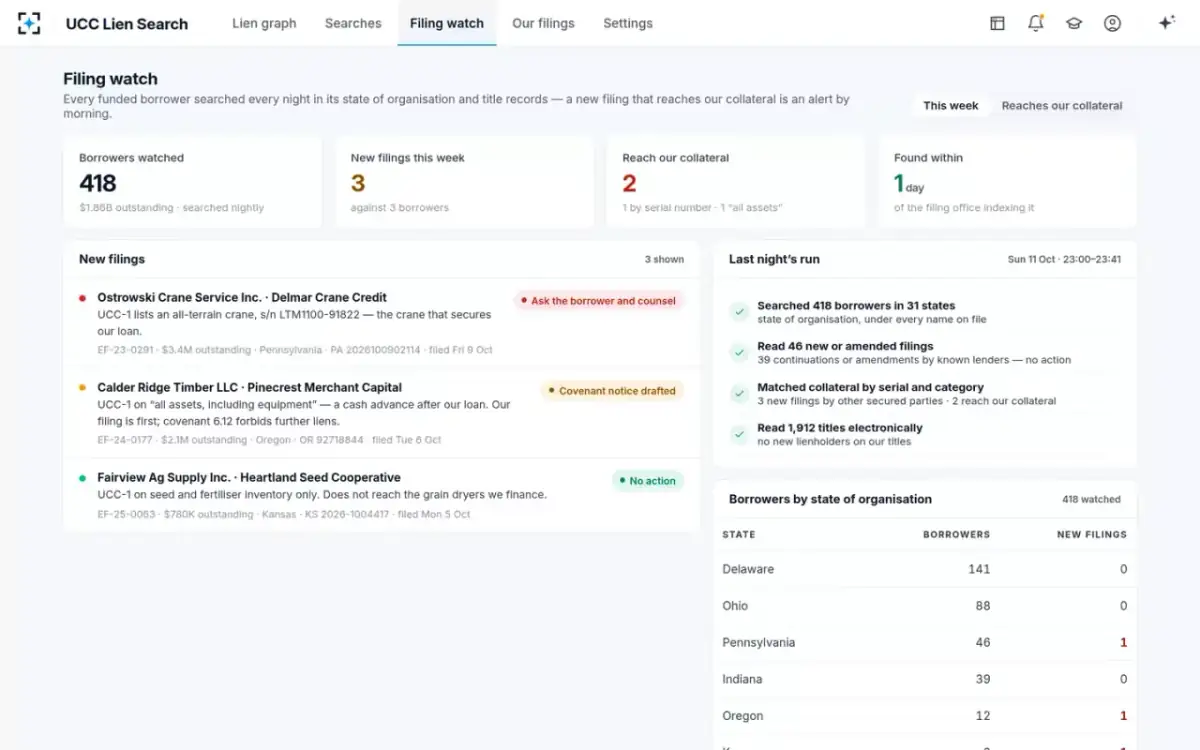
On the fictional sample book, one night's run read 46 new or amended filings and 1,912 titles across 418 borrowers. One of them mattered immediately: a new Pennsylvania filing, recorded the previous Friday, listed the serial number of the all-terrain crane securing Ostrowski Crane Service's loan — and the alert was already waiting for the portfolio manager, Tomas Reyes, by morning. On a periodic cycle, that same filing might have surfaced at the next scheduled review, months after it was recorded and after whatever the new filer's claim represents had already had time to develop further.
What should trigger an alert, and who should see it first
Not every new filing against a funded borrower needs the same response, and a monitoring system that alerts on everything equally trains the person reviewing it to stop reading closely. The filings that matter most are the ones that reach collateral the lender's own loan is secured by — a new filing naming the same serial number, VIN, or the same category of equipment already pledged — rather than a filing against some other asset of the borrower's that doesn't touch the lender's own collateral at all.
What to ask collateral monitoring software about registries, frequency and escalation
- Which registries does the nightly sweep actually cover?
State UCC offices alone miss county tax liens and certificate-of-title changes.
- Does it match new filings against your specific collateral, or just list them?
A list of every new filing against a borrower, with no match to what you’re actually secured by, is noise to sift through.
- Who is the alert routed to, and how fast?
A named portfolio manager, by morning — not a report that sits until the next scheduled review.
- Does it watch titled assets as well as UCC filings?
A lienholder appearing on a title, outside the UCC system entirely, is as real a risk as a new filing.
- What happens on a borrower that moves across state lines or renames itself?
Monitoring has to follow the debtor, not just re-run the same search plan built at origination.
Is manual collateral monitoring still common, and why it falls behind
Where no monitoring system is in place it is the default, and it falls behind for a straightforward reason: re-running a full collateral search and reading every result against a loan book's existing positions by hand does not scale past a modest number of relationships without either a growing team or a longer interval between checks. A lender watching some portion of its book by hand on a quarterly or annual schedule is making the same tradeoff every lender without automation makes — accepting a longer blind-spot window because closing it manually costs more than the lender is willing to spend.
That tradeoff is exactly what automated monitoring removes, not by making the review smarter but by making it cheap enough to run every night instead of every quarter. The OCC's broader guidance on automated ABL monitoring systems describes the expected benefit in those terms: systems that "enhance the bank's ability to detect problems early and minimize the risk of borrower fraud," alongside reduced administrative cost. The benefit is earlier detection at lower cost, not a different kind of review.
What regulators expect a bank to do after funding, not just before
Bank regulatory guidance treats collateral oversight as a continuing obligation, not a closing-day event. The OCC's handbook asks for a lien search before funding "and periodically thereafter", and its examination questions ask whether a bank maintains "a system to verify lien perfection and monitor lien expirations on a regular basis". The FDIC's modules ask whether a bank's asset-based lending policy sets "monitoring requirements for bank management and third-party vendors" (FDIC, Commercial and Industrial Lending). Interagency third-party guidance reinforces the same point for any vendor involved: the bank's responsibility for the collateral it is relying on does not pause once the loan is on the books, and does not transfer to whichever vendor runs the monitoring.
A lender whose only lien search happens at origination, with nothing watching the collateral afterward, is meeting the letter of a one-time diligence requirement while leaving the continuing obligation unaddressed. Nightly monitoring is one way to close that gap completely; a well-run periodic cycle, consistently followed and risk-rated toward the borrowers most likely to need it, can also meet the continuing obligation — what matters to an examiner is evidence that monitoring happens after funding, not only before it.
Periodic review vs. nightly watch — what each would have caught, and when
Periodic review: Found at the next scheduled review — potentially months after it was recorded.
Nightly watch: Found the morning after it was recorded.
Periodic review: Caught only if titles are specifically re-checked that cycle.
Nightly watch: Checked every night alongside UCC filings.
Periodic review: Caught if the review’s search plan is rebuilt for the new name — easy to miss.
Nightly watch: Followed continuously as part of the nightly sweep.
Periodic review: High per run — drives the long interval between reviews.
Nightly watch: Low per run — the interval is no longer the constraint.
There is a quieter benefit to nightly watch beyond catching the dramatic case. Most nights, the sweep finds nothing that changes anything — no new filing reaches any funded borrower's collateral, and the portfolio manager's morning review is a confirmation rather than an alert. That is not wasted effort; it is the difference between a lender who knows its book is clean as of last night and one who can only say its book was clean as of the last scheduled review, however many months ago that was. The value of monitoring shows up as much in what it lets a lender say with confidence on an ordinary day as in what it catches on the day something is actually wrong.
What a pilot on your own funded book should prove before you switch
Before moving a funded book onto continuous monitoring, test it the same way a lien search provider should be tested: against borrowers the lender already has a documented history for, where a past periodic review already found something. A pilot worth trusting reproduces those known findings and, ideally, surfaces them at the point they would actually have first become visible in the registries — not just confirms they existed by the time the lender's own review eventually caught them. A pilot that misses a known historical finding has failed the one test that actually matters before a whole funded book depends on it.
Worth checking specifically: that the monitoring follows a borrower through a name change or a move across state lines, since a watch built only around the identity captured at origination can silently stop covering a borrower that has since changed either. UCC debtor name changes, and the four months that can cost a lender covers what a search plan has to do to keep following a renamed debtor correctly, and the same logic applies to a monitoring plan running every night rather than once.
Filing watch: every funded borrower, searched nightly
Our filings: the same discipline applied to a lender's own lapse calendar
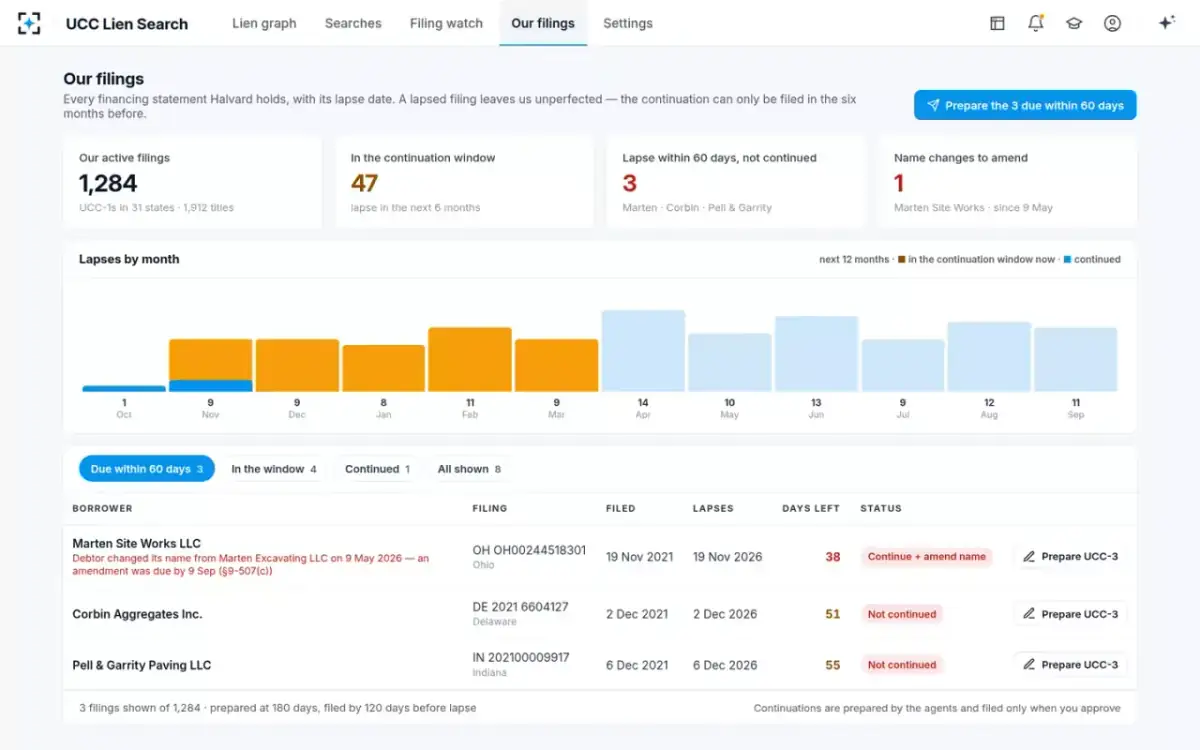
Watching the funded book is half of keeping collateral risk current after close; keeping the lender's own filings from lapsing on the five-year clock is the other half, and the two sit on the same portfolio view in UCC Lien Search rather than in separate systems. The six months before your own lien lapses covers that side in full. To see the nightly watch, the escalation and the lapse calendar together, start from UCC Lien Search.
None of this removes the portfolio manager's judgment from the loop — if anything, it puts more decisions in front of them, sooner, with more evidence attached. The agent's job ends at drafting the alert and attaching the filing it rests on; deciding whether the new claim is a paperwork artifact, a legitimate secondary lender that needs a conversation, or an early sign something is wrong with the relationship stays a person's call, made with the filing in front of them the morning after it was recorded instead of months later.
Questions people ask
What is collateral monitoring software?
Software that continuously checks a lender's already-funded loans against new filings, liens and title changes, rather than searching collateral only once at origination. It runs the same kind of registry search and collateral match a lien search uses, repeated on a short cycle — nightly in UCC Lien Search — against the entire funded book.
How often should collateral be monitored?
There is no single regulatory frequency; banks set it by policy, and the OCC asks for periodic lien searches "particularly for higher-risk borrowers". Once searching is automated, the cost constraint that set that cadence mostly disappears, and nightly monitoring becomes achievable for a full funded book rather than only the highest-risk names.
Collateral monitoring vs collateral management: what's the difference?
Collateral management tracks what a borrower reports its collateral is worth — values, advance rates, availability. Collateral monitoring checks whether anyone else has filed a legal claim against that collateral since the loan funded. A borrowing base can be managed perfectly and still be wrong if nothing is monitoring for new filings underneath it.
What should trigger a collateral monitoring alert?
A new or amended filing, title change, or tax lien that reaches collateral the lender's own loan is specifically secured by — not every filing against a borrower generally, which would bury the alerts that matter in noise. The match should be by serial number, VIN or the specific collateral category the loan relies on.
Is manual collateral monitoring still common?
Where no automated system is in place, re-searching and matching by hand is the default, and the OCC notes that many banks "find this type of monitoring difficult and have sustained losses as a result". Manual monitoring falls behind as a book grows, because the labor cost of each re-search is what forces the long interval between checks.