Double financing — lenders also call it double pledging — is pledging the same collateral — a pool of loans, a batch of receivables, a specific machine — to more than one lender or securitization at the same time, without disclosing the earlier claim to the second one. It is not a clerical slip, and it survives on one habit: a clearance process that starts from the borrower's own schedule and financing disclosure, and checks live filings against individual assets late, partially or not at all. Botminds' UCC Lien Search exists because that backstop is the part that actually catches it — matching every serial number and VIN on a schedule against every filing that claims it, rather than trusting a borrower's word that the assets are free and clear.
Two federal fraud cases that followed collapses in September 2025, Tricolor Holdings and First Brands Group, are alleged to have run for years on exactly this gap. The figures below are the government's own, from the SEC's and IRS Criminal Investigation's charging announcements, and they are allegations: none of the defendants named in them had been tried when those announcements were made.
What the charged double pledging left behind, in the government's numbers
$945M
of ABS principal still owed to investors at Tricolor's bankruptcy, on auto loans the SEC says were double pledged
$1.9B
raised by Tricolor through ABS offerings from at least 2020, the SEC alleges
$9B+
of liabilities First Brands declared at bankruptcy, against $12 million of cash, per the indictment announcement
What is double financing, exactly?
Double pledging is using the same asset as collateral for two or more financing arrangements, each one made without the others knowing. It is distinct from a legitimate second lien, where a junior lender knowingly takes a claim behind a disclosed senior one, priced and structured for exactly that risk. Double pledging works the other way: the borrower represents each lender as having a clear or first claim, so each lender prices and advances as if no other lender exists on that collateral. When the fraud surfaces, two or more lenders find themselves holding competing claims on assets worth far less than what they collectively lent against.
The mechanics vary by asset. The SEC alleges Tricolor pledged subprime auto loans to multiple asset-backed securities offerings and lenders at once. The First Brands indictment alleges "double-pledged invoices" sold to factors, "double- and triple-pledge loan collateral", and inventory pledged to other financiers as "unencumbered" when it "was already subject to liens by, or otherwise pledged to, First Brands' senior lenders". The common thread in both is not the asset class; it is that a category-level description — "these receivables," "this loan pool" — was never checked against a unique identifier for each underlying unit, across every lender involved.
How did Tricolor and First Brands double-pledge collateral for years?
As charged, both ran for five years or more. The SEC's announcement says that "from at least 2020 through Tricolor's bankruptcy in September 2025", the company raised more than $1.9 billion through asset-backed securities offerings while its executives were "double pledging hundreds of millions of dollars of subprime auto loans to multiple asset-backed securities (ABS) offerings and lenders" (SEC, 18 August 2026). The First Brands indictment covers 2018 to 2025 and alleges the founder and his brother "perpetrated multiple fraud schemes to fake and falsely inflate invoices for accounts receivable and payable; double- and triple-pledge loan collateral; falsify corporate financial statements; and conceal substantial liabilities from lenders" (IRS-CI, 29 January 2026). First Brands filed for bankruptcy on 28 September 2025, the same month as Tricolor.
Years, not months — how long each scheme ran before bankruptcy forced it into the open
- Scheme running: subprime auto loans double-pledged to multiple ABS deals and lenders2020–Sep 2025
- Scheme running: invoices faked, receivables double- and triple-pledged, liabilities concealed2018–Sep 2025
On the government's account, neither scheme was stopped by a lender's review: each ran until the company failed, and the charges followed the bankruptcies. What both rested on was a representation. In Tricolor's offering materials, the SEC says, the company "represented that the loans included in the ABS collateral pools were free and clear of any other liens when the defendants knew that many had been or would soon be double pledged". A representation that the collateral is free is exactly the statement a double pledge makes false, which is why it cannot be the control that catches one.
The cases also show where a public filing search stops. A lender that searches a borrower's name sees every other secured party that filed against the same category: a second factor's filing against "accounts", a second lender's against "chattel paper". It does not see which individual invoice or loan another lender's facility funds. The search tells a lender that it shares a category with someone; finding out whether it shares a specific asset takes the borrower's records, the other lender, or the account debtor, which is why the OCC tells field auditors to "obtain written account verifications" and examine "original invoices" (OCC, Asset-Based Lending).
Why a financing disclosure alone can't catch it
A financing disclosure is the borrower's own list of what it has already pledged and to whom — and in both frauds, it was exactly the document that was false. A disclosure only protects a lender if the borrower tells the truth on it, which means a disclosure, on its own, can never be the control that catches an undisclosed prior claim; by definition, the thing the control is supposed to catch is the thing the borrower chose not to write down.
Two frauds, one mechanism: trusted disclosure, untested filing
Subprime auto loan pools pledged to more than one ABS deal or lender; each counterparty relied on Tricolor's own representation that the pool backing its deal was dedicated to it alone.
Invoices faked or inflated, then pledged — sometimes twice or three times over — to different lenders, while inventory already under a lien was represented as free and clear.
In each case, what stopped a lender from seeing the prior claim was never a lack of public filings — it was that nobody matched the specific unit of collateral, loan by loan or invoice by invoice, against every live claim a lender or filing office already had on record.
What a serial-level match actually tests
The test that actually catches double pledging is narrower and more mechanical than reading a disclosure: for every individual unit of collateral — a serial number, a VIN, a unique loan or invoice identifier — does any live filing or title anywhere already claim it, by name or by a category broad enough to reach it? That test does not care what the borrower said it pledged; it checks what every filing actually says, against every unit on the schedule, one at a time.
This is a different kind of work from simply reading a search result for conflicts. A conflict check at the filing level asks whether two filings against the same debtor name exist; a serial-level match asks a sharper question — of the dozens or hundreds of individual assets a schedule lists, which specific ones does each filing's own collateral clause actually reach? A filing naming "all equipment" is a conflict against every piece of equipment on the schedule, whether or not the borrower mentioned it; a filing naming a single serial number is a conflict against exactly one line. Getting that distinction right, asset by asset, is what separates a search that merely lists filings from one that tells a lender what it can safely fund.
What a serial-level match checks, asset by asset — not category by category
Agent
Take the schedule as given, not as trustedEvery serial, VIN or invoice number on the collateral schedule becomes a thing to test, not a fact to accept.
Agent
Pull every live filing and title the debtor touchesEvery registry the search plan covers, read for its collateral clause — specific, categorical or "all assets" — not just its headline total.
Agent
Test each unit against each filingDoes this exact serial, VIN or invoice fall inside what this filing's clause actually reaches? A category match counts; a borrower's say-so does not.
Agent
Flag what the disclosure left outA live claim on an asset the borrower represented as unpledged is the signal — not a missing filing, but an undisclosed one.
A person decides
Hold, escalate, or clear on the documentA flagged asset is held until the document that clears it exists — a release, a payoff, a subordination — never on an updated disclosure alone.
Never: An asset a live filing already reaches is cleared on a corrected schedule by itself.
Is double pledging illegal?
Yes, when the borrower misrepresents collateral as unencumbered to obtain financing. That is how the two cases were charged: Tricolor's former executives face SEC antifraud charges under the securities laws, with parallel criminal charges brought in New York in December 2025, and First Brands' founder and his brother were indicted for wire fraud, bank fraud and conspiracy. Pledging the same collateral to a second lender is not illegal when it is disclosed; a junior lien, a subordination or an intercreditor agreement makes a known second claim lawful and priced for its place in line. The line is disclosure, not the fact of a second claim.
Who loses when the same collateral is pledged twice?
Usually the second lender, even though it was the one deceived. Between two lenders that both perfected, UCC §9-322(a)(1) ranks them "according to priority in time of filing or perfection", dating from the earlier of the first filing or perfection. A lender that filed in 2024 against "all equipment" outranks one that filed in 2026 against two named excavators, whatever the borrower told the second lender. The fraud gives the second lender a claim against the borrower and its executives; it does not move the second lender up the line on the collateral.
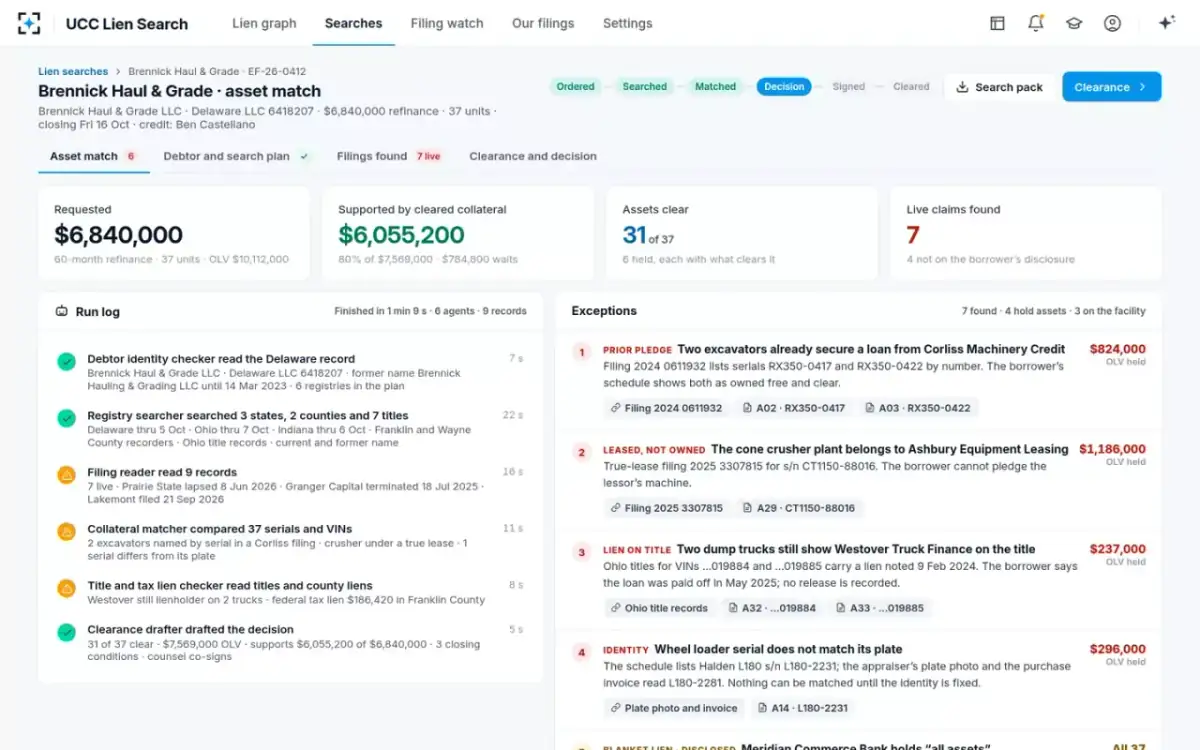
That is why a search before funding matters more than a remedy after it. In the sample deal used across these guides, a fictional company's schedule listed two excavators as free and clear while a 2024 filing by another lender named both by serial number: the earlier filer would rank first on both machines, so UCC Lien Search held the $824,000 of value they carried until a release arrived. The UCC lien priority guide works through the ranking rules and their exceptions.
Regulators describe the pattern plainly. The OCC's Comptroller's Handbook on asset-based lending says "fraud is a frequent cause of loss in ABL" and warns that "a fraudulent borrower can submit falsified sales and collection documentation, use the same receivables as collateral to obtain financing from more than one bank, divert cash or collateral proceeds, misrepresent purchase orders, or overstate inventory levels" (OCC, Asset-Based Lending, version 1.1, 2017). That list was published years before either case was charged, and the First Brands indictment alleges items from it side by side: fake invoices, double-pledged collateral and falsified financial statements.
The list is also the argument against checking collateral in isolation. The same paragraph puts double pledging next to falsified documentation and overstated inventory, and the handbook's answer is the same for all of them: "regular collateral monitoring and timely field audits are the best deterrents to fraud-related losses". A lien search tests the claims on the collateral; the field exam tests whether the collateral and the invoices behind it are real. A lender that does one without the other is checking one symptom of a pattern that tends to show up in several places at once.
How to detect double pledging before you fund, not after
Detection before funding means running the serial-level test above against every asset on a schedule, at every registry the debtor's assets touch, before the advance goes out — not relying on the disclosure the borrower hands over, and not relying on a search ordered under only the registered organization's home state when its assets sit in other counties or carry titles elsewhere. A search that returns no conflicts because it looked in the wrong place, or because nobody checked individual serials against category-level filings, looks identical to a search that found nothing because there was nothing to find.
The other half of detection is cadence, not just coverage. A search run once, at closing, only protects a lender against claims that existed on that one day; a borrower capable of fabricating a disclosure once is capable of pledging the same collateral again after funding, to a lender who never checks back. Catching that requires searching the funded book again, not only the deal at closing — the same collateral matcher that clears a deal before funding can run the identical test every night against everything already on the books, so a new filing against collateral that already secures a loan is a flag the morning after it is filed, not a discovery made at the next scheduled review or the next bankruptcy.
Every exception, matched to the filing behind it
The undisclosed claim, on the graph
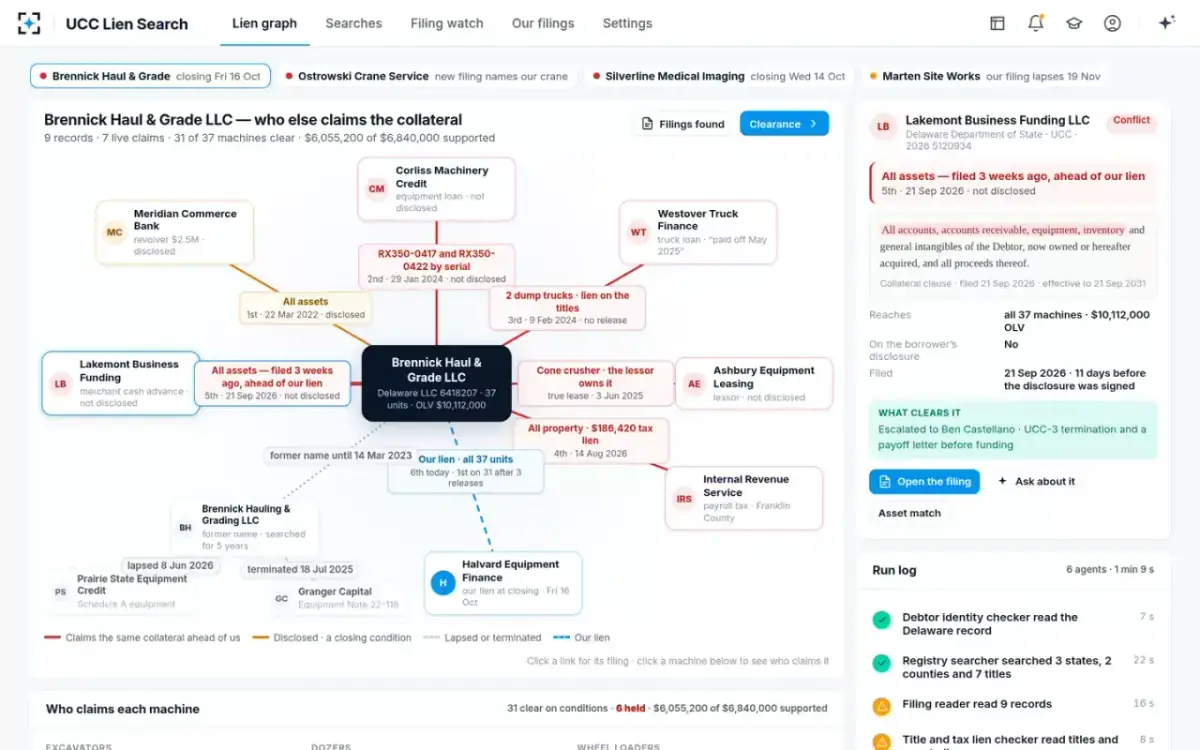
Neither exception list nor graph above required a tip, a whistleblower or a bankruptcy to surface — they came from running the same test every lender could run before funding: match the schedule, not the disclosure, against every live claim.
What a serial-level match needs to test for
- Every unit, not every category
A clean-looking total on a disclosure says nothing about whether any one serial, VIN or invoice is already claimed elsewhere.
- Every registry the assets actually touch
State of organisation, every county of location, title records for titled assets — a search confined to one registry can miss a claim filed in another.
- The current name and every former name
A borrower that changed its name can have a live filing sitting under the old one, missed by a search run only under the new.
- What the filing's clause actually reaches
A category or "all assets" filing can reach an asset the borrower never mentioned pledging, without naming it specifically.
- What is NOT on the disclosure, not just what is
The charged schemes in both Tricolor and First Brands turned on claims the lenders were told did not exist: the gap, not the list.
What regulators already warn asset-based lenders to watch for
The OCC's warning is not new guidance written in response to either case; it is standing text in the booklet examiners use to review a bank's asset-based lending, and the same booklet tells them to "evaluate the effectiveness of the bank's process to verify the perfection of liens" and asks whether the bank verifies "the borrower's accounts receivable and inventory or require[s] an independent verification on a periodic basis". The expectation is that collateral fraud is a live risk to test for. What has held lenders back is the cost of reading every filing against every unit by hand, which pushes teams toward sampling and toward the disclosure.
What changes when every filing is matched by machine, not by category
When the match runs asset by asset rather than by category, a clean disclosure stops being proof of anything on its own; it becomes one more document that either agrees with the filings and titles or does not. An asset with a live claim the borrower never mentioned is visible the day the search runs. That does not make fraud impossible. A filing search cannot see which invoice or loan another lender funds, and a determined borrower can still fake the invoice or title the match relies on. What it closes is the gap between what a borrower says it pledged and what every public filing and title says, which is the part of a double pledge a lender can check without anyone else's cooperation.
For how a search plan has to be built before this kind of match means anything, see UCC lien search: what it actually finds, and what it misses. And for how two filed claims on the same collateral are actually ranked once both are found, rather than just flagged, UCC lien priority covers who gets paid first.
Questions people ask
What is double pledging?
Pledging the same collateral — the same loan pool, receivables or specific asset — to more than one lender or financing arrangement at once, without disclosing the earlier claim. It becomes fraud when the borrower represents the collateral as unencumbered to get a second lender to advance against it.
How does double pledging happen?
A borrower pledges an asset to one lender, then pledges the same asset — or a pool or category that includes it — to a second lender without telling either about the other. It survives because most lenders test the borrower's disclosure for internal consistency, not every individual asset against every live filing anyone else has on record.
Is double pledging illegal?
Yes, when it involves misrepresenting collateral as unencumbered to obtain financing: the Tricolor executives face SEC securities-fraud and criminal charges, and the First Brands founders were indicted for wire and bank fraud. A disclosed second claim, by contrast, is a routine and lawful part of secured lending.
What is the First Brands fraud case?
A federal indictment unsealed on 29 January 2026 charges First Brands' founder Patrick James and his brother Edward James with wire fraud, bank fraud and conspiracy, alleging fake and inflated invoices, double- and triple-pledged collateral, falsified financial statements and concealed liabilities from at least 2018 until the company's bankruptcy on 28 September 2025. The charges are allegations until proven.
How was Tricolor's double pledging discovered?
The public record begins with Tricolor's bankruptcy in September 2025. Criminal charges against three former executives followed in December 2025, and the SEC's civil complaint of 18 August 2026 alleges they double pledged subprime auto loans to multiple asset-backed securities offerings and lenders from at least 2020.
Can a UCC search catch double pledging?
A UCC search is the raw material, but only if it is run under the right name, at every registry the collateral touches, and then matched asset by asset against the schedule — a search that stops at "filings found" without testing each serial or VIN against each filing's clause can miss exactly what double pledging depends on going unnoticed.