A collateral field exam is an asset-based lender's on-site review of a borrower's collateral, books and controls, run by a field examiner who physically inspects inventory and equipment and tests the borrowing base against the records behind it — the thing a desk review of paperwork cannot do on its own. The OCC's own description of the method is direct about why banks still send someone: a field audit "helps detect fraud and financial weakness and is a customary way to confirm the quality of the borrower's financial data, receivables, inventory, and internal controls" (OCC, Comptroller's Handbook, Asset-Based Lending). Botminds' UCC Lien Search does not replace that exam. It runs a serial-by-serial, VIN-by-VIN match between the collateral schedule and every live UCC filing and title before the exam's limited days ever start, so the field examiner's time goes to the handful of assets a document match genuinely cannot resolve.
The two methods ask different questions. A field exam asks whether the collateral is physically where the borrowing base certificate says it is, in the condition and quantity claimed. A document-level match asks whether anyone else has already filed a legal claim against that same collateral. Confusing the two — treating a clean document match as proof the inventory exists, or treating a clean field exam as proof no one else has a lien — is where both reviewers and lenders get into trouble. This guide keeps the two apart.
What is a collateral field exam, and why does ABL need one?
Asset-based lending extends credit against the value of specific assets — receivables, inventory, equipment — rather than against the borrower's overall cash flow, which means the lender's security depends on the collateral being real, owned, and roughly as valuable as reported, continuously, not just at closing. A field exam exists because paper can say things that are no longer true: an invoice for inventory that was already shipped, a receivable from a customer who disputes the debt, a piece of equipment that was sold, scrapped or moved to another site. The OCC's handbook calls field audits "integral to monitoring and controlling ABL," and for good reason — the borrowing base certificate the lender advances against is the borrower's own representation, and ABL by design leans harder on that representation than cash-flow lending does.
The FDIC's examination modules for commercial and industrial lending treat the exam as part of the core control set. Examiners are told to "determine whether periodic on-site audits of borrowers are performed" and, if so, how often, and whether the audits cover shipping documents, inventory invoices, turnover and "direct verification of AR and AP"; the same modules list "perfection of lien inspection (title and UCC searches)" among the documents a loan file should hold (FDIC, Commercial and Industrial Lending). A field exam is not a sign the lender distrusts a particular borrower; it is a standard part of how asset-based lending is monitored, because the collateral, not the income statement, is doing most of the work of protecting the loan.
What does a field examiner actually check?
A field examiner's work is broader than counting boxes. The OCC describes testing financial records as "reviewing borrowing base collateral — physically inspecting the collateral, testing its validity and value as reported on financial statements and borrowing base certificates, and examining original invoices and other supporting documentation" (OCC, Comptroller's Handbook, Asset-Based Lending). In practice that means walking the floor to confirm inventory exists and matches the quantities claimed, sampling receivables against invoices and shipping records to confirm they are real and collectible, reconciling the borrowing base certificate's math against the underlying ledgers, and reviewing the borrower's internal controls over how it reports all of this in the first place.
None of that is something a UCC search or a title check can do. A filing office has no idea whether the inventory named in a collateral description is actually sitting in a warehouse; it only knows what has been filed against it. A field exam is the check that closes the gap between what the paper claims and what is physically true — which is exactly why it stays a person's job even as document-level matching gets faster and more thorough.
What a document-level match can clear before the exam starts
Where a document match earns its place is in the part of collateral verification that is genuinely about documents: does this serial number or VIN appear in anyone else's live filing, and does the title show the lender the borrower claims is already paid off? UCC Lien Search's collateral matcher tests every scheduled asset by serial or VIN against every live filing and title the search plan reaches, and clears what it can before a field examiner is scheduled at all.
The collateral matcher's path, from schedule to every live filing and title
Agent
Collateral schedule readEvery asset on the borrower’s schedule is read for its serial number or VIN, alongside plate photos and purchase invoices where supplied.
Agent
Matched against every live filing and titleEach serial or VIN is checked against every UCC filing, certificate-of-title lienholder and tax lien the search plan reached.
Agent
Exceptions flagged, each tied to its filingA serial named in another lender’s filing, a title still showing a lienholder, or an identity that doesn’t match its plate is held, with the document behind the hold attached.
A person decides
Specialist and field examiner take it from thereCleared assets need no further document chase; held and unresolved assets, and anything a document alone cannot settle, go to the exam.
Never: clears an asset a live filing reaches
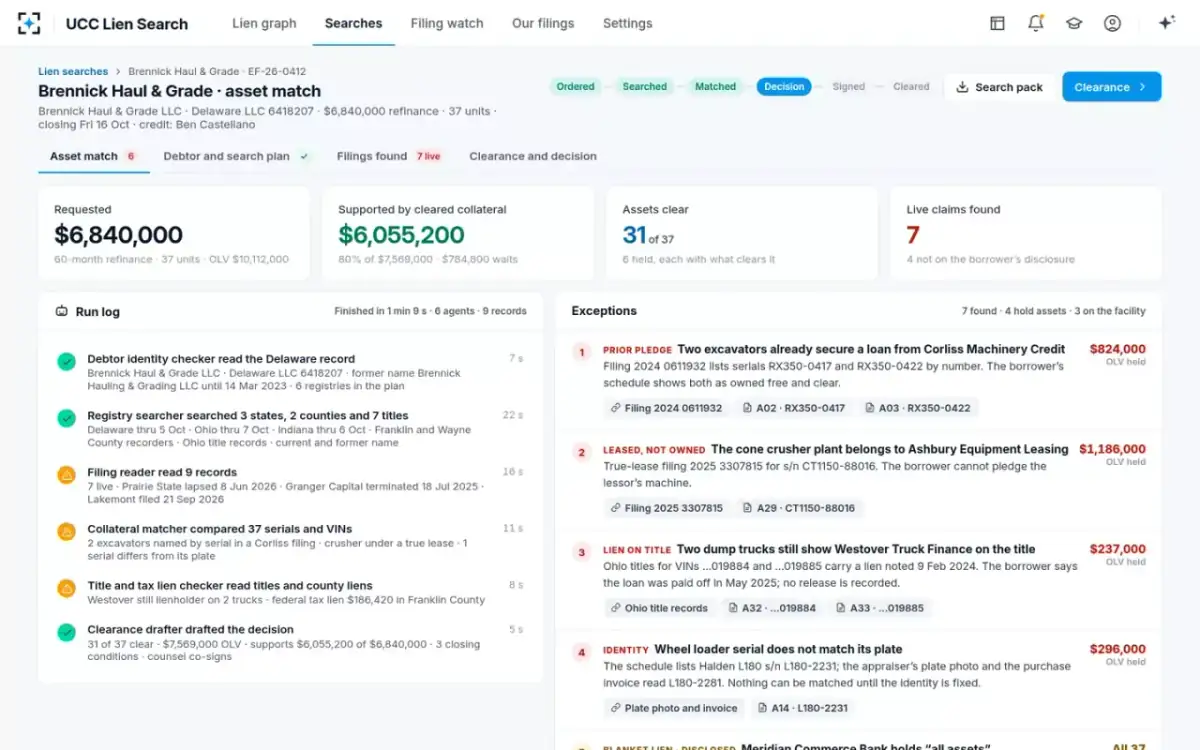
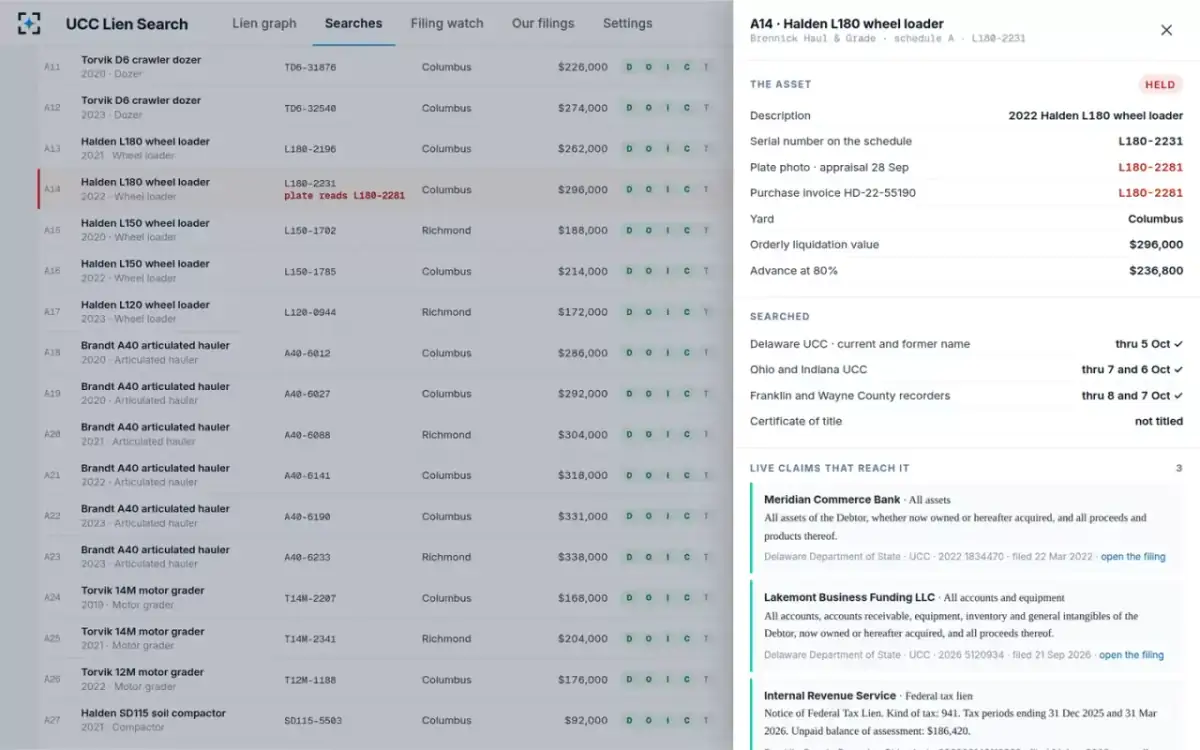
On the sample deal — 37 machines scheduled against a $6,840,000 refinance — the matcher cleared 31 units by serial or VIN against every registry the search plan reached, and held six under four exceptions, each with the filing or title record behind it: two excavators named by serial in another lender's filing, a leased cone crusher, two dump trucks whose Ohio titles still showed a different lienholder, and a wheel loader whose serial didn't match its own plate. Thirty-one machines did not need a field examiner to confirm nobody else has filed against them by serial number; the registries already answered that question. The six held machines are exactly where a field exam, a payoff letter, or a corrected schedule still has work to do.
One sample deal: what a document match resolved before the exam
37
scheduled units checked by serial or VIN against every live filing and title
31of 37
cleared by document match alone — no live filing or title claim reaches them
6
units held under four exceptions, each tied to the specific filing or title record behind it
What a field exam catches that a lien search alone can't
A clean document match tells a lender that no one else has filed a claim naming that collateral by serial number or category. It tells the lender nothing about whether the collateral is still there, still in the condition claimed, or still owned outright in ways no filing would ever record — a piece of equipment quietly sold for cash with no lien filed by the buyer, inventory that was double-counted across two warehouses, a receivable from a company that stopped operating six months ago. These are the failures a field exam is built to catch, and they are invisible to any registry search, however thorough.
The reverse is also true, and it's the reason this guide keeps the two methods separate rather than ranking one above the other: a field examiner standing in a warehouse, confirming a machine is physically present, has no way of knowing that the same serial number is already named in another lender's filing three states away. That is a registry question, not a floor question. A sound collateral review needs both: the document match to catch legal claims the examiner cannot see from the floor, and the field exam to catch physical problems no registry will ever record.
How often are field exams required?
There is no single federally mandated frequency; banks set their own schedules in policy, risk-rated by borrower, and examiners check that the schedule is followed. The OCC's handbook says "a field audit should be conducted before a new account is booked and regularly thereafter—often quarterly but more frequently if risk dictates. In a high-risk relationship or workout situation, weekly or daily audits may be appropriate." It tells examiners to pay "special attention to an ABL unit that delays audits or extends audit cycles because of staffing shortages", and notes that the cost "is generally passed on to the borrower" (OCC, Asset-Based Lending). The FDIC's modules ask examiners to record the frequency of on-site audits for each asset-based relationship.
The credit agreement usually sets the borrower's side of the same schedule, and a lender adds exams when the credit weakens. A lender using document-level matching between exams still needs the exam on its own schedule: the match narrows what the examiner has to chase down on the next visit, it does not extend the interval between visits.
Can AI replace a field exam?
No, and treating a document match as a substitute for physical verification is the mistake this guide is trying to head off. A collateral-matching agent reads what has been filed; it has no way to confirm what is physically true on the ground, and nothing in UCC Lien Search is designed to pretend otherwise. The collateral matcher's own operating limit — never clears an asset a live filing reaches — is a floor on confidence, not a ceiling: even an asset with no competing filing at all still needs the field exam's physical confirmation on whatever schedule the bank's policy sets.
What changes is where the examiner's limited days go. A field exam is expensive and time-consuming precisely because a person has to travel, count, sample and reconcile by hand; sending that person to re-verify 31 machines a document match already cleared of competing claims, instead of spending that time on the six that are actually in dispute, is where the two methods compound rather than duplicate each other.
What the collateral matcher agent does, and what it is never allowed to do
UCC Lien Search draws the collateral matcher's boundary deliberately narrow. It matches every scheduled asset by serial or VIN to the collateral clauses and titles it finds, and it flags serial hits, category coverage, lease language and identity mismatches — a wheel loader whose serial does not match its plate is held, not waved through, because an identity that differs from its own plate is exactly the kind of discrepancy a field exam would also catch, just later and at greater cost.
What a field exam should still test, even after a clean document match
- Physical presence and condition
No registry search confirms a machine is on the floor, in the condition the schedule claims, or hasn’t quietly left the site.
- Receivables against real invoices and shipping records
A document match checks filings against serial numbers; it does not sample receivables for collectability.
- Internal controls over what gets reported
Whether the borrower’s own reporting process is reliable is a question about people and process, not about registries.
- Inventory that exists but is double-counted or stale
Two warehouses reporting the same units, or units that haven’t moved in a year, look clean on paper.
- Anything a title or filing search genuinely cannot reach
Unregistered personal property, cash, and assets outside the registries this search plan covers.
Where the two methods overlap, and where only a person can go
The overlap is real and worth using: both methods, in their own way, are checking whether the collateral a lender is relying on is actually there to be relied on. Where they overlap most directly is identity — a serial number or VIN is the common key a document match reads from a filing and a field examiner reads off a machine's own plate, and a mismatch between those two readings, as on the sample deal's wheel loader, is a signal either method alone might miss but both together catch from different directions.
What a document match can rule out, and what still needs boots on the floor
| Question | Document match | Field exam |
|---|---|---|
| Does another lender already claim this serial number? | Yes — reads every live filing | Not visible from the floor alone |
| Is the collateral physically present and in the claimed condition? | Cannot see it | Yes — physical inspection |
| Does the title still show a different lienholder? | Yes — reads title records | Not a title search |
| Are receivables real and collectible? | Not a document-level question | Yes — sampled against invoices |
| Does a serial match its own plate? | Flags a mismatch against the filing | Confirms the plate in person |
What a field exam catches that the collateral matcher was never built to is as important to say plainly as what the matcher adds: a serial-level match replaces nobody's judgment about whether a business and its collateral are what they claim to be. It replaces the slower, costlier part of confirming that no one else has already filed against the same machines — the part a registry can answer definitively, fast, so the examiner's time goes to the part only a person on-site can answer at all. For how that same serial-level discipline catches a more deliberate failure than a stale record, see how double pledging happens, and how it's caught; for what a lien search finds before any exam is scheduled, see what a UCC lien search actually finds, and what it misses.
The asset-match run log: 31 cleared, six held, each tied to its filing
One asset's evidence: schedule serial against plate and invoice
The cost case for running the two together is straightforward even before any fraud is involved. A field examiner's day is expensive — travel, time on-site, and the sampling and reconciliation work afterward — and every hour spent re-confirming that an already-cleared machine has no competing filing is an hour not spent on the handful of assets actually in dispute. On the sample deal, narrowing the document chase from 37 units to the six genuinely in question is not a smaller exam; it frees the examiner's hours for the floor count, the receivables sample and the controls review that only a visit can do, which is where a fixed examination budget does the most good.
Start from a document-level match that clears what a filing can settle, keep the field exam's schedule exactly where policy sets it, and treat any disagreement between a serial, a plate and an invoice as the signal it is, not a reason to trust whichever source answered first.
Questions people ask
What triggers an asset-based lending field exam?
The lender's own policy and the credit agreement set the cadence. The OCC's handbook expects an exam before a new account is booked and "regularly thereafter—often quarterly but more frequently if risk dictates", with weekly or even daily audits in a high-risk or workout relationship. There is no single federal frequency requirement; examiners check that the bank's own schedule is followed.
What does a field examiner check that a desktop review can't?
Physical presence and condition of inventory and equipment, sampled receivables against real invoices and shipping records, and the reliability of the borrower's own internal reporting controls. A desktop or document review can confirm what has been filed against the collateral; only an on-site exam confirms the collateral is actually there.
Field exam vs desktop review: what's the real difference?
A desktop review reads documents the borrower or a registry provides — borrowing base certificates, UCC filings, title records. A field exam sends a person on-site to physically verify inventory and test receivables against underlying records. A document match, like UCC Lien Search's collateral matcher, is a desktop method made faster and more thorough; it is still not a substitute for the on-site exam.
Can AI replace an asset-based lending field exam?
No. A collateral-matching agent can clear assets no live filing reaches and flag identity mismatches before an exam begins, narrowing what the examiner has to chase down, but it cannot confirm a machine is physically present or that a receivable is genuinely collectible — the core jobs of a field exam.
What does a collateral matching agent do, and what can't it do?
It matches every scheduled asset by serial or VIN against every live UCC filing and title the search plan reaches, flagging serial hits, category coverage, lease language and identity mismatches. It cannot verify an asset is physically present, in the condition claimed, or that a receivable is collectible — those stay the field exam's job.
How accurate is automated collateral matching?
It is only as complete as the registries searched and the identifiers supplied — a serial number or VIN that is missing, mistyped, or outside the search plan's registries cannot be matched. UCC Lien Search's rule is conservative by design: an identity that differs from its own plate is held rather than cleared, and an asset a live filing reaches is never cleared regardless of how the match otherwise reads.