UCC lien priority decides who gets paid first when more than one creditor has a claim on the same collateral, and the general rule is simpler than most of the exceptions that get argued about: conflicting perfected security interests rank in the order they were filed or perfected, full stop — not in the order the loans were signed, not by who is owed more, and not by who asked first in a conversation with the borrower. Two exceptions override that order often enough to matter: a purchase-money lender that perfects within a short window after the debtor takes possession jumps ahead of an earlier blanket filer, and a federal tax lien runs on its own notice rule that can cut in line ahead of — or behind — a UCC filer depending on timing. Botminds' UCC Lien Search ranks every live claim on every scheduled asset in this order automatically, because getting the order wrong is exactly how a lender ends up advancing against collateral it is not actually first on.
The worked example below is a single machine from a fictional sample deal: a 2022 Ridgeline RX350 hydraulic excavator in Brennick Haul & Grade LLC's equipment schedule, with five separate claims competing for a place in line. The company and its lenders are invented; the priority rules and the statutes behind them are real, linked where they appear.
UCC lien priority, in one rule: first to file or perfect wins
The default rule for competing security interests in the same collateral is stated that plainly in UCC §9-322(a)(1), quoted below, and priority "dates from the earlier of the time a filing covering the collateral is first made or the security interest or agricultural lien is first perfected". Filing or perfection, not the closing or funding date, is the clock that matters. A financing statement "may be filed before a security agreement is made" (§9-502(d)), and a lender that files before it advances any money keeps the earlier date, which is why careful lenders file before closing rather than waiting for the wire to go out.
"Conflicting perfected security interests and agricultural liens rank according to priority in time of filing or perfection."
UCC §9-322(a)(1), the general priority rule
Applied to a real stack of claims, the rule reads like a queue: whoever filed first against a given asset — and stayed perfected — is first in line for whatever that asset is worth if more than one claim has to be satisfied from it. The practical work is not reciting the rule; it is correctly identifying every claim that actually reaches a given asset, in the right order, which is harder than it sounds once category filings, titled assets and tax liens are all mixed into the same stack.
One machine, every claim that reaches it, in order
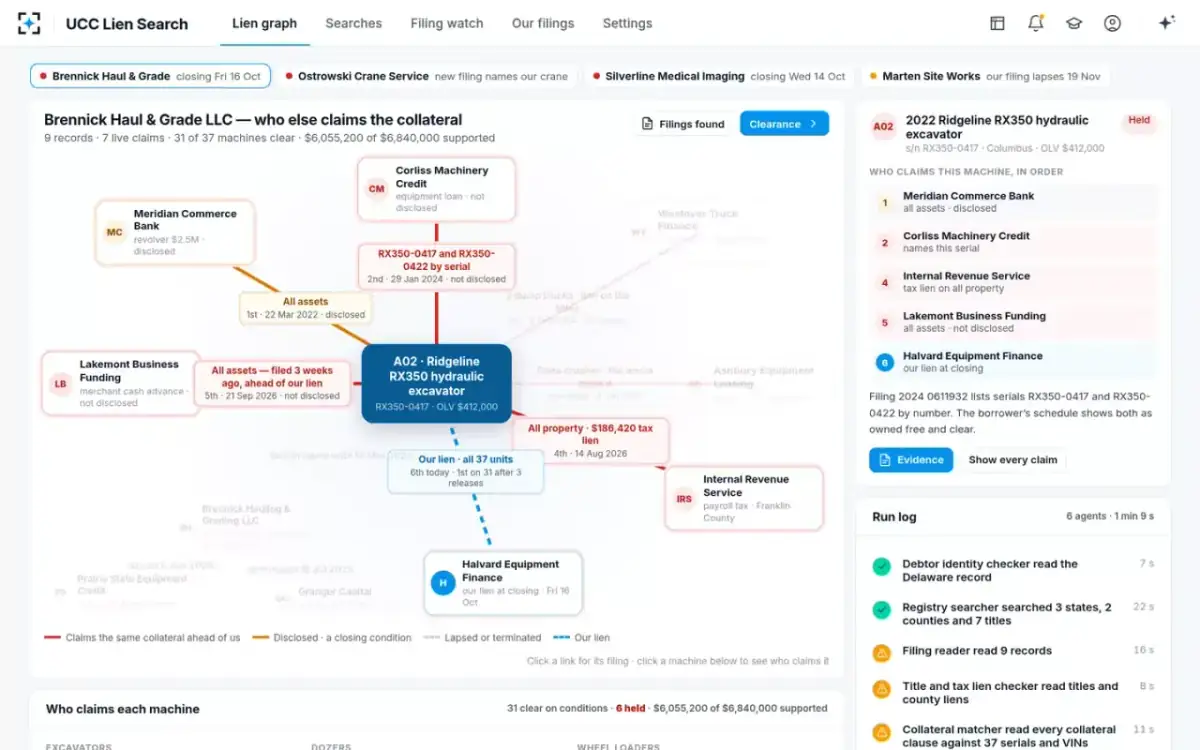
That ranked list is the point: rank 3 is simply absent from this machine's stack, because Westover Truck Finance's claim is on two specific dump trucks and never reaches the excavator at all. A priority stack is not one list per deal — it is one list per asset, and an asset's own stack can skip ranks that apply to other assets in the same schedule.
What is a purchase money security interest, and why does it jump the line?
A purchase money security interest, or PMSI, is a security interest taken by whoever actually financed the purchase of the specific collateral — a lender that advances the money used to buy a machine, or a seller that finances its own sale of the machine, in each case secured by the item bought. The law gives a PMSI a real advantage over the general first-to-file rule, because without it a borrower with an existing blanket lien on "all equipment, now owned or hereafter acquired" could never finance a new piece of equipment at all — the blanket filer's existing priority would automatically reach anything new the borrower bought, leaving no room for a new equipment lender to take a meaningful first position on the thing it financed.
A PMSI is also narrower than it sounds: it only covers the specific item the money was used to buy, not a borrower's other assets, and it only earns its jump-the-line priority if the PMSI lender perfects promptly, which is the subject of the race below.
The 20-day race: perfecting a PMSI before someone else's blanket lien catches it
The UCC gives a PMSI lender a real but time-limited head start: for goods other than inventory, "a perfected purchase-money security interest in goods other than inventory or livestock has priority over a conflicting security interest in the same goods...if the purchase-money security interest is perfected when the debtor receives possession of the collateral or within 20 days thereafter" (UCC §9-324). Miss that 20-day window, and the PMSI lender loses its jump-the-line advantage and falls back into the ordinary first-to-file queue — behind any blanket filer who was already perfected against "equipment, now owned or hereafter acquired" before the new machine arrived.
Take an illustrative case, not the sample deal: a lender finances a new wheel loader for a borrower that already has a blanket equipment lien filed two years earlier. If the new lender files its financing statement within 20 days of the borrower taking delivery, its claim on that one wheel loader jumps ahead of the older blanket filer, even though the blanket filing is years senior. File on day 25, and the new lender drops behind the blanket filer on that machine: the same collateral, the same loan, a materially worse position because of five missed days.
Inventory works differently, and the difference trips up lenders who know only the equipment rule. Under §9-324(b) a purchase-money lender on inventory gets no 20-day grace: it must be perfected "when the debtor receives possession of the inventory", and before that it must send a signed notification to any earlier lender that has filed against the same types of inventory, stating that it "has or expects to acquire a purchase-money security interest in inventory of the debtor and describes the inventory". The notice is good for five years. A dealer-floorplan lender that skips it ranks behind the blanket filer on every unit it financed.
Does a federal tax lien beat a UCC lien?
It depends entirely on which was filed first, with its own notice rule governing the comparison. A federal tax lien arises automatically by statute once a taxpayer neglects or refuses to pay after demand, but it is not valid against most other claimants — including a UCC secured lender — until the government files notice of it. The statute is explicit: "The lien imposed by section 6321 shall not be valid as against any purchaser, holder of a security interest, mechanic's lienor, or judgment lien creditor until notice thereof which meets the requirements of subsection (f) has been filed by the Secretary" (26 U.S.C. §6323(a)). A UCC lender that perfected before the IRS filed its notice generally outranks the tax lien on that collateral; a tax lien notice filed before a UCC lender perfects generally outranks the lender.
One detail makes the tax lien different from a competing UCC filer: the tax code counts money, not filings. Under §6323(h)(1) a security interest exists for this purpose only when the property exists, the interest is protected under state law against a judgment lien, and "to the extent that, at such time, the holder has parted with money or money's worth". A lender with a 2022 filing that advances fresh money on a revolving line after the IRS files is not protected for those new advances by its old filing date; the 45-day window below is the main exception.
In Brennick's sample deal, the IRS's $186,420 federal tax lien was filed in Franklin County on 14 August 2026, reaching all of the debtor's property. Against the excavator, it ranks fourth — behind Meridian's 2022 blanket filing and Corliss's 2024 serial-specific filing, both perfected well before the tax lien existed, but ahead of Lakemont's all-assets filing, made over a month later in September.
The 45-day window: why a lender can still fund safely after a tax lien is filed
The notice-filing rule above is not the whole story once a tax lien is already on file: a narrow exception still lets certain lenders make new, protected disbursements for a window after the tax lien's notice is filed. Under 26 U.S.C. §6323(d), "such lien shall not be valid with respect to a security interest which came into existence after tax lien filing by reason of disbursements made before the 46th day after the date of tax lien filing, or (if earlier) before the person making such disbursements had actual notice or knowledge of tax lien filing" — but only where that disbursement is made under a written financing agreement that already existed before the tax lien notice was filed, not a brand-new loan negotiated afterward.
The 45-day window, drawn against the deal's own dates
- Disbursements under a pre-existing agreement, protected14 Aug – ~28 Sep 2026
- Window open14 Aug – ~28 Sep
- Closing, 16 Oct — 63 days after the tax lien, no pre-existing agreement to protect it16 Oct
Two things rule out §6323(d) protection for Halvard's new loan on this deal, and either alone would be enough. First, the loan agreement is new — negotiated and signed as part of this refinance, not a pre-existing obligatory disbursement agreement that predates 14 August. Second, even if it had predated the lien, closing on 16 October falls 63 days after the tax lien was filed, well past the 45-day window. With neither condition met, the only safe path is the one the sample deal actually takes: the $186,420 tax lien is paid off directly from closing proceeds, with the IRS's own certificate of release recorded, rather than relying on any statutory window to protect a lien the lender would otherwise be funding behind.
Reading a priority stack correctly, machine by machine, not loan by loan
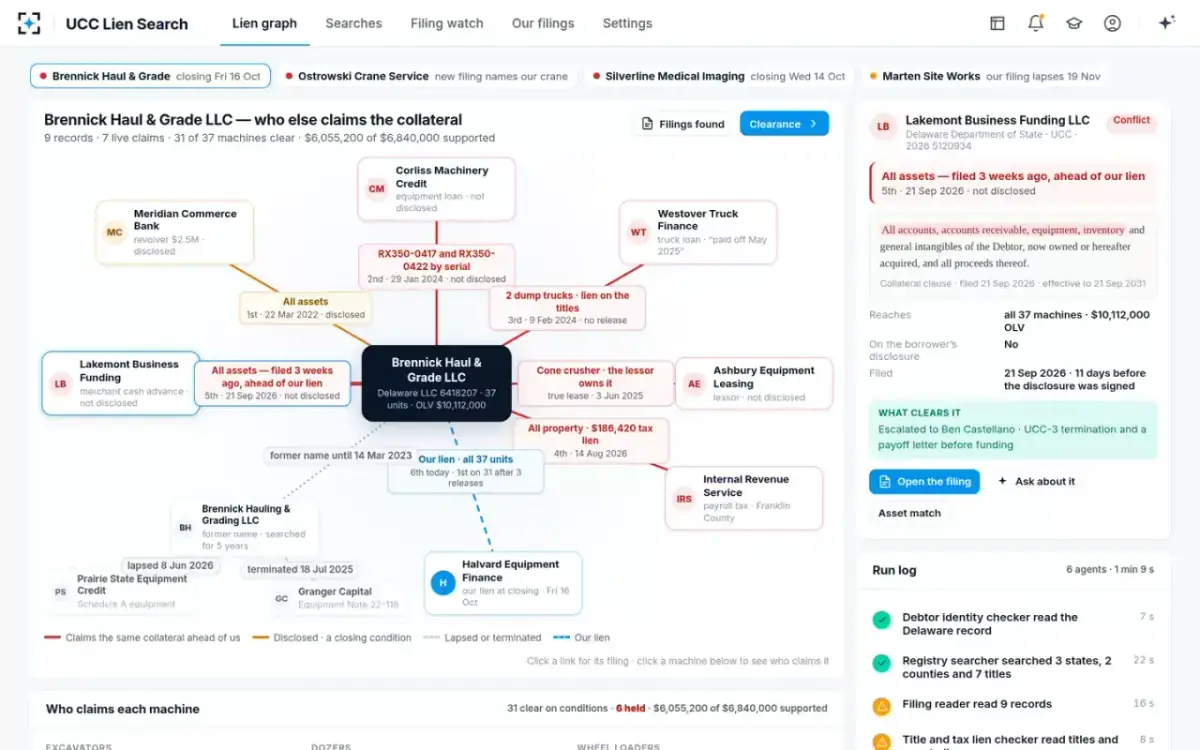
A priority stack is only correct if it is built per asset, because a claim's rank can change entirely depending on which machine is being asked about — as the gap at rank 3 on the excavator above shows. Building it correctly means, for every scheduled asset: list every filing or title entry whose collateral description reaches that specific item, order them by filing or perfection date, then apply the PMSI and federal tax lien exceptions where they actually qualify, not by default. A blanket "all assets" filer from 2022 outranks a serial-specific filer from 2024 on every asset both reach, simply on filing date — being more specific does not by itself confer priority; filing earlier does.
The priority stack for one machine, ranked
All-assets filing, 22 Mar 2022. Earliest perfected claim that reaches this machine; disclosed on the borrower's financing disclosure.
Names this serial directly, filed 29 Jan 2024. Not disclosed by the borrower.
Federal tax lien on all property, notice filed 14 Aug 2026 — ranks by notice-filing date against the UCC filers above and below it, no PMSI or §6323(d) exception applies here.
All-assets filing, 21 Sep 2026 — after the tax lien, so it ranks behind it. Not disclosed by the borrower.
Files at closing; ranks last on this machine today, first on the 31 cleared units once the senior releases above it are obtained.
The same stack, in the graph every other machine draws from
What happens when two filings land on the same day
Two filings on the same day are rarely a tie, because the filing office records a time as well as a date: UCC §9-523(c)(2) requires it to report "the date and time of filing of each financing statement" in every search response. Under §9-322(a)(1) the earlier time is the earlier filing. The practical lesson is to read the time on the filing office's own record, not a summary that shows only the calendar date, and to treat a same-minute conflict as a question for counsel rather than a coin toss.
Why a blanket "all assets" filer still loses to a serial-named PMSI
A blanket "all assets" filer with years of seniority still loses to a new PMSI lender that perfects within the 20-day window, on the one asset the PMSI financed — the earlier filing date does not help the blanket filer here, because the PMSI exception is written specifically to override the general first-to-file rule for exactly this situation. That is a deliberate policy choice, not an accident: without it, a borrower with any blanket lien on file could never obtain new equipment financing on acceptable terms, because every new machine would automatically fall behind an existing senior claim the new lender had no part in and no visibility into. The PMSI exception exists so that financing new equipment stays possible even for a borrower whose other assets are already fully encumbered — but only for the lender that actually financed that specific purchase, and only if it perfects inside the 20-day window above.
Knowing which rule governs a given claim only matters once the underlying search has actually found every claim to rank — UCC lien search: what it actually finds, and what it misses covers what a search returns before priority can even be assessed. And because a borrower's own name can change the registries a search has to cover in the first place, UCC debtor name change covers the window a name change opens before a lender's own priority can quietly lapse.
Questions people ask
What are the UCC lien priority rules?
The general rule is first to file or perfect: among conflicting perfected security interests in the same collateral, the earliest filing or perfection date wins. Two statutory exceptions override it — a purchase-money security interest perfected within 20 days of the debtor taking possession, and a federal tax lien, which ranks by its own notice-filing date against UCC claims rather than by the UCC's filing rule.
What is first to file or perfect?
It is the UCC's general priority rule: between two conflicting perfected security interests in the same collateral, whichever was filed or perfected earliest in time outranks the other, regardless of which loan is larger or which lender asked first.
Does a tax lien beat a UCC lien?
It depends on timing. A federal tax lien is not valid against a UCC secured lender until the government files notice of it; a lender perfected before that notice generally outranks the tax lien on that collateral, while a tax lien notice filed earlier generally outranks a lender who perfects afterward.
What is a purchase money security interest?
A security interest held by whoever financed the actual purchase of specific collateral — a lender that advanced the funds used to buy it, or a seller that financed its own sale — secured by that item. Perfected promptly, it can outrank an earlier blanket lien on the same asset.
What are the PMSI priority rules?
For goods other than inventory, a purchase-money lender that perfects when the debtor takes possession or within 20 days after has priority over a conflicting security interest in the same goods, even one filed earlier. Miss the 20-day window, and the PMSI lender falls back into the ordinary first-to-file order.
Does a later UCC filing ever win?
Yes, in two situations: a later-filed PMSI that perfects inside its statutory window on the asset it financed, and a later filer whose earlier competitor's filing has lapsed, been terminated, or never properly named the debtor in the first place.