A certificate of insurance tracking spreadsheet is the most common system in commercial loan servicing and the only one with no line in the budget, which is why it survives. Search for one and you will find templates: a tab per borrower, columns for carrier, policy number, expiry, limit and a conditional format that turns a cell amber at sixty days. The template is not the problem. The problem is that the workbook can only hold what somebody keyed into it, so it is blind to the two failures that cost the most — a mortgagee clause quietly dropped at renewal, and a financing statement whose continuation window closed — and a cost you cannot see is not a saving. Botminds' Collateral Insurance & Lien Tracking replaces the workbook with the reading it never did, and this page prices the comparison honestly, including where the workbook is still the right answer.
The hours and portfolio figures come from a fictional sample bank as it runs through the solution: Kestrel Valley Bank, 1,846 commercial loans, $2.31 billion, 3,706 financing statements in 14 states. The people, banks, borrowers and agents are sample data, and the hours are an estimate rather than a measured customer result. The wage and the law are published, and linked.
The inputs a business case needs, and where each comes from
$23.67/hr
published median wage for the clerical occupation that does this work — the floor under any hourly rate, before the bank’s own loading
5.25hrs
by hand on one commercial property renewal that comes back short, across chasing, keying, checking, drafting and sending
1.35hrs
on the same renewal with agents doing the reading and the drafting
≈40
certificates a day one specialist keys, which is the ceiling on a desk that keys rather than reads
What a certificate of insurance tracking spreadsheet really costs
Three things, and only the first ever gets counted. It costs the hours spent keeping it: chasing documents, typing what they say, and checking by hand whatever anybody still checks. It costs the work it does not do, which has to be done somewhere else or not at all. And it costs the exposure it hides, because a workbook reports only on the fields it has, and silence in a spreadsheet looks exactly like good news.
That last point is the one to hold on to. A tracking workbook with 1,846 rows, every expiry date current and every cell green, is a perfectly accurate statement that 1,846 policies exist. It says nothing at all about whether the bank is named on any of them. Those are different claims, and only one of them is what the loan agreement required.
What belongs in the spreadsheet, if you are going to keep it
Plenty of banks will keep it for another year or three, and a better workbook is worth more than a worse one. Four changes make the most difference, and all of them are about turning the file from a diary into evidence.
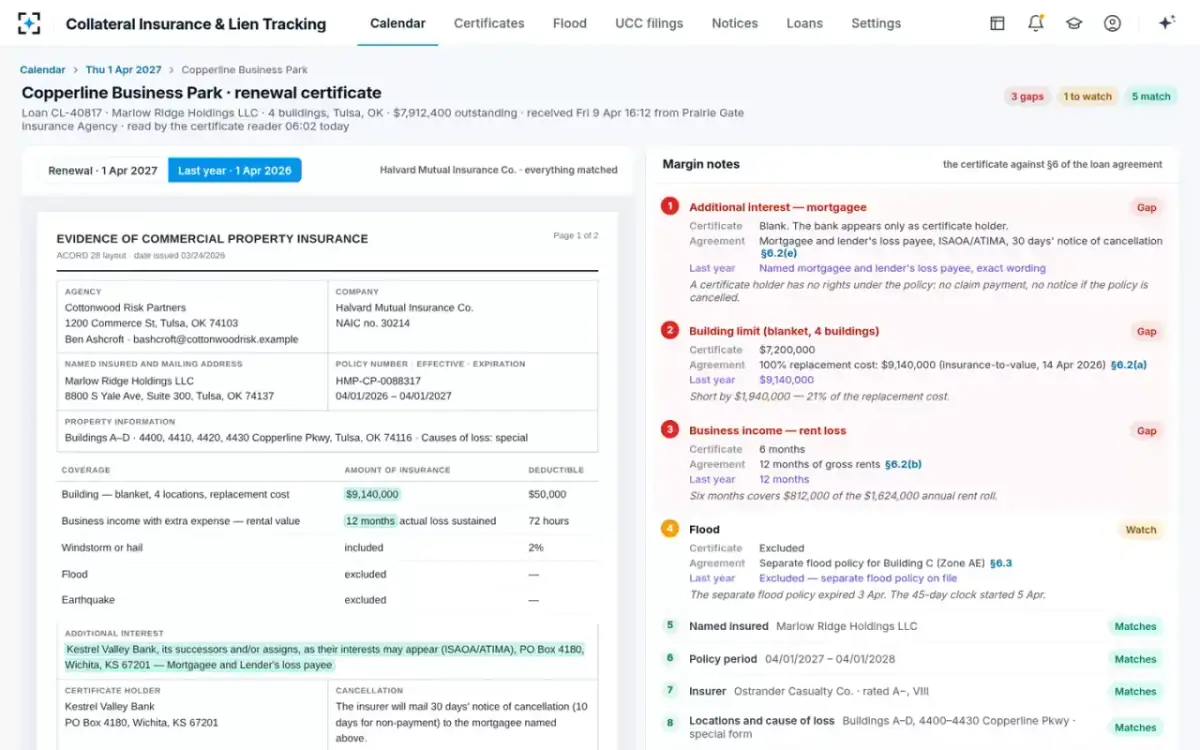
A column for the clause, not only for the limit. One cell holding the exact mortgagee and loss payee wording as it appeared on the last certificate, so the next renewal can be compared with something. If that cell is empty across the book, the workbook has never checked the thing most likely to break.
A row per building, not per loan. Limits, deductibles and flood zones are properties of buildings. A multi-property borrower collapsed into one row is a borrower whose shortfall cannot be seen.
The agreement's section number beside each requirement. So the person chasing knows what they are entitled to ask for, and the letter can cite it. A requirement with no clause behind it gets negotiated away at renewal.
A separate sheet for financing statements, keyed on the file number. Not the debtor name, which changes, and not the loan number. With the file date and the lapse date in adjacent columns, and a column for where each date came from — which, honestly filled in, is the most useful column in the book.
The hours: where they go on one renewal that comes back short
Take the commonest piece of work on the desk: a commercial property renewal arrives, and it is not what the agreement requires. By hand that is a little over five hours spread across days, and the shape of it matters more than the total, because the hours are not where people expect.
Five and a quarter hours on one short renewal, and where they go
By hand — 5.25 hours
- Chasing the agent — 1.5h · 28.6%
- Keying — 0.75h · 14.3%
- Checking wording and limits — 1.5h · 28.6%
- Drafting the notice — 1h · 19%
- Review and send — 0.5h · 9.5%
With agents — 1.35 hours
- Chasing — 0.25h · 18.5%
- Keying — 0.1h · 7.4%
- Checking — 0.25h · 18.5%
- Drafting — 0.25h · 18.5%
- Review and send — 0.5h · 37%
Two readings follow. The first is that keying — the activity the workbook exists to support — is the smallest of the five. Most of the time goes on chasing a document and on checking what it says against an agreement, and a spreadsheet helps with neither. The second is that the only segment which does not shrink is review and send, and it should not: the person reading the draft before it leaves the bank is the control, and a saving taken there is the one saving nobody should want.
The two failure modes a workbook cannot see
Not "might miss" — cannot see, structurally, because neither failure changes any value the workbook holds.
A clause dropped at renewal. The borrower moves to a new carrier and a new agency. The certificate arrives before expiry, the dates are good, the limit is in the right order of magnitude, and the bank is listed in the certificate holder box with the additional interest box blank. Every column in the workbook is green. The bank has no rights under the policy — no claim payment, no notice of cancellation — and will discover it when it makes a claim. What a certificate holder actually gets works through why those two boxes are not the same thing.
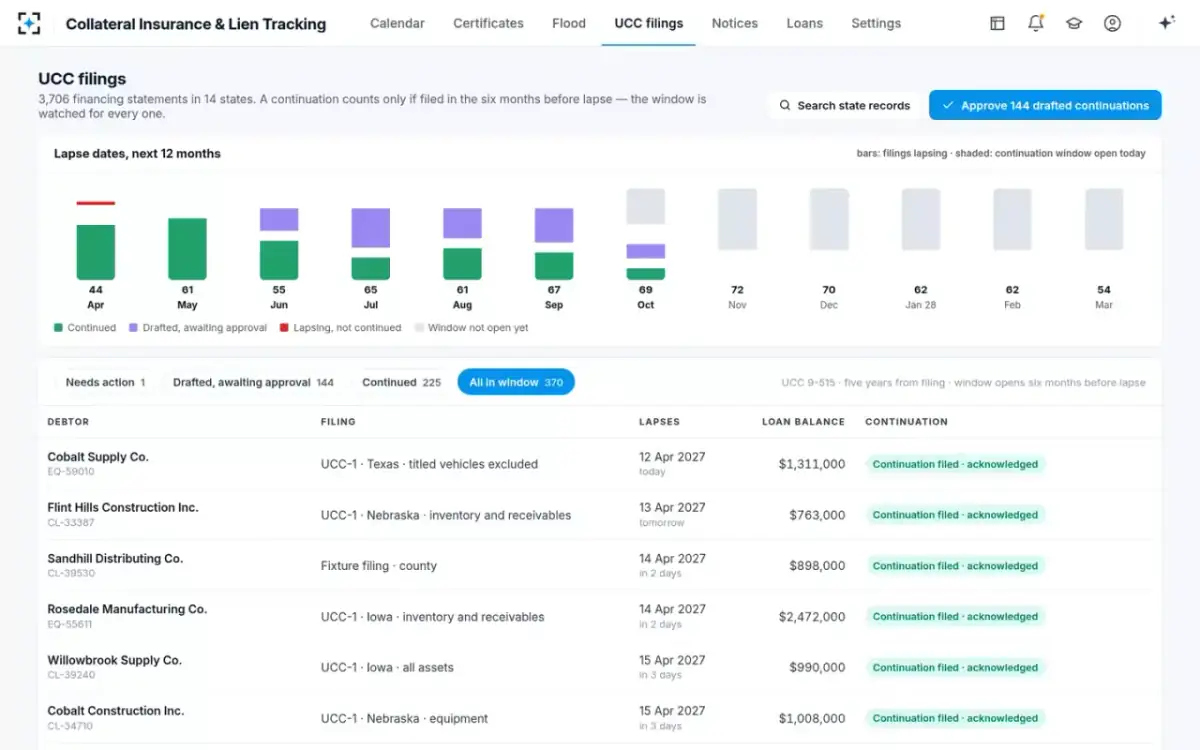
A continuation window missed. The lapse date in the loan system is a copy, keyed once at boarding, and if it is wrong the reminder fires in the wrong year or not at all. Nothing in the workbook is inconsistent; the date it holds simply is not the date the filing office holds. By the time anybody notices, the filing has lapsed and the window has closed. Where the lapse date comes from sets out the five ways the two dates drift apart.
How long each failure stays invisible, and what ends it
What a lapse costs: the unperfected lien and the capped penalty
On the lien side the consequence is structural rather than a fee. When a financing statement lapses, the security interest it perfected becomes unperfected, and § 9-515(c) adds that as against "a purchaser of the collateral for value" the interest is deemed never to have been perfected at all. A secured loan becomes an unsecured one, retroactively, and the loss is whatever the collateral was carrying. On a book where financing statements outnumber loans two to one, that is not a remote scenario; it is one date per filing, five years apart, with nothing in between to make anybody look.
On the flood side the penalty itself is capped and small: a civil money penalty under the flood statute "may not exceed $2,000 for each violation". The number that matters is the count, not the cap, and the assessment process and the arithmetic behind it belong to their own page. For a business case, the right use of the flood line is not the penalty total but the examination cost: findings, a corrective plan, and a desk that spends a quarter reconstructing dates it never kept.
Should a bank outsource insurance tracking?
It is a legitimate answer, and for a small book it is often the cheapest one. A tracking bureau receives the evidence, keys it, chases the agents and reports exceptions, usually priced per loan per month. What it buys is capacity; what it does not buy is relief. The interagency guidance on third-party relationships is explicit that using a third party does not reduce a bank's own responsibility for the activity, and that the monitoring of such a relationship runs for its whole duration rather than ending at selection (88 FR 37920). So the bank that outsources acquires a supplier to oversee as well as a job to stop doing.
Three questions decide it. Does the bureau read the documents or key them — because a bureau that keys has the same blind spot as the workbook, staffed differently. Does it work against your agreements or a template of standard requirements. And what comes back if you leave: documents and dates, or a report. The honest comparison is not bureau against software; it is all three options priced on the same lines, including the lines nobody quotes.
Three ways to do the job, priced the same way
Price all three the same way, on the same lines, or the comparison decides itself: a workbook has no licence line, so any case built on licence alone concludes that it is free. The table sets out what each option actually does, and the arithmetic under it is a shape rather than a quotation — the inputs are yours, and only one of them is published anywhere.
Three ways to do the job, priced on the same seven lines
| A spreadsheet | An outsourced bureau | An agentic desk | |
|---|---|---|---|
| Who reads the document | Nobody re-reads the wording. A person keys the dates and limits. | A keying team, usually against a standard requirement template. | Agents read every field and cite the page and position each value came from. |
| Where the requirement comes from | A column somebody filled in at boarding, if at all. | The template agreed at onboarding, updated by request. | The loan agreement itself, section by section, including amendments. |
| Who chases | The specialist, by email, when the conditional format turns amber. | The bureau, on its own schedule. | An agent, at the bank’s own lead times — 45 days, then 15. |
| Who drafts and who sends | The specialist does both. | The bureau drafts to its template; the bank usually sends. | An agent drafts with the clause cited; a person always sends. |
| What you pay | Nothing visible. Hours inside a salary line. | A fee per loan per month, plus the hours of overseeing it. | A licence, plus the half hour per exception that does not go away. |
| What you still own | Everything. | Everything — plus a supplier to monitor for the life of the relationship. | Everything, with the evidence for it in one place. |
| What happens when a clause is dropped | Nothing. No column changes. | Depends entirely on whether the template includes the wording. | A gap, cited to the agreement, with last year’s wording beside this year’s. |
Cost per loan per year, written out with every input named
Evidence handling
documents per loan per year × hours per document × fully loaded hourly cost
At the sample bank, about 5.25 hours by hand on a renewal that comes back short and far less on one that matches. The published median wage is the floor under the hourly cost, not the cost.
Loan operations
Lien upkeep
financing statements per loan × (minutes to confirm the date + minutes a year to watch the window)
3,706 filings across 1,846 loans is two per loan. Confirming a date against the filing office is a one-off; watching the window runs for five years.
Collateral analyst
Exposure you cannot see
probability × exposure, for each of the two failures a workbook cannot see
A dropped mortgagee clause met at a claim, and a lapsed financing statement met at a default. Both are rare per loan and neither is small when it lands.
Credit and compliance
Licence, fee or build
the line most business cases contain, and the only one a vendor quotes
Compare it against the sum of the other three, not against zero. A workbook has no line here and three large ones above it.
Vendor management
The comparison a workbook cannot make: this year's certificate against last year's
The numbers to measure before you change anything
Measure the current desk for one month before pricing any alternative, because the baseline is also the thing you will be judged against afterwards. Six counts are enough, and five of them can be got from the workbook and an inbox.
Documents received, and the share compared with an agreement. Not the share filed — the share where somebody opened the credit document and checked. On most desks this number is a shock, and it is the number the whole case rests on.
Renewals where the mortgagee wording was re-read. Separately, because it is the failure with the shortest path to a loss.
Open gaps, and their age in days. A desk with no aged list has gaps it has forgotten rather than gaps it has none of.
Financing statements whose lapse date has never been confirmed against the filing office. Count them. On a desk that keys lapse dates from a closing checklist, the honest answer is often all of them.
Placements per thousand loans. Every placement is a chase that did not work, so this is the cleanest measure of whether the front of the process is functioning.
Exceptions open past their review date. An exception is a decision to stay out of compliance on purpose; one that nobody revisits has become a policy change made by accident.
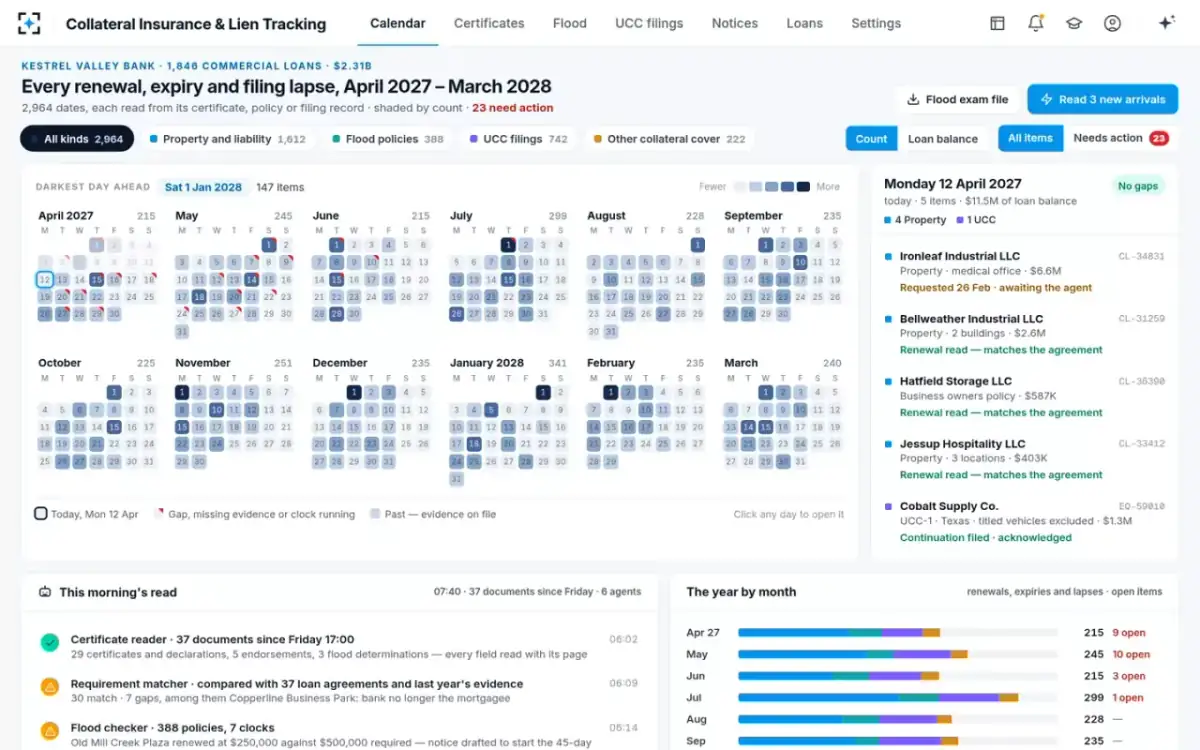
What replaces the workbook: twelve months of dates, each read from its document
Building the case: one page your finance partner will accept
Keep it to five paragraphs and resist the temptation to lead with efficiency, which is the weakest argument available and the easiest to dispute.
Open with the exposure. Two sentences: a financing statement that lapses leaves the bank unsecured retroactively against a purchaser of the collateral for value, and a certificate that renews without the mortgagee clause leaves the bank with no rights under the policy. Both are invisible on the current desk. Give the count of filings whose dates have never been confirmed, and the count of renewals where the wording was re-read.
Then the baseline. The six measures above, for one month, with the method stated. A finance partner will accept an estimate whose method is written down and reject a better number whose method is not.
Then the four cost terms, with your own inputs in them and the wage source cited. Show the licence line last and in proportion.
Then what stays with the bank. Whichever option is chosen, the responsibility for enforceable claims and monitored loans does not move, and the monitoring of any supplier runs for the whole relationship. Saying so first is more persuasive than being asked.
Close with what changes on the desk, in the specialist's own words rather than in percentages: the keying stops, the wording gets re-read every time, the lapse dates come from the states, and the half hour before a letter leaves the bank stays exactly where it is.
The lien side of the same case: every window, on one screen
The fair conclusion is not that spreadsheets are indefensible. A bank with ninety loans, one property each, one agent and no flood exposure can run a workbook well for years. The case changes with the number of buildings, the number of filings and the number of agencies, because each of those multiplies the reading and the workbook does none of it. To see what the reading looks like when something else does it, start from Collateral Insurance & Lien Tracking.
Questions people ask
Is a spreadsheet enough for certificate of insurance tracking?
It is enough to hold dates, and dates are the part that rarely goes wrong. It cannot hold what a certificate says about the mortgagee clause, the named insured, the deductible or the schedule of locations, because nobody keyed those and there is nothing to compare them with. A small single-property book can be run on a workbook for years; a book with multiple buildings per borrower, flood exposure and financing statements cannot, and the failures when it is tried are silent.
What should an insurance tracking spreadsheet contain?
A row per building rather than per loan, the exact mortgagee and loss payee wording from the last certificate so the next one can be compared, the agreement's section number beside each requirement, the deductible ceiling the covenant allows, and a separate sheet for financing statements keyed on the file number with a column recording where each date came from. That last column, filled in honestly, usually answers the question of whether the workbook can stay.
How many certificates can one person handle?
If the job is keying dates and limits, a specialist can work through around forty documents a day, which is the figure the sample bank started from. That is a ceiling on typing, not on tracking: re-reading the mortgagee wording against the agreement on each one is a different activity and takes far longer, which is why it is the step that quietly disappears when volume rises.
What does a tracking bureau actually do?
Receives the evidence, keys it, chases the agents of record and reports exceptions, usually for a fee per loan per month. Whether it reads the documents or only keys them is the question that decides its value, because a bureau that keys has the workbook's blind spot with a different payroll behind it. And outsourcing adds an obligation rather than removing one: the relationship itself has to be monitored for its whole duration.
What is the risk of tracking liens in a spreadsheet?
That the date in the sheet is a copy of a copy. A lapse date is set by the filing office and appears on its acknowledgment; the figure in most loan systems and workbooks was keyed once at boarding from a closing checklist, and a mistyped year is invisible because nothing else in the file disagrees with it. When the date is wrong the reminder fires in the wrong year, the continuation window closes unused, and the lien ends with no document anywhere recording that it did.
How do you build the business case for a tracking system?
Lead with the exposure rather than the hours: a lapsed financing statement leaves the bank unsecured retroactively against a purchaser of the collateral for value, and a renewal without the mortgagee clause leaves the bank with no rights under the policy. Then give a measured one-month baseline, four cost terms with your own inputs and the wage source cited, and what stays with the bank whichever option wins. The licence line goes last, in proportion to the other three.