A UCC lapse date is the day a financing statement stops being effective. Under U.C.C. § 9-515(a) a filed financing statement is effective for five years after the date of filing, and the filing office prints the resulting date on the acknowledgment it returns. That is the whole of it, and it is why the lapse date is not a fact the lender owns: the state sets it, from the record the state actually indexed, on the day the state actually indexed it. The field in the loan system is a copy — hand-keyed once, at boarding, usually from a closing checklist rather than from the acknowledgment. Botminds' Collateral Insurance & Lien Tracking takes every lapse date from the filing office acknowledgment and compares it with the one the loan system holds, which is how a date keyed a year late gets caught nine days before a lien ends instead of a year after.
The worked examples below come from a fictional sample bank as it runs through the solution: Kestrel Valley Bank, 1,846 commercial loans, $2.31 billion, and 3,706 financing statements in 14 states. The people, banks, borrowers and carriers are sample data. The law is real, and linked where it appears.
One financing statement, two lapse dates: the state's and the loan system's
- Five years of effectiveness, § 9-515(a)60 months
- Lapsed, had nobody filed a continuationfrom 21 Apr 2027
- Believed effective72 months — twelve of them wrong
What does the lapse date mean on a UCC filing?
It means the date on which the financing statement ceases to be effective, so that the perfection it provided ends. It is not a reminder, not an internal deadline, and not tied to the maturity of the loan: a seven-year equipment loan secured by a financing statement filed at closing is unperfected for its last two years unless somebody files a continuation. The date is arithmetic the filing office performs on the day it indexes the record, and it appears on the acknowledgment as a field of its own.
Two consequences follow immediately, and both are in § 9-515. The first is that the date moves only by a continuation, and only in one direction. The second is that nothing about the loan changes it — not an amendment, not a payment, not a renewal of the credit facility, not a new note. Lenders who assume that re-papering a facility re-papers its perfection are reading the loan file, not the filing index.
Where the date comes from, and who sets it
The filing office sets it, and the acknowledgment is the only document that states it with authority. The chain from closing to loan system has four hops, and the date can be lost at any of them.
First, a lawyer, a filing service or the bank's own collateral analyst submits the financing statement. Second, the office indexes it and assigns a file number and a file date — which is the date of filing for § 9-515(a), and not necessarily the date on the submission. Third, the office returns an acknowledgment carrying the file number, the file date and, in most states, the computed lapse date. Fourth, somebody keys a date into the loan system, often from a closing checklist prepared days before the filing was made.
Only the third of those four documents is authoritative, and it is the one least likely to be in the hands of the person doing the keying. A closing checklist is written in advance and says what the bank intended to file. The acknowledgment says what the state did file, and when.
Five years from what, exactly
Five years from the date of filing. Not from the closing, not from the date on the security agreement, not from the date the acknowledgment arrived in the post, and not from the date anybody keyed anything. A financing statement signed at a closing on 7 April and lodged with the office on 21 April is effective from 21 April and lapses on 21 April five years later.
There are two variations worth knowing. A financing statement filed in connection with a public-finance transaction or a manufactured-home transaction, and indicating that it is, runs for thirty years rather than five under § 9-515(b). And a timely continuation does not restart the clock from the day it is filed: under § 9-515(e), on timely filing "the effectiveness of the initial financing statement continues for a period of five years commencing on the day on which the financing statement would have become ineffective in the absence of the filing". The new lapse date is five years from the old one, to the day.
That sentence is the arithmetic most often got wrong, and it is got wrong in the safe direction once and the dangerous direction after that. A continuation filed four months early does not buy four extra months; it buys exactly five years from the original date. A bank that re-keys the lapse date as five years from the continuation has given itself a date that is up to six months late, and the six-month window in which the next continuation may be filed will have opened and closed before its tickler fires. The window itself — when it opens, what the office will reject — belongs to the continuation statement, and this page stays on the date.
Lapse, termination and release: three different ends to a filing
The words are used loosely on most desks, and they describe three unrelated events with three different owners. A lapse is the absence of an act; a termination and a release are acts by the secured party.
Four things that can happen to a financing statement, and who does each
| Event | Who files it | What it does to effectiveness | Can it be undone? |
|---|---|---|---|
| Lapse | Nobody. It happens on the calendar. | Effectiveness ends on the lapse date; the security interest becomes unperfected unless perfected some other way. | No. A new initial financing statement can be filed, but perfection dates from the new filing, not the old one. |
| Continuation | The secured party, inside the six-month window before lapse. | Carries effectiveness forward five years from the old lapse date, under § 9-515(e). | Not applicable. A continuation filed outside the window is simply ineffective (§ 9-510(c)). |
| Termination | The secured party, by a UCC-3 termination statement. | Ends effectiveness deliberately, from the moment it is indexed. | No. A terminated filing stays terminated; a fresh UCC-1 is the only route back. |
| Release of collateral | The secured party, by a UCC-3 amendment. | Removes some collateral from the filing. The filing stays effective, with its lapse date unchanged, for the rest. | Yes, in effect — collateral released in error can be added by a further amendment, but priority runs from the amendment. |
The row that matters for a tracking desk is the first one. Lapse is the only one of the four that no one chooses, no one signs and no one is notified of. The filing office does not write to say that a lien has ended. It simply stops returning the filing as active to anyone who searches.
Why the loan system's lapse date drifts from the state's
When a loan system's lapse date differs from the state's, it is almost always for one of five reasons, none of them exotic. They are worth listing because each has a different fix.
It was keyed from the closing checklist. The commonest and the quietest. The checklist carries the intended filing date; the office indexed the record a week or two later. The drift is days, and it is in the bank's favour, so nobody notices — until the same clerical habit produces a year.
The year was typed wrong. A single digit. There is no validation to catch it, because any date five years out looks reasonable in a field that nothing else reads.
The first filing was rejected and re-filed. The office rejected the original for a fee, a form or a missing address; the collateral analyst corrected and re-lodged it days or weeks later. The loan system kept the first date.
A continuation was filed and the date never moved. Or it moved to five years from the continuation rather than five years from the old lapse date — the § 9-515(e) error above.
An amendment was mistaken for a renewal. Collateral was added, a name was corrected, an address changed. None of those touch the lapse date, and a desk that treats "we filed something in 2024" as "the lien runs to 2029" is five years out.
The same financing statement, as two systems describe it
The Kansas acknowledgment: Tallgrass Leasing Company LLC — the exact name indexed in April 2022.
The loan system's collateral screen: The same name, keyed in 2022 and never re-checked against the state after the December 2026 name change.
The Kansas acknowledgment: 2022-0418877, assigned by the office.
The loan system's collateral screen: 2022-0418877 — the one field that always matches, and the one to search on.
The Kansas acknowledgment: 21 April 2022, 10:42, the moment the office indexed the record.
The loan system's collateral screen: Not what the lapse date was computed from: the field was keyed at boarding, a year out.
The Kansas acknowledgment: 21 April 2027, computed by the office under § 9-515(a).
The loan system's collateral screen: 21 April 2028 — a year late, keyed at boarding and never checked since.
The Kansas acknowledgment: None indexed against this file number.
The loan system's collateral screen: Blank, which reads the same as "not yet due".
The Kansas acknowledgment: What the state did, on the day it did it.
The loan system's collateral screen: What one person believed, on one day in 2022.
How do you reconcile UCC filings against the loan system?
By searching the filing office on the file number, not the debtor name, and comparing six fields per filing. Searching on the name is how a reconciliation misses exactly the filings it exists to find: a debtor that has changed its name, or an initial filing that carried a typographical error, will not come back under the name the loan system holds, and an empty result reads like a clean sweep. The file number is immutable, and it is on the acknowledgment.
The comparison itself is short. For each financing statement, take the file number, the date of filing, the lapse date, the exact debtor name as indexed, the secured party of record, and every continuation or amendment lodged against it. Then classify the filing into one of four verdicts, because each needs a different next step.
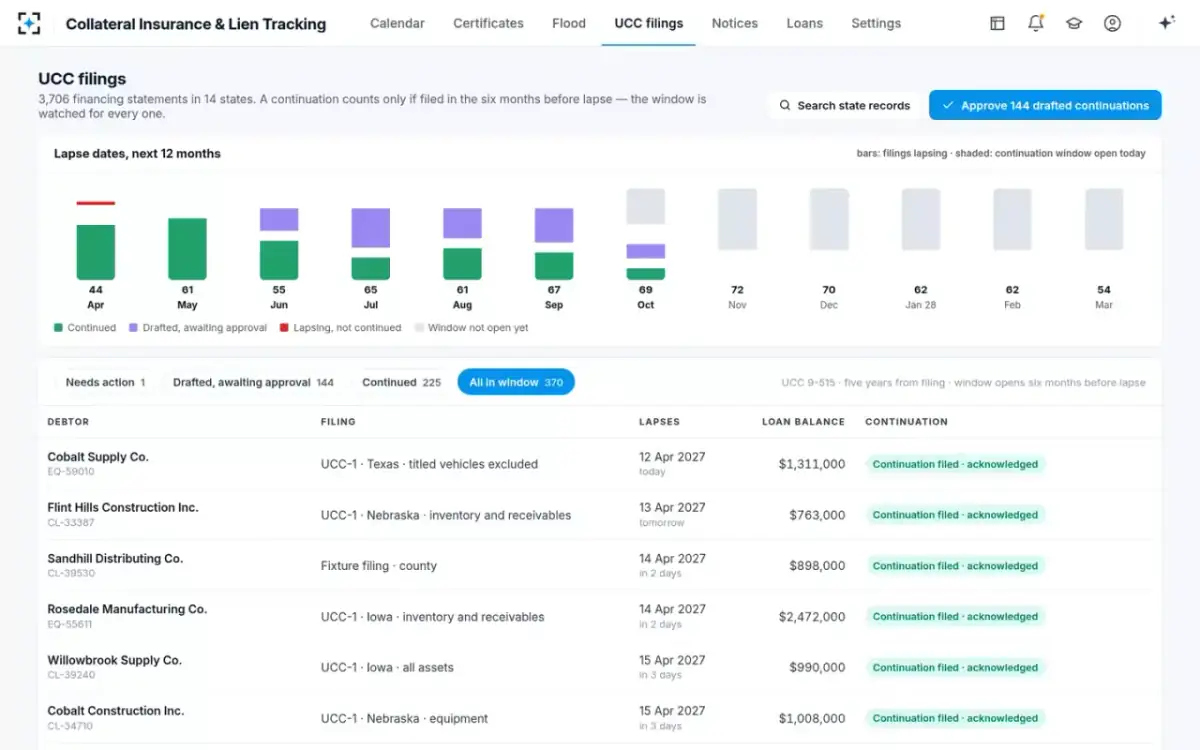
370 filings inside their continuation window on one Monday, by status
The verdicts that matter are the ones that need work. A filing whose dates differ by days needs the field corrected and nothing else. A filing whose dates differ by a year needs the window recomputed at once, because the real window may already be open or closed. A filing with no acknowledgment on file needs the state searched and the acknowledgment obtained, and until it is, the bank has a lien it cannot date.
A date keyed a year late, and the nine days it left
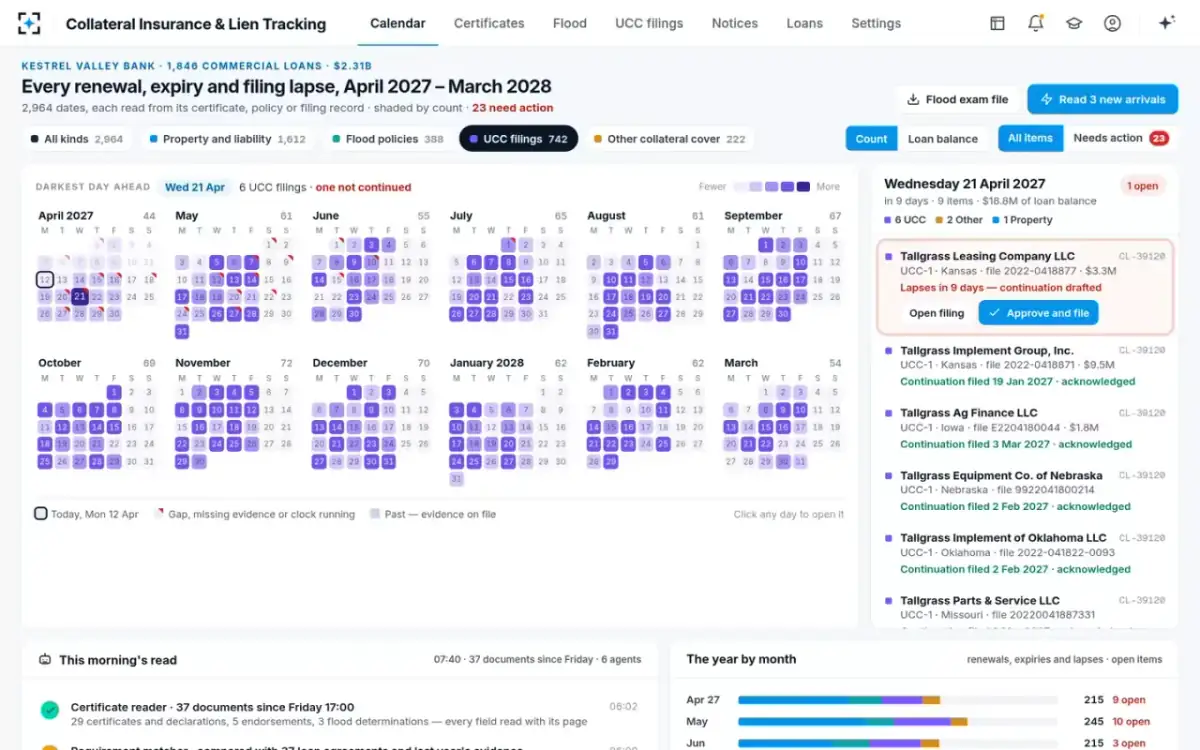
Monday 12 April 2027, 07:40. The calendar at Kestrel Valley Bank is switched from insurance to filings, and Wednesday 21 April darkens: six financing statements for the Tallgrass Implement Group relationship, all lodged together at closing in 2022. Five of the six were continued between 19 January and 3 March and acknowledged by Kansas. One was not.
The one that was not is file 2022-0418877, Tallgrass Leasing Company LLC. It lapses on 21 April 2027 — in nine days. The loan system shows 21 April 2028. Two separate faults had to line up for that filing to be the only survivor of its own closing, and in this file they did. The lapse date was keyed a year late at boarding, so the tickler that caught the other five was never going to fire. And the debtor had amended its articles on 14 December 2026 and become Tallgrass Equipment Leasing LLC, so a search of the filing index under its current name returned nothing: a filing that cannot be found under the borrower's name is also a filing nobody is reminded about. Why a name change does that, and what § 9-506(a) means by a statement that is "seriously misleading", is worked through on the debtor name change page.
The filing, its Kansas acknowledgment, and the date the loan system held
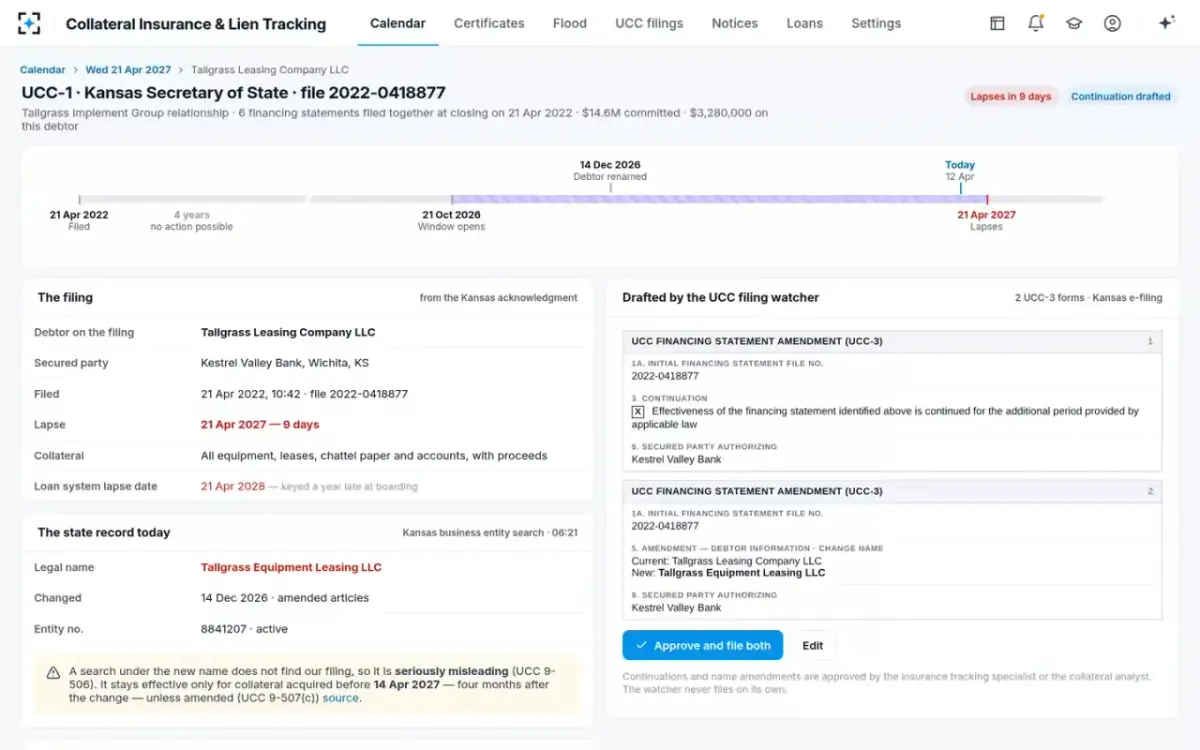
Both UCC-3s were drafted and approved the same morning, Kansas acknowledged both the same day, and the filing now lapses on 21 April 2032 — five years from 21 April 2027, exactly as § 9-515(e) provides. The nine days are the part worth noticing. Nine days is enough. The six-month window was still open, the office was still accepting the form, and the only thing that had been missing for five years was a comparison that takes a computer no time at all.
What lapse costs: unperfected, and retroactively so
The consequence is set out in § 9-515(c), and its second sentence is the one lenders underweight. On lapse the financing statement stops being effective and the security interest it perfected becomes unperfected, unless something else perfects it. And once unperfected on lapse, the interest is treated as never having been perfected at all against a purchaser of the collateral for value.
Read that as a lender. Lapse does not merely stop perfection going forward; against a purchaser of the collateral for value it unwinds perfection backwards, as though the five good years had not happened. A buyer who took the collateral in year three, when the filing was live, is treated as having taken it from an unperfected secured party. That is a very different exposure from "we are unsecured from Tuesday".
Nor can it be cured by acting quickly. § 9-510(c) is one sentence: a continuation statement not filed within the six-month period that § 9-515(d) prescribes is ineffective. A continuation lodged on the day after lapse is not late; it is nothing. The only route back is a fresh initial financing statement, which perfects from its own filing date and takes its place behind everyone who filed in the meantime — including, very often, the other lender who noticed the gap.
And the file is examined. The Interagency Guidelines Establishing Standards for Safety and Soundness ask an institution to keep loan documentation that makes its claim on the borrower legally enforceable and shows the loan being properly administered and monitored (12 CFR part 364, appendix A; the standard is quoted on what insurance tracking is). A lapse date that nobody has compared with the filing office in five years is hard to describe as monitoring, whatever the tickler report says.
The reconciliation as a standing control, not a project
Most banks reconcile their filings once, as a clean-up, and then return to the tickler that produced the mess. The reconciliation is worth more as a repeating check, because the two things that break a lapse date — a continuation filed and not reflected, and a debtor that changes its name — both happen after the clean-up is finished.
The six facts to hold for every financing statement, and the document each must come from
- File number
From the acknowledgment. It is the only key that survives a name change, and the only safe thing to search on.
- Date of filing
From the acknowledgment, not the closing checklist. This is the date § 9-515(a) counts five years from.
- Lapse date
From the acknowledgment, and re-derived after every continuation as five years from the previous lapse date.
- Debtor name exactly as indexed
From the acknowledgment, character for character, so a later state entity search can prove whether it still matches.
- Secured party of record
From the acknowledgment. After a merger or a portfolio purchase this is often a name the bank no longer uses.
- Every continuation and amendment
From the filing office index, searched by file number — not from the bank’s own copy of what it believes it sent.
Cadence matters more than depth. At the sample bank the state records are searched weekly for name changes, and the internal deadline for filing a continuation is set at 60 days before lapse, inside the statutory window with room for a rejection and a re-filing. Both are settings rather than fixed behaviour, and every change to them is saved as a new rule version with the person who made it — a bank that wants weekly searches and a 90-day internal deadline sets that instead.
Every continuation window in the book, on one screen
The day itself: six filings, five continued, one nine days out
The honest summary of this page is short. The lapse date is evidence, and evidence has a source document. If the source document for yours is a field in a loan system, you do not have a lapse date; you have a note somebody made at boarding, and the only way to find out whether it is right is to go and look. To see the comparison running across a whole book, start from Collateral Insurance & Lien Tracking.
Questions people ask
Is the UCC lapse date five years from the filing or from the acknowledgment?
From the filing. § 9-515(a) makes a financing statement effective for five years after the date of filing, which is the date the office indexed the record. The acknowledgment is the document that tells you what that date was, and in most states it prints the computed lapse date as well — but the acknowledgment's own arrival date has no legal significance at all.
What is the difference between a UCC lapse and a termination?
A lapse is what happens when nobody acts: the five years run out and effectiveness ends on the calendar. A termination is a deliberate act by the secured party, filed as a UCC-3, usually when the debt is paid. The practical difference is who knows about it. A termination is signed, dated and in the bank's own file; a lapse leaves no document anywhere, which is exactly why it is found late.
What happens when a UCC filing lapses?
The security interest it perfected becomes unperfected, unless it is perfected some other way — by possession or control, for instance. Worse, § 9-515(c) provides that as against a purchaser of the collateral for value the interest is deemed never to have been perfected, so the exposure reaches backwards over the whole life of the filing, not only forward from the lapse date.
Can the lapse date in a loan system be wrong?
Routinely, and in both directions. It is usually keyed once at boarding from a closing checklist written before the filing was lodged, so it drifts by days as a matter of course; a mistyped year, a rejected and re-filed statement, or a continuation whose effect was computed from the wrong starting point produce differences of a year. The only way to know is to search the filing office on the file number and compare.
How do you find the lapse date on a UCC filing?
Search the filing office's index on the file number from the acknowledgment. Many state offices offer an online search that returns the file date, the current status, the lapse date and every continuation or amendment lodged against the record. Searching on the debtor name instead is the common mistake: if the name has changed or was mis-indexed, the search returns nothing and the absence looks like good news.
How often should a lender check its UCC filings?
There is no prescribed frequency, so it is a matter of policy, and the two things that break a lapse date set the pace: a continuation lodged and not reflected, and a debtor that changes its name. Weekly searching of state entity records is a common setting where the book is large enough to carry a few name changes a month; the date comparison itself costs nothing once the acknowledgments are held, so there is little reason to do it less often than the filings move.