Force-placed flood insurance has one deadline everyone knows and several nobody counts correctly: if the borrower does not obtain flood insurance within 45 days after notification, the lender must purchase it. The 45 days run from the notice the lender sends on determining that a designated loan has no flood cover or not enough, not from the policy's expiry date, not from the day the certificate was filed, and not from a courtesy letter sent in advance. Everything that makes this hard sits either side of that span — the silent days before the determination, and the obligations that follow on day 46. Botminds' Collateral Insurance & Lien Tracking runs each clock from the day the bank knew, shows every one of them on a single screen, and drafts the placement for a person to approve.
The examples are a fictional sample bank, Kestrel Valley Bank, on Monday 12 April 2027. The borrowers, buildings and people are invented sample data; the rules and quotations are real and cited where they appear. This page follows the FDIC's text at 12 CFR part 339; the OCC, Board, FCA and NCUA rules are the same in substance at their own citations.
Force-placed flood insurance in 45 days: the clock, start to finish
The sequence has six moments, and only two of them are fixed by a calendar. The regulation states the core duty plainly: "if the borrower fails to obtain flood insurance within 45 days after notification, then the … institution or its servicer shall purchase insurance on the borrower's behalf", and the lender "may charge the borrower for the cost of premiums and fees incurred in purchasing the insurance, including premiums or fees incurred for coverage beginning on the date on which flood insurance coverage lapsed or did not provide a sufficient coverage amount" (12 CFR § 339.7(a)).
One loan's flood clock, drawn to scale
- Policy expires 3 Apr; determination made 5 Apr2 d
- Notice sent 5 Apr — the clock startsday 1–7
- Days 8–45, evidence may still arrive; purchase on 20 May if it does notto 20 May
- 30 days from the confirmation to terminate the placed policy and refund the overlapping premium30 d
Note what is not on that line. There is no grace period before the notice, no extension for a borrower who is negotiating with an agent, and no rule that lets a lender wait for a renewal it has been promised. There is also no second notice requirement: one notice, properly dated, starts and defines the whole period.
When does the 45-day clock start for force-placed flood insurance?
On the date of the notice the lender sends after determining that the building is uninsured or underinsured. The agencies describe the trigger as the determination itself: "when a lender makes a determination that the collateral securing the loan is uninsured or underinsured, it must begin the force placement process" (Interagency Q&A, Force Placement 1). The notice is expected to follow immediately.
"The Agencies expect that such notice will be provided to the borrower at the time of determination of no or insufficient coverage. If there is a brief delay in providing the notice, the Agencies will expect the lender or servicer to provide a reasonable explanation for the delay."
Interagency Questions and Answers Regarding Flood Insurance, Force Placement 2 (87 FR 32826, 31 May 2022)
That second sentence is the one to read twice, because it is where most real files live. On the sample desk, Copperline Building C's policy expired on 3 April and the notice went out on 5 April. Two days. That is exactly the "brief delay" the agencies contemplate, and the bank can explain it — the expiry fell on a Saturday and the determination was made on the next business day. But the explanation has to exist, and it has to be on the file with dates attached, not reconstructed from memory eighteen months later when an examiner asks why the notice is dated after the lapse.
A practical consequence follows for anyone designing the desk. The date that matters for the clock is the notice date; the date that matters for your exposure is the determination date; and the date that matters for your examiner is both, plus the lapse date, plus the distance between them. A system that stores only "notice sent" has thrown away two of the three.
Can a lender send the notice before the policy expires?
It can send one, and it still has to send another. The agencies are explicit that an advance letter is a courtesy and not the statutory notice.
"Although a lender may send notice prior to the expiration date of the flood insurance policy as a courtesy, the lender or servicer is still required to send notice upon determining that the flood insurance policy actually has lapsed or is insufficient in meeting the statutory requirement."
Interagency Questions and Answers Regarding Flood Insurance, Force Placement 4 (87 FR 32826, 31 May 2022)
This is the most expensive misunderstanding in the whole area, because the mistake looks like diligence. A bank with good renewal habits sends a reminder 45 days before expiry, the borrower does nothing, the policy lapses — and the desk believes the clock has already run and that it may place on the expiry date, or worse, believes the reminder discharged the obligation and nothing more is owed. Neither is true. The clock begins again, properly, on the post-lapse notice.
The same answer carries a second point that works in the lender's favour: "the lender may purchase insurance on the borrower's behalf beginning on the date of the lapse." The purchase happens on day 46, but the coverage it buys, and the premium the borrower may be charged for, can reach back to the day the cover actually stopped. Advance notices are still worth sending. They are just not the notice.
Two clocks on the same loan: the bank's renewal lead times, and the regulation's
The bank's own lead times (settings): 45 days before expiry: a renewal request to the agent of record.
The flood regulation: Nothing. No duty arises until a determination of no or insufficient coverage.
The bank's own lead times (settings): 15 days before expiry: a second request, to the agent and the borrower.
The flood regulation: Still nothing. A courtesy notice before expiry does not satisfy the requirement.
The bank's own lead times (settings): The renewal is overdue; the loan moves to the exceptions list.
The flood regulation: Determine whether the loan is now uninsured or underinsured — this is the trigger.
The bank's own lead times (settings): Chasing letters may already have gone to agent and borrower.
The flood regulation: The statutory notice goes at the time of determination. Day 1 of 45.
The bank's own lead times (settings): Nothing in the bank’s own policy requires a purchase.
The flood regulation: The lender shall purchase, and may charge premiums back to the date of lapse.
Day 46: what the lender must have done, and what it may charge
On day 46 the duty is not to decide; it is to have purchased. If no evidence of adequate cover has arrived, the lender shall purchase insurance on the borrower's behalf. The agencies allow a narrow tolerance for operational reality, and they describe the kind of reason they will accept.
"If the borrower fails to obtain flood insurance and the lender does not force place flood insurance by the end of the force placement notification period," the Q&As state, "the Agencies will expect the lender to provide a reasonable explanation for the brief delay, for example, that a lender uses batch processing to purchase force-placed flood insurance policies" (Force Placement 5). Batch processing is the named example; "we were short-staffed in May" is not.
What the lender may charge is set out in the same section of the regulation as the purchase duty: the cost of premiums and fees incurred in purchasing the insurance, including premiums or fees for coverage beginning on the date the cover lapsed or became insufficient. In other words the borrower can be charged for the gap period, not only from day 46 forward. This is one of the few places where moving slowly costs the bank rather than the borrower, because the bank has carried an uninsured building through the whole span.
Underinsured, not uninsured: force placing only the shortfall
Most of the hard cases are not blank files; they are policies that exist and are too small. A borrower renews at $250,000 on a building whose required amount is $500,000, and the loan is now a designated loan with insufficient coverage. The force-placement process begins on exactly the same terms as a total lapse — the same determination, the same notice, the same 45 days — but what the lender buys at the end of it is the difference, not a whole new policy.
Two practical traps live here. The first is that the required amount has to be worked out correctly before anyone can say a policy is short; a desk that uses the wrong test will send notices it cannot justify, and miss shortfalls it should have caught. How much flood cover a lender must require is a three-part test, and the two-part shorthand in common circulation gets the wrong answer on small buildings. The second is that a shortfall is easy to create accidentally: an increase in the loan balance, a new building added to the collateral, or an insurer's own reduction at renewal all move the required amount or the coverage without anyone deciding anything.
Determination to purchase: who does what in Collateral Insurance & Lien Tracking
Agent
Flood checkerReads the determination and the policy, works out the required amount for each building, and compares it with the cover in force.
Never: Never force-places. It drafts the request and waits.
Agent
Notice drafterDrafts the borrower notice with the building, the zone, the required amount and the shortfall, citing the determination behind it.
Never: Never sends. Nothing leaves the bank unapproved.
A person decides
Flood compliance officerConfirms the determination, reads the draft and sends the notice. The 45 days start on this date.
Agent
Flood checkerRuns the clock day by day, watches for evidence arriving, and drafts the placement request as day 45 approaches.
A person decides
Loan servicing managerApproves the force-placement, with the amount and the effective date, and the file carries his approval.
Agent
Flood checkerOn evidence of adequate cover, drafts the termination and the refund calculation for the 30-day window.
Never: Never terminates a placed policy or issues a refund on its own.
What stops the clock, and the 30-day refund that follows
Evidence stops it. A borrower who delivers proof of adequate cover on day 44 has complied, and no placement follows; the file should show what was received and when. If a policy has already been placed and the borrower then produces confirmation of its own cover, a second obligation begins immediately: within 30 days of receiving confirmation, the institution or its servicer must notify the insurance provider to terminate the purchased policy and "refund to the borrower all premiums paid by the borrower for any insurance purchased by the … institution or its servicer" for the period of overlap (12 CFR § 339.7(b)(1)).
The confirming document matters too, and the regulation names it: the institution "shall accept from the borrower an insurance policy declarations page that includes the existing flood insurance policy number and the identity of, and contact information for, the insurance company or agent". A desk that insists on a full policy copy before it will unwind a placement is refusing a document the rule requires it to accept — and is accruing a refund obligation while it argues.
Two housekeeping points follow. Overlapping-period refunds are calculated from dates, so the placed policy's effective date has to be right, which is another reason the lapse date must be the real one. And a borrower who produces a policy that is adequate but dated later than the lapse leaves a genuine gap in the middle: the placement is terminated prospectively from the borrower's effective date, and the lender's charge for the earlier period stands.
The gap no rule covers: lapse to determination
Everything above is governed. The one span that is not governed is the one that does the damage: the days between the moment cover actually stops and the moment the bank determines that it has. No regulation sets a maximum. The agencies' only lever is the expectation that a notice follow the determination promptly and that a delay be explainable, which assumes the determination itself happened on time.
On a desk that works from renewal diaries, that span is as long as the diary interval — if the loan is reviewed when the next certificate arrives, a mid-term cancellation for non-payment can sit undetected for months. On a desk that works from the documents, it is as long as it takes to read the mail. The sample bank's two days from the Saturday lapse to the Monday determination is at the short end of what a manual desk achieves, and it is still two days of an uninsured building in Zone AE.
Examiners measure this indirectly but reliably, by asking for the lapse date, the determination date and the notice date on a sample of files and looking at the spread. A bank whose spread is consistently one or two days has a monitoring process. A bank whose spread is forty days has a diary.
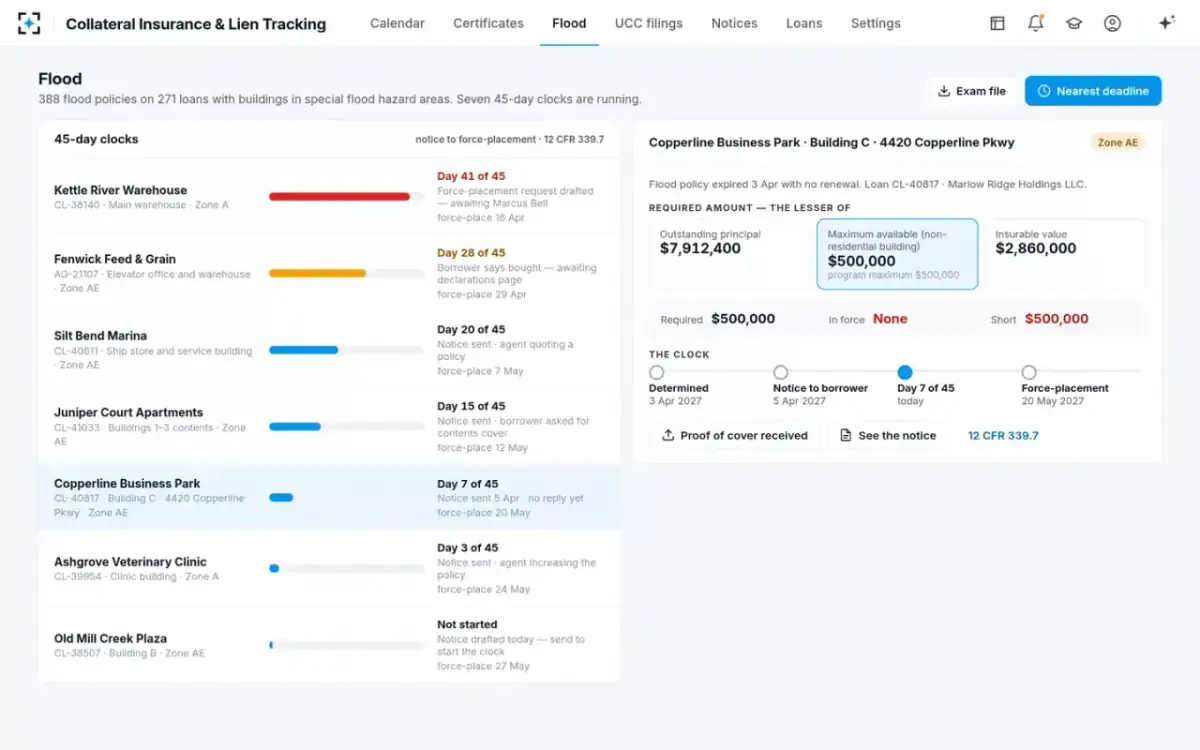
Every running flood clock, with the day each one is on
Remapping: the day a loan becomes a designated loan
A loan can acquire a flood obligation without anybody touching it, when the Federal Emergency Management Agency remaps the area and a building that was outside a special flood hazard area is suddenly inside one. The agencies answer the timing question directly: "when a lender or its servicer receives advance notice that a property will be remapped into an SFHA, the effective date of the remapping becomes the date on which the lender or its servicer must determine whether the property is covered by sufficient flood insurance" (Force Placement 16).
So the determination date is the map's effective date, not the day the bank got around to reviewing the map change, and the 45 days run from the notice that follows it. The operational implication is that map changes have to be watched as events in their own right and matched against the collateral schedule — a job that is invisible on a desk organised around renewal dates, because no renewal date moves when a map changes.
The reverse case is worth knowing too. A building remapped out of a hazard area no longer requires flood insurance under the Act, but the loan agreement may still require it, and a placed policy should not be cancelled on the strength of a map alone.
Who may press the button, and what the file has to show afterwards
Force-placement is a decision with consequences for the borrower — a premium the borrower did not choose, charged back to it, and a conversation the relationship manager will have to have. It should be approved by a named person with the authority to make it, from a file that already contains the evidence. On the sample desk that is the loan servicing manager, and the request reaches him already drafted: building, zone, required amount, shortfall, the dates of the lapse, determination and notice, and what the borrower said if anything.
The seven dates one force-placement file has to carry
- The determination date, and the form behind it
The standard flood hazard determination form for the building, with the finding that the loan is a designated loan.
- The date cover lapsed or became insufficient
From the policy or the carrier’s cancellation notice — not the date the bank noticed.
- The date the bank determined there was no or insufficient cover
With an explanation if it is not the same day as the lapse. This is the gap an examiner measures.
- The notice date
Day 1 of 45, and the date every other deadline is counted from. Keep evidence the notice was sent.
- Day 45, and the purchase date
If the purchase is later, the reasonable explanation goes on the file at the time, not afterwards.
- The effective date of the placed cover
It may reach back to the lapse. It drives both the charge to the borrower and any later refund.
- The date confirmation of the borrower’s own cover arrived
It starts the 30 days to terminate and refund. A declarations page is sufficient confirmation.
The drafted notice, with the determination and the shortfall cited
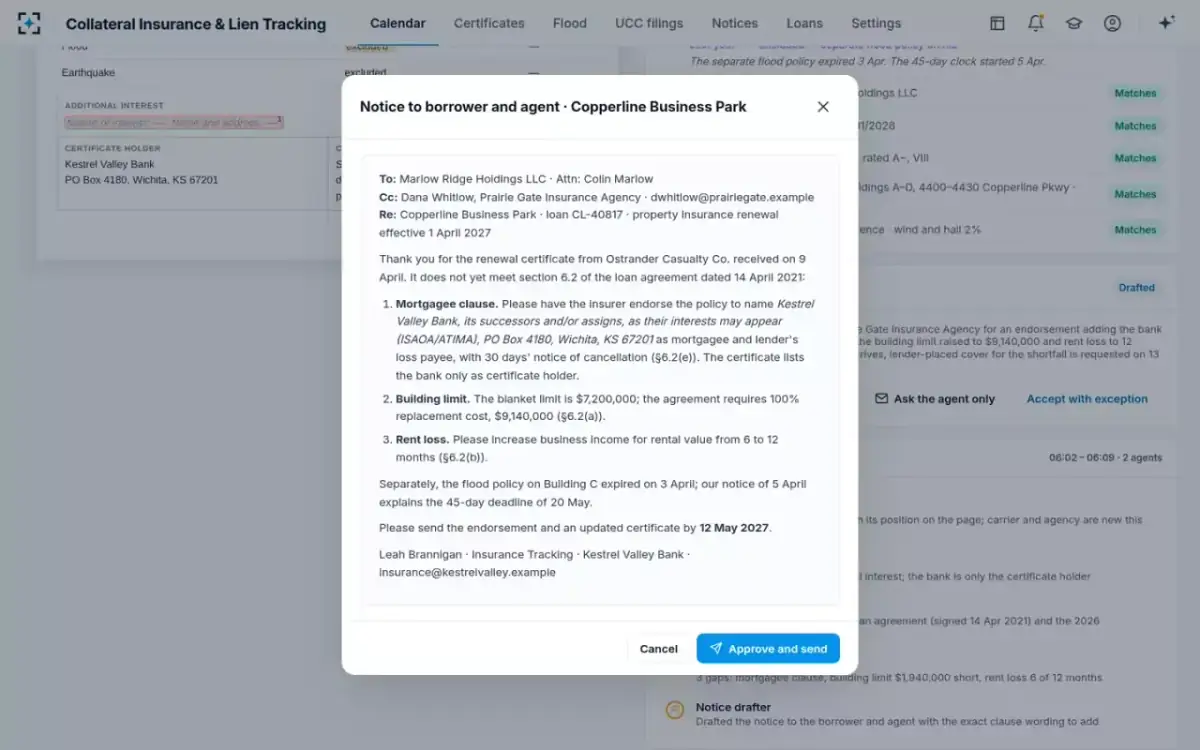
Notices and requests waiting for a person
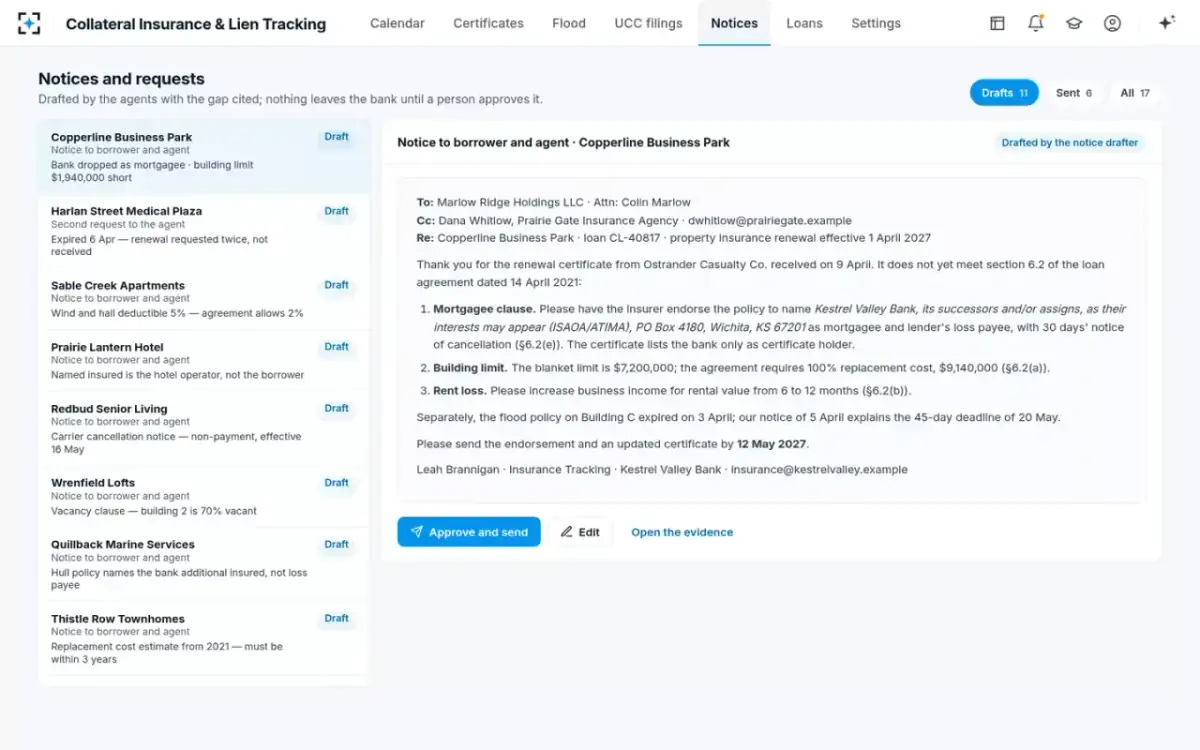
The adjacent question — what a lender may place on non-flood collateral, and under what rules — is a different regime with different notices: when a lender may place collateral protection insurance covers it. To see the clocks, the drafts and the dated file together, start from Collateral Insurance & Lien Tracking.
Questions people ask
What is the 45-day letter for flood insurance?
It is the notice a lender sends after determining that a designated loan has no flood insurance or not enough. It tells the borrower what cover is required, that the borrower has 45 days to obtain it, and that if the borrower does not, the lender will purchase cover at the borrower's expense. Its date is day one of the 45, so it is also the single most important date in the file.
What happens if the borrower provides proof on day 44?
No placement follows. The borrower has complied inside the period, and the file should show the document received and the date. If the proof shows cover that is adequate but began after the lapse, the gap in the middle remains real, and the lender may still have placed cover for that earlier period and charged for it. A declarations page with the policy number and the insurer's contact details is a document the lender must accept as confirmation.
Does the lender have to refund force-placed premiums?
Yes, for any overlapping period, and quickly. Within 30 days of receiving confirmation of the borrower's own coverage, the lender or servicer must notify the insurer to terminate the placed policy and refund to the borrower all premiums paid for the period in which both policies were in force. The 30 days run from receipt of the confirmation, not from the termination.
Can a lender charge the borrower for the lapse period?
Yes. The regulation allows the lender to charge the cost of premiums and fees for the purchased insurance, including coverage beginning on the date flood insurance lapsed or became insufficient. The purchase may happen on day 46, but the cover bought — and the charge — can reach back to the lapse itself.
What happens if the bank misses the force-placement date?
The agencies expect a reasonable explanation for a brief delay, and name batch processing of placements as the kind of reason they have in mind. A long or unexplained delay is a different matter: the lender has failed to purchase when required, and failures of this kind are cited and penalised. The remedy is to place as soon as the miss is found and to put the explanation on the file with its date.
Who can approve a force-placement at a bank?
No rule names a title; the bank's own procedure should. Because the decision charges a borrower for a policy it did not buy, the sensible structure is approval by a servicing or compliance manager with the file in front of them — the determination, the lapse, the notice, the dates and the amount — rather than by whoever runs the clock. Separating the person who detects the shortfall from the person who authorises the placement is also what makes the dated record credible at an exam.