Insurance tracking is the loan operations work of making sure every commercial loan's collateral stays insured the way the loan agreement requires, for as long as the loan is outstanding. In practice it means chasing renewal evidence out of hundreds of insurance agents, reading each certificate and policy against the agreement that governs it, running the flood clocks that federal regulation imposes, and — usually on the same desk — keeping the bank's UCC financing statements effective so the lien behind the insurance is still worth having. It is hard because the evidence arrives as thousands of unstructured documents a year and every one of them has to be read against a different contract. Botminds' Collateral Insurance & Lien Tracking is software for that desk: agents read each document field by field, compare it with the agreement and last year's evidence, and draft the notice or the filing, while the people keep every decision.
The desk in the examples below is a fictional sample bank running through the solution — Kestrel Valley Bank, 1,846 commercial loans, $2.31 billion, four named people. The bank, the borrowers, the carriers and the people are invented. The rules, the wage data and the regulatory quotations are real and cited where they appear.
What is insurance tracking? A working definition
A useful definition has three parts, and most published answers only give the first. Insurance tracking is (1) confirming that required coverage exists, (2) confirming that it is the coverage the agreement actually demands, and (3) doing both continuously, for the life of the loan, with a record of when the bank knew what. Part one is a date in a field. Part two is a reading job. Part three is the reason a tracking desk exists at all rather than a reminder in a diary.
Consumer mortgage servicing and commercial loan servicing mean slightly different things by the term. On a consumer mortgage, tracking usually means hazard and flood coverage on a single dwelling, often with an escrow account paying the premium. On a commercial loan it means a schedule of buildings, equipment and inventory; property, liability, business income, builder's risk and flood policies from several carriers; required clause wording; per-location limits; deductible caps; insurer rating floors; and a borrower who pays its own premiums directly. The commercial version is the one with no escrow account to tell the bank that a premium went unpaid.
It is also the version where the evidence itself is weak. A certificate of insurance summarises a policy; it is not the policy, and it cannot give the bank rights the policy does not contain. Confirming coverage exists and confirming the bank is protected by it are two different checks — certificate holder versus mortgagee is where that distinction decides whether a bank gets paid.
The four jobs hiding inside one title
Ask four banks what their insurance tracking team does and you will get four answers, because the title covers four jobs with different skills, different deadlines and — this is the part that matters — different legal footing.
Four jobs, one title: what each is, and what actually requires it
| The job | What it is, day to day | The rule or practice behind it |
|---|---|---|
| Chasing evidence | Asking the agent of record, then the borrower, for renewal certificates, declarations pages and endorsements before expiry — and again after it. | The loan agreement’s insurance covenant. It is a contract duty the bank wrote for itself; nothing outside the agreement sets a date. |
| Reading evidence | Checking named insured, clause wording, limits per location, deductibles, the schedule of locations, insurer rating and the policy term against the agreement and last year’s document. | Also the agreement — plus safety-and-soundness expectations about documentation and monitoring. |
| Running the flood clocks | Determinations, notices, the 45 days to force-placement, the required amount per building, refunds, and the dated record of each step. | Federal regulation. The Flood Disaster Protection Act and 12 CFR part 339 (and its sister rules at the other agencies) set the steps and the deadlines. |
| Keeping liens perfected | Watching every financing statement’s five-year life, filing continuations inside the one window that counts, and catching debtor name changes. | Article 9 of the Uniform Commercial Code, § 9-515: a filed financing statement is effective for five years from the date of filing, and lapses unless it is continued. |
The asymmetry in that table explains most of what goes wrong. The two jobs with hard external deadlines — flood and Article 9 — are the two that produce penalties and unsecured losses, and they are the two that look least urgent on a Tuesday morning, because nothing arrives in the inbox to prompt them. The two jobs with no external deadline generate all the day's traffic: the certificates keep coming, and reading them feels like the work.
Why do banks track insurance on loans at all?
Because the collateral is the bank's second way out of the loan, and an uninsured building is not collateral. A $9 million warehouse that burns is worth the land under it; a loan advanced against the building becomes, overnight, an unsecured claim on a borrower who has just lost its premises. Insurance tracking exists to keep the second way out intact for the whole term, not only on the day of closing when a lawyer read the policy.
Supervisors say the same thing in the language of documentation. The interagency safety-and-soundness standards require that an institution's loan documentation practices "ensure that any claim against a borrower is legally enforceable" and "demonstrate appropriate administration and monitoring of a loan" (12 CFR part 364, appendix A, II.C). Those two phrases are doing a great deal of work on a tracking desk: a mortgagee clause that was never endorsed, and a continuation that was never filed, are each a failure of exactly that standard, discovered at exactly the wrong moment.
There is also a purely commercial reason. The alternative to tracking is force-placement or lender-placed coverage, which is slow, expensive, narrow in what it covers, and damaging to the borrower relationship. Every renewal caught early is a placement avoided.
Is a lender required to monitor coverage for the life of the loan?
On flood, the honest answer is that no rule says so in terms — and that nearly every lender does it anyway. The agencies put it on the record in their flood questions and answers.
"Although there is no explicit duty to monitor flood insurance coverage over the life of the loan in the Act or Regulation, for purposes of safety and soundness, many lenders monitor the continuous coverage of flood insurance for the building or mobile home and any personal property securing the loan."
Interagency Questions and Answers Regarding Flood Insurance, Force Placement 15 (87 FR 32826, 31 May 2022)
Read that carefully, because it is widely misquoted in both directions. It does not say monitoring is optional in practice. The obligations that do bite — the requirement that adequate flood insurance be in place when a designated loan is made, increased, extended or renewed, and the force-placement duty that follows a determination of insufficient coverage — are unforgiving, and a lender who is not monitoring will discover a lapse too late to run the clock properly. The answer is better read as an explanation of why monitoring is universal rather than a licence to stop.
Outside flood, the duty comes from the loan agreement, which usually requires the borrower to maintain the coverage and to furnish evidence on request. That is a contract right, not a self-executing control: the bank still has to exercise it, document that it did, and act when the answer is unsatisfactory. This is precisely the gap between a covenant and a control that examiners probe.
The desk, seat by seat: specialist, collateral analyst, flood officer, servicing manager
At a mid-sized commercial bank the four jobs sit in four seats, sometimes in four different reporting lines. The split below is the sample bank's, and it is a common one.
Four seats on one desk, in Collateral Insurance & Lien Tracking
Today
Keys dates and limits from about 40 certificates a day. A certificate tells her a policy exists, not that the bank is still named on it.
With agents
Starts from a document already read, with every difference cited to the clause it breaks, and approves the drafted notice.
Still theirs: Every notice that leaves the bank, and the judgement about what is a real gap.
Today
Holds financing statements in 14 states and has to remember each one for five years to catch it inside a six-month window.
With agents
Sees every filing’s window open and close, with lapse dates taken from the state’s own acknowledgment and names re-checked weekly.
Still theirs: Filing. Nothing is filed with a state office without her approval.
Today
Owns determinations and 45-day clocks, and has to prove to an examiner the day the bank knew, for every building.
With agents
Watches every running clock on one screen, each with the day it is on, and the dated file assembles itself as the work happens.
Still theirs: The determination, and the decision that a placement is warranted.
Today
Signs force-placements and accepts exceptions, and has to gather the certificate, the agreement and the dates before he can.
With agents
Sees each requirement, the evidence behind it and the whole timeline on one page before he approves.
Still theirs: Approval of every placement and every exception, with a reason on the file.
Smaller banks collapse the four into one or two people, and that is where the quiet failures start. A specialist who also owns UCC filings will always serve the inbox first, because the inbox is noisy and a lapse date four years away is silent. A flood officer who also chases certificates will answer the borrower who is on the phone before the clock that is on day 41.
A week on the desk, in documents
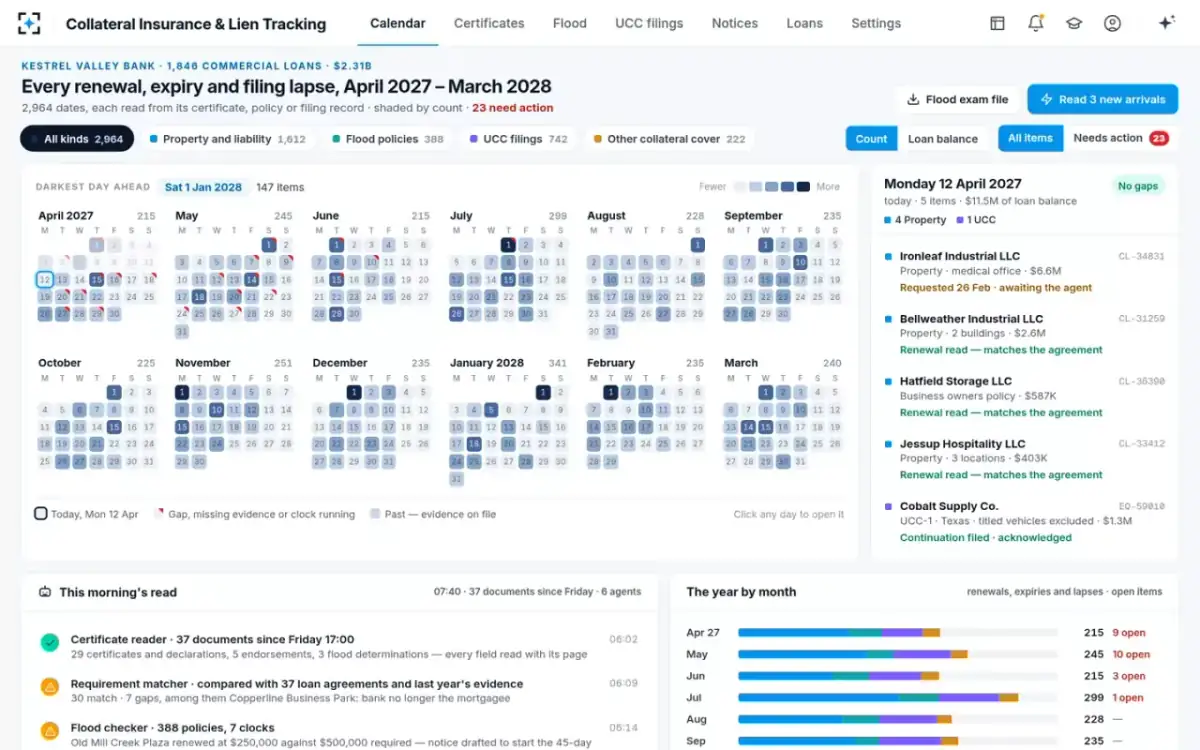
The volume is the reason the job resists discipline. On the sample book, 37 insurance documents arrived between Friday evening and Monday morning — certificates, declarations pages, endorsements and flood determinations. Thirty matched their agreements. Seven did not. Across the year the same book carries 2,964 dated events: renewals, policy expiries and filing lapses, each one read from the document that establishes it rather than typed into a field at boarding.
Twelve months of renewals, expiries and filing lapses on one calendar
Where does the time go on one renewal? The sample bank's own estimate for a single commercial property renewal that comes back short is about 5.25 hours by hand, and most of it is not reading. Chasing the agent takes an hour and a half. Keying dates and limits takes three-quarters of an hour. Checking the wording and limits against the agreement and last year takes another hour and a half, drafting the borrower and agent notice an hour, and review and sending half an hour.
One renewal that comes back short: where 5.25 hours go
By hand
- Chasing the agent · 1.5 h · 29%
- Keying · 0.75 h · 14%
- Checking wording and limits · 1.5 h · 29%
- Drafting the notice · 1 h · 19%
- Review and send · 0.5 h · 9%
Two-fifths of that is chasing and keying. The hour and a half of real analysis is squeezed between them, and it is the first thing to be shortened when forty certificates arrive on a Monday.
Where insurance tracking ends and escrow administration begins
The two are often confused because both watch a policy, but they answer different questions and usually sit in different teams. Escrow administration is about money: collecting monthly, holding it, paying the premium and the taxes when they fall due, and analysing the account for shortages and surpluses. Insurance tracking is about adequacy and evidence: does coverage exist, is it the coverage the agreement requires, and is the bank named in it.
An escrowed loan gets one tracking benefit free — the bank pays the premium, so the bank knows it was paid. Commercial loans are rarely escrowed, so the bank learns about non-payment only if its mortgagee clause earns it a cancellation notice, which is another reason the clause matters more than the expiry date.
The other neighbouring function is collateral administration: the files, the searches, the filings and the releases. On many desks it is the same person, and in this solution it is deliberately the same screen, because the two questions a loan officer actually asks on a problem credit are "is it insured" and "is the lien good". Only one of those is an insurance question.
What the desk owns that nobody outside it can see
Insurance tracking is invisible when it works, which has a predictable staffing consequence. The occupational data shows an under-pressure clerical function: the U.S. Department of Labor's occupation for insurance claims and policy processing clerks — the closest national match to the keying half of this desk — records 239,100 people employed in 2025 at a median wage of $49,230, with employment projected to decline over the decade (O*NET OnLine 43-9041.00).
The clerical half of the desk, nationally
239,100
insurance claims and policy processing clerks employed in the United States, 2025
$49,230
median annual wage for the occupation in 2025, or $23.67 an hour
Decline
projected change in employment for the occupation, 2025–2035
A shrinking clerical pool against a growing document volume is a problem a bank solves in one of three ways: by hiring, by outsourcing to a tracking service, or by automating the reading. The third is the only one that also improves the second job on the list, because an outsourced tracker keys dates from the same certificate the bank's own clerk would have keyed.
What the desk owns that nobody sees is the set of dates that never became events: the renewal that arrived short and was corrected before expiry, the continuation filed in the fourth month of its window, the flood policy renewed at the right amount because somebody read the determination. None of those appear in any report. The failures appear in all of them.
What good looks like: five things a reviewer should be able to see in an hour
Whether you manage the desk, audit it or are buying software for it, the same five things separate a tracking function that works from one that merely keys dates. Each should be visible in an hour, from a desk, without asking anyone to assemble anything.
Five things a reviewer should be able to see in an hour
- Every date, traced to the document it came from
Not the loan system field. Ask where one expiry date came from and expect the certificate, the page and the position — and for a filing, the state’s own acknowledgment.
- A list of loans where the bank is not in the right clause
If the desk can only report expired policies, it is tracking dates and not coverage. A clause report is the test.
- Every flood clock, with the day each one is on
Not a list of lapsed policies: a list of running clocks, each with its determination date, notice date and the day force-placement falls due.
- Every financing statement’s window, open and closed
Five-year lives, the six-month window to continue, and what the state acknowledgment says — plus any debtor whose name has changed.
- Exceptions, each with a reason and a review date
Accepting a gap is a decision. It should name who accepted it, why, and when it will be looked at again.
One loan, requirement by requirement, with the evidence behind each
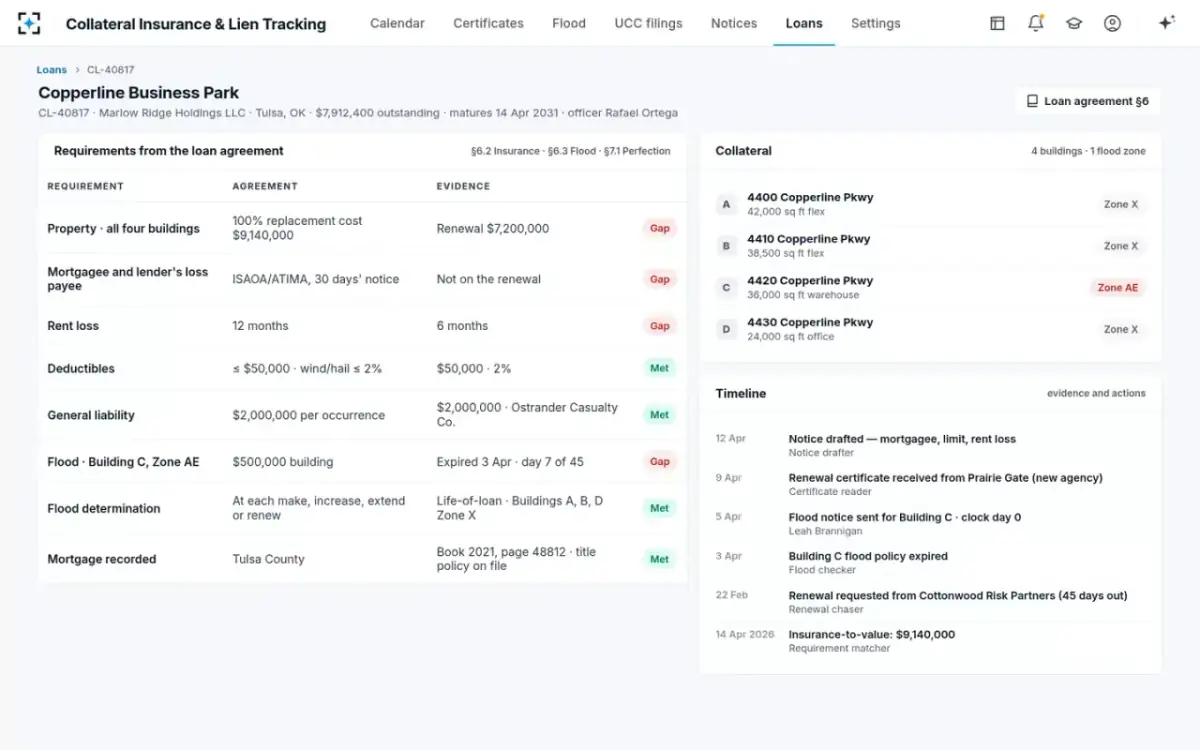
The flood half of the desk has the hardest deadlines and the clearest rules, and it is worth learning separately: how the 45 days to force-placement are counted and how much flood cover a lender must require are the two questions that produce most of the violations examiners cite. To see the four jobs on one screen, start from Collateral Insurance & Lien Tracking.
Questions people ask
What does an insurance tracking specialist do?
Chases renewal evidence from insurance agents and borrowers, reads each certificate, declarations page and endorsement against the loan agreement that governs it, keys or confirms the dates and limits, drafts the letters that go out when something is short, and escalates the gaps that need a credit decision. On a commercial book the reading is the skilled part: named insured, clause wording, per-location limits, deductibles and the schedule of locations all have to match a contract that was negotiated loan by loan.
What is the difference between insurance tracking and escrow administration?
Escrow administration handles the money — collecting, holding and paying premiums and taxes, and analysing the account for shortages. Insurance tracking handles adequacy and evidence — whether required coverage exists, whether it matches the agreement, and whether the bank is named in it. An escrowed loan gets a tracking benefit free, because the bank pays the premium and therefore knows it was paid. Commercial loans are rarely escrowed, which is why lapses there surface late.
Who tracks UCC filings at a bank?
Usually a collateral analyst or loan documentation specialist in loan operations, often on the same desk as insurance tracking. The work is driven by Article 9: a financing statement is effective for five years from filing, and a continuation counts only if it is filed in the six months before lapse. Lapse dates should come from the filing office's acknowledgment rather than from a field keyed at boarding, which is where a year-out error typically hides.
What happens if a bank does not track collateral insurance?
Three distinct consequences. The credit one: a loss on uninsured or underinsured collateral turns a secured loan into an unsecured claim. The regulatory one: flood violations are assessed against lenders who miss determinations, notices or placements, and they are among the most frequently cited consumer compliance violations. The supervisory one: documentation practices that fail to demonstrate appropriate administration and monitoring of a loan are themselves a finding, whether or not anything was lost.
What is a tickler in loan operations?
A diary entry that fires on a date — insurance expiry, financial statement due, filing lapse — usually held in the loan system. It is a reminder, not a control: it fires on whatever date was keyed, says nothing about whether the coverage behind the date is adequate, and goes quiet the moment the item is marked received. Most lapses found at a loss or an exam were on somebody's tickler, marked done.
How many certificates does a tracking clerk process in a day?
Volumes vary with the book, but a specialist on a mid-sized commercial portfolio handling around 40 documents a day is a realistic picture, and that is the figure the sample desk in this guide uses. At that rate there is time to confirm a date and a limit on each one; there is not time to read the clause wording, compare the schedule of locations and check the deductible against the agreement on every document. What gets skipped is the part that protects the bank.