Loss payee vs. additional insured sounds like a formality until the machine it was supposed to protect is a total loss and the certificate names the wrong one. Additional insured status protects a lender against a liability claim — someone else suing over an accident the equipment caused. Loss payee status protects the lender's own financial stake in the machine, so that when the equipment itself is stolen, wrecked or destroyed, the insurance check is made payable to the lender, not only to the lessee. A certificate that names a lender additional insured but not loss payee has done the first job and skipped the second, and a lessor rarely discovers the gap until a claim is already in progress.
The example below comes from a fictional sample package run through Botminds' Equipment Finance Pre-Funding Review: Tamarack Earthworks LLC, financing a new trailer among three other machines from Basin Iron Equipment Co. Every regulatory source below is quoted from the filed form or the regulator's own opinion.
Two boxes on the same form, two different rights
The standard certificate equipment lenders rely on, ACORD 27, lists several boxes a lender's name can be checked against for a single piece of scheduled property: additional insured, lender's loss payable, and loss payee. They are not three ways of writing the same protection; they are three different legal relationships to the same policy, and a certificate can check one without checking the others. A lessor that is only additional insured on a certificate has a right to be defended and indemnified if the equipment hurts someone or damages property it does not own. It has no right, by virtue of that status alone, to any part of the insurance payment when the equipment itself is the thing that is damaged or destroyed.
That gap matters most exactly when a lessor needs the money most: a total loss. A lawsuit over an accident is defended by the insurer regardless of whose name sits in which box, provided someone is a named or additional insured. A payment for a destroyed machine goes wherever the policy says to send it — and if the lender's name is not in the loss-payee field, the policy sends the whole check to the lessee, who may or may not still be solvent enough, or motivated enough, to pay off the loan with it.
What "additional insured" actually buys the lender — and what it doesn't
Additional insured status exists to extend liability coverage, not property coverage, to a party that is not the policyholder. It is the right protection for a landlord worried about a tenant's negligence, or a lender worried about a lawsuit arising from how leased equipment is used on a jobsite. It buys the lender a legal defense and a share of liability coverage if a third party is hurt by the financed equipment.
What it does not buy is any claim to the property-damage payout on the equipment itself. If the trailer this guide follows is stolen, or the excavator rolls and is destroyed, additional-insured status on the liability side of the policy gives the lender no standing to receive any part of the physical-damage settlement. For that, the certificate needs the lender named loss payee — or, on a lender-specific form, as the beneficiary of a lender's loss payable endorsement — on the property side of the policy, a separate box entirely.
A state regulator's own form: what a lender's loss-payable endorsement promises
Washington's insurance commissioner publishes the standard form lenders rely on for exactly this right, Form 438BFU NS, the Lender's Loss Payable Endorsement. Its second clause is the one that matters most, because it protects the lender's payment even when the borrower has done something that would otherwise void the policy: "The insurance under this policy... as to the interest only of the Lender, its successors and assigns, shall not be invalidated nor suspended... by any breach of warranty, act, omission, neglect, or non-compliance with any of the provisions of this policy... by the named insured... excluding herefrom, however, any acts or omissions of the Lender while exercising active control and management of the property" (Washington OIC, Form 438BFU NS).
"The insurance under this policy... as to the interest only of the Lender... shall not be invalidated nor suspended... by any breach of warranty, act, omission, neglect, or non-compliance with any of the provisions of this policy... by the named insured."
Form 438BFU NS, Lender's Loss Payable Endorsement, clause 2
That clause is the entire reason loss payee status is worth insisting on separately from additional insured status. A lessee who lets the policy lapse, misrepresents how the equipment is used, or otherwise breaches the policy would ordinarily let the insurer walk away from the whole claim — but the lender's own interest survives that breach intact, provided the lender's name is on the right box of the right form. An additional insured has no equivalent protection on the property side, because additional insured status was never the right it was built to provide.
Ten days' notice: where a lender's warning of cancellation actually comes from
A lender also needs warning before cover ends, and the source of that warning is narrower than many desks assume. New York's Department of Financial Services, answering a question about notices to lenders, explained that the state's general cancellation statutes, Insurance Law §§3425 and 3426, "do not contain a general requirement that notices of cancellation or non-renewal of personal or commercial property/casualty insurance policies be sent by insurance companies to lenders of the properties insured". A statutory ten-day rule exists for a mortgagee under a fire policy, under §3404(e). Otherwise, the opinion says, "if a particular policy were to name such a lender as an additional insured to whom notice of cancellation or notice must be given, then the insurer would have to give notice in accordance with the provisions of the policy" (NY DFS, Office of General Counsel opinion 04-03-22).
So for equipment, the notice right is mostly contractual, and the lender's loss payable endorsement is where it lives. Form 438BFU NS promises that if the insurer cancels, "this policy shall continue in force for the benefit of the Lender for ten (10) days after written notice of such cancellation is received by the Lender", and that if the insured stops paying, the insurer will notify the lender and the lender's rights "shall not be terminated before ten (10) days after receipt of said written notice" (Form 438BFU NS, clauses 3 and 6). A lender that is only an additional insured, or only named on a certificate, has whatever the policy happens to say. The practical check is to confirm that the endorsement, not just the certificate, is on the policy.
The trailer that was insured — the wrong trailer
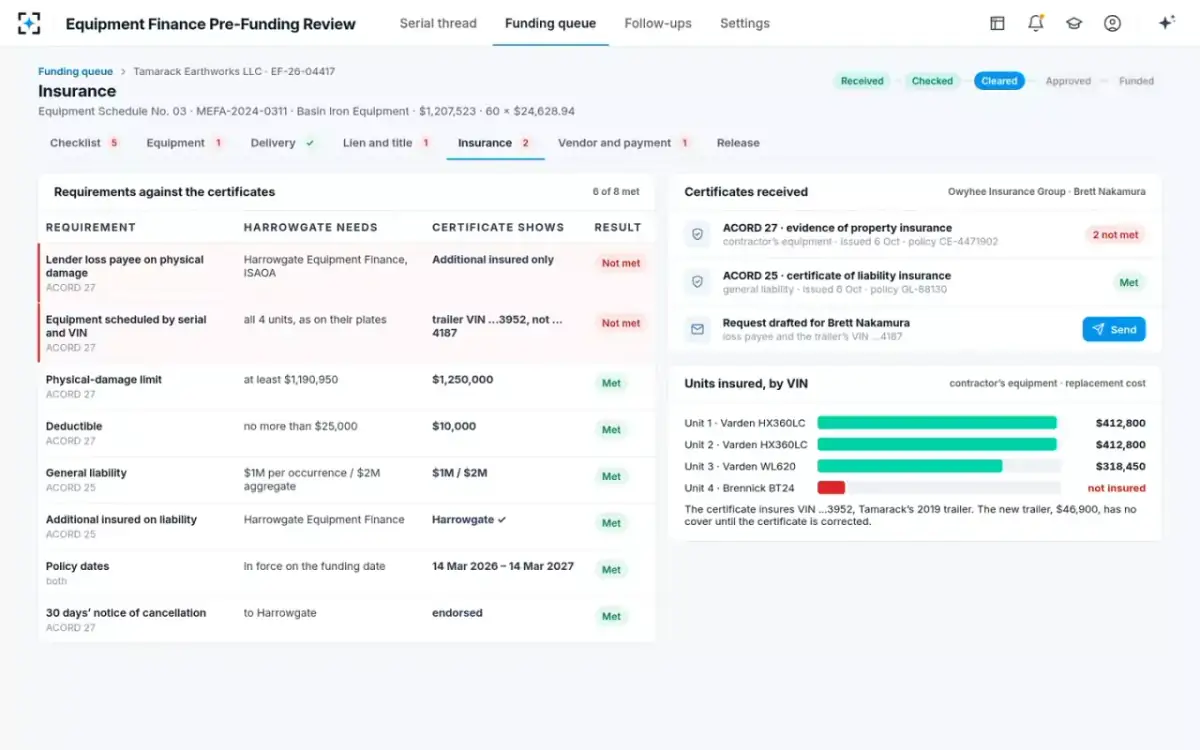
Tamarack Earthworks' new titled trailer is where the two gaps met on one certificate. The ACORD 27 from Owyhee Insurance Group named Harrowgate Equipment Credit additional insured only, not lender loss payee — the liability box checked, the property box left blank. On its own that would have been enough to flag. The certificate compounded it by scheduling the wrong trailer entirely: VIN ending TS003952 instead of Tamarack's actual new trailer, VIN ending TS004187. A lookup of TS003952 found a real but unrelated machine — a 2019 Brennick BT24 already on an Idaho title, with a different lienholder, Silverline Equipment Credit, recorded since 2019.
One ACORD 27, annotated at the two fields that matter
Additional insured / lender's loss payable / loss payee box
Additional insured: checked
Lender's loss payable / loss payee: blank
Harrowgate Equipment Credit has a liability right on this policy and no claim to a physical-damage payout.
Scheduled property, VIN
…TS003952
Not Tamarack's trailer. Belongs to a 2019 Brennick BT24, already titled to a different lienholder in Idaho.
What Tamarack's actual trailer needed
…TS004187, lender loss payee checked
The $46,900 trailer had no cover at all under the certificate as issued.
Until the certificate was corrected, Tamarack's new trailer was, in practical terms, uninsured from the lender's point of view twice over: the wrong box was checked for the right trailer, and the right VIN was scheduled to the wrong machine. Either error alone would have left Harrowgate with nothing to collect if the trailer were destroyed; together they meant the certificate on file did not insure the collateral it was supposed to insure, under any box.
The mismatched VIN, flagged against the schedule
ACORD 25 vs. ACORD 27: liability and property aren't the same certificate
The confusion between additional insured and loss payee is made easier by a second, adjacent mix-up: the two standard ACORD certificates that cover liability and property are not interchangeable, and a lender that only ever sees one of them is only seeing half the coverage picture. ACORD 25, the Certificate of Liability Insurance, is where additional insured status lives — it evidences liability coverage, the kind that responds to a third-party lawsuit. ACORD 27, the Evidence of Property Insurance, is where loss payee and lender's loss payable status live: its "additional interest" section carries separate boxes for additional insured, lender's loss payable, loss payee and mortgagee, because it evidences the property coverage that responds to the machine's own damage or destruction (ACORD 27 (2016/03), as published by NY DFS).
The same form carries a warning in capitals that a funding desk should read literally: the evidence "is issued as a matter of information only and confers no rights upon the additional interest named below", and it "does not affirmatively or negatively amend, extend or alter the coverage afforded by the policies". The certificate is a report of what the policy says, not the policy. A lender's rights come from the endorsement attached to the policy itself, which is why a desk that relies on a large loan or a high-value unit asks for the endorsement, not only the certificate.
The four boxes in ACORD 27's additional-interest section, and what each gives a lender
| Box | What it is | What it gives an equipment lender |
|---|---|---|
| Additional insured | Extends the policy’s coverage to a party that is not the policyholder | A liability right, if the policy says so; no claim on a physical-damage payout |
| Lender’s loss payable | Names the lender under a lender’s loss payable endorsement such as Form 438BFU NS | Payment of loss to the lender, protection against the borrower’s breaches, ten days’ notice before cover ends |
| Loss payee | Names the party to whom a property loss is paid | Payment of loss, without the endorsement’s protection against the borrower’s breaches unless the policy adds it |
| Mortgagee | The real-property term, carried over from the standard mortgage clause | The protections the mortgage clause and, for fire policies, state law provide |
A lender who collects an ACORD 25 showing additional insured status and assumes that covers the machine itself has confirmed the wrong certificate for the right. The two forms exist because the two kinds of coverage genuinely are separate products, often from different parts of the same insurer, and a complete file needs both — a liability certificate for the lawsuit risk, and a property certificate, correctly naming the lender loss payee and correctly scheduling the exact collateral, for the destruction risk.
What to check on every certificate before releasing a dollar
What to check on an insurance certificate before funding
- Which box is checked, not just whether a box is checked
Additional insured protects against a lawsuit. Lender loss payable or loss payee protects the lender's money. A certificate can check one and not the other.
- The exact VIN or serial scheduled, against the exact unit financed
A certificate that insures a real, correctly titled machine is worthless if it is the wrong machine.
- Which certificate this is — ACORD 25 or ACORD 27
Liability and property coverage are evidenced on different forms. A complete file needs both, matched to the right box.
- The notice-of-cancellation promise, and where it comes from
For equipment the notice right is mostly contractual: a lender’s loss payable endorsement such as Form 438BFU NS promises ten days. A certificate alone confers no rights.
- Limits against the equipment cost, not the amount financed
A physical-damage limit set only to the loan balance can leave a gap if the equipment's replacement cost is higher.
When "additional insured" is still not enough
There is one more trap worth naming directly: a certificate can list a lender as additional insured on the very policy that also carries loss-payee language, and still leave the lender short, if the loss-payee or lender's loss payable box on that specific schedule line was never checked for this unit. ACORD 27 schedules property line by line, and a policy can correctly name a lender loss payee for some scheduled units and not others — a renewal, an added machine, or a clerical gap can leave one piece of equipment on the policy's property section without the box checked, even while the certificate as a whole looks complete. The fix is the same either way: check the specific line for the specific unit, every time, rather than trusting that a lender's name appearing anywhere on the certificate covers everything scheduled under it.
On the Tamarack Earthworks package, correcting both the box and the VIN meant a new certificate request to Owyhee Insurance Group's agent, Brett Nakamura, rather than a request to the lessee — insurance corrections, unlike a schedule's serial number, come from the insurer's own agent, because only the agent can reissue the form. How the equipment side of this same package was traced and corrected is told in is this machine already financed, and the lien side in where do you file the UCC-1.
Questions people ask
Loss payee vs. additional insured — what's the difference?
Additional insured status covers liability: it gives a lender a right to defense and indemnity if the financed equipment causes a third party's injury or property damage. Loss payee status covers the property itself: it makes the insurance payment for a stolen, wrecked or destroyed machine payable to the lender, not only the lessee. The two sit in different sections of a policy and a certificate can check one without the other.
What is a lender loss payee?
A party named on a property insurance policy to receive payment, or a share of it, when the insured property is damaged or destroyed — in equipment finance, usually the lender that holds a security interest in the machine. A "lender's loss payable endorsement" goes further, protecting the lender's payment even against certain policy breaches by the borrower that would otherwise void the claim.
What's the difference between loss payee and mortgagee?
They are separate boxes on ACORD 27 and come from different traditions. "Mortgagee" is the real-property term from the standard mortgage clause, and some of its protections are statutory: New York, for example, requires ten days' written notice to a mortgagee under a fire policy (Insurance Law §3404(e)). "Loss payee" is the general term for whoever is paid on a property loss; for equipment, the lender's protection usually comes from a lender's loss payable endorsement rather than a statute.
ACORD 25 vs. ACORD 27 — which one do I need?
Both, for a complete file. ACORD 25 is the Certificate of Liability Insurance, where additional insured status is evidenced. ACORD 27 is the Evidence of Property Insurance, where loss payee and lender's loss payable status for scheduled equipment are evidenced. A lender collecting only one has confirmed only half of what a financed machine needs insured.
Does additional insured cover a financed machine if it's destroyed?
No. Additional insured status is a liability right, not a property right — it does not entitle the lender to any part of a payout for the machine's own loss or damage. Only loss payee or lender's loss payable status on the property side of the policy does that.
What happens if insurance names the wrong lienholder, or the wrong machine?
The policy's protection effectively does not reach the lender's actual collateral. A lienholder misnamed on the certificate has no standing under that policy; a correctly named lienholder scheduled against the wrong VIN or serial has, in effect, insured someone else's equipment. Either error has to be corrected by the insurer's own agent before the certificate can be relied on.