Where to file a UCC-1 for an LLC or a corporation is the first filing question an equipment lender gets wrong, and the mistake is almost always the same one: filing where the business operates, or where the equipment sits, instead of where the debtor is organized. Article 9 of the Uniform Commercial Code answers the question plainly — an LLC, a corporation or any other entity formed by filing with a state is a "registered organization", and a registered organization is located, for UCC purposes, in the state under whose law it was formed. File anywhere else and the lien does not perfect, no matter how carefully every other line of the filing was completed. Botminds' Equipment Finance Pre-Funding Review reads the debtor's state record against the UCC-1 on every funding package, so a wrong-state filing is caught while the purchase-money window is still open, not after a bankruptcy trustee finds it.
The example below follows a fictional sample lessee, Tamarack Earthworks LLC, through the solution. Every statute quoted is linked to the section it comes from.
The question that gets filed wrong: which state?
A documentation officer filing a UCC-1 against a piece of equipment has, in practice, three states to choose from: where the lessee's headquarters sits, where the equipment will operate, and where the lessee was legally formed. Only one of the three is the UCC's answer, and it is the one with nothing to do with the collateral at all. The equipment can sit in Idaho for its entire working life; the filing still has to go to the debtor's state of organization, because Article 9 locates the debtor, not the collateral.
The mistake is easy to make because it feels backwards. A documentation officer who has just confirmed a delivery address in Boise reasonably reaches for the Idaho Secretary of State's UCC filing portal next. If the lessee is a Delaware LLC, that filing is complete, timely and in the wrong state — and a UCC-1 in the wrong state does nothing. It does not create a defective lien that can be fixed later with a footnote; it creates no perfected lien at all.
The statute's own answer: where the entity is organized
UCC §9-307 answers the question directly, and its answer does not depend on judgment. "A registered organization that is organized under the law of a State is located in that State," the statute reads (UCC §9-307(e)). An LLC, a corporation, a limited partnership and any other entity that exists because a state's filing office issued it a charter is a registered organization, and its UCC location is fixed the day it is formed — not where its headquarters later moves, not where most of its revenue is earned, not where the collateral is used.
"A registered organization that is organized under the law of a State is located in that State."
UCC §9-307(e)
That single sentence is why a lessee's letterhead, its invoice address and its "doing business as" filings are the wrong documents to check. The right one is the certificate of formation or the state's own entity record, which names the state of organization in a field that cannot be argued with. Equipment Finance Pre-Funding Review pulls that state record directly and compares it with the state named on the UCC-1 before the filing goes out, which is exactly the check a documentation officer is otherwise trusting the lessee's paperwork to have gotten right.
The 20-day clock: why purchase-money priority is a race
Filing in the right state matters more for an equipment lender than for most secured creditors, because most equipment financing creates a purchase-money security interest — a lien that paid for the very thing it attaches to — and purchase-money priority is a race with a short, fixed head start. Under UCC §9-324(a), "a perfected purchase-money security interest in goods other than inventory or livestock has priority over a conflicting security interest in the same goods... if the purchase-money security interest is perfected when the debtor receives possession of the collateral or within 20 days thereafter" (UCC §9-324(a)). Miss that 20-day window and the lender does not lose the lien outright — it loses the head start, and falls back into line behind anyone who perfected an interest in the same equipment earlier.
The 20-day purchase-money window, from delivery to the deadline
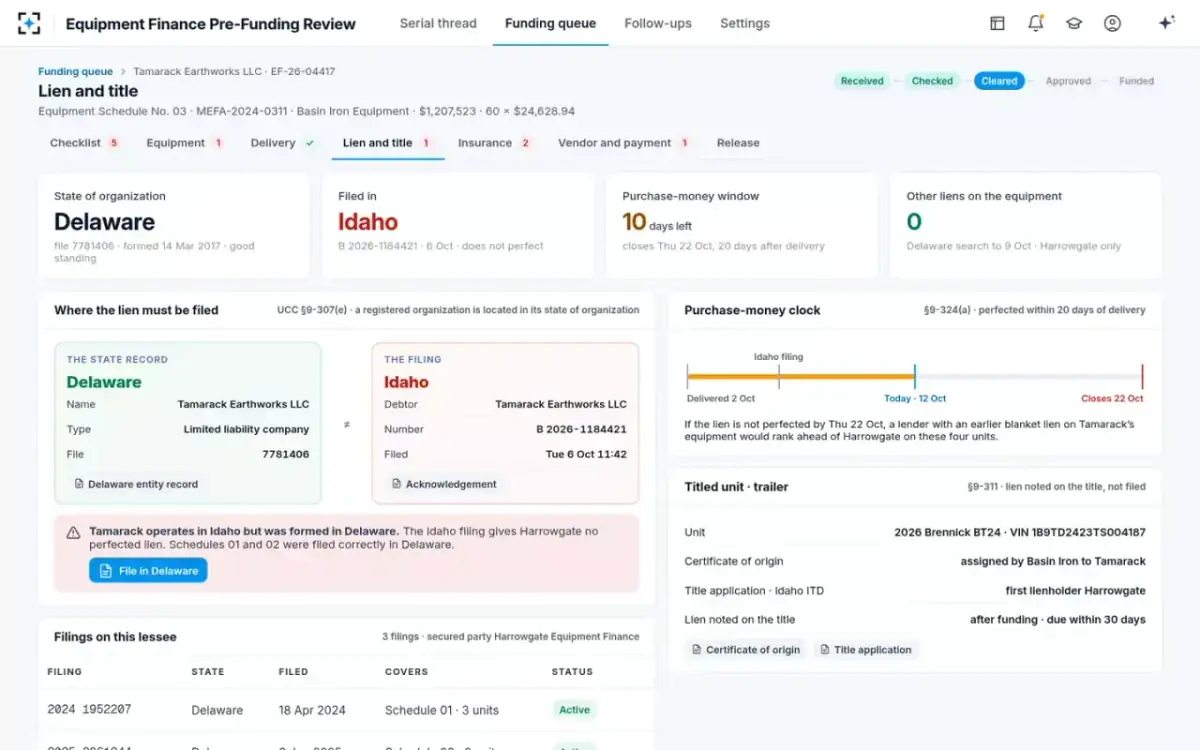
- Delivered 2 Oct; Idaho UCC-1 filed 6 Oct, which does not perfect; error found 12 OctDays 0–10
- Open: Delaware filing still needed by 22 Oct10 days left when the error was found
A funder who files on day 21 has not lost the lien — a security interest perfected late is still a security interest — but has lost purchase-money priority over anyone who filed earlier against the same collateral, including an earlier-perfected blanket lien on the lessee's after-acquired equipment. For a machine that was supposed to be the lender's first-priority collateral, filing one day late can turn a first lien into a junior one.
What "unperfected" costs: the lien creditor who jumps the queue
Unperfected is not a paperwork problem until someone else's claim on the same equipment becomes real, and the UCC is specific about who jumps the queue when that happens. "A security interest or agricultural lien is subordinate to the rights of... a person that becomes a lien creditor before the earlier of the time the security interest or agricultural lien is perfected," the statute reads (UCC §9-317(a)(2)). A lien creditor includes a judgment creditor who has levied on the collateral, and — the case that matters most to a lender — a bankruptcy trustee, who under federal bankruptcy law stands in the shoes of a hypothetical lien creditor as of the petition date.
That is the scenario every documentation officer is really filing against: a lessee files for bankruptcy months after delivery, the trustee runs a lien search, and finds a UCC-1 filed in the wrong state — which, for UCC purposes, is the same as no UCC-1 at all. The equipment the lender thought it could repossess becomes an unsecured claim in a bankruptcy estate, worth cents on the dollar if anything. The fix costs nothing but attention at filing time; the miss costs the equipment.
Individuals, general partnerships, and the exceptions to "state of organization"
Not every lessee is a registered organization, and the rule changes for the ones that are not. UCC §9-307(b) sets the default: "A debtor who is an individual is located at the individual's principal residence," and a debtor "that is an organization and has only one place of business is located at its place of business," while one "that is an organization and has more than one place of business is located at its chief executive office" (UCC §9-307(b)). A sole proprietor leasing a backhoe for a one-truck landscaping business is filed against at a home address, not a shop address. A general partnership — which exists the moment two or more people agree to run a business together, with no state filing to create it — is an organization but not a registered one, so it falls under the same place-of-business rule as a sole proprietor, not the state-of-organization rule that governs an LLC or a corporation.
The distinction is easy to miss because the two rules produce the same answer so often: a small, single-location LLC's state of organization and its place of business are frequently the same state, so the difference never surfaces until a lessee is organized in Delaware and operates from Idaho, as Tamarack Earthworks LLC does. The rule to carry away is simpler than the exceptions make it look: ask first whether the debtor is a registered organization. If yes, the answer is the state of organization, full stop, regardless of where anything else about the business happens to sit.
Delaware's quirk: no public search, only an authorized searcher
Filing correctly in Delaware then runs into a second, unrelated surprise: Delaware has no free, do-it-yourself public UCC search. The state's own page is explicit about it — "effective December 1, 2001, all non 'Search to Reflect' UCC Searches will be performed by a Delaware Authorized Searcher" (Delaware Division of Corporations, UCC Search) — meaning a lender cannot simply type a debtor's name into a state website and see every filing against it, the way it can in many states. An authorized searcher — typically a registered agent, a service company or a law firm certified by the Division of Corporations — runs the search against Delaware's UCC information system and returns a certified result.
For a desk that files mostly against Delaware entities, this is not an edge case; it is a routine extra step that a filing-location checklist built around other states' free public portals will miss. A funder that assumes every state search works the way its own state's does is the funder most likely to skip the Delaware step entirely.
What to confirm about the debtor before a UCC-1 is filed
- Pull the entity record, not the letterhead
The lessee's invoice, email signature and contract cover page can all show an address with nothing to do with its state of organization.
- Confirm the exact legal name on the state record
A UCC-1 filed against a close variant of the registered name can fail a search even in the right state.
- Check whether the debtor is a registered organization at all
A sole proprietor or general partnership is filed against under the place-of-business rule, not the state-of-organization rule.
- Confirm the state's own search method
Many states offer an online public search; Delaware requires an authorized searcher. Know which kind of state is being filed in.
- Count 20 days from delivery, not from signing
The purchase-money clock in §9-324(a) runs from when the debtor receives possession, which is usually later than contract signature.
A decision tree for four debtor types
Put together, the location rule reduces to a short decision tree, with the first branch doing almost all of the work: is the debtor a registered organization?
Equipment Finance Pre-Funding Review's four-type filing decision
LLC
Registered organization — located where it is organized
The Secretary of State (or equivalent office) of the state of formation, never the state where it operates or where the equipment sits.
Corporation
Registered organization — located where it is organized
The state that issued its charter. A Delaware corporation files in Delaware even if every employee works in Ohio.
Individual
Not a registered organization — located at principal residence
The state of the individual's principal residence, under UCC §9-307(b)(1) — a sole proprietor's home state, not the shop's address.
General partnership
An organization, but not a registered one
One place of business: file there. More than one: file at the chief executive office, under UCC §9-307(b)(2)–(3).
Tamarack Earthworks LLC sits in the first row. It is a registered organization formed in Delaware, file number 7781406, so its UCC location is Delaware regardless of where its machines work. The Idaho filing on 6 October followed the equipment, not the entity, and the solution's lien and title checker flagged the mismatch the moment it read the Delaware record against the filing — citing the exact field, the state named on the UCC-1, that disagreed with the state named on the entity record.
The state record next to the filing, with the clock running
What refiling after a wrong-state filing fixes, and what it cannot
A wrong-state UCC-1 does not create a defective filing that can be patched; under the statute it perfects nothing, so "refiling" is really just filing, done again in the right place. The security interest itself still exists between lender and lessee; what was missing is perfection. As soon as the correct filing is made in the debtor's state of organization, the interest perfects from that date, and the 20-day rules do the rest. Under §9-324(a), a purchase-money interest perfected within 20 days of possession has priority over a conflicting security interest in the same goods, even one perfected in the meantime. Under §9-317(e), a purchase-money filing made "before or within 20 days after the debtor receives delivery of the collateral" also takes priority over "the rights of a buyer, lessee, or lien creditor which arise between the time the security interest attaches and the time of filing". On Tamarack's package the Delaware filing was drafted on day 10, with ten days of the window still open: the error cost attention, not priority.
What refiling cannot fix is a filing made after day 20. Then the grace periods are gone: purchase-money priority is lost for good, any secured party that perfected in the meantime ranks ahead, and a lien creditor, including a bankruptcy trustee if the lessee filed for bankruptcy while the lien sat unperfected, takes ahead of the lender under §9-317(a)(2). A funder who discovers a wrong-state filing on day 19 is in a very different position from one who discovers it on day 25; the calendar, not the correction itself, decides which.
22 of 22 conditions, the filing condition included
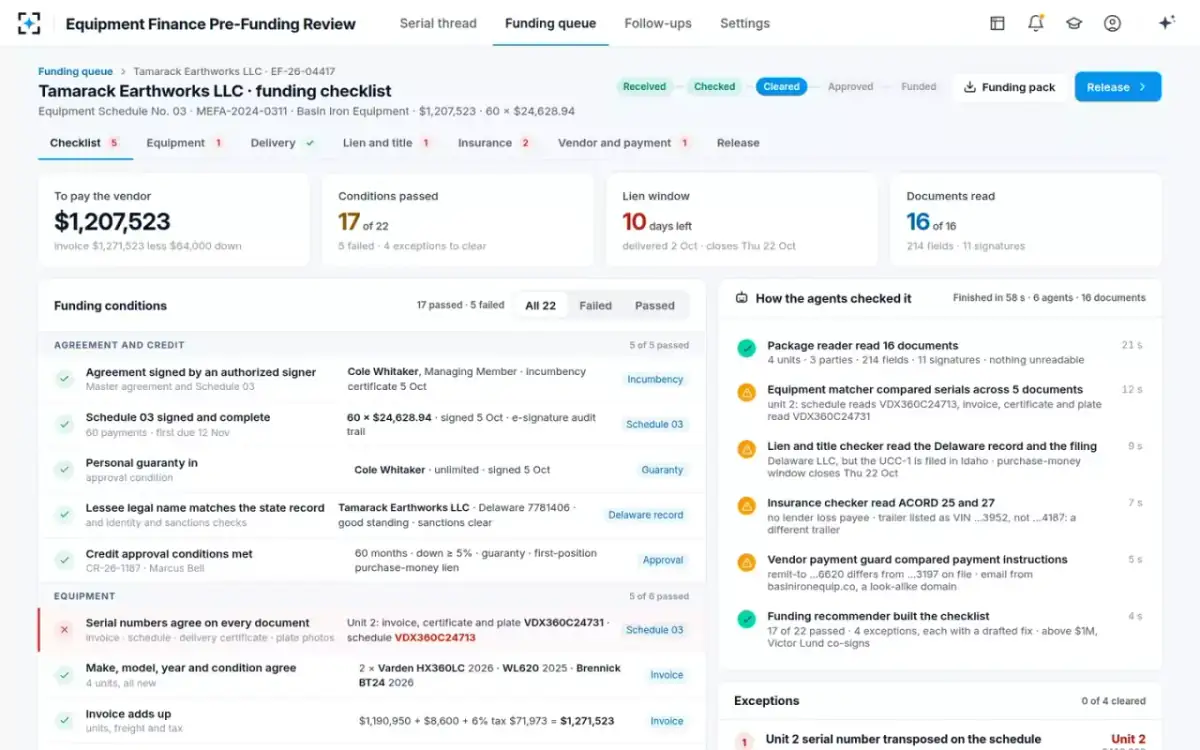
Every other condition on the package can pass — the invoice, the schedule, the insurance certificate, the signatures — and the lien condition still has to clear on its own terms, because it is the one condition that a careful read of the contract cannot verify. Equipment Finance Pre-Funding Review's lien and title checker never treats a filing in the wrong state as perfected and files only with the funder's approval, which is the two-part safeguard a wrong-state filing needs: catch the error, and let a person, not an algorithm, decide when and where the correction goes. For how the same six agents divide the rest of the package, see six agents review a funding package, and for what a transposed serial costs beside a wrong-state filing, see what a wrong serial or an unperfected lien really costs a lessor.
Questions people ask
Where do you file a UCC-1 for an LLC?
In the state where the LLC was formed, not where it operates or where the collateral is located. An LLC is a registered organization under UCC §9-307(e), and a registered organization is located in the state under whose law it was organized. Check the LLC's certificate of formation or the state's own entity record, not its mailing address.
Where do you file a UCC-1 for a corporation?
The same rule as an LLC: the state that issued its charter. A corporation incorporated in Delaware files in Delaware even if its headquarters, its operations and the collateral are all somewhere else entirely.
What is a purchase money security interest?
A security interest that secures the very debt used to buy the collateral — the classic case being equipment financed by the lease or loan that paid for it. Purchase-money interests get a priority advantage over other liens on the same collateral, but only if perfected within the statute's 20-day window after the debtor takes possession.
How long do you have to perfect a lien after delivery?
For a purchase-money security interest in equipment, 20 days from when the debtor receives possession of the collateral, under UCC §9-324(a). Filing after that window still perfects the lien going forward, but without the purchase-money priority that would have put the lender ahead of an earlier-perfected competing interest.
What happens if a UCC-1 is filed in the wrong state?
It does not perfect the lien at all. A filing against a registered organization's debtor name, made in any state other than its state of organization, creates nothing a court will recognize as a perfected security interest — the equipment can be treated as unencumbered by anyone who becomes a lien creditor first, including a bankruptcy trustee.
Does Delaware have a public UCC search?
Not a free, do-it-yourself one. Delaware requires non-"Search to Reflect" UCC searches to be run by a Delaware Authorized Searcher — typically a registered agent, service company or law firm certified by the Division of Corporations — rather than offering an open public lookup the way many states do.