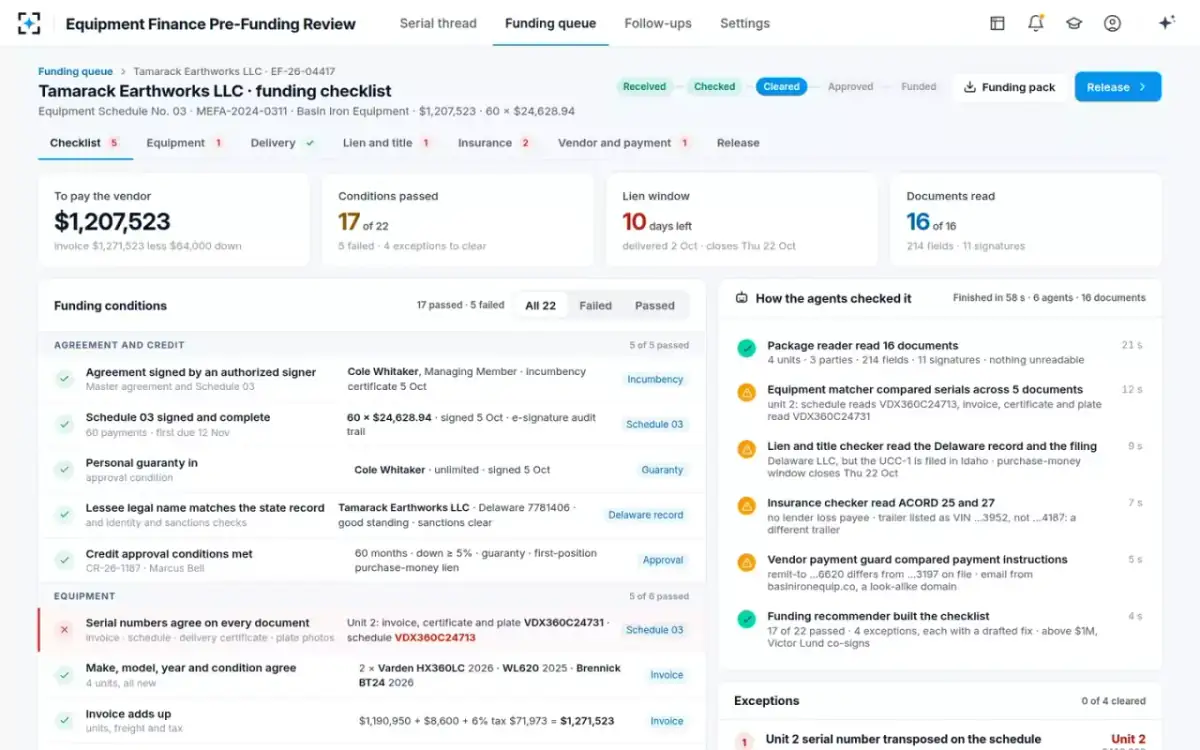
An equipment finance funding conditions checklist is usually written as a list of yes-or-no boxes: signer authorized, legal name confirmed, lien filed, insurance current. What the list leaves out is the one thing that actually decides whether each box is true — the specific field, on a specific document, that the condition is testing. "Legal name confirmed" sounds like one check; it is really a comparison between the name on a signature block and the name on a state's own entity record, letter for letter. Equipment Finance Pre-Funding Review tests 22 such conditions on every package, and this guide maps every one of them to the document and field behind it.
The example below follows a fictional sample package through the solution: Tamarack Earthworks LLC, financing two excavators, a wheel loader and a titled trailer from Basin Iron Equipment Co. The statutes and the federal advisory quoted are linked to their source.
22 conditions, six groups
The 22 conditions are not scattered at random across the package; they cluster into six groups, each testing a different document or pair of documents against each other. Signer and incumbency conditions test who is allowed to sign. Legal name and state conditions test whether the lien will actually perfect. Invoice math conditions test the money. Delivery and acceptance conditions test whether the machine that was promised is the machine that arrived. Insurance conditions test what happens if it is destroyed. Payment conditions test where the money goes.
22 conditions, mapped to the document and field each one tests
Signer and incumbency · conditions 1–4
| Condition | Document | Field tested |
|---|---|---|
| Signer authorized under the incumbency certificate | Incumbency certificate | The named officer's title and authority to bind the lessee |
| Guaranty signed and matches the credit approval | Personal or corporate guaranty | The guarantor's name, amount and signature |
| Power of attorney, if used, properly executed | Power of attorney | Scope of authority and the date it was granted |
| E-signature audit trail matches the named signer | E-signature certificate | Signer identity, timestamp and document hash |
Legal name and state · conditions 5–8
| Condition | Document | Field tested |
|---|---|---|
| Debtor's exact legal name matches its state record | State entity record | Registered legal name, letter for letter |
| State of organization confirmed from the entity record | State entity record | State of organization field |
| UCC-1 filed in the debtor's state of organization | UCC-1 filing | Filing office named on the acknowledgment |
| Collateral description on the UCC-1 covers every unit | UCC-1 filing | Serial numbers listed in the collateral description |
Invoice math · conditions 9–12
| Condition | Document | Field tested |
|---|---|---|
| Invoice total matches the equipment schedule total | Vendor invoice + schedule | Line-item totals, unit by unit |
| Down payment received matches the contract | Payment record | Amount and date against the contract term |
| Sales or use tax calculated correctly | Vendor invoice | Tax rate applied against the taxable amount |
| Amount financed reconciles to the credit approval | Credit approval + invoice | Approved amount vs. invoice less down payment |
Delivery and acceptance · conditions 13–16
| Condition | Document | Field tested |
|---|---|---|
| Delivery and acceptance certificate signed and dated | Delivery certificate | Lessee's signature and delivery date |
| Serial numbers match across invoice, schedule and plate photo | Invoice, schedule, plate photo | Serial number, cross-document |
| Delivery date falls within the approval window | Delivery certificate + approval | Delivery date vs. approval expiration |
| Equipment condition (new or used) matches the schedule | Delivery certificate + schedule | New/used designation |
Insurance and payment · conditions 17–22
| Condition | Document | Field tested |
|---|---|---|
| Lender named loss payee or lender's loss payable | ACORD 27 certificate | Loss-payee / lender's-loss-payable field |
| Scheduled property matches the serial or VIN financed | ACORD 27 certificate | Scheduled-property VIN or serial |
| Physical-damage limit at least the equipment cost | ACORD 27 certificate | Stated coverage limit |
| Vendor bank account matches the account on file | Invoice + vendor register | Remit-to account number |
| Any payment change confirmed by a recorded call-back | Call-back record | Date, person and the number called |
| Remit-to sender's domain matches the vendor's own | Email headers + vendor register | Sender domain vs. vendor's domain on file |
Signer and incumbency: proving who may sign
The first group asks a question that sounds obvious and is not: is the person who signed actually allowed to? An incumbency certificate names the officers of an LLC or corporation and the authority each holds, and the first condition tests the signer's name and title on the contract against that certificate — not against a business card or an email signature, which prove nothing about legal authority. A guaranty, if the credit approval required one, is tested the same way: the guarantor's name, the amount guaranteed and the signature itself, each checked against what credit actually approved, not against what the contract happens to say the guaranty covers.
Where a power of attorney stands in for a signature, the condition tests the scope of the authority granted and the date it was granted, because a power of attorney that expired before signing, or that never covered this kind of transaction, signs nothing. And because most packages now arrive e-signed, the fourth condition in this group tests the e-signature platform's own audit trail — signer identity, timestamp and document hash — against the document it claims to have signed, catching the rare case where a signature block and its underlying audit record disagree.
Legal name and state: the two words that make or break a lien
The second group is small — four conditions — and carries disproportionate weight, because every one of them feeds directly into whether a lien perfects at all. UCC §9-307(e) is unambiguous that "a registered organization that is organized under the law of a State is located in that State" (UCC §9-307(e)), so the state-of-organization condition is not a formality; it is the fact that decides where the UCC-1 has to be filed. The exact-legal-name condition exists because a UCC-1 filed against a name that is close to, but not identical to, the debtor's registered name can fail a search even when filed in the right state.
The statute sets the test precisely. For a registered organization, a financing statement sufficiently names the debtor "only if the financing statement provides the name that is stated to be the registered organization's name on the public organic record" (UCC §9-503(a)). A name that misses that standard makes the financing statement "seriously misleading", and so ineffective, unless a search of the filing office's records "under the debtor's correct name, using the filing office's standard search logic, if any, would disclose" it anyway (UCC §9-506(b)–(c)). That is why the condition compares the signature block with the state's entity record, not with the invoice or the credit application: the public organic record is the only source the statute recognises.
The purchase-money priority that makes a timely, correctly filed UCC-1 worth more than a late one depends on the same group: "a perfected purchase-money security interest in goods other than inventory or livestock has priority over a conflicting security interest in the same goods... if the purchase-money security interest is perfected when the debtor receives possession of the collateral or within 20 days thereafter" (UCC §9-324(a)). On Tamarack Earthworks, the Idaho filing passed none of these conditions — wrong state, and therefore no perfection at all — until the Delaware filing corrected it with ten days still left on the 20-day clock. The full mechanics of that correction are in where do you file the UCC-1.
Invoice math: down payment, tax and the amount financed
The third group has no legal citation behind it, only arithmetic, which is exactly why it is easy to under-check: nobody expects a funder's own invoice to contain an error, so the condition that actually recomputes it is the one most likely to be skipped by a reader working from habit rather than from the numbers. The invoice total has to match the schedule's line-item total unit by unit, not just in aggregate, because two offsetting errors can make a wrong total look right. The down payment received has to match what the contract specifies, in both amount and timing. Sales or use tax has to be recalculated against the taxable amount, not simply accepted as printed. And the amount actually financed has to reconcile to the credit approval — invoice less down payment — because a documentation officer correcting one number without re-checking the amount financed is a common, quiet source of a package that funds for the wrong figure.
Delivery and acceptance: proving the machine arrived
The fourth group ties the paperwork to the physical machine. A signed, dated delivery and acceptance certificate is the condition that establishes the equipment actually arrived and was accepted — the date on that certificate is also the date that starts the 20-day purchase-money clock, so an error here does not just affect this group, it moves the deadline in the legal-name group too. The serial-number condition in this group is the one this series returns to most often, because it is where a transposed digit hides: Tamarack's second excavator read VDX360C24713 on its schedule and VDX360C24731 everywhere else, a mismatch covered in full in is this machine already financed.
The delivery-date condition checks that delivery happened inside the approval's validity window — a credit approval that expired before the equipment shipped is not an approval the funder can rely on, no matter how clean everything else looks. And the new-versus-used condition matters because it decides whether a separate inspection threshold applies: Tamarack's used-equipment packages require a third-party inspection above $250,000, a rule that a schedule misdescribing a used machine as new would quietly bypass.
Insurance and payment: the two groups fraud usually targets
The last six conditions split across two groups that this series treats together because they are where an active attempt to defraud a funder — as opposed to an honest clerical error — usually surfaces. On the insurance side, the loss-payee condition tests whether the lender is named to receive a property-damage payout at all, not merely named somewhere on the certificate: the standard lender's loss payable endorsement, Form 438 BFU NS, as published by Washington's Office of the Insurance Commissioner, specifies that "loss or damage, if any, under this policy shall be paid to the Payee named on the first page of this policy, its successors and assigns, hereinafter referred to as 'the Lender'... whatever form or capacity its interests may appear" (Form 438BFU NS, clause 1) — a right additional-insured status alone does not carry, as loss payee vs. additional insured sets out in full. The scheduled-property condition and the coverage-limit condition round out the group: the wrong VIN scheduled, or a limit set below the equipment's cost, both leave the lender short exactly when a claim is filed.
On the payment side, the three conditions exist because of a fraud pattern federal regulators have named directly: "a criminal impersonates one of Company C's suppliers to e-mail and inform Company C that future invoice payments should be sent to a new account number and location," as FinCEN's advisory on business email compromise describes it (FinCEN Advisory FIN-2016-A003). The account-match condition catches a changed number before it is used; the call-back condition requires that any change be confirmed to a number already on file, never a number supplied by the request itself; and the domain-match condition catches the look-alike sender domain that usually accompanies the fraud. The minute-by-minute version of all three conditions firing on one package is in the email that almost moved $1.2M.
The field each condition actually tests
Laid end to end, the pattern across all 22 conditions is the same: a condition is not "the invoice looks right" or "the lien is fine" — it is one specific field compared against one other specific field, with a pass or fail that does not depend on how the package reads as a whole. "The same legal name, address, serial numbers and amounts appear on five or six of them," as the solution's own description of the package puts it, and every one of the 22 conditions is a bet that all five or six copies of that value actually agree, rather than a bet that the package looks complete.
A condition read by eye, against the same condition read field by field
Read by eye: "Looks like Tamarack Earthworks" across several documents, close enough on a fast read.
Read field by field: Byte-for-byte against the Delaware entity record; a one-character variant fails.
Read by eye: Confirmed on the schedule and the invoice; the plate photo is not re-opened.
Read field by field: All seven documents traced to the plate photo; a schedule-only serial fails outright.
Read by eye: "Lender is named on the certificate" — additional insured counted as enough.
Read field by field: The specific loss-payee or lender's-loss-payable field checked for this unit, this line.
Read by eye: Matches the latest invoice, which is itself the thing being tested.
Read field by field: Matches the account on file and the change history, independent of the invoice.
What 214 fields and 11 signatures looks like on one package
Scaled up from 22 conditions to the whole package, the numbers get larger without changing what is being tested. Sixteen documents hold 214 individual fields and 11 signatures across the Tamarack Earthworks package, and the package reader that opens the file reads every one of them, citing the page and position of each value rather than filling in anything it cannot actually find printed on the page.
One package, 22 conditions, 58 seconds
16
documents read, 214 fields and 11 signatures, nothing unreadable
22
funding conditions tested against the exact field on each document
58sec
for six agents to read the package and test every condition
17 of 22 passed, 4 exceptions open
The 22 funding conditions, in order
- 1–4 · Signer and incumbency
Authorized signer, guaranty, power of attorney, e-signature audit trail.
- 5–8 · Legal name and state
Exact legal name, state of organization, UCC-1 filed in that state, collateral description complete.
- 9–12 · Invoice math
Invoice total, down payment, tax, amount financed reconciled to approval.
- 13–16 · Delivery and acceptance
Signed certificate, serial numbers cross-matched, delivery inside the approval window, condition (new/used) confirmed.
- 17–19 · Insurance
Loss payee or lender's loss payable named, correct VIN scheduled, limit at least the equipment cost.
- 20–22 · Payment
Account matches the vendor register, any change confirmed by call-back, sender domain matches the vendor's own.
Every condition on this list cites the document it rests on, which is the governance rule underneath the whole checklist: nothing passes on the strength of looking right, and nothing fails without naming the field that failed it. For how the four exceptions on this specific package were found and fixed, start from six agents review a funding package, and for what a missed condition costs when nobody catches it, see what a wrong serial or an unperfected lien really costs a lessor.
Questions people ask
What is an equipment finance funding conditions checklist?
A list of conditions a funding package must satisfy before the vendor is paid — covering who signed, whether the lien will perfect, whether the invoice math is correct, whether the equipment was delivered, whether it is insured correctly, and whether the payment instructions are genuine. Each condition should trace to one specific field on one specific document, not to a general impression that the package looks complete.
What documents are needed to fund an equipment lease?
Typically the vendor invoice, the lease or loan agreement and its equipment schedule, an incumbency certificate and any guaranty, a signed delivery and acceptance certificate with serial-plate photos, a title or certificate of origin for titled units, a UCC-1 filing acknowledgment, and an insurance certificate naming the lender correctly. Sixteen documents carried 214 fields and 11 signatures on the sample package this guide follows.
What does a funder check before paying the vendor?
That every party named across the documents agrees — legal name, address, serial numbers and amounts, which typically appear on five or six documents each — that the lien will perfect in the correct state within the purchase-money window, that the insurance names the lender on the right box for the right unit, and that the payment instructions match the vendor's account on file.
What's the difference between a pre-funding documentation checklist and an equipment loan closing checklist?
In practice, very little — both describe the same set of conditions tested before money moves, whether the transaction is structured as a lease or a loan. The conditions that matter most, state-of-organization filing, serial-number matching and insurance naming, apply the same way regardless of which term a desk uses.
How many conditions should a funding checklist actually test?
There is no regulatory number; it depends on how many documents the package carries and how many distinct risks a funder wants tested separately rather than folded together. This series' sample package tests 22, grouped into six categories, each tracing to a specific field rather than a general read of the document.