Equipment finance operations usually look like paperwork from outside: file the schedule, chase the signature, hold the certificate until it is right. In practice the work sits inside a desk of four seats (a funding specialist, a documentation officer, a credit analyst and the vice president who co-signs above a limit), and almost all of the friction in funding a lease sits in the handoff between those seats, not inside any one of them. Botminds' Equipment Finance Pre-Funding Review does not replace any of the four. It starts each one from a package where the mechanical matching is already done, so the week each seat spends shifts from checking to judging.
The package below is a fictional sample: Tamarack Earthworks LLC, financing $1,207,523 for two excavators, a wheel loader and a titled trailer, as it moves through Equipment Finance Pre-Funding Review. The people, amounts and company are invented; the Uniform Commercial Code text cited alongside them is not.
One package, four seats, and the numbers that describe the week
4
seats carry one funding package, each with a different job
16
documents in a complete package, all of which must agree
45–90min
of by-eye checking per package, before the follow-up emails
22of 22
funding conditions tested on every deal before a dollar moves
Four seats, one package
A funding package does not move from "complete" to "funded" by one person's decision. It moves through four seats, each of which can stop it. The credit analyst sets the conditions the deal must meet before the package is even built. The documentation officer turns those conditions into a schedule, a lien filing and a set of requirements the vendor and the borrower must satisfy. The funding specialist is the one who opens the finished package, checks it line by line, and either releases the money or sends something back for a fix. Above a limit, a vice president has to agree before the wire goes out.
Each seat has its own duties, and each one also depends on the other three doing theirs correctly, which is why a mismatch that starts in one seat almost always surfaces in another. A transposed serial number that the credit analyst never sees shows up as a funding specialist's exception. A lien filed in the wrong state by a documentation officer who trusted the wrong record becomes a vice president's liability eighteen months later, when nobody remembers the filing at all.
The same package, four seats, before and after the mechanical checking is already done
Today
Compares 12–20 documents per package by eye. The signatures are never the problem; the serial number on page three is.
With agents
Starts from a traced package with every break marked and its fix drafted; mends, calls back and releases.
Today
Files what the system gives her. If the state is wrong there, it is wrong at the filing office.
With agents
Sees the state of organization from the state record beside the filing, with the purchase-money clock running.
Today
Approves a credit with conditions and has to trust the deal is funded exactly as approved.
With agents
Sees each approval condition (amount, term, down payment, guaranty, lien position) tested on the checklist before funding.
Today
Owns time-to-fund and the audit findings, and learns about an unperfected lien after the money has gone.
With agents
Co-signs above $1,000,000 with every condition passed and the call-back already on record.
Monday morning: ten packages, ranked by risk and by how long the vendor has waited
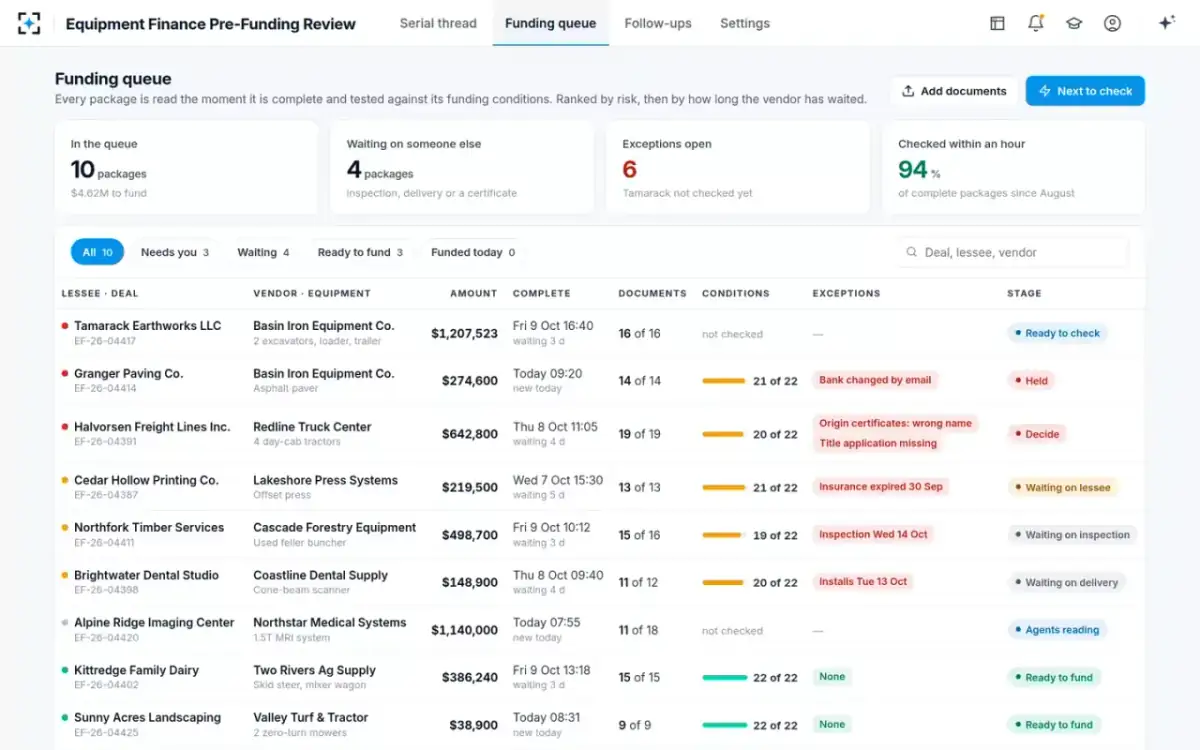
The funding specialist: 45–90 minutes of checking by eye, before the follow-up emails
Of the four seats, the funding specialist is the one whose week is most visibly checking. Comparing twelve to twenty documents in a package (the invoice, the schedule, the delivery certificate, the plate photos, the title, the UCC filing, the insurance certificate, the vendor's payment instructions) by eye takes an estimated 45 to 90 minutes per package before any exception is even raised. The signatures are rarely the problem. A serial number copied once onto a schedule and never checked against the plate photo again is.
On paper this seat's duty is "fund the package," but the actual week is "find the four or five fields across sixteen documents that disagree, in time to still fund today." A specialist checking by eye is reading for consistency across documents that were typed by different people at different companies on different days: the vendor's accounting system, the lessee's signature page, a state filing office, an insurance agent's binder. Nothing forces those four sources to agree, so somebody has to check that they do.
The documentation officer: the state of organization is the only state that matters
A documentation officer's job looks like filing: send the schedule, submit the UCC-1, hold the certificate. The seat's real risk is narrower and easier to get wrong than it sounds: a UCC-1 perfects a lien only when it is filed against the debtor's state of organization, not the state where the equipment sits or where the business operates. The Uniform Commercial Code is explicit about it: "A registered organization that is organized under the law of a State is located in that State" (UCC §9-307(e)). A filing against the wrong state is not a smaller lien. It is not a lien at all.
That single fact is why the documentation officer's seat carries more legal weight than its job title suggests. A credit analyst who approves a deal "secured by a first lien on the equipment" is trusting that whoever files the UCC-1 reads the debtor's formation record correctly: a Delaware LLC is located in Delaware no matter where its yard, its bank or its equipment are. In Equipment Finance Pre-Funding Review, the documentation officer sees the state of organization pulled from the state record next to the filing itself, with the purchase-money clock already counting down, rather than trusting a form that was filled in from the lessee's mailing address.
The credit analyst: approving conditions nobody later tests
A credit analyst's duty is to set the conditions a deal must meet (amount, term, down payment, guaranty, lien position) and then move to the next file. The seat's structural problem is that approving a condition and testing it later are two different jobs, usually done by two different people weeks apart, and nothing automatically connects them. A condition that says "first lien position, insured as loss payee" is only as good as whoever checks the certificate for the word "payee" instead of "insured," three weeks later, on a different desk.
The checklist: 22 conditions in six groups, each tied to the field it was tested on
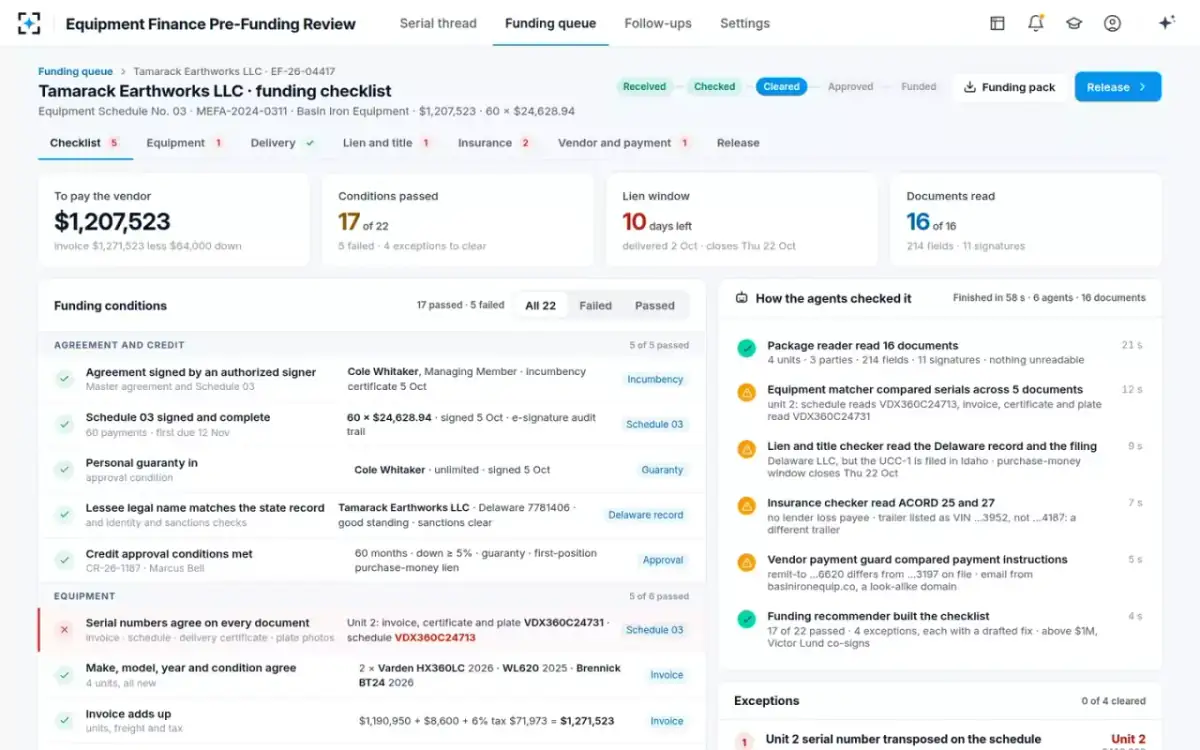
The VP: learning about a bad lien after the money is already gone
A vice president who owns a funding desk's time-to-fund and its audit findings has a seat defined by exposure rather than checking. The VP rarely reads page three of a schedule. The VP finds out, months later, that a lien was never perfected, that an insurance certificate insured the wrong trailer, or that a wire went to an account nobody at the vendor recognizes, usually from an auditor, a loss, or a bankruptcy filing, not from the desk that funded the deal.
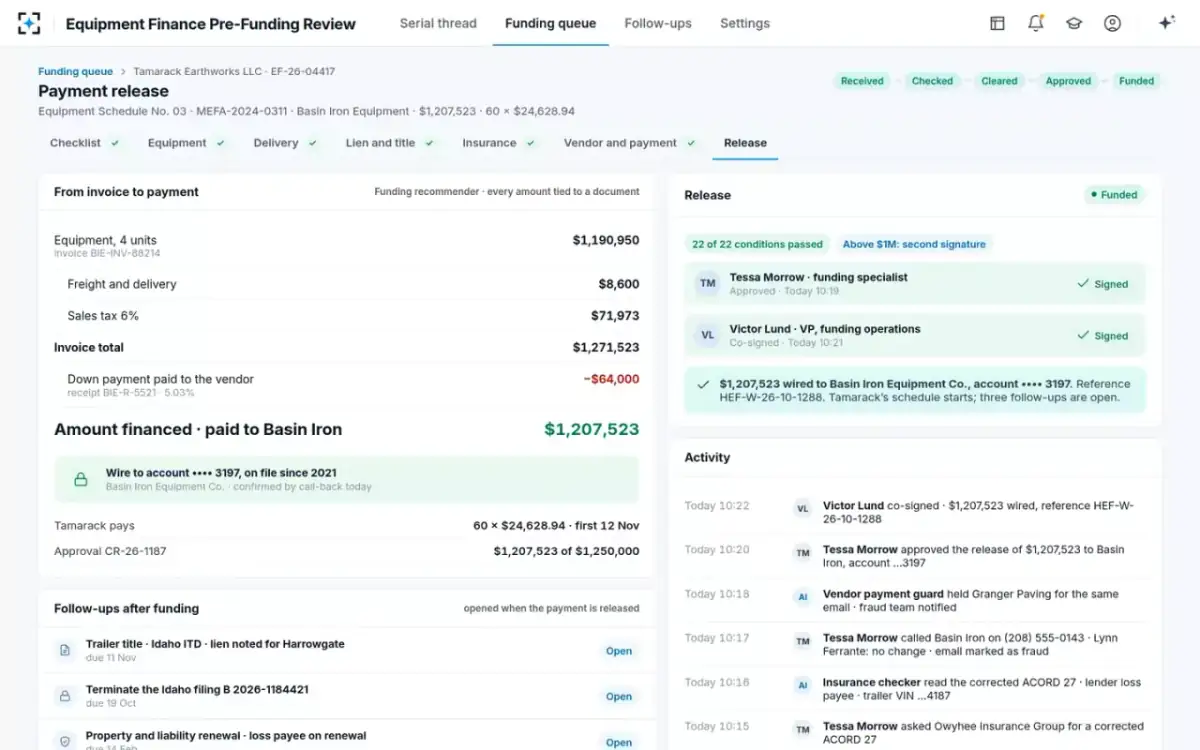
That is the argument for a second signature. In Equipment Finance Pre-Funding Review, a funding specialist can release up to $1,000,000 alone; above that, a second person, typically the VP, has to co-sign, and the checklist that specialist worked through is what the VP is co-signing against, not a summary of it. The seat's job does not change: the VP is still the person accountable for a bad lien. What changes is whether "accountable" means finding out in time to stop a release, or finding out in a legal proceeding eighteen months later.
Released: signed, co-signed, and wired to the account on file
Why the cost of a miss does not depend on which seat misses it
A serial number missed outside the schedule is the same missing machine whichever seat was checking it, junior or senior. Seniority on the desk reflects judgment and accountability, not how much of the week goes to comparing two documents side by side, and the comparing is where a transposed digit or a mismatched VIN gets caught, or does not.
Where the week actually goes: checking versus judging
A funding specialist's week on a package with exceptions splits into five kinds of work: waiting for a package to reach the top of the queue, checking documents against each other by eye, getting a corrected schedule signed, refiling a lien or chasing an insurance certificate, and the vendor call-back, sign-off and wire itself. Before the mechanical matching is done for them, the queue wait and the eye-check dominate the week; once a package arrives pre-traced, almost the same five things still have to happen, but the specialist's own time concentrates on the two steps that need a person: getting the fix signed, and deciding whether a call-back answer is good enough.
A funding specialist's week, by kind of work, before and after the matching is already done
Before: checking by eye
- Queue wait · 50%
- Checking by eye · 8%
- Getting a schedule signed · 17%
- Refiling and chasing insurance · 17%
- Call-back, sign-off, wire · 8%
After: matching already done
- Queue wait · 20%
- Checking by eye · 10%
- Getting a schedule signed · 20%
- Refiling and chasing insurance · 30%
- Call-back, sign-off, wire · 20%
The share of the week spent refiling a lien or chasing an insurance certificate grows as a proportion, even though the total time shrinks, because that step needs a human decision: whether to accept a corrected certificate, whom to call, what counts as resolved. The steps that shrink hardest in proportion are the ones that were never really judgment in the first place: waiting in a queue, and comparing two documents to see if they say the same thing.
What changes on each desk when the thread is already traced
None of the four seats goes away when a package arrives with its serial numbers already traced from the plate through every document that names them. What changes is the shape of each seat's own decision.
The same four seats, now starting from a package that already shows where it disagrees with itself
A person decides
Credit analystStill sets the conditions before the package is built: amount, term, down payment, guaranty, lien position.
A person decides
Documentation officerStill files the schedule and the lien, now beside the state of organization pulled from the state record and the purchase-money clock already running.
A person decides
Funding specialistStill opens, checks and releases the package, now starting from a checklist that already shows which of the 22 conditions passed and why, with every break marked and a fix already drafted.
A person decides
VP, second signatureStill co-signs above $1,000,000, now against the same evidenced checklist the funding specialist worked through, not a separate summary written after the fact.
A credit analyst still decides what conditions a deal needs. A documentation officer still decides where to file and when a certificate is good enough. A funding specialist still decides whether to release the money, and a VP still decides whether to co-sign. The seats are the same four people with the same four job descriptions. What is different is that each decision starts from a package where the mechanical comparison (does this serial match that one, does this state match that filing, does this account match the one on file) has already been done and shown, rather than left for whoever opens the file next to discover by eye.
Questions people ask
What does an equipment finance funding specialist do?
A funding specialist opens a completed funding package (typically the invoice, the lease or loan agreement and equipment schedule, the delivery and acceptance certificate, the title or certificate of origin, the UCC-1 filing acknowledgement, the insurance certificate and the vendor's payment instructions), checks that every document agrees on names, amounts and serial numbers, resolves anything that does not, and releases payment to the vendor, usually up to a set dollar limit before a second signature is required.
What does an equipment finance documentation officer do?
A documentation officer or documentation specialist prepares and files the paperwork a funding package needs: the lease or loan agreement and its equipment schedule, the guaranty and incumbency certificate, and the UCC-1 lien filing against the debtor's state of organization. The seat's core responsibility is narrower than "paperwork" suggests: filing against the wrong state does not create a weaker lien, it fails to perfect the lien at all under UCC §9-307(e).
What does a credit analyst do in equipment finance?
A credit analyst reviews a prospective borrower's financial condition and sets the conditions a deal must meet to be approved: amount, term, down payment, guaranty and lien position among them.
Where does a loan officer sit in equipment finance funding?
A loan officer evaluates, authorizes or recommends approval of loan applications, which in equipment finance overlaps with both credit analysis and funding decisions depending on how a lessor's desk is organized.
Who checks funding documents before a lease is funded?
In most equipment-finance organizations, three or four people check a funding package before money moves: a credit analyst who set the approval conditions, a documentation officer who prepared the filings, a funding specialist who checks the completed package against those conditions, and, above a set dollar limit, a second signer, often a vice president, who co-signs before the wire goes out.