How to check if equipment is already financed before funding comes down to two different searches that get treated as one. A UCC search by the debtor's legal name tells a lender whether someone else already has a filed interest in the lessee's equipment. A serial-number lookup tells a lender whether the specific machine named on an invoice actually exists, matches what the lessee says it is, and is not quietly double-pledged under a serial nobody cross-checked. Equipment Finance Pre-Funding Review runs both on every package, and the two checks catch genuinely different fakes: the double-financed machine that is real but already someone else's collateral, and the phantom machine that exists only on paper.
The example below is a fictional sample package: Tamarack Earthworks LLC, financing two excavators, a wheel loader and a titled trailer from Basin Iron Equipment Co. The sources quoted are the statute itself and the equipment-finance industry's own published research.
Two different checks, often confused
A name search answers "has anyone already filed against this lessee?" A serial lookup answers "does this specific machine exist, and is it the one the paperwork says it is?" A credit analyst who runs only the first can clear a lessee with no filings against it and still fund a machine that was transposed onto the schedule by a typo, or double-pledged under a serial nobody traced across documents. A documentation officer who runs only the second can confirm a real, correctly numbered machine and still miss that the same lessee pledged it to another lender last month under a UCC-1 the schedule check never looked for.
Treating the two as one check — "run a UCC search" — is how packages get funded with either gap still open. They need to be run as two separate questions, because a clean answer to one says nothing about the other.
The entity search: what the statute actually promises
A UCC search is not a courtesy a filing office extends to lenders; it is a public record the statute requires the office to provide, on a fixed schedule, to anyone who asks. Article 9 is specific: "the filing office shall communicate or otherwise make available in a record the following information to any person that requests it," and that response is due "not later than two business days after the filing office receives the request" (UCC §9-523). The same section requires the filing office to make its whole dataset available on a rolling basis: "at least weekly, [the filing office] shall offer to sell or license to the public on a nonexclusive basis, in bulk, copies of all records filed in it" (UCC §9-523).
Read together, those two provisions promise a specific, checkable thing: any lender can request a search against a legal name and expect an answer within two business days, and any lender willing to buy the bulk feed can run its own name search against the whole state's UCC database on a weekly cadence. What the statute does not promise is a serial-number index. A UCC filing's collateral description is free text, and a filing office's name search is exactly that — a search by registered name, not a search by what the collateral description says.
Why Delaware has no public search, and what lenders do instead
The two-business-day promise assumes a lender can simply ask, and many states let a lender do exactly that through an online search of the filing office's index. Delaware is the visible exception: the state's own UCC page states that "effective December 1, 2001, all non 'Search to Reflect' UCC Searches will be performed by a Delaware Authorized Searcher" (Delaware Division of Corporations, UCC Search), meaning a free self-service name search is not available the way it is in most other states. Because so many lessees are Delaware entities, as Tamarack Earthworks is in the sample, a lender's standard search process has to include a specific, extra step — routing the request through an authorized searcher, typically a registered agent or service company — rather than assuming every state works the same way the lender's home state does.
A search workflow built only around the states that offer self-service portals will quietly skip Delaware debtors unless someone remembers to route them differently. Equipment Finance Pre-Funding Review's lien and title checker reads the debtor's actual state of organization first and routes the search method to match it, rather than defaulting to one search process for every lessee regardless of where it was formed.
The search's own blind spot: the last few days
Even a correct name search, in the correct state, has a gap built into the statute. Section 9-523(c) requires the office to report what was on file "on a date and time specified by the filing office, but not a date earlier than three business days before the filing office receives the request" (UCC §9-523(c)). A search report can therefore be up to three business days stale on the day it is issued, and it is staler still by the day the wire goes out. A competing lender that filed during that gap is invisible to the search.
The practical answer is a bring-down search: a fresh search, run as close to funding as the filing office allows, whose "through" date is checked against the funding date rather than assumed. The search report states the date and time it covers; a funding checklist that records that date, and refuses a report older than a set number of days, closes most of the gap. What it cannot close is a filing made in the hours before the money moves, which is why a lender's own perfection also matters: under the first-to-file rule a lender that files before funding takes its place in line from the filing.
The serial lookup: the second check a name search cannot do
A clean UCC name search against a lessee's legal name says nothing about whether the specific machine on this invoice is real, correctly identified, or already pledged under a different filing the name search would not catch — because collateral descriptions in UCC filings are written as free text, not structured serial-number fields a system can index and cross-reference automatically. Catching a serial-level problem takes a second kind of search: tracing one serial number across every document that is supposed to name it, and separately checking whether that exact serial appears in any other filing against any other debtor.
Two checks, run as a funnel: name, then serial, then cross-document match
1
Entity search by legal name
Confirms no one else has a filed interest in this lessee's equipment, state of organization only.
2
Serial or VIN lookup
Confirms this specific machine exists, matches the invoice, and is not pledged under a different filing or a different lessee.
3
Cross-document match
Confirms the same serial reads the same way on all seven documents that are supposed to name it.
The schedule that named a machine that didn't exist
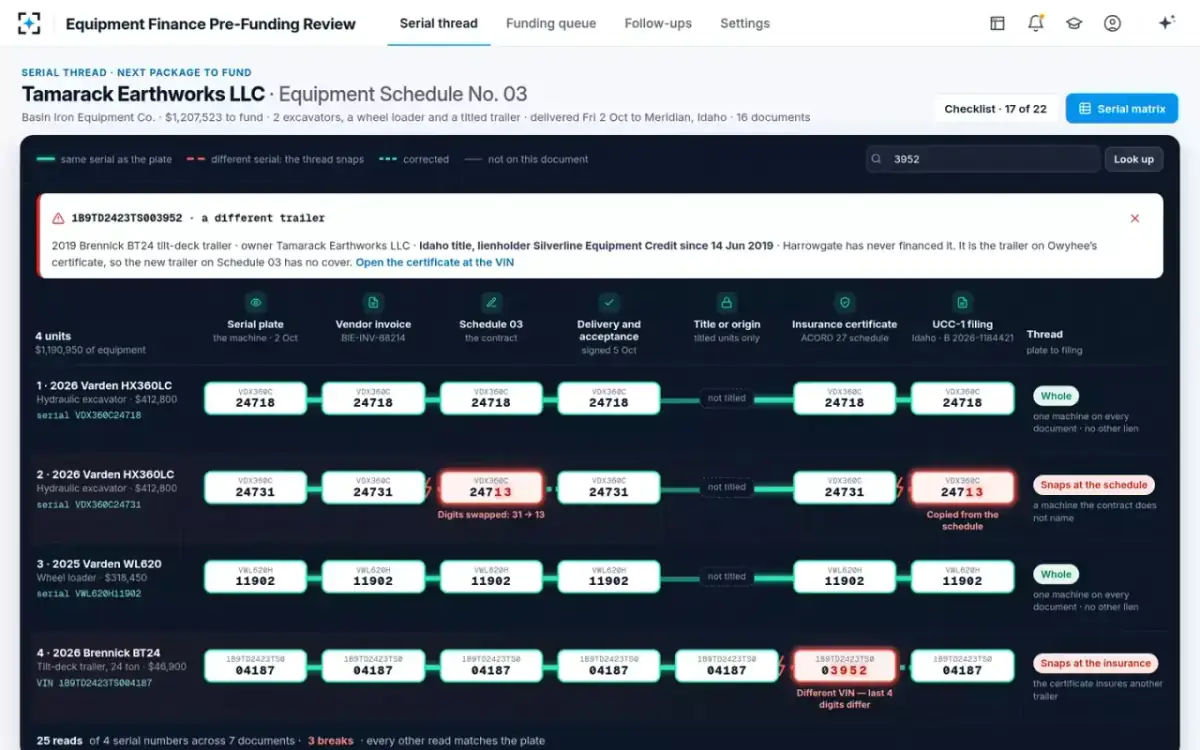
Tamarack Earthworks' second excavator is the case that shows why the third step matters as much as the first two. Its equipment schedule listed the unit as serial VDX360C24713. The vendor invoice, the delivery and acceptance certificate and the plate photo taken at delivery all read VDX360C24731 instead — two digits transposed. A serial lookup against 24713 found nothing: no machine, in Basin Iron's records or anywhere else, carries that serial. It existed only on the schedule and on the UCC-1 filing that had copied the schedule's error forward.
One serial, seven documents: what each should show
| Document | What it should show for unit 2 |
|---|---|
| Vendor invoice | Serial, make, model, year, price |
| Equipment schedule | The same serial, tied to the master agreement |
| Delivery and acceptance certificate | The same serial, signed as received |
| Serial-plate photo | The serial as stamped on the machine itself |
| Title or certificate of origin | The same serial or VIN, on a titled unit |
| Insurance certificate | The same serial or VIN, scheduled by the insurer |
| UCC-1 filing | The same serial, in the collateral description |
A name search against Tamarack Earthworks LLC would have returned clean — nobody else had filed against the lessee. A serial lookup against the schedule's own number, 24713, would have returned nothing at all, because that number belongs to no machine. Only tracing the real serial, 24731, across all seven documents and finding six-to-one agreement located the actual error: not a double-financed machine, but a transposed digit that had quietly built a filing, a schedule and nearly a funded loan around a serial number that named nothing.
24713 traced, 24731 found instead
Why a machine that does not exist cannot secure the loan
A phantom serial is not a paperwork blemish; it goes to whether the lessor has collateral at all. Article 9 makes a security interest enforceable against the debtor and third parties "only if" three things are true, and the second is that "the debtor has rights in the collateral or the power to transfer rights in the collateral to a secured party" (UCC §9-203(b)). Nobody has rights in a machine that was never built. A lien described by a serial that names nothing attaches to nothing, however carefully the UCC-1 was filed and however promptly it was searched.
The description test points the same way. Article 9 accepts a collateral description "whether or not it is specific, if it reasonably identifies what is described," and lists "specific listing" as one way to do it (UCC §9-108). A serial number is the most specific listing there is, which is exactly why a wrong one is dangerous: it identifies, precisely and reasonably, a different machine or no machine. A description by category, such as "equipment", does not stand or fall on any one serial; a description that lists one serial cannot borrow the right machine's identity from the invoice beside it.
Fabricated paperwork is also a recognised pattern, not a thought experiment. FinCEN's 2019 advisory on email-compromise fraud notes that "Perpetrators of BEC fraud are using fraudulent vendor invoices when targeting certain industries," and that "fraudulent vendor and client invoices are generally affiliated with larger BEC transaction amounts than even the CEO fraud scheme," because they ride on "higher expected and previously recurrent transaction amounts to pay for goods and services" (FinCEN Advisory FIN-2019-A005). An equipment invoice is that kind of document: large, expected and paid to a vendor. A desk that checks only whether the invoice looks right is checking the thing a fraud is designed to get right.
No government or academic source puts an industry-wide rate on how often a funded package describes equipment that does not exist, separate from double financing or outright invoice fraud. A desk that wants its own number has to build it from its own exception log, the way the rest of this series' measuring the accuracy of an AI funding review describes for accuracy more broadly.
Building a serial-first search, not just a name-first one
A search process built to catch both kinds of fake starts from the serial number, not from the lessee's name, because the serial is what ties every document together and the name search cannot see it. That means pulling the serial from the plate photo first — the one document a fraud attempt cannot simply retype, because it is a photograph of a physical stamp — and checking every other document against that photo, rather than trusting the schedule as the master record and checking everything else against the schedule's own number.
What to search before funding, and in what order
- Start from the plate photo, not the schedule
The schedule is typed; the plate is photographed. A transposed digit survives in text and dies against a photograph.
- Run the entity search by the debtor's exact legal name
Confirm the state of organization first — a name search in the wrong state returns a false clean result, not an error.
- Run the serial or VIN lookup against the package, the book and public filings
A serial that is double-pledged shows up in the lender's own financed-equipment book before it shows up anywhere public.
- Trace the serial across all seven documents, not just two
Six documents agreeing and one disagreeing names the error; two documents agreeing proves nothing.
- Treat Delaware and other authorized-searcher states differently
A self-service search process will silently skip a state that requires a certified searcher instead.
One package, traced before a dollar moved
25
reads of 4 serial numbers across 7 documents
3
breaks found — one of them a phantom serial that matched nothing
58sec
for six agents to read the 16-document package and test 22 funding conditions
What a clean search still cannot tell you
Even a serial lookup that returns a perfect match across all seven documents answers a narrower question than it sounds like it does: it confirms the machine named on the paperwork is the machine in the paperwork, consistently described. It does not confirm the machine is in the physical condition the delivery certificate claims, that it has not been damaged since the plate photo was taken, or that the vendor delivering it has clear title to sell it free of a lien nobody has filed yet. A clean cross-document match rules out the fakes a serial check is built to catch; it is not a substitute for the title and lien check covered in where do you file the UCC-1, or for the insurance check covered in loss payee vs. additional insured.
What a clean search buys is narrower and still valuable: confidence that the collateral being funded is the collateral it is described as, traced from a photograph of a physical machine through every document that claims to describe it. On the Tamarack Earthworks package, that confidence took 58 seconds for six agents to establish and a signature from the lessee to confirm, once the schedule's two digits were corrected and sent back for Cole Whitaker's e-signature.
Questions people ask
How do you check if equipment is already financed before funding?
Run two separate checks: a UCC search by the lessee's exact legal name, to see whether anyone else has already filed against it, and a serial-number lookup against the lender's own book and public filings, to see whether this specific machine is already pledged elsewhere. A name search alone misses equipment that is double-pledged under a filing's free-text collateral description rather than a structured serial field.
How do you search UCC filings by state?
Many states offer an online search by debtor name through the Secretary of State's office or another central filing office. Delaware is a notable exception: it requires a Delaware Authorized Searcher — typically a registered agent, service company or law firm certified by the Division of Corporations — to run anything beyond a "Search to Reflect" lookup.
What is double-financed equipment?
Equipment that has been pledged as collateral to more than one lender, often because a later lender's search missed an earlier filing — often because the search ran by name only, or because the collateral description used a serial number the search never checked. A serial-first search catches this where a name-only search can miss it.
How do you verify a machine exists before funding?
Trace its serial number from a photograph of the physical plate — not from the typed schedule — through every other document that is supposed to name it: the invoice, the delivery certificate, the title, the insurance certificate and the UCC filing. A serial that appears on a schedule and nowhere else, as happened on the Tamarack Earthworks package, names a machine that does not exist.
Can a lien attach to equipment that does not exist?
No. Under UCC §9-203(b), a security interest is enforceable only if the debtor has rights in the collateral, and no one has rights in a machine that was never built. A UCC-1 that lists a phantom serial is on file, but it secures nothing, so the loss usually surfaces when the lessor goes looking for the machine.