Business email compromise, wire fraud and an unperfected lien each cost a lender money in a different place and at a different time — and the cheapest of the three is priced from the funder's own public exposure, not from a vendor's marketing claim. A transposed serial, a lien filed in the wrong state, a certificate that insures the wrong trailer, and a wire sent to a fraud account are four different mistakes with four very different price tags, and the price depends almost entirely on who catches it, and when.
The worked figures on this page come from a fictional sample package in Equipment Finance Pre-Funding Review — Tamarack Earthworks LLC financing $1,207,523 through Basin Iron Equipment Co. — used here to make the cascade concrete. The dollar figures on business email compromise, fraud trends and the law's own priority rules are not fictional.
The numbers behind the cascade
$3.1B
in reported business-email and account-compromise fraud, 2013 to 2016 (FinCEN)
25%
of reported business-email compromise cases hit manufacturing and construction, the top sector (FinCEN, 2019)
20days
from delivery to perfect a purchase-money lien ahead of everyone else (UCC §9-324)
10days
left on that window when the wrong-state filing was caught, in the sample package
Four ways a package goes wrong, priced from cheapest to worst
The same underlying mistake — a mismatch nobody checked for — costs a wildly different amount depending on which person in the chain is the one who finds it. Caught by the documentation officer before the wire goes out, almost every mismatch costs a signature, a phone call or a refiled form. Caught later, by a lien creditor who perfects first or a bankruptcy trustee who avoids a lien entirely, the same mistake can cost the whole collateral position.
The same missed mismatch, priced by who finds it
| Who finds it | What it costs | Priced from |
|---|---|---|
| A documentation officer, before funding | A signature, a phone call, a refiled UCC-1 — the ordinary cost of checking in the first place. | This desk |
| The funder, after funding but before a loss | Rework: a corrected schedule, a corrected certificate, a refiled lien — still cheap, now with an auditor watching. | This desk |
| A later lien creditor | Subordinated priority — the lessor's lien loses to whoever perfected first on the same collateral. | UCC §9-317 |
| A bankruptcy trustee | The lien avoided entirely if it was never perfected — the full exposure, priced at the loan balance. | UCC §9-317; 11 U.S.C. §544 |
$3.1 billion in three years: what business email compromise cost by 2016
Business email compromise is not a hypothetical risk for a funding desk; it is a measured one. The Financial Crimes Enforcement Network's advisory on the fraud describes exactly the pattern a vendor payment guard is built to catch: "a criminal impersonates one of Company C's suppliers to e-mail and inform Company C that future invoice payments should be sent to a new account number and location" (FinCEN Advisory FIN-2016-A003). Across every variant of the scheme, the same advisory, issued in September 2016, put a number on the damage: "since 2013, there have been approximately 22,000 reported cases of BEC and EAC fraud involving $3.1 billion" (FinCEN).
That figure is national and cumulative, not specific to equipment finance, and it should be read as the backdrop a single wire sits inside rather than a per-case estimate. A lessor paying a vendor by wire, on instructions that arrived by email, is one more case inside a pattern the federal government has been tracking, and pricing, for a decade.
A bank account changed by email, three days before the wire was due
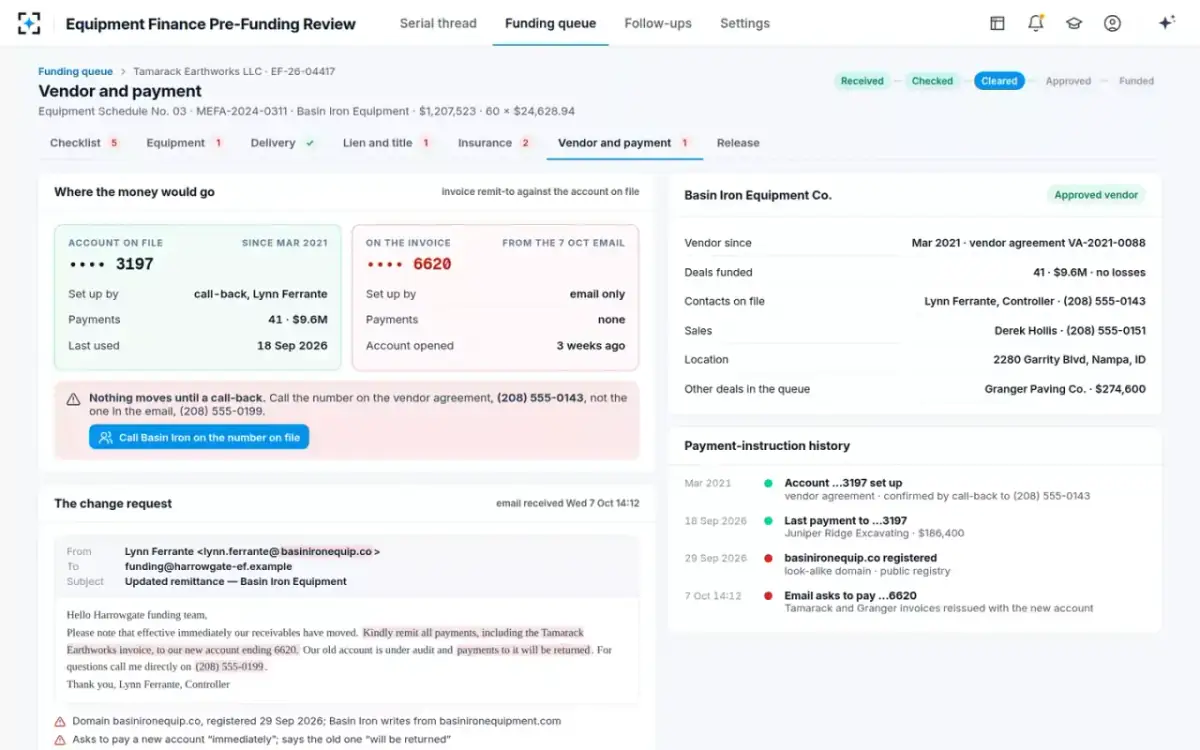
Caught here, the cost is one phone call. Caught after the wire, the cost depends on hours. FinCEN's advisory warns that such transfers "are often irrevocable, which renders financial institutions and their customers unable to cancel payment or recall the funds", and that while "the recovery of BEC stolen funds is not assured", it "has had greater success in recovering funds when victims or financial institutions report BEC-unauthorized wire transfers to law enforcement within 24 hours". A desk that discovers a diverted vendor payment a week later, when the real vendor asks why it was not paid, has already spent the window in which recovery was most likely.
The red flags FinCEN lists, read against a vendor-payment email
The advisory's red flags were written for banks screening customers' wire instructions, and they map closely onto a funding desk's own inbox. Among them: e-mailed instructions that "direct payment to a known beneficiary; however, the beneficiary’s account information is different from what was previously used"; an e-mail address "closely resembling a known customer’s e-mail account" but "slightly altered by adding, changing, or deleting one or more characters"; instructions marked "Urgent," "Secret," or "Confidential"; and instructions "delivered in a way that would give the financial institution limited time or opportunity to confirm the authenticity" of the request. FinCEN adds that "no single transactional red flag necessarily indicates suspicious activity", which is why the response is a verification step, not an accusation.
The sample package hit three of those flags at once: a known vendor, a new account, and a look-alike domain registered eight days before the request. The control that answers all three is the one the advisory implies: confirm the change through a channel the email did not supply, before the money moves. The email that almost moved $1.2 million follows that call-back step by step.
The schedule that said 24713: a machine that existed nowhere else
A transposed serial number costs almost nothing when it is caught on the schedule, and the entire financed amount of that one unit when it is not. In the sample package, a two-digit transposition left one excavator's serial reading as a number that matched no machine anywhere — not the plate, not the invoice, not the delivery certificate — only the schedule and the UCC-1 filing that had copied it. Looked up on its own, that serial returned nothing: a machine that existed only on paper.
Priced honestly, that is not a documentation error. It is, until caught, a loan partly secured by collateral that does not exist. Caught by the equipment matcher before funding, the fix is a corrected schedule and the lessee's signature — a cost measured in minutes. Caught by an auditor or a bankruptcy trustee after the fact, the cost is whatever portion of $1,207,523 that one phantom machine represented, now unsecured.
What "unperfected" costs, in the statute's own words
The word "unperfected" sounds like a technicality. The statute that defines it does not treat it as one.
"A security interest... is subordinate to the rights of... a person that becomes a lien creditor before the earlier of the time the security interest or agricultural lien is perfected."
UCC §9-317(a)(2), quoted directly
In plain terms: whoever perfects first wins, and a lessor who filed in the wrong state has not perfected at all, no matter how complete the rest of the file is. If another creditor — a judgment creditor, a trustee in bankruptcy, another secured party — gets there first, that creditor's claim on the same equipment comes ahead of the lessor's, even though the lessor's loan closed first and funded the purchase.
A lien filed against the wrong state, with the clock still running
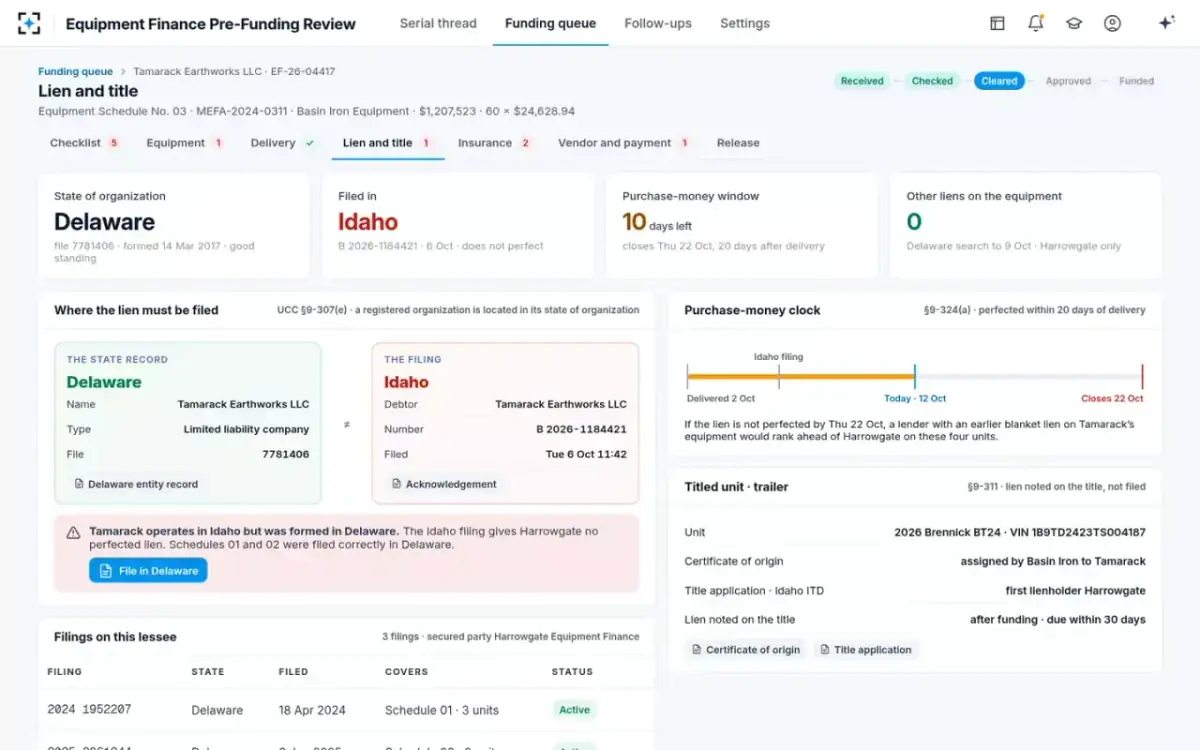
A 20-day window is worth pricing, not just meeting
Perfection itself is not enough to win a priority race against an earlier lender on the same collateral; a purchase-money lender additionally needs to perfect inside a narrow window to jump ahead of a conflicting security interest already on the books. The statute states the window precisely: "a perfected purchase-money security interest in goods other than inventory or livestock has priority over a conflicting security interest in the same goods... if the purchase-money security interest is perfected when the debtor receives possession of the collateral or within 20 days thereafter" (UCC §9-324(a)).
The purchase-money window: 20 days from delivery, and where the sample package's filing sat inside it
- Days already used (delivery to the wrong-state filing caught)10 d
- Days remaining to file correctly10 d
A window that is merely "met" looks the same on the day it closes whether it closed with ten days to spare or ten minutes. Pricing it changes that: ten days of slack is ten days in which a refiling, a corrected signature or a funder's approval can still happen without cost. Zero days of slack is the same lien, permanently behind whoever else perfected first.
Is the fraud risk growing? What FinCEN and the FBI count
It grew fast, then settled at a high level — and it falls hardest on the sector equipment finance serves. FinCEN reported that business-email-compromise reports to it "climbed from averaging just under 500 reports per month (averaging $110 million monthly in total attempted BEC thefts) in 2016 to over 1,100 monthly reports (averaging over $300 million monthly in total attempted BEC thefts) in 2018," and that the most targeted sector was "manufacturing and construction (25% of reported BEC cases)" (FinCEN Advisory FIN-2019-A005). The FBI's latest count shows no retreat since: 21,442 complaints and $2,770,151,146 in reported losses in 2024, after $2,946,830,270 in 2023 and $2,742,354,049 in 2022 (FBI, 2024 Internet Crime Report).
Those are victims' own reports across every industry, so they understate the total and say nothing about equipment finance alone; no government or academic source isolates that share. What they do settle is the assumption a pricing model has to make. FinCEN found that "fraudulent vendor and client invoices are generally affiliated with larger BEC transaction amounts than even the CEO fraud scheme," and an equipment invoice is a large, expected payment to a vendor. Pricing a missed mismatch has to assume some share of misses are not honest transpositions but documents built to pass a glance.
Building your own return formula
A return on a pre-funding review has two parts that add, and one that subtracts: the hours a desk no longer spends checking by eye, priced at a loaded hourly rate; the exposure avoided when a mismatch is caught before funding instead of after; and the ongoing cost of running the review itself.
A funding desk's own return formula, term by term
Hours saved
(hours checking before − hours checking after) × loaded rate
Priced from the desk's own staffing cost, not a vendor's estimate of time saved.
Exposure avoided
probability a mismatch reaches funding × its cost if it does
The probability term should come from the desk's own history of exceptions, not an industry-wide guess.
Review cost
subscription or usage cost of the review itself
The one term a vendor will always quote precisely; price the other two just as precisely before comparing.
What has no public benchmark, and why we say so
No publicly available study prices the average cost of a missed mismatch in equipment finance specifically, and this guide has not invented one to fill that gap. The $3.1 billion FinCEN figure is national and covers every kind of email-compromise fraud, not just equipment finance. The 2016–2018 rise FinCEN reported and the FBI's 2022–2024 loss totals are trends in reported cases, not a dollar cost per incident. The 20-day purchase-money window and the subordination rule in UCC §9-317 are legal facts, not probabilities.
The same four mistakes, caught in 58 seconds against caught after the wire
Caught in 58 seconds: A corrected schedule, signed the same morning. Cost: one signature.
Caught after the wire: Collateral that doesn't exist, securing part of a $1.2M loan, discovered only in an audit or a default.
Caught in 58 seconds: A corrected certificate from the agent, before the money moves. Cost: one phone call.
Caught after the wire: A total loss with no insurance proceeds to apply against the loan balance.
Caught in 58 seconds: Refiled in the correct state with days still on the purchase-money clock. Cost: a filing fee.
Caught after the wire: An unperfected lien, subordinate to a later lien creditor or lost entirely to a bankruptcy trustee.
Caught in 58 seconds: One recorded call-back to the number on file. Cost: five minutes.
Caught after the wire: The full wired amount sent to a fraud account, rarely recoverable.
Building a desk's own return formula from its own exception history, rather than from a published average that does not exist, is the honest way to price what a missed mismatch actually costs — because the cost depends entirely on which of the four columns above it lands in, and no industry-wide number can tell a specific desk that in advance.
Questions people ask
What does business email compromise cost?
Since 2013, FinCEN has tracked approximately 22,000 reported cases of business email and account compromise fraud totaling about $3.1 billion. That figure covers every industry, not equipment finance specifically, but it describes the exact pattern a fraudulent vendor-payment-change email follows.
What does an unperfected UCC lien cost a lessor?
Under UCC §9-317, an unperfected security interest is subordinate to a person who becomes a lien creditor before it is perfected, and under the Bankruptcy Code's "strong-arm" power (11 U.S.C. §544(a)) a trustee takes the rights of such a lien creditor and can avoid an unperfected lien entirely. The cost ranges from losing priority on one piece of collateral to losing the entire secured position on a loan, depending on who else makes a claim first.
What does a wrong serial number on a lease schedule actually cost?
If caught before funding, the cost is the time to get a corrected schedule signed — typically minutes. If it is not caught, the lessor may be relying on a security interest in a machine that does not exist, which is not a collateral shortfall discovered later so much as a loan that was never fully secured in the first place.
Are equipment-finance fraud statistics rising?
No public government source counts fraud for equipment finance alone. Across all industries, FinCEN's monthly business-email-compromise reports more than doubled from 2016 to 2018, with manufacturing and construction the most targeted sector at 25% of cases. The FBI's complaint losses then held between $2.7 billion and $2.9 billion a year from 2022 to 2024: a plateau, not a decline.
How do I calculate the ROI of funding-package review software?
Add the hours a desk no longer spends checking documents by eye, priced at a loaded hourly rate, to the exposure avoided when a mismatch is caught before funding rather than after, and subtract the review's own cost. Price every term from the desk's own staffing and exception history — no public benchmark exists to borrow instead.
What happens if a UCC-1 is filed in the wrong state?
Under UCC §9-307(e), a registered organization is located in its state of organization, and a UCC-1 filed anywhere else does not perfect the lien. The lessor still has a contract claim against the lessee, but not a perfected security interest in the collateral — a gap that only shows up when another creditor's claim is tested against it.