Agentic AI document review of a loan or lease funding package means, in practice, six specialized agents, each reading for one kind of mismatch, each bound by a lending limit it may never cross on its own: never correcting a serial number, never changing a vendor's bank account, never releasing money. In Equipment Finance Pre-Funding Review, those six agents read a complete package — sixteen documents, 214 fields, eleven signatures — and test it against 22 funding conditions, each one tied to a specific field on a specific document. What they are built never to do carries at least as much of the argument as what they do.
The package behind the figures on this page is a fictional sample: Tamarack Earthworks LLC financing $1,207,523 for two excavators, a wheel loader and a titled trailer from Basin Iron Equipment Co. The federal guidance quoted alongside it is not fictional, and it is the honest frame for how far an agentic review can be trusted today.
One package, six agents, 58 seconds
58s
for six agents to read 16 documents and test 22 funding conditions
214
fields read, with the page and position of each one cited
16
documents in the package, all of which must agree
4
exceptions found in the sample package — none released without a person
Six agents, six jobs
Agentic AI document review earns its name from division of labor, not from autonomy. Equipment Finance Pre-Funding Review splits the work of checking a funding package into six single-job agents rather than one agent asked to do everything, and each agent's job description doubles as the boundary of what it is allowed to decide.
Six agents, six jobs, and the one action each is built never to take
| Agent | What it does | What it never does |
|---|---|---|
| Package reader | Sorts the package and reads every party, amount, date, serial number and signature, with the page and position of each value. | Never fills in a field it cannot read. |
| Equipment matcher | Ties each unit's serial, make, model, year and price across the invoice, schedule, delivery certificate, plate photos, title and filing. | Never corrects a serial on its own — the lessee signs the fix. |
| Lien and title checker | Reads the debtor's state record and the UCC-1, runs the 20-day purchase-money clock, checks a titled unit's lienholder. | Never treats a filing in the wrong state as perfected. |
| Insurance checker | Reads ACORD 25 and 27 against the requirements: loss payee, additional insured, scheduled equipment, limits, dates. | Never accepts additional insured in place of loss payee. |
| Vendor payment guard | Compares payment instructions with the account on file, the change history and the sender's domain. | Never changes a vendor's bank account. |
| Funding recommender | Builds the 22-condition checklist with its evidence and drafts a fix for each failed condition. | Never releases money. |
The thread: how one serial number travels through seven documents
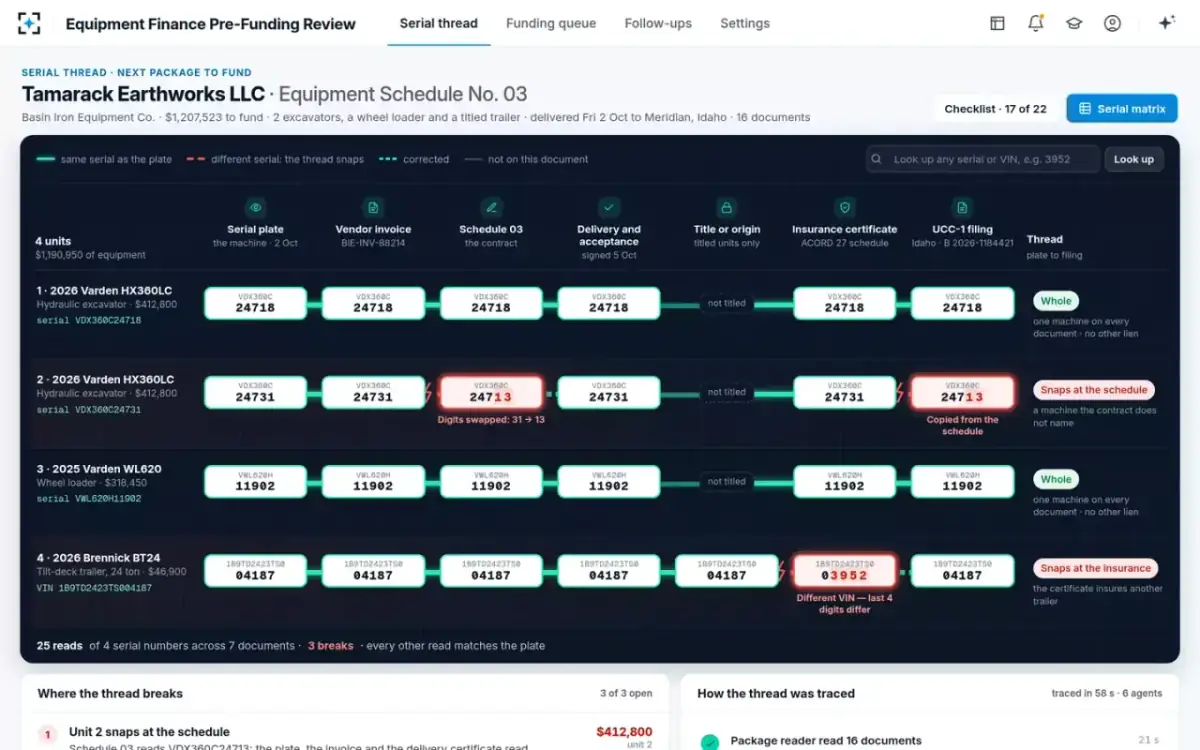
The clearest way to see what agentic AI document review actually checks is to follow one fact — a single machine's serial number — across every document that names it. On a titled trailer or an excavator with a plate, the serial starts at the plate, photographed at delivery. From there it should read identically on the vendor invoice, the equipment schedule, the delivery and acceptance certificate, the title or certificate of origin, the insurance certificate's scheduled-property section, and the UCC-1's collateral description. Seven places, one number.
The equipment matcher reads all seven and reports whether the thread holds. Where a document reads a different serial, the thread snaps at that document, and the agent names exactly where: not "something is wrong with unit 2," but "the schedule reads one serial, and the invoice, the delivery certificate and the plate photo all read a different one." In the sample package, a two-digit transposition on the equipment schedule was the only document that disagreed with the other six — invisible to a reader who checks the schedule against the invoice but never circles back to the plate photo.
The thread, traced: four machines, seven documents, one break
Why the agent that finds a mismatch never corrects it
A limit stated once, in a product description, is a sentence. A limit tested on every package, every time, is a design decision — and the decision that matters most in this review is that the agent that finds a mismatch is never the agent that fixes it without a person's say. The equipment matcher drafts a corrected schedule; it does not sign it. The lien and title checker drafts the correct state's filing; it does not file it without the funder's approval. The vendor payment guard holds a package on a bank-account change; it never changes the account itself, no matter how convincing the request looks.
What an agent proposes, against what a person actually decides, for each exception in the sample package
The agent proposes: Flags the mismatch against the plate, invoice and delivery certificate, and drafts a corrected schedule.
A person decides: The lessee signs the corrected schedule. Nothing on the funding condition changes until that signature exists.
The agent proposes: Flags that the scheduled VIN does not match the financed unit and drafts a request to the insurance agent.
A person decides: The insurance agent issues a corrected certificate; the funding specialist checks it names loss payee, not only additional insured.
The agent proposes: Flags that the filing does not perfect under the debtor's state of organization and drafts the correct filing.
A person decides: The funder approves before anything new is filed. The purchase-money clock keeps running regardless of who is deciding.
The agent proposes: Holds the package and flags that the sending domain was registered days earlier.
A person decides: A named person calls the number already on file — never one in the request — and records what the vendor said.
"Confabulation": a federal AI risk framework's name for the failure that matters most
The reason a drafted fix is never treated as a fact has a name in federal AI risk guidance. The National Institute of Standards and Technology's Generative AI Profile defines confabulation as "the production of confidently stated but erroneous or false content" — the behavior most people mean when they say an AI system "hallucinated" (NIST AI 600-1). The risk is not that a model sometimes gets a field wrong. It is that a wrong answer and a right one can look, and be stated, exactly the same way.
Confabulation is also why "reads every field it can" and "fills in a field it cannot read" have to be two different rules enforced separately, not one judgment call left to the model. The package reader's limit — never filling in a field it cannot read, and citing the page and position of every value it does read — exists specifically against this failure mode. A confidently wrong serial number and a correctly read one are indistinguishable to anyone who cannot see the source the agent cited; a limit that forces the citation is what makes the claim checkable at all.
Why the writer is never the checker
Splitting one review into six single-job agents is also an architectural choice with a measured cost and a measured benefit, and a 2026 benchmark of multi-agent architectures for financial document extraction puts a number on both. Comparing sequential pipelines, parallel fan-out, hierarchical supervisor-worker designs and reflexive self-correcting loops across five language models and 10,000 SEC filings, the study found that "reflexive architectures achieve the highest field-level F1 (0.943) but at 2.3× the cost of sequential baselines, while hierarchical architectures occupy the most favorable position on the cost-accuracy Pareto frontier (F1 0.921 at 1.4× cost)" (arXiv 2603.22651, not peer reviewed). The paper is about SEC filings, not loan packages, and its numbers should not be read onto a different task — but the shape of its finding lines up with the design here: a supervisor that recommends and a set of workers that each check one thing, rather than one model asked to re-check its own output, buys most of the accuracy at a fraction of the cost of letting an agent grade itself. The same study reports that hybrid configurations "can recover 89% of the reflexive architecture's accuracy gains at only 1.15x baseline cost", and that throughput and accuracy degrade in "non-obvious" ways as volume scales from 1,000 to 100,000 documents a day, which is a reason to measure a review on a desk's own volume rather than trust a benchmark's.
That is also the practical answer to "why doesn't the agent that drafts the fix just also approve it." The funding recommender, which builds the 22-condition checklist and drafts a fix for every failed condition, is a different agent from the equipment matcher, the lien and title checker, the insurance checker and the vendor payment guard that found the problems in the first place — and none of the five releases money. The writer of a fix and the approver of a release are structurally different roles, held by different agents, with a person deciding at the only point where a wrong decision is expensive.
What federal bank guidance asks of a model before it is relied on
Innovation and compliance leads evaluating an agentic review bring a specific question: what does a bank's own model-risk framework expect before any model — AI or not — is relied on for a funding decision? The Federal Reserve's current guidance to banking organizations answers in two parts. First, before use: "validation generally occurs prior to a model's first use" (SR 26-2). Second, on an ongoing basis: "outcomes analysis compares model outputs to corresponding real-world outcomes to assess model performance relative to model objectives and business use. Outcomes analysis and other elements of the validation process may identify material errors or persistent deviations outside of the banking organization's established performance thresholds" (SR 26-2).
The same discipline applies to a vendor relationship, not only to the model inside it. The Office of the Comptroller of the Currency frames third-party due diligence as what a bank assesses "before entering into a third-party relationship" — "a particular third party’s ability to perform the activity as expected, adhere to the community bank’s policies, comply with all applicable laws and regulations, and conduct the activity in a safe and sound manner" (OCC, Third-Party Risk Management: A Guide for Community Banks). Neither quote mentions agentic AI by name. Both describe exactly the questions a careful buyer should be asking about six agents reviewing a funding package: what was validated before go-live, and what gets checked against real outcomes afterward.
Where agentic AI still sits outside that guidance — and why that matters here
The honest caveat, and the reason the limits in this review matter more than a borrowed rulebook, is that the guidance just quoted does not yet reach agentic systems. The same Federal Reserve letter says so directly: "Generative AI and agentic AI models are novel and rapidly evolving. As such, they are not within the scope of this guidance" (SR 26-2). A six-agent review is not yet something a bank's model-risk office can validate against an established federal framework built for it, because that framework does not exist yet.
That gap is exactly why the limits described above — never corrects a serial on its own, never changes a vendor's bank account, never releases money — are doing the work a borrowed rulebook cannot do yet. Until agentic systems are inside model-risk guidance, what an agent is forbidden to do, and who has to act before anything changes, is the thing to check first, not the thing to assume because a bank-grade framework must already cover it.
The release: a person signs, and above $1,000,000 a second person co-signs
Every limit in the table above converges on one point: a person releases the money, and above a threshold, a second person has to agree first. In the sample package, the funding specialist approves the $1,207,523 release with the meaning of the signature recorded — "I checked the exceptions and approve this release" — and because the amount is above $1,000,000, a vice president co-signs before the wire goes out. Above $5,000,000, the same governance sends the release to a credit committee instead of a single second signer.
Checklist, before release: 22 conditions, each tied to the field it was tested against
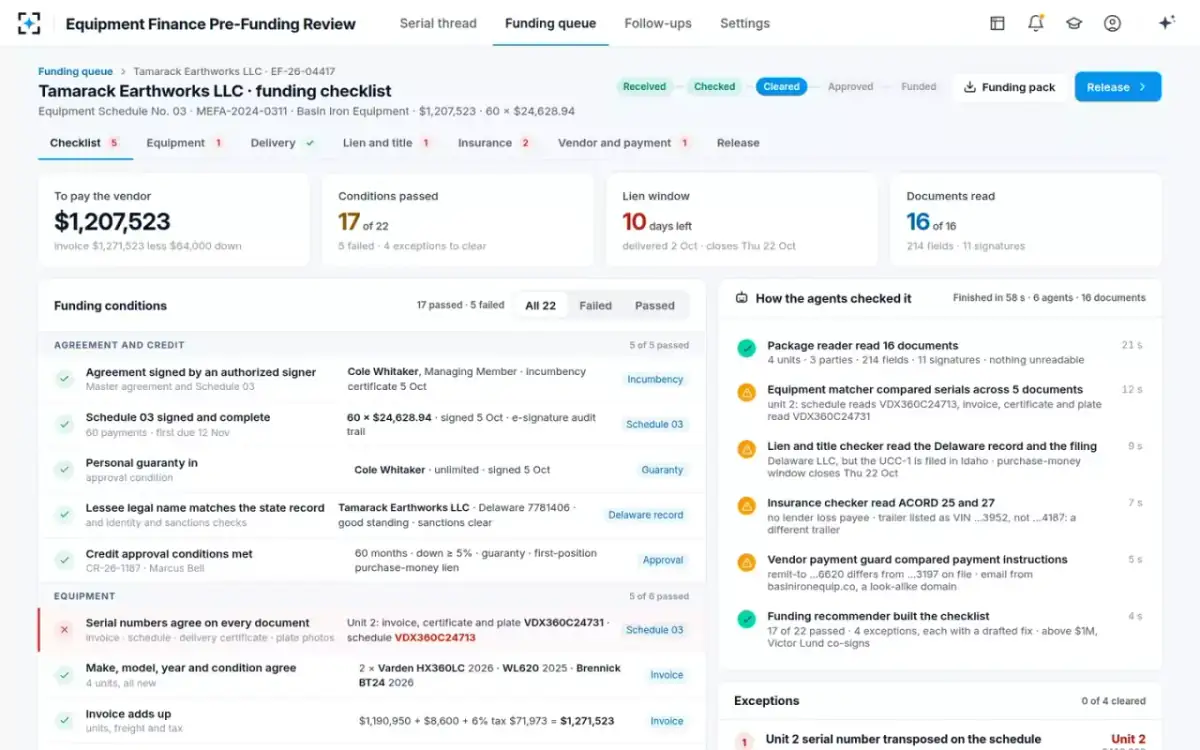
Every agent finding and every human action in the sample package is kept on the deal's own activity trail — who, what and when — and a change to the funding conditions themselves is versioned. That is the part a six-agent pipeline cannot substitute for: the guidance that does not yet cover agentic AI will eventually catch up, and when it does, a desk that can already show who decided what, and when, will not be starting from nothing.
Questions people ask
How do AI agents review equipment finance funding packages?
In Equipment Finance Pre-Funding Review, six specialized agents each check one part of a sixteen-document package — reading every field, matching serial numbers across documents, checking the lien filing against the debtor's state of organization, checking insurance coverage, checking vendor payment instructions, and building a 22-condition checklist with a drafted fix for anything that fails. No agent releases money; a person does.
Can AI agents catch fraud in loan documents?
They can flag the pattern that fraud usually produces — in the sample package, a vendor payment change requested from a domain registered days earlier — and hold the package until a person calls the number already on file and records the answer. The agent never changes the account itself; catching the pattern and confirming it are deliberately kept as two separate steps.
What can't AI do in loan funding?
In this review, an agent never corrects a serial number, changes a vendor's bank account, treats a filing in the wrong state as perfected, accepts additional insured in place of loss payee, or releases money. Each of those actions is reserved for a named person, specifically because a confidently wrong answer and a correct one can look identical — the failure NIST's AI risk framework calls confabulation.
Does AI release loan funds?
No. The funding recommender agent builds the checklist and drafts a fix for anything that fails, but the release itself is a person's signature, recorded with its own meaning, and above $1,000,000 a second person has to co-sign before the wire goes out.
What is AI confabulation?
NIST's Generative AI Profile defines it as "the production of confidently stated but erroneous or false content" — language colloquially called hallucination. It matters in document review because a confabulated field reads with the same confidence as a correctly extracted one, which is why every value an agent reads is cited to its page and position rather than taken on trust.
Is agentic AI covered by bank model risk guidance?
Not yet, by the current federal letter's own account. The Federal Reserve's SR 26-2 states plainly that "generative AI and agentic AI models are novel and rapidly evolving" and "are not within the scope of this guidance." Banks evaluating an agentic review today are checking it against the review's own stated limits, not against an established agentic-AI model-risk framework, because that framework does not yet exist.